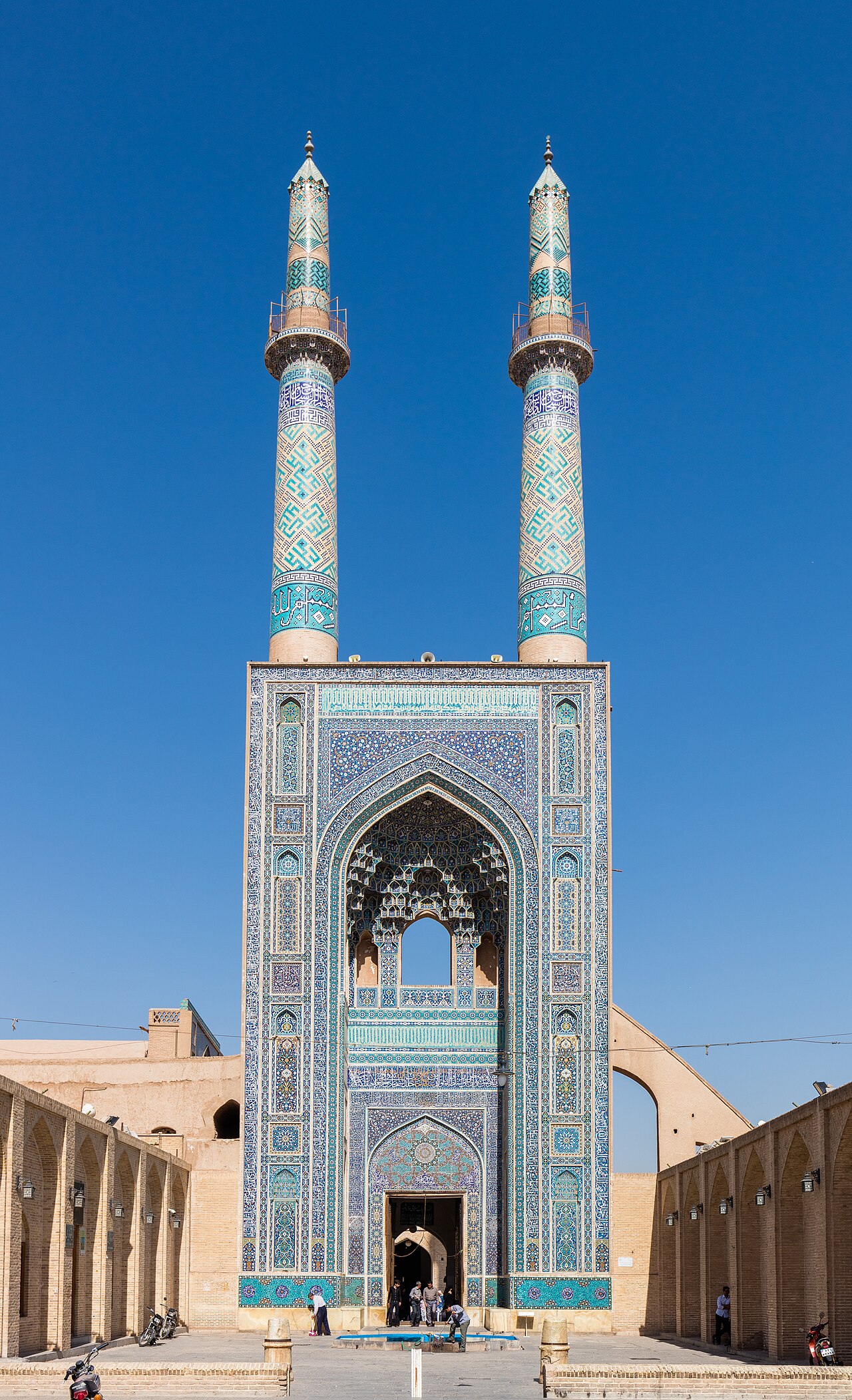
The Jameh Mosque of Yazd (مسجد جامع یزد), the city’s Friday mosque, was built mainly between 1324 and the 1370s under the last Ilkhanid ruler and the Muzaffarid dynasty. Its entrance portal, flanked by two slender minarets, is one of the tallest in Iran, and its prayer hall holds some of the finest 14th-century tile mosaic in the country. It stands in Fahadan, the oldest quarter of Yazd, inside the UNESCO-listed historic city.
| Persian name | Masjed-e Jâme’-e Yazd |
|---|---|
| Main building | 1324–1328 under the Ilkhanid Abu Sa’id; enlarged under the Muzaffarids, 1360s–1370s |
| Earlier mosque | 12th century, on the same site; little or nothing survives |
| Known for | Very tall portal and minarets; tile-mosaic mihrab dated 1365 |
| UNESCO | Part of the Historic City of Yazd, inscribed 2017 |

Three mosques on one site
Yazd had a Friday mosque long before the present building. Local tradition holds that the site was first used by a Zoroastrian fire temple, which would fit the pattern of many Iranian towns, but there is no archaeological proof. A mosque was built here in the 12th century under the Kakuyid governors of Yazd. It seems to have been ruined, perhaps during the Mongol period, and little of it can be identified today.
The present mosque was begun in 1324, in the reign of the Ilkhanid sultan Abu Sa’id, at the expense of a local notable, Sayyed Rokn al-Din Mohammad. The great portal, the main iwan and the domed sanctuary date from this campaign. Abu Sa’id’s death in 1335 and the break-up of the Ilkhanate are told on our page Abu Sa’id and the collapse of the Ilkhanate.
The Muzaffarids, a local dynasty from the Yazd region who went on to rule Shiraz and Isfahan, continued the work. In the 1360s and 1370s they added the prayer halls beside the dome chamber, galleries and the tile-mosaic mihrab. Their story, and their rivalry with the Injuids of Shiraz, is on our page about the Injuids and Muzaffarids. Later dynasties repaired and retiled the building. The two tall minarets are usually attributed to the Safavid period, and the mosque was restored again in the 20th century.
What to look at
The portal
Seen from the narrow street in front, the entrance pishtâq (پیشطاق) is enormous: a tall arched frame faced with tile, rising above the low mud-brick houses of Fahadan, with a minaret on each side. The pair of minarets is often said to be the tallest in Iran, with figures of around 50 metres given. Inside the arch, bands of tiled inscription and a half-dome of muqarnas lead the eye upward. This view was printed on the Iranian 200-rial banknote for many years.
The courtyard and iwan
Beyond the portal a long, narrow courtyard leads to the main iwan, a deep vaulted hall that frames the entrance to the dome chamber. The shape is unusual: the courtyard is longer than it is wide, because the mosque had to fit into the dense old town.
The dome chamber and mihrab
Under the dome, the walls are covered with tile mosaic in dark blue, turquoise, white and gold-brown, cut piece by piece and set in geometric and floral patterns. The mihrab, the niche that shows the direction of Mecca, is dated 1365 and is one of the masterpieces of Muzaffarid tilework. The light in the chamber is soft and indirect, reflected from white plaster in the side halls.
The side halls
The prayer halls on either side of the dome chamber have plain whitewashed vaults that contrast with the colour of the sanctuary. They show the brick vaulting techniques used across Iran in the 14th century.
Comparing it with Isfahan
The Jameh Mosque of Isfahan grew over a thousand years and is a lesson in how a mosque changes. The Yazd mosque is the opposite: a single 14th-century design, mostly completed within two generations, with one dominant entrance. Seeing both gives a good sense of the range of Iranian mosque architecture.
Visiting
- The mosque is in the Fahadan quarter, a short walk from Amir Chakhmaq Square through the old lanes. Our pages on Yazd and the Amir Chakhmaq Complex cover the area.
- It is a working mosque. Dress modestly; women should cover their hair, and a chador may be requested in the prayer halls. Avoid walking in front of people praying, especially at Friday noon prayers.
- The portal is best photographed in the late afternoon, and again after dark when it is lit.
- Rules on entry for non-Muslims, opening times and any fee can change. Check locally.
Persian words from this page
| مسجد جامع | masjed-e jâme’ | Friday (congregational) mosque |
| یزد | Yazd | Yazd |
| پیشطاق | pishtâq | monumental entrance portal |
| ایوان | eyvân | iwan, vaulted hall open on one side |
| محراب | mehrâb | mihrab, prayer niche |
| مناره | manâre | minaret |
| کاشی | kâshi | glazed tile |
Sources and further reading
- UNESCO World Heritage Centre, “Historic City of Yazd” (inscribed 2017).
- Encyclopaedia Iranica, “YAZD“.
- Donald N. Wilber, The Architecture of Islamic Iran: The Il Khanid Period (Princeton University Press, 1955).
- Sheila S. Blair and Jonathan M. Bloom, The Art and Architecture of Islam, 1250–1800 (Yale University Press, 1994).
Want to learn Persian? Get the free Starter Pack
Get the 14-page printable Starter Pack (all 32 letters, a 7-day reading plan, 100 core words and 20 survival phrases) and a short 5-email course. Free.
More in Top Places to Visit in Iran
- Naqsh-e Jahan Square
- Shah (Imam) Mosque, Isfahan
- Sheikh Lotfollah Mosque
- Ali Qapu Palace
- Jameh Mosque of Isfahan
- Si-o-se Pol and Khaju Bridge
- Vank Cathedral
- Hasht Behesht Palace
- Naqsh-e Rostam
- Eram Garden, Shiraz
- Nasir al-Molk (Pink) Mosque
- Tomb of Hafez (Hafezieh)
- Tomb of Saadi (Saadieh)
- Shah Cheragh Shrine
- Arg of Karim Khan
- Fin Garden, Kashan
- Historic Houses of Kashan
- Jameh Mosque of Yazd
- Yazd Fire Temple and Towers of Silence
- Dowlatabad Garden and Windcatcher
- Amir Chakhmaq Complex
- Golestan Palace
- National Museum of Iran
- Treasury of National Jewels
- Tehran Grand Bazaar
- Milad Tower
- Imam Reza Shrine, Mashhad
- Tomb of Ferdowsi, Tus
- Tomb of Omar Khayyam, Neyshabur
- Tomb of Avicenna, Hamadan
- Ganjnameh Inscriptions, Hamadan
- Behistun (Bisotun): Visiting the Site
- Taq-e Bostan: Visiting the Site
- Tabriz Historic Bazaar
- Takht-e Soleyman
- Armenian Monastic Ensembles of Iran
- Sheikh Safi al-Din Shrine, Ardabil
- Dome of Soltaniyeh
- Alamut Castle
- Falak-ol-Aflak Castle
- Shushtar Historical Hydraulic System
- Chogha Zanbil: Visiting the Ziggurat
- Susa Archaeological Site
- Arg-e Bam
- Ganjali Khan Complex, Kerman
- Shazdeh Garden, Mahan
- Rayen Castle
- Dasht-e Lut (Lut Desert)
- Maranjab Desert and Caravanserai
- Varzaneh Desert
- Mount Damavand
- Hyrcanian Forests
- Lake Urmia
- Badab-e Surt Springs
- Ali Sadr Cave
- The Kaluts of Shahdad
- Qeshm Geopark
- Hormuz Island Colours
- Visiting Persepolis: A Day Trip from Shiraz
- Visiting Pasargadae
- Persian Caravanserais
- The Qanat of Gonabad
- Meymand Village
- Sasanian Sites of Fars: Firuzabad, Bishapur and Sarvestan
- Gonbad-e Qabus: Visiting the Tower
- Zayandeh Rud and Isfahan’s Bridges
- Tochal and Darband: Hiking Above Tehran
- Mount Sabalan
- Skiing in Iran: Dizin and Shemshak
- Golestan National Park