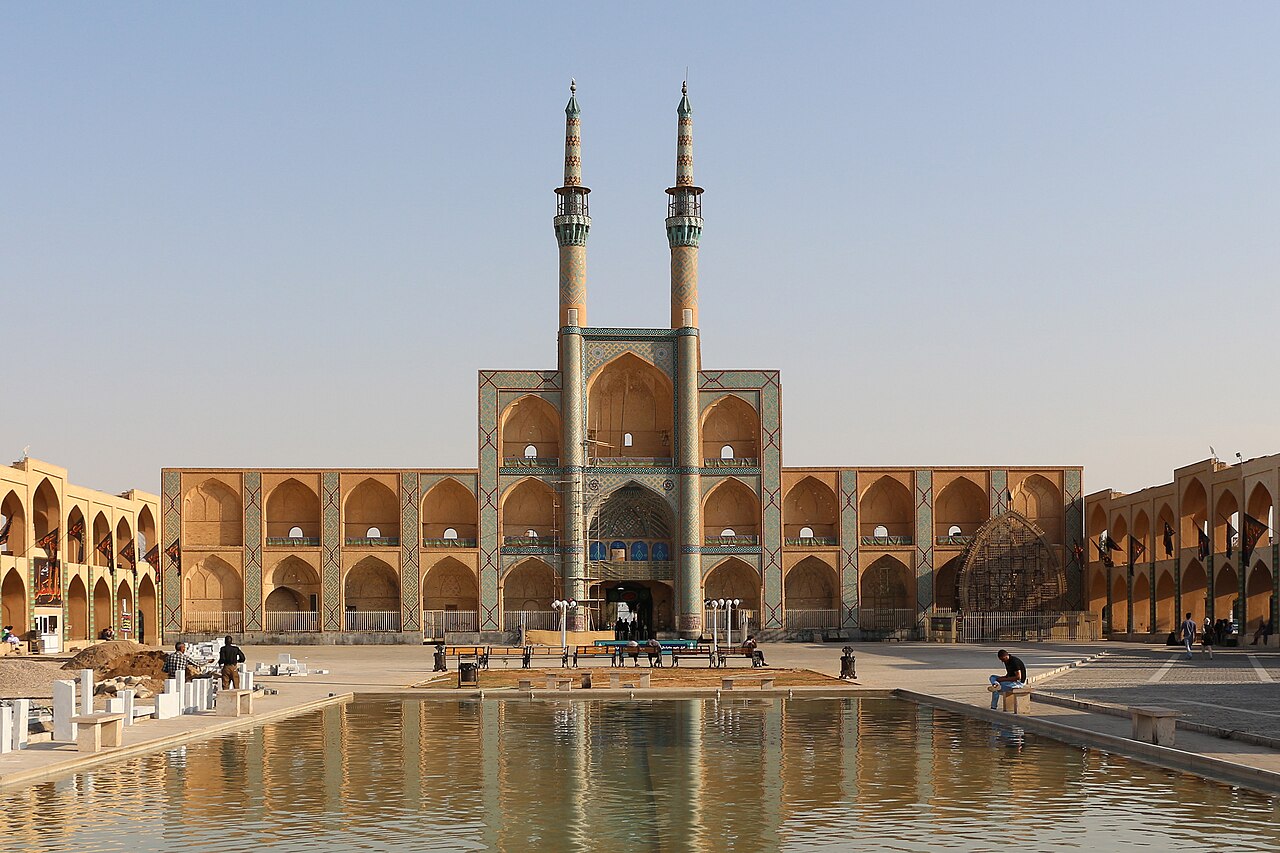
The Amir Chakhmaq Complex (مجموعه امیرچخماق) is the square, mosque and three-storey arcaded façade at the heart of Yazd, named after Jalal al-Din Chakhmaq, the city’s Timurid governor in the 1430s. The façade, a tekye used for the mourning ceremonies of Muharram, is the best-known image of Yazd. Behind and around it lie the 15th-century mosque that he and his wife founded, a bazaar, a bathhouse and a cistern.
| Persian name | Majmu’e-ye Amir Chakhmâq, also Meydân-e Amir Chakhmâq |
|---|---|
| Founders | Amir Jalal al-Din Chakhmaq, Timurid governor of Yazd under Shahrukh, and his wife Fatima Khatun |
| Mosque | Completed c. 1437–1438 |
| Tekye façade | Present form largely from later rebuilding and 20th-century restoration |
| Use today | Public square; mosque in use; tekye used during Muharram |
A Timurid governor’s foundation
In the first half of the 15th century Iran was ruled by Shahrukh, son of Timur, from Herat. His era, when Persian art and learning flourished across the Timurid lands, is described on our pages about Shahrukh and Herat and the Timurid Renaissance. Yazd was governed for him by one of his generals, Jalal al-Din Chakhmaq Shami.
Chakhmaq and his wife Fatima Khatun paid for a group of public buildings on the edge of the old city: a congregational mosque, a Sufi lodge, a bathhouse, a well and a caravanserai, around an open square. This was the usual way for a governor to show piety and power, and to make money from rents. The mosque was completed in about 1437–1438. The next governor, Haj Qanbar Jahanshahi, added a bazaar and caravanserai at the sides of the square.
How the square changed
Most of the medieval buildings fell into disrepair. Parts were repaired in the Safavid period, and in the Qajar period a merchant restored the mosque. The biggest changes came in the 20th century. When a new avenue was cut through Yazd in 1935 under Reza Shah, part of the old square was demolished, and later road schemes in the 1950s left little except the tekye façade. The arcades at its sides were filled in during the 1960s to keep it from collapsing, and later restorations gave the square its present open form.
So the view visitors love is real, but it is not a frozen Timurid scene. It is a historic façade, rebuilt and restored over centuries, standing on a modern traffic square.

What to look at
The tekye façade
The façade rises in three storeys of recessed arches, symmetrical about a taller central arch, with a pair of slender minarets above. The arches are shallow niches rather than rooms, so the whole is essentially a giant stage set, built for watching. A tekye (تکیه) is a place for the rituals that mourn the death of Imam Hossein at Karbala in 680, and the square in front of it is the arena. You can usually climb inside one of the minarets or onto the upper level for a view over the rooftops and windcatchers.
The nakhl
In the square you will often see a huge wooden frame shaped like a cypress or a teardrop, called a nakhl (نخل). On Ashura, the tenth day of Muharram, it is covered in black cloth, mirrors and swords and carried around the square by dozens of men as a symbol of the coffin of Imam Hossein. The ceremony, called nakhl-gardâni, is one of the most striking Muharram rituals in Iran.
The mosque
The Amir Chakhmaq Mosque, on the south side of the square, keeps more of its 15th-century character, with a tiled mihrab and inscriptions from the Timurid period. It is less visited than the Jameh Mosque of Yazd and quieter.
Around the square
The area has an old bathhouse, a domed water cistern with windcatchers, and a long-established sweet shop selling Yazd specialities such as bâghlavâ and qottâb. The bazaar lanes behind lead towards the old quarters.
Visiting
- The square is open and free to walk around at any hour. It is at its best at dusk and after dark, when the arches are lit in orange.
- Access to the upper level and the minaret may be ticketed and closed at times. Check locally.
- During Muharram, and especially on Tasua and Ashura, the square is crowded with mourners. Visitors are usually welcome to watch; dress in dark, modest clothes, do not photograph people close up without asking, and follow the lead of those around you. The dates move each year with the lunar calendar.
- Our Yazd page covers the old quarters, and the Iranian festivals and holidays page explains Muharram.
Persian words from this page
| تکیه | tekye | building for Muharram mourning rituals |
| نخل | nakhl | wooden frame carried on Ashura (also “palm tree”) |
| عاشورا | Âshurâ | Ashura, tenth day of Muharram |
| میدان | meydân | square |
| محرم | Moharram | Muharram, month of mourning |
| قطاب | qottâb | almond-filled pastry from Yazd |
Sources and further reading
- UNESCO World Heritage Centre, “Historic City of Yazd“.
- Encyclopaedia Iranica, “YAZD“.
- Peter Chelkowski (ed.), Ta’ziyeh: Ritual and Drama in Iran (New York University Press, 1979).
Want to learn Persian? Get the free Starter Pack
Get the 14-page printable Starter Pack (all 32 letters, a 7-day reading plan, 100 core words and 20 survival phrases) and a short 5-email course. Free.
More in Top Places to Visit in Iran
- Naqsh-e Jahan Square
- Shah (Imam) Mosque, Isfahan
- Sheikh Lotfollah Mosque
- Ali Qapu Palace
- Jameh Mosque of Isfahan
- Si-o-se Pol and Khaju Bridge
- Vank Cathedral
- Hasht Behesht Palace
- Naqsh-e Rostam
- Eram Garden, Shiraz
- Nasir al-Molk (Pink) Mosque
- Tomb of Hafez (Hafezieh)
- Tomb of Saadi (Saadieh)
- Shah Cheragh Shrine
- Arg of Karim Khan
- Fin Garden, Kashan
- Historic Houses of Kashan
- Jameh Mosque of Yazd
- Yazd Fire Temple and Towers of Silence
- Dowlatabad Garden and Windcatcher
- Amir Chakhmaq Complex
- Golestan Palace
- National Museum of Iran
- Treasury of National Jewels
- Tehran Grand Bazaar
- Milad Tower
- Imam Reza Shrine, Mashhad
- Tomb of Ferdowsi, Tus
- Tomb of Omar Khayyam, Neyshabur
- Tomb of Avicenna, Hamadan
- Ganjnameh Inscriptions, Hamadan
- Behistun (Bisotun): Visiting the Site
- Taq-e Bostan: Visiting the Site
- Tabriz Historic Bazaar
- Takht-e Soleyman
- Armenian Monastic Ensembles of Iran
- Sheikh Safi al-Din Shrine, Ardabil
- Dome of Soltaniyeh
- Alamut Castle
- Falak-ol-Aflak Castle
- Shushtar Historical Hydraulic System
- Chogha Zanbil: Visiting the Ziggurat
- Susa Archaeological Site
- Arg-e Bam
- Ganjali Khan Complex, Kerman
- Shazdeh Garden, Mahan
- Rayen Castle
- Dasht-e Lut (Lut Desert)
- Maranjab Desert and Caravanserai
- Varzaneh Desert
- Mount Damavand
- Hyrcanian Forests
- Lake Urmia
- Badab-e Surt Springs
- Ali Sadr Cave
- The Kaluts of Shahdad
- Qeshm Geopark
- Hormuz Island Colours
- Visiting Persepolis: A Day Trip from Shiraz
- Visiting Pasargadae
- Persian Caravanserais
- The Qanat of Gonabad
- Meymand Village
- Sasanian Sites of Fars: Firuzabad, Bishapur and Sarvestan
- Gonbad-e Qabus: Visiting the Tower
- Zayandeh Rud and Isfahan’s Bridges
- Tochal and Darband: Hiking Above Tehran
- Mount Sabalan
- Skiing in Iran: Dizin and Shemshak
- Golestan National Park