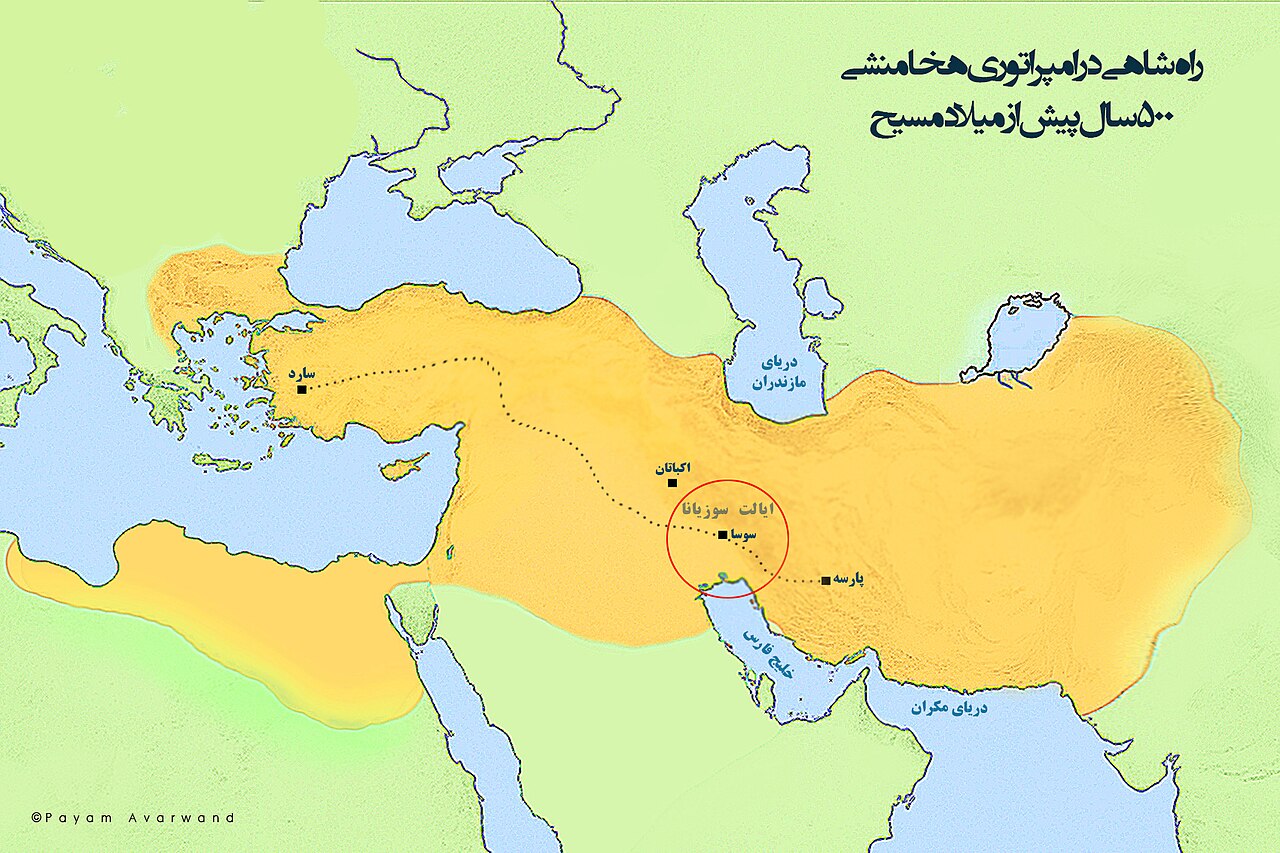
The Royal Road was the main highway of the Achaemenid Empire, running from Sardis in western Anatolia to Susa in southwestern Iran, a distance Herodotus gives as 450 parasangs, roughly 2,500 km. Along it stood royal stations where travellers with a king’s pass could rest and draw rations, and relays of mounted couriers carried messages faster than anything else in the ancient world. It was one part of a wider road network that held the empire together.
| Route | Sardis to Susa, through Phrygia, Cappadocia, Cilicia, Armenia and Mesopotamia |
|---|---|
| Length | 450 parasangs or 13,500 stades (Herodotus 5.53), about 2,500 km |
| Stations | 111, according to Herodotus |
| Travel time | About 90 days on foot; the royal couriers were far faster |
| Courier | Greek angaros, from a Persian or Babylonian word; the system was the angareion |
| Main sources | Herodotus 5.52–54 and 8.98; Xenophon, Cyropaedia 8.6; Persepolis Fortification Tablets |
Herodotus walks the road
Our description of the Royal Road comes from a moment of drama in Herodotus. In 499 BCE Aristagoras of Miletus went to Sparta to ask for help in the Ionian Revolt, showing the Spartan king Cleomenes a bronze map of the world. When Cleomenes asked how far it was from the sea to the Persian king’s city, Aristagoras admitted it was three months’ journey, and the Spartan sent him away.
Herodotus then pauses to describe the road stage by stage. Everywhere, he says, there were royal stations and excellent inns, and the whole road ran through inhabited and safe country. He gives the number of stations and the distance in parasangs for each region: Lydia and Phrygia, the crossing of the river Halys, guarded by gates and a fort, then Cappadocia, Cilicia, Armenia, the land of the Matieni and finally Cissia, ending at the Choaspes river and Susa. At 150 stades a day, he calculates, the journey takes ninety days, and three more from the coast at Ephesus to Sardis.

Where exactly did it run?
Herodotus’s route is easy to follow at both ends and hard in the middle. Some scholars take it north through Cappadocia and along the Tigris past Arbela (Erbil), then south to Susa; others place it further south. Archaeologists have found stretches of an ancient paved road near Gordion in central Anatolia that may belong to it. The Persian word for the measure of distance, the parasang, survives in modern Persian as farsang, a unit of roughly 5 to 6 km.
One road among many
The Royal Road of Herodotus was only the best-known highway, because it led to the Greek world. The Persepolis Fortification Tablets, written in Elamite between 509 and 493 BCE, show a network of roads radiating from the royal centres in Persis and Elam. Travellers on them came from or went to Sardis, Egypt, Babylon, Media, Bactria, Arachosia, Kerman and India. One major road ran from Babylon through the Zagros past the cliff of Behistun to Ecbatana and on to the east, the line of the later Khorasan road and part of what would become the Silk Road.
Passes and rations: the Persepolis evidence
The tablets give a close view of how the system worked. A traveller on royal business carried a sealed document, called a halmi in Elamite, issued by the king, a satrap or a senior official. It stated who the traveller was, where he was going and how many companions he had. At each station along the route an official read the pass and issued daily rations of flour, beer or wine, and sometimes meat, recording the issue on a clay tablet that was sent to the administration at Persepolis.
The tablets name guides, groups of workers on the move, officials travelling to the king and envoys returning from distant provinces. One traveller is recorded on his way from India, another taking a group of workers from Egypt. Some texts mention express messengers, which shows a special category of fast travel alongside ordinary journeys.
The royal couriers
Herodotus describes the courier system in Book 8, when Xerxes sends news of his capture of Athens back to Susa in 480 BCE. Men and horses, he says, were posted at intervals of a day’s ride along the road, and neither snow, rain, heat nor darkness kept each rider from completing his stage at full speed. Each passed the message to the next, like the torch-race in honour of Hephaestus. The Persians called this relay the angareion.
The Athenian writer Xenophon credits Cyrus the Great with the idea: Cyrus worked out how far a horse could go in a day and set up stations at that distance with horses and grooms. Whether Cyrus or Darius created it, the system was firmly in place under Darius, whose administration needed fast communication across 3,000 km. Greek writers also mention fire signals and chains of men calling from hilltop to hilltop for urgent news, though such reports are hard to check.
The phrase from Herodotus about snow, rain and heat is now best known as the unofficial motto carved on the main post office building in New York, completed in 1914.
What the roads did for the empire
The roads were built for the king, not for trade, and their stations served officials, soldiers and messengers on royal business. But they made it possible to govern the empire as one: orders, tribute, troops and information could move between the centre and the satrapies in weeks, and satraps knew that reports of their conduct could reach the king quickly. Merchants and caravans used the same routes. The Greek word for the forced service of providing horses and transport, angareia, passed into Roman law, and later Iranian rulers kept up relay posts. The caravanserais that line Iran’s old roads, many built centuries later, are described on Persian Caravanserais.
For the administration that used the roads, see Darius’s reforms and the Persepolis Fortification Tablets.
Persian words from this page
| راه شاهی | râh-e shâhi | Royal Road |
| فرسنگ | farsang | parasang |
| پیک | peyk | messenger, courier |
| کاروانسرا | kârvânsarâ | caravanserai |
| سارد | Sârd | Sardis |
| اسب | asb | horse |
Sources and further reading
- Herodotus, Histories, Book 5, chapters 49–54, and Book 8, chapter 98.
- Xenophon, Cyropaedia, Book 8, chapter 6.
- Richard T. Hallock, Persepolis Fortification Tablets (University of Chicago, 1969), the travel ration texts.
- Pierre Briant, From Cyrus to Alexander (2002), chapter 9.
- David F. Graf, “The Persian Royal Road System”, in Achaemenid History VIII (1994).
Want to learn Persian? Get the free Starter Pack
Get the 14-page printable Starter Pack (all 32 letters, a 7-day reading plan, 100 core words and 20 survival phrases) and a short 5-email course. Free.
More in The Achaemenid Empire (550–330 BCE)
- Achaemenes, Teispes and the Early Persian Kings of Anshan
- Cyrus the Great: Birth, Legends and Rise to Power
- Cyrus Conquers Lydia: Croesus and the Battle of Thymbra
- The Persian Conquest of Ionia and Asia Minor
- Cyrus Takes Babylon (539 BCE)
- The Cyrus Cylinder
- Cyrus and the Return of the Jews
- The Death of Cyrus and the Massagetae
- Pasargadae: Cyrus’s Capital and Tomb
- The Tomb of Cyrus through History
- Cambyses II
- Cambyses Conquers Egypt: The Battle of Pelusium
- Bardiya and Gaumata: The Usurper Question
- Darius the Great Takes the Throne
- The Great Revolts of 522–521 BCE
- The Behistun Inscription
- The Persian Conquest of the Indus Valley
- Darius’s Scythian Campaign
- Darius’s Canal from the Nile to the Red Sea
- Darius’s Reforms: Satrapies, Taxes and Law
- The Royal Road and the Persian Postal System
- The Daric: Achaemenid Coinage and Economy
- The Ionian Revolt (499–493 BCE)
- The Greco-Persian Wars: An Overview
- Mardonius and the First Persian Expedition to Greece (492 BCE)
- The Battle of Marathon (490 BCE)
- The Death of Darius I and the Succession of Xerxes
- The Royal Tombs of Naqsh-e Rostam
- Xerxes I: King of Kings (486–465 BCE)
- Xerxes’ Invasion of Greece (480–479 BCE)
- The Battle of Thermopylae (480 BCE)
- The Battle of Artemisium (480 BCE)
- The Persian Capture of Athens (480–479 BCE)
- The Battle of Salamis (480 BCE)
- The Battle of Plataea and the End of the Invasion (479 BCE)
- The Palace of Darius at Susa
- Building Persepolis: How Darius and Xerxes Built Parsa
- The Persepolis Fortification and Treasury Tablets
- Herodotus and the Persians
- The Apadana Reliefs: Nations Bringing Gifts
- The Achaemenid Paradise Gardens
- The Persian Immortals and the Achaemenid Army
- The Achaemenid Navy
- Religion of the Achaemenid Kings
- Women of the Achaemenid Court
- Old Persian Language and Cuneiform
- Egypt under Persian Rule
- Babylon under Persian Rule
- Artaxerxes I
- The Peace of Callias
- Darius II and the Peloponnesian War
- Famous Satraps of the Persian Empire
- Artaxerxes II Mnemon
- Cyrus the Younger and the Battle of Cunaxa
- The King’s Peace (387 BCE)
- The Great Satraps’ Revolt
- Artaxerxes III and the Reconquest of Egypt
- Darius III, the Last Achaemenid King
- The Battle of the Granicus (334 BCE)
- The Battle of Issus (333 BCE)
- Alexander Takes Tyre, Gaza and Egypt (332 BCE)
- The Battle of Gaugamela (331 BCE)
- Ariobarzanes and the Battle of the Persian Gate
- The Burning of Persepolis (330 BCE)
- The Death of Darius III and Bessus
- The Legacy of the Achaemenid Empire