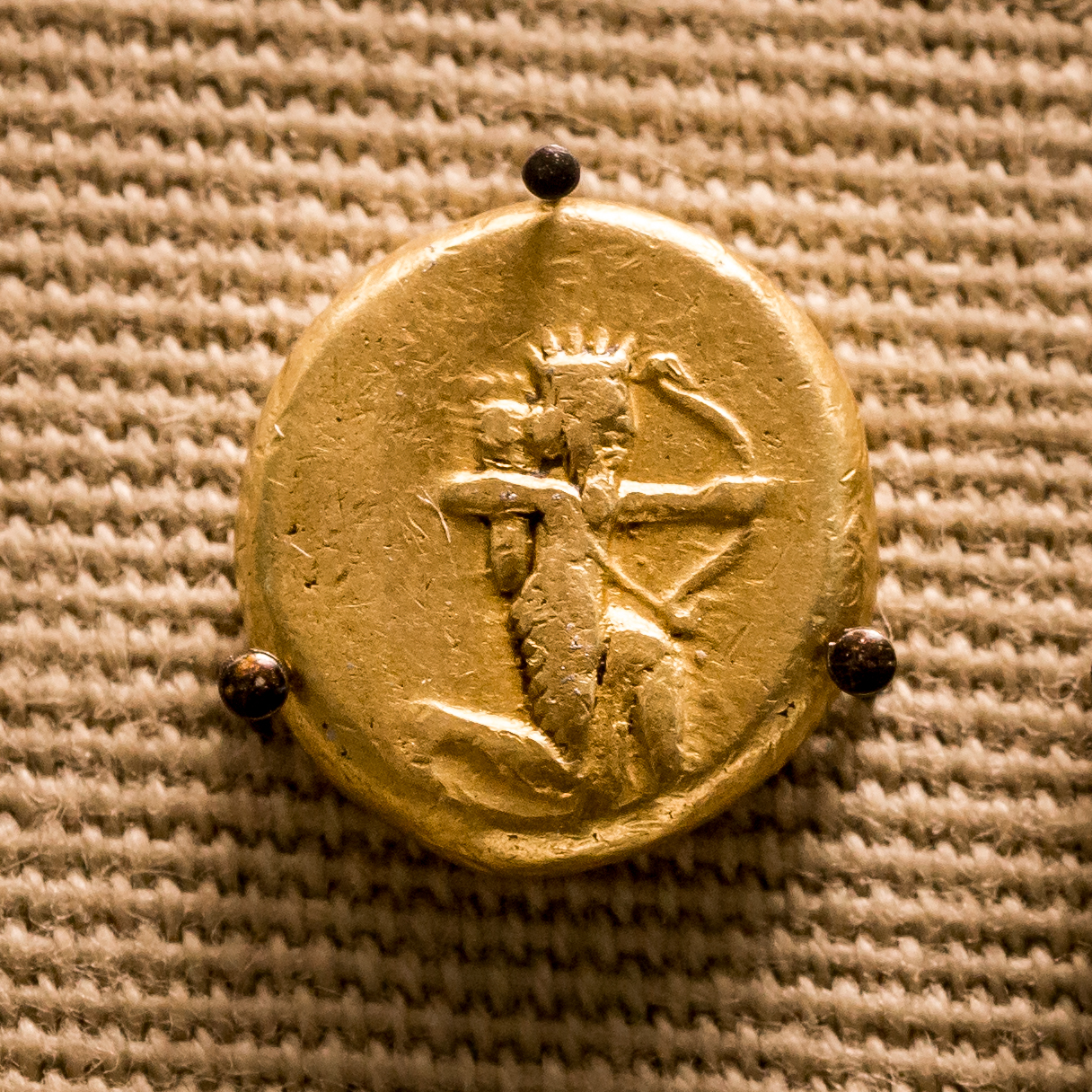
The daric was the gold coin of the Persian Empire, introduced under Darius I in the late 6th century BCE, with a silver companion, the siglos. Both show the Persian king as an archer and were struck to a fixed weight for nearly two centuries, until Alexander’s conquest. Coins were only one part of the Achaemenid economy, which also ran on weighed silver, payments in kind and the credit of great Babylonian business houses.
| Introduced | Under Darius I, probably before 500 BCE; older studies proposed soon after 515 |
|---|---|
| Daric | Gold, about 8.4 g, nearly pure |
| Siglos | Silver, about 5.4 g, later slightly heavier; about 20 sigloi to the daric |
| Design | The king or royal hero as an archer; the reverse has only a rough punch mark |
| Main mint | Sardis, in Lydia, is the most likely |
| Name | Greek dareikos; perhaps from Old Persian dari-, “golden”, rather than from Darius |
Before the daric: Lydian money
Coins were invented in western Anatolia in the 7th century BCE, in the kingdom of Lydia and the Greek cities near it. Under Croesus, Lydia struck separate coins of gold and silver, marked with the heads of a lion and a bull. When Cyrus took Sardis in the 540s BCE (see Cyrus conquers Lydia), the Persians found a working mint and seem to have kept these “Croeseid” coins in production for some decades.

Dating the first daric
For a long time historians dated the new royal coinage soon after 515 BCE, as one of Darius’s reforms. The firmest evidence now is a clay tablet from the Persepolis Fortification archive, published by Margaret Cool Root, that bears the impression of two coins of the kneeling-archer type. The tablet is dated to Darius’s 22nd year, 500–499 BCE, which proves the type existed by then. Foundation deposits under the Apadana at Persepolis contained Lydian and Greek coins but no darics or sigloi, which is consistent with a start in the late 6th century.
The archer types
Numismatists divide the coins into four main types, all with a crowned figure in a Persian robe:
- Type I: the king shown from the waist up, holding a bow and arrows. Known only on silver.
- Type II: the king kneeling and drawing his bow.
- Type III: the king running, with bow and spear, the most common type, with many varieties.
- Type IV: the running king with bow and dagger, from the later Achaemenid period.
The coins carry no name and no inscription, so they cannot be assigned to individual kings with certainty. The figure seems to represent the king in general, the ideal Persian archer of the royal inscriptions, rather than a portrait. Darius says in his tomb inscription that he was a good bowman on foot and on horseback.
The name
Greeks believed the coin was named after Darius, and Herodotus says Darius refined gold to the highest purity for his coinage. Modern scholars, including the authors of the Encyclopaedia Iranica article, tend to derive “daric” from an Old Persian word for gold and see the link with Darius as a Greek folk etymology. Either way, the name stuck: Greek writers counted bribes, payments and ransoms in darics.
Who used the coins?
Darics and sigloi were struck mainly in Asia Minor and circulated mostly there and in the Aegean. Few have been found in the Iranian heartland. They paid Persian troops in the west, Greek mercenaries and Greek allies. Herodotus tells of Aryandes, satrap of Egypt, who was put to death by Darius after striking silver coins of exceptional purity in imitation of the king’s gold; historians doubt the story in that form, but it shows how closely coinage was tied to royal status.
Later, Persian gold shaped Greek politics. In the Peloponnesian War, Persian satraps funded the Spartan fleet, and in the 4th century the Spartan king Agesilaus is said to have joked that he had been driven out of Asia by “ten thousand archers”, meaning the darics paid to his enemies in Greece. See Darius II and the Peloponnesian War.
An economy of silver and rations
In most of the empire, value was measured by weighing silver, as it had been for centuries in Mesopotamia. Babylonian contracts give prices in shekels of silver, and hoards from the period often contain cut pieces of silver and jewellery alongside coins. At Persepolis, the Fortification Tablets show workers paid mostly in grain, wine, beer and livestock, and the later Treasury Tablets show part of the wages being converted into silver. Darius also issued official stone weights, so that payments could be checked across provinces.
Tribute, as listed by Herodotus, reached the king mostly as silver by weight, and was stored as metal. Greek writers say the kings melted gold and silver into jars and broke off what they needed. When Alexander took Susa and Persepolis in 331–330 BCE, the treasuries were said to hold enormous amounts of bullion, which he then struck into coins.
Banking houses of Babylon
Babylonia, the richest province, had firms that lent money, managed land and collected rents. Two family archives are especially famous.
The Egibi family of Babylon was active from the late Neo-Babylonian period into the reign of Darius I. Their tablets record loans, house sales, slave purchases and partnerships, and show the family working with officials of the new Persian regime.
The Murashu family of Nippur is known from several hundred tablets found by an American expedition in 1893, dating to the reigns of Artaxerxes I and Darius II, roughly 455–403 BCE. The Murashu leased land held by Persian nobles, members of the royal family and soldiers settled on “bow land”, “horse land” and “chariot land”, and paid the owners in silver while supplying tenants with seed, animals and water rights. The archive shows how the empire’s military land grants were tied into the Babylonian economy, and it names many Iranians living in Babylonia.
A coin that outlived its empire
Darics stayed in use after the fall of the Achaemenids, and Alexander’s own gold staters were struck to a similar weight. The archer image disappeared, but in Iranian memory the idea of Persian gold endured. The broader story of Darius’s reorganisation is on Darius’s reforms.
Persian words from this page
| سکه | sekke | coin |
| زر | zar | gold |
| سیم | sim | silver (literary) |
| کماندار | kamândâr | archer |
| وام | vâm | loan |
| بازرگان | bâzargân | merchant |
Sources and further reading
- Encyclopaedia Iranica, “Daric”.
- Herodotus, Histories, Book 3, chapter 96, and Book 4, chapter 166.
- Margaret Cool Root, “Evidence from Persepolis for the Dating of Persian and Archaic Greek Coinage”, Numismatic Chronicle 148 (1988).
- Matthew W. Stolper, Entrepreneurs and Empire: The Murašû Archive, the Murašû Firm, and Persian Rule in Babylonia (1985).
- Pierre Briant, From Cyrus to Alexander (2002), chapter 10.
Want to learn Persian? Get the free Starter Pack
Get the 14-page printable Starter Pack (all 32 letters, a 7-day reading plan, 100 core words and 20 survival phrases) and a short 5-email course. Free.
More in The Achaemenid Empire (550–330 BCE)
- Achaemenes, Teispes and the Early Persian Kings of Anshan
- Cyrus the Great: Birth, Legends and Rise to Power
- Cyrus Conquers Lydia: Croesus and the Battle of Thymbra
- The Persian Conquest of Ionia and Asia Minor
- Cyrus Takes Babylon (539 BCE)
- The Cyrus Cylinder
- Cyrus and the Return of the Jews
- The Death of Cyrus and the Massagetae
- Pasargadae: Cyrus’s Capital and Tomb
- The Tomb of Cyrus through History
- Cambyses II
- Cambyses Conquers Egypt: The Battle of Pelusium
- Bardiya and Gaumata: The Usurper Question
- Darius the Great Takes the Throne
- The Great Revolts of 522–521 BCE
- The Behistun Inscription
- The Persian Conquest of the Indus Valley
- Darius’s Scythian Campaign
- Darius’s Canal from the Nile to the Red Sea
- Darius’s Reforms: Satrapies, Taxes and Law
- The Royal Road and the Persian Postal System
- The Daric: Achaemenid Coinage and Economy
- The Ionian Revolt (499–493 BCE)
- The Greco-Persian Wars: An Overview
- Mardonius and the First Persian Expedition to Greece (492 BCE)
- The Battle of Marathon (490 BCE)
- The Death of Darius I and the Succession of Xerxes
- The Royal Tombs of Naqsh-e Rostam
- Xerxes I: King of Kings (486–465 BCE)
- Xerxes’ Invasion of Greece (480–479 BCE)
- The Battle of Thermopylae (480 BCE)
- The Battle of Artemisium (480 BCE)
- The Persian Capture of Athens (480–479 BCE)
- The Battle of Salamis (480 BCE)
- The Battle of Plataea and the End of the Invasion (479 BCE)
- The Palace of Darius at Susa
- Building Persepolis: How Darius and Xerxes Built Parsa
- The Persepolis Fortification and Treasury Tablets
- Herodotus and the Persians
- The Apadana Reliefs: Nations Bringing Gifts
- The Achaemenid Paradise Gardens
- The Persian Immortals and the Achaemenid Army
- The Achaemenid Navy
- Religion of the Achaemenid Kings
- Women of the Achaemenid Court
- Old Persian Language and Cuneiform
- Egypt under Persian Rule
- Babylon under Persian Rule
- Artaxerxes I
- The Peace of Callias
- Darius II and the Peloponnesian War
- Famous Satraps of the Persian Empire
- Artaxerxes II Mnemon
- Cyrus the Younger and the Battle of Cunaxa
- The King’s Peace (387 BCE)
- The Great Satraps’ Revolt
- Artaxerxes III and the Reconquest of Egypt
- Darius III, the Last Achaemenid King
- The Battle of the Granicus (334 BCE)
- The Battle of Issus (333 BCE)
- Alexander Takes Tyre, Gaza and Egypt (332 BCE)
- The Battle of Gaugamela (331 BCE)
- Ariobarzanes and the Battle of the Persian Gate
- The Burning of Persepolis (330 BCE)
- The Death of Darius III and Bessus
- The Legacy of the Achaemenid Empire