The Sasanian Empire paid its soldiers, collected its taxes and impressed its neighbours in silver. Its standard coin, the drachm (Middle Persian drahm), was struck for over four hundred years with the same basic design: the king’s crowned bust on one side and a Zoroastrian fire altar on the other. Because every king wore a crown of his own, coins are the surest way to tell Sasanian rulers apart, and the drachm lived on as the Islamic dirham. Silver plates and bowls from royal workshops carried the same royal image across Asia.
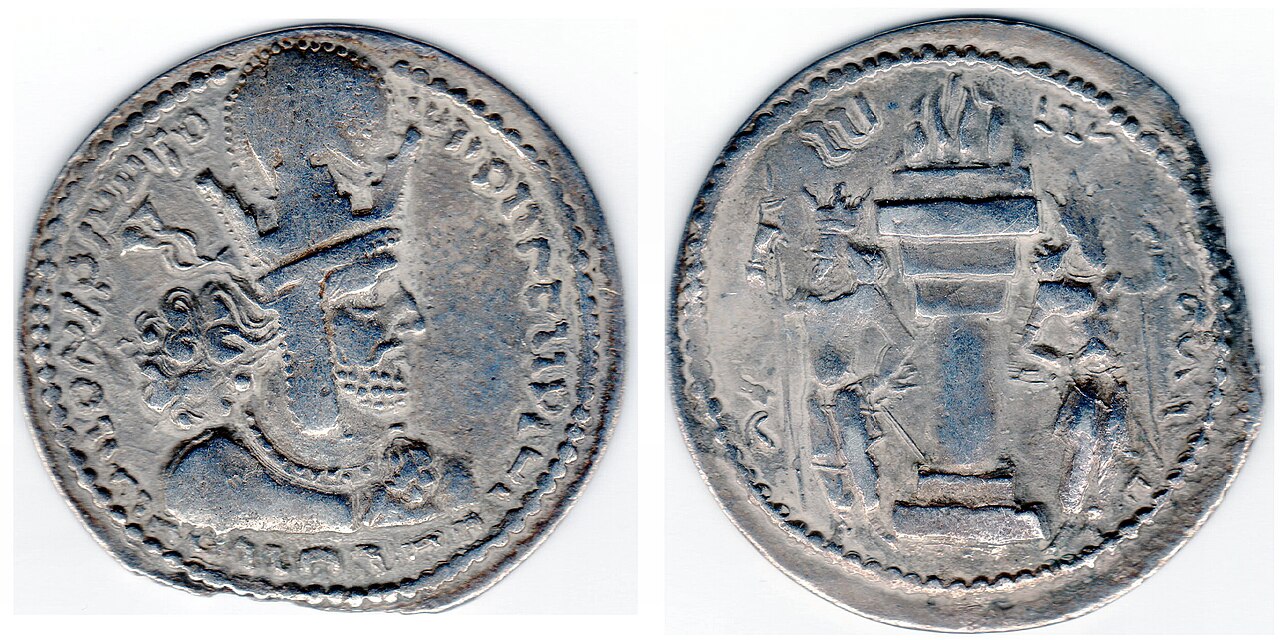

The drachm: a coin built for four centuries
Ardashir I, the founder of the dynasty, took over the drachm from the Parthians in the 220s and gave it a new form. Sasanian drachms weigh about 4 grams of fairly pure silver. They became broader and thinner over time, until late coins are wafers 30 millimetres or more across, struck with several thin rings around the edge. They were produced in very large numbers, above all under the warrior kings Kavad I, Khosrow I and Khosrow II, and they turn up in hoards from China to Scandinavia.
Alongside the silver, the kings struck gold dinars, at first heavy pieces of about 7 grams, mostly for ceremony, gifts and prestige rather than daily use, and some copper for small change. But the economy of the empire, and its taxes, were counted in drachms. al-Tabari, drawing on Sasanian records, describes the land tax set by Khosrow I in these terms: a fixed number of drachms for each measure of land sown with wheat or barley, a higher rate for vines and alfalfa, and a poll tax paid in four bands of 12, 8, 6 and 4 drachms according to wealth. The tax reform is explained on the reforms of Khosrow I.
Reading a Sasanian coin
The front: a king and his crown
The obverse shows the king in profile, with a long curled beard, earrings and necklace, and a crown topped by a large globe, probably a ball of hair wrapped in silk, which numismatists call the korymbos. Around it runs a legend in Pahlavi script. On the early coins it is a full statement of royal ideology. Ardashir’s coins call him “the Mazda-worshipping lord Ardashir, king of kings of Iran, whose seed is from the gods”; from Shapur I onwards the title became “king of kings of Iran and non-Iran”.
The crown is the key to the whole series. Each king chose his own, built from symbols of the gods he favoured. Shapur I wore a mural crown like the battlements of a city; Bahram II added wings, the emblem of the victory god Wahram; Later kings combined crescents, stars and wings. Rock reliefs and silver plates can be identified by comparing their crowns with the coins, which is how scholars name the kings on monuments that carry no inscription. The system broke down only in the last decades, when crowns became stylised and the many short-lived kings of 628–632 sometimes reused older types. Even then the coins tell a story: Queen Boran struck coins in her own name, a direct statement of her legitimacy (see women in the Sasanian Empire).
The back: fire, mint and year
The reverse shows a fire altar, the emblem of the Zoroastrian faith, usually with two standing figures on either side. On early coins these are the king and a god; later they are stiff, repeated attendants. From about 400 the reverse also carries an abbreviated mint name, and from the late 5th century the king’s regnal year. Dozens of different mint signatures are known, though not all have been matched to a city. With mint and year together, a single late Sasanian drachm can be dated to the year and the province, which makes coin hoards one of the best sources for the empire’s economy and wars.
Silver on the table
Silver did not only circulate as coin. Royal workshops produced plates, bowls, ewers and drinking vessels, many of them gilded and decorated in relief with the king hunting on horseback, a theme that also runs through court life (see polo, hunting and games at the Sasanian court). Some vessels carry inscriptions recording their owner or their weight in drachms, a reminder that a plate was also a store of bullion that could be weighed, given or melted down. The plates were diplomatic gifts and rewards for loyal nobles, and many ended up far from Iran, in the Perm region of Russia, in Central Asia and in China. Their design and technique are described on Sasanian art: silver, reliefs and silk.
The vessels raise a problem coins do not. Many are undated and unprovenanced, the style was copied after the fall of the dynasty, and specialists such as Prudence Harper have spent decades separating royal Sasanian work from provincial and post-Sasanian pieces. A hunting plate with a recognisable crown can be attributed with some confidence; much else remains debated.
After the Sasanians
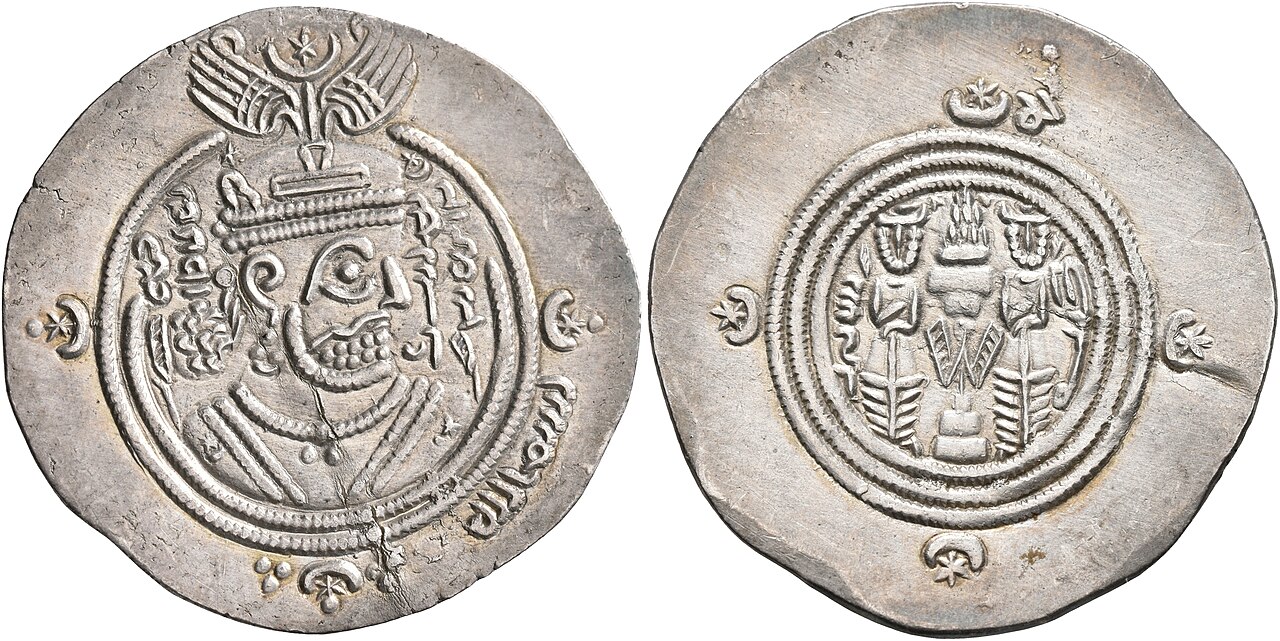
The Arab conquerors of the 640s and 650s did not abolish the Sasanian coin. They went on striking drachms of the same weight and design, usually with the bust of Khosrow II and the fire altar, adding a short Arabic phrase such as bismillah, “in the name of God”, in the margin and later the names of Muslim governors in Pahlavi. These Arab-Sasanian coins circulated for half a century, until the Umayyad caliph Abd al-Malik introduced an all-text Islamic dirham in the late 690s. In Tabaristan on the Caspian, local rulers kept a Sasanian-style coinage into the 8th century.

The word survives too. The Persian درهم (derham) and the Arabic dirham both come from the Greek drachma through Middle Persian, and the dinar comes, by way of the same route, from the Roman denarius. A Persian learner who meets these words in an old text, a proverb or a dictionary is meeting the money of the Sasanian king of kings. For the empire’s own words and script, see Middle Persian (Pahlavi) language and literature.
Persian words from this page
| سکه | sekkeh | coin |
| درهم | derham | dirham, from the drachm |
| دینار | dinâr | dinar, gold coin |
| نقره | noghreh | silver |
| تاج | tâj | crown |
| آتشدان | âtashdân | fire altar |
| ضرابخانه | zarrâbkhâneh | mint |
Sources and further reading
- Robert Göbl, Sasanian Numismatics (Klinkhardt & Biermann, 1971).
- Michael Alram and Rika Gyselen, Sylloge Nummorum Sasanidarum (Austrian Academy of Sciences, 2003–).
- Prudence O. Harper, Silver Vessels of the Sasanian Period, vol. 1: Royal Imagery (Metropolitan Museum of Art, 1981).
- al-Tabari, The History of al-Tabari, vol. 5, trans. C. E. Bosworth (SUNY Press, 1999), on Khosrow I’s taxes.
- Encyclopaedia Iranica, “Coins and Coinage” and “Derham”.
Want to learn Persian? Get the free Starter Pack
Get the 14-page printable Starter Pack (all 32 letters, a 7-day reading plan, 100 core words and 20 survival phrases) and a short 5-email course. Free.
More in The Sasanian Empire (224–651 CE)
- The Origins of the Sasanian Family
- Ardashir I, Founder of the Sasanian Empire
- Firuzabad: Ardashir’s Round City
- Shapur I, King of Kings of Iran and Non-Iran
- Bishapur: Shapur’s City
- The Battle of Edessa and the Capture of Valerian
- The Ka’ba-ye Zartosht Inscription of Shapur I
- Mani and Manichaeism
- Hormizd I and Bahram I
- Kartir and the Zoroastrian Church
- Bahram II
- Narseh and the Peace of Nisibis
- Shapur II the Great
- Julian’s Invasion of Persia (363)
- Christians in the Sasanian Empire
- Shapur III and the Partition of Armenia
- Yazdegerd I
- Bahram V Gur
- Yazdegerd II
- The Battle of Avarayr (451)
- The Hephthalites and Iran’s Eastern Frontier
- Peroz I and the Hephthalite Disaster
- Kavad I
- Zamasp and Kavad’s Return
- Mazdak and the Mazdakite Movement
- Khosrow I Anushirvan the Just
- The Sasanian–Byzantine Wars of the 6th Century
- The Battle of Dara (530)
- Khosrow I Sacks Antioch (540)
- The Lazic War (541–562)
- The Reforms of Khosrow I
- The Academy of Gondishapur: History and Legend
- Borzuya, Chess and Kalila wa Dimna
- Taq Kasra: The Arch of Ctesiphon
- The Sasanian Conquest of Yemen
- The Sasanians and the Western Turks
- Hormizd IV
- Bahram Chobin’s Rebellion
- Khosrow II Parviz
- The Last Great War: Byzantium and Persia, 602–628
- The Siege of Constantinople (626)
- Heraclius Strikes Back
- Shirin: Queen and Legend
- Shahrbaraz, the General Who Became King
- Civil War and the Queens Boran and Azarmidokht
- Yazdegerd III, the Last Sasanian King
- The Sasanian Army
- Sasanian Society and the Class System
- Zoroastrianism under the Sasanians
- Sasanian Art: Silver, Reliefs and Silk
- The Sasanian Reliefs of Naqsh-e Rostam
- Taq-e Bostan
- Sasanian Cities, Palaces and Bridges
- Middle Persian (Pahlavi) Language and Literature
- Sasanian Coins and Silverwork
- Women in the Sasanian Empire
- Polo, Hunting and Games at the Sasanian Court
- The Sasanian Legacy