Bahram II ruled the Sasanian Empire from about 274 to 293 CE. His reign saw a Roman army reach Ctesiphon, a rebellion by a royal brother in the east, and the peak of the high priest Kartir’s power. He is also the Sasanian king who left the most rock reliefs, and the only one who regularly put his queen and son beside him on his coins.
| Reign | c. 274–293 CE (start sometimes given as 276) |
|---|---|
| Father | Bahram I |
| Wars | Roman invasion under Carus (283); revolt of Hormizd in the east (280s) |
| Peace | Agreement with Diocletian, c. 287–288 |
| Monuments | Reliefs at Naqsh-e Rostam, Sar Mashhad, Naqsh-e Bahram, Barm-e Delak, Guyum and Bishapur |
| Successor | His son Bahram III (293), soon overthrown by Narseh |
A young king and a powerful priest
Bahram II came to the throne after the short reigns of his uncle Hormizd I and his father Bahram I, described on the page on Hormizd I and Bahram I. He inherited a court in which the Zoroastrian priesthood had already gained ground, and he went further. In his inscriptions the priest Kartir says that Bahram II made him one of the grandees of the realm, chief priest and judge of the whole empire, and master of the Anahid fire at Istakhr, the family shrine of the dynasty. Kartir even took a new name: “Kartir whose soul Bahram saved”.
What the king gained in return is less clear. A loyal priesthood gave him allies against relatives who thought he had no right to the throne, above all his great-uncle Narseh. The story of Kartir’s career and his claim to have “struck” other religions belongs to the page on Kartir and the Zoroastrian Church; here it is enough to say that the two men rose together.
The Roman invasion of 283
In 283 the emperor Carus marched down the Euphrates into Mesopotamia. Bahram was probably busy in the east, and the Romans met little resistance. Carus took Ctesiphon and the twin city of Seleucia, the heart of the Sasanian realm. Then he died suddenly in his camp. Roman writers say he was killed by lightning; others suspected his praetorian prefect. His army withdrew, and the invasion ended as fast as it had begun.
The episode showed how exposed the Sasanian capital was to an army coming down the rivers, a lesson repeated in 363 and again in 627.
The rebellion in the east
The likely reason Bahram was away was a rebellion by a prince named Hormizd, probably his brother, who held the eastern lands around Sistan. The main evidence is Roman: a Latin speech in praise of the emperor Maximian, delivered in 291, says that the Persian king was at war with his own brother Ormies, who was backed by the Saci (Sakas), the Gelli of Gilan and other peoples. Coins struck in the east in the name of a Hormizd may belong to this rebel, though that identification is debated.
Bahram won. He then gave Sistan to his own son, Bahram, with the title Sakanshah, “king of the Sakas”, a post that marked the heir.
Peace with Diocletian
Around 287–288, with Rome now led by Diocletian, Bahram agreed a peace. Roman panegyrics boast that the Persian king sent gifts and gave up his claims. In practice the agreement seems to have allowed Rome to regain influence in Armenia, where an Arsacid prince, Tiridates, was restored under Roman protection. The exact date and terms are uncertain. The settlement held until Narseh broke it a decade later.

A king in stone
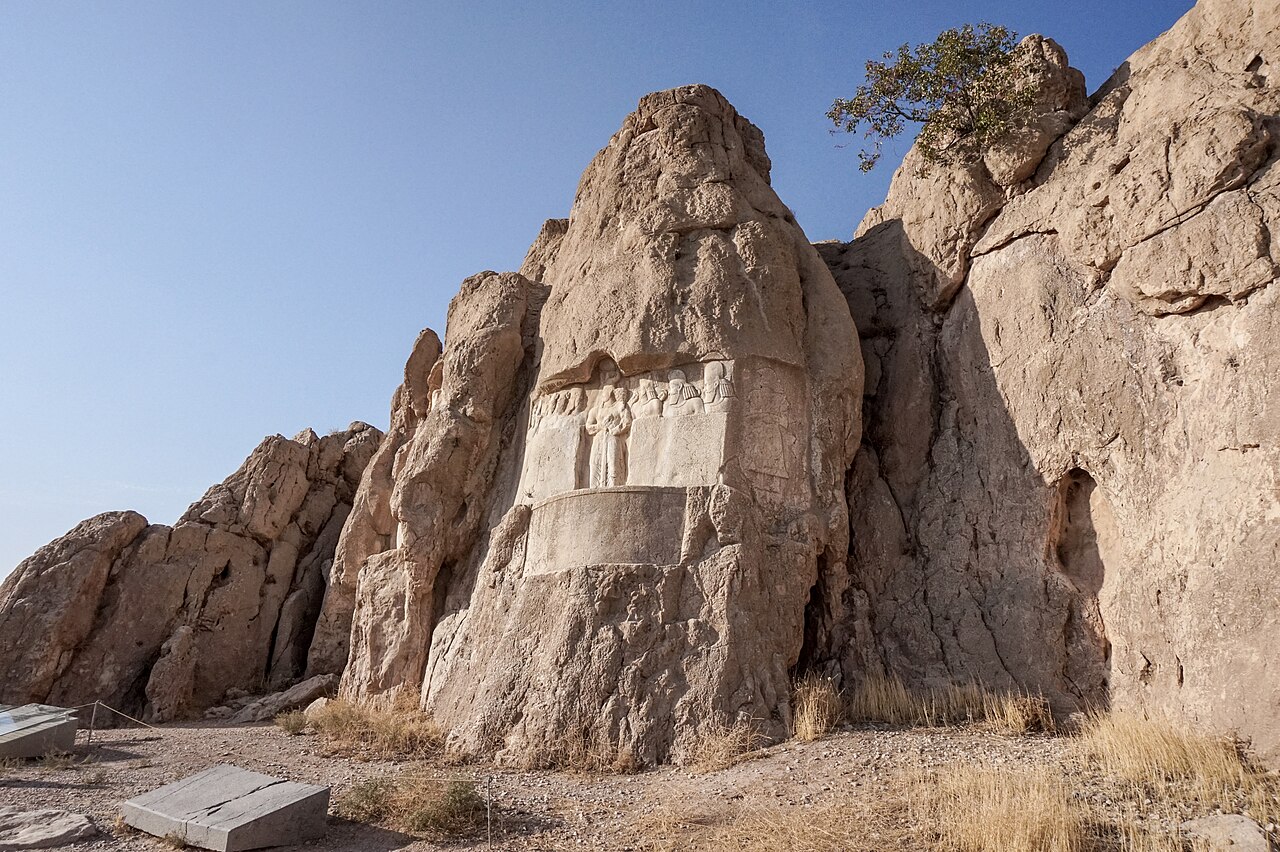
Bahram II commissioned more rock reliefs than any other Sasanian king, about ten in all, and they are unusual in what they show. Earlier reliefs show investiture by a god or victory over Rome. Bahram’s often show his family and his court.
The family reliefs
At Naqsh-e Rostam he had an older Elamite relief cut away and replaced with a scene of himself standing, hands on his sword, with members of his family on one side and nobles on the other. One of the figures may be Kartir. At Naqsh-e Bahram, near Kazerun, he sits enthroned between courtiers. At Barm-e Delak, outside Shiraz, he appears to offer a flower to a woman, usually taken to be his queen.
The lion relief at Sar Mashhad
The most vivid scene is at Sar Mashhad (سرمشهد), in southern Fars. The king strides forward with his sword through one lion while another lies dead at his feet, and behind him stand the queen and other figures, perhaps the prince and Kartir. Scholars read it as an image of the king protecting his house from danger, whether a real hunt or a symbol of his enemies. Kartir’s longest inscription is cut beside it.
Victory and envoys
Two equestrian combat scenes at Naqsh-e Rostam, set below the Achaemenid royal tombs, are attributed to Bahram II by many scholars, though some prefer other kings. At Bishapur a relief shows him on horseback receiving a delegation, with men leading horses and camels, usually interpreted as Arabs bringing tribute.
Coins with a royal family
Bahram II’s silver drachms are easy to recognise. On many issues the king’s bust faces a woman, and on some a youth stands before them. The woman is his queen; the boy is usually taken to be the heir, Bahram. No other Sasanian king put his family on coins so consistently. Together with the reliefs, the coins suggest a king who wanted his line, not only himself, to be seen as chosen.
Death and the end of the line
Bahram II died in 293. His son was proclaimed as Bahram III by a noble named Wahnam, but within months Narseh, the last surviving son of Shapur I, marched from Armenia and was recognised as king at the Paikuli pass. The line of Bahram I lost the throne for good. That story, and Narseh’s own inscription, are told on the page on Narseh and the Peace of Nisibis.
For a guide to all the royal reliefs at the cliff, see the Sasanian reliefs of Naqsh-e Rostam.
Persian words from this page
| بهرام دوم | Bahrâm-e dovvom | Bahram II |
| نقش رستم | Naqsh-e Rostam | “picture of Rostam”, the relief cliff |
| شیر | shir | lion |
| سیستان | Sistân | Sistan, land of the Sakas |
| تیسفون | Tisfun | Ctesiphon |
| سکه | sekke | coin |
Sources and further reading
- Kartir’s inscriptions at Sar Mashhad (KSM), Naqsh-e Rostam (KNRm) and the Ka’ba-ye Zartosht (KKZ)
- Panegyrici Latini XI (III), speech for Maximian, 291 CE
- Encyclopaedia Iranica, entry on Bahram II (iranicaonline.org)
- Georgina Herrmann, The Iranian Revival (1977), on the Sasanian rock reliefs
- Touraj Daryaee, Sasanian Persia: The Rise and Fall of an Empire (2009)
Want to learn Persian? Get the free Starter Pack
Get the 14-page printable Starter Pack (all 32 letters, a 7-day reading plan, 100 core words and 20 survival phrases) and a short 5-email course. Free.
More in The Sasanian Empire (224–651 CE)
- The Origins of the Sasanian Family
- Ardashir I, Founder of the Sasanian Empire
- Firuzabad: Ardashir’s Round City
- Shapur I, King of Kings of Iran and Non-Iran
- Bishapur: Shapur’s City
- The Battle of Edessa and the Capture of Valerian
- The Ka’ba-ye Zartosht Inscription of Shapur I
- Mani and Manichaeism
- Hormizd I and Bahram I
- Kartir and the Zoroastrian Church
- Bahram II
- Narseh and the Peace of Nisibis
- Shapur II the Great
- Julian’s Invasion of Persia (363)
- Christians in the Sasanian Empire
- Shapur III and the Partition of Armenia
- Yazdegerd I
- Bahram V Gur
- Yazdegerd II
- The Battle of Avarayr (451)
- The Hephthalites and Iran’s Eastern Frontier
- Peroz I and the Hephthalite Disaster
- Kavad I
- Zamasp and Kavad’s Return
- Mazdak and the Mazdakite Movement
- Khosrow I Anushirvan the Just
- The Sasanian–Byzantine Wars of the 6th Century
- The Battle of Dara (530)
- Khosrow I Sacks Antioch (540)
- The Lazic War (541–562)
- The Reforms of Khosrow I
- The Academy of Gondishapur: History and Legend
- Borzuya, Chess and Kalila wa Dimna
- Taq Kasra: The Arch of Ctesiphon
- The Sasanian Conquest of Yemen
- The Sasanians and the Western Turks
- Hormizd IV
- Bahram Chobin’s Rebellion
- Khosrow II Parviz
- The Last Great War: Byzantium and Persia, 602–628
- The Siege of Constantinople (626)
- Heraclius Strikes Back
- Shirin: Queen and Legend
- Shahrbaraz, the General Who Became King
- Civil War and the Queens Boran and Azarmidokht
- Yazdegerd III, the Last Sasanian King
- The Sasanian Army
- Sasanian Society and the Class System
- Zoroastrianism under the Sasanians
- Sasanian Art: Silver, Reliefs and Silk
- The Sasanian Reliefs of Naqsh-e Rostam
- Taq-e Bostan
- Sasanian Cities, Palaces and Bridges
- Middle Persian (Pahlavi) Language and Literature
- Sasanian Coins and Silverwork
- Women in the Sasanian Empire
- Polo, Hunting and Games at the Sasanian Court
- The Sasanian Legacy