The Hephthalites were a Central Asian people who built a powerful state north of the Hindu Kush in the second half of the 5th century CE and became the most dangerous enemy on the Sasanian Empire’s eastern frontier. They defeated and killed King Peroz in 484, took tribute from Iran for decades and helped Kavad I regain his throne, until Khosrow I and the Western Turks destroyed their kingdom around 560.
| Period of power | c. 450s to c. 560 CE |
|---|---|
| Heartland | Tokharistan (ancient Bactria), on both sides of the upper Oxus (Amu Darya) |
| Names | Greek Ephthalitai; “White Huns” in Procopius; Chinese Yeda; Arabic and Persian Hayatila, Haytal |
| Written language | Bactrian, in a Greek-based script |
| Key clash with Iran | Death of Peroz I in battle, 484 |
| End | Defeated by Khosrow I and the Western Turks, c. 557–563 |
Who the Hephthalites were
The Hephthalites appear in our sources as one of several “Hunnic” groups that moved south from the steppes into Bactria in the 4th and 5th centuries, after the Kidarites and the Chionites and alongside the Alkhan, who went on into India. Where they came from, and what language their rulers spoke, are still debated. Older scholarship looked for a Turkic or Mongolic origin; others argue for an Iranian-speaking people. What is certain is that their state used Bactrian, an Iranian language written in Greek letters, for its documents and coins, and that hundreds of Bactrian legal and administrative documents from the period have survived in northern Afghanistan.
The Byzantine historian Procopius, writing in the 540s, says the “White Huns” were not nomads like other Huns but lived in a fertile land, were ruled by a king and lived under laws. Chinese envoys described a people who moved between summer and winter camps. Both may be partly right: a nomadic ruling elite governing the old towns and farms of Bactria.

A frontier under pressure
Iran’s northeast, the province of Khorasan with its great oasis city of Merv, faced open country to the north and east. Bahram V had defeated an invasion there in the 420s, and Yazdegerd II spent years campaigning from a base in the region. In this period the Sasanians also built, or strengthened, the long Wall of Gorgan east of the Caspian, one of the largest defensive works of the ancient world.
By the 460s the Hephthalites had become the leading power in Bactria. Their rise coincided with a crisis in the Sasanian royal family. When Yazdegerd II died in 457, his sons Hormizd III and Peroz fought for the throne, and Peroz won with Hephthalite help. A king who owed his crown to them was soon at war with them.
The disaster of 484
Peroz fought the Hephthalites at least twice. In the first war he was trapped and captured, and he was released only after paying a large ransom and leaving his son Kavad as a hostage. In 484 he invaded again and was killed with much of his army; Procopius says the Hephthalites lured the Persian cavalry into a hidden trench. The details of these campaigns, and how historians reconstruct them, are told on the page on Peroz I and the Hephthalite Disaster.
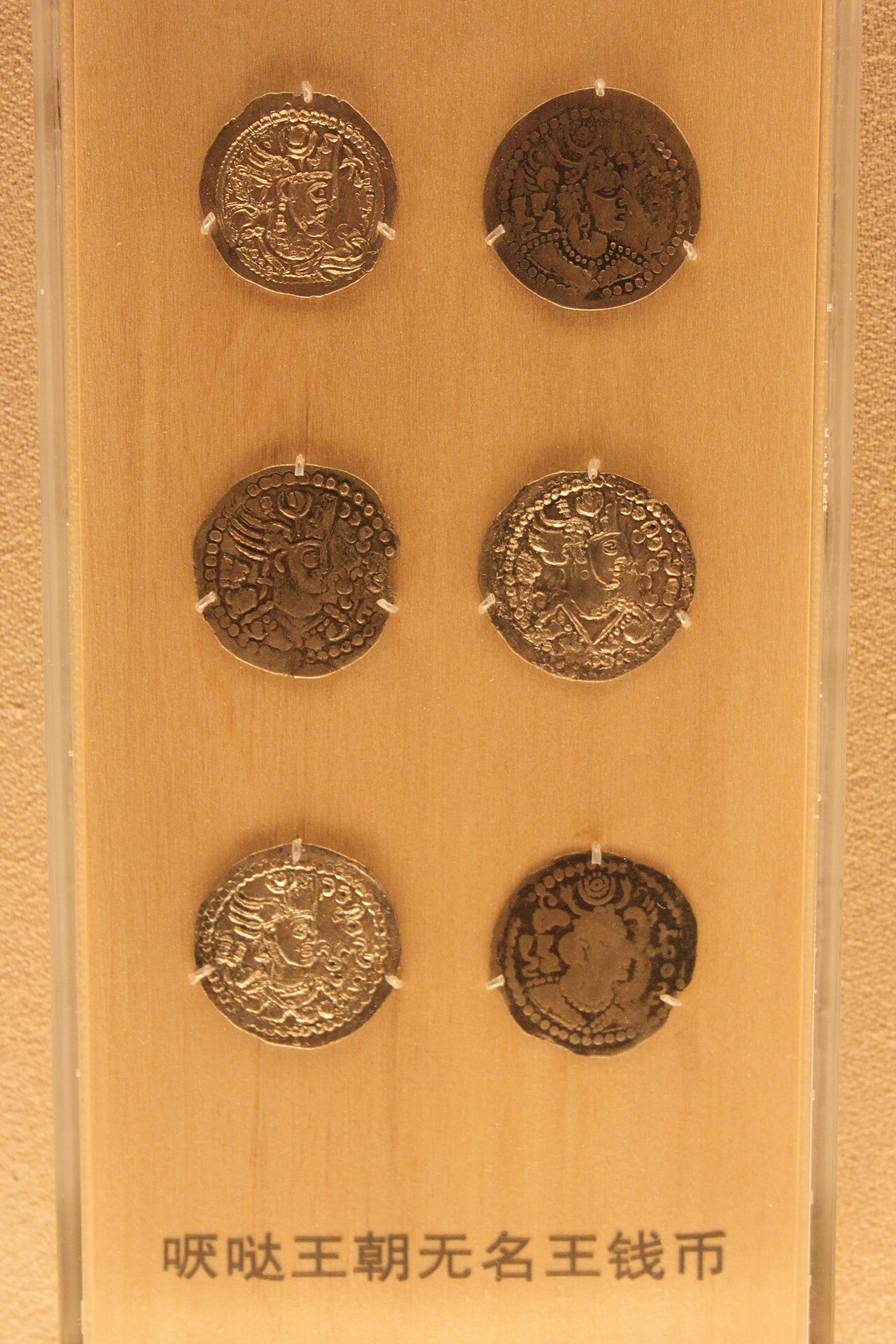
The defeat changed the balance of power. For roughly the next forty years Iran paid the Hephthalites tribute. Sasanian silver drachms of Peroz turn up in large numbers in Central Asia, and the Hephthalites stamped their own countermarks on them and copied them for their own coinage. These coins are the plainest evidence of how much silver flowed east.
Kingmakers in Iran
The Hephthalites’ hold on Iran went beyond money. When Kavad I was deposed by the nobles in 496, he escaped from prison and fled to the Hephthalite king, whom he had known as a hostage. He married into the royal family and returned around 498 with a Hephthalite army, which put him back on the throne. For a time, then, a Sasanian king ruled with the backing of the same people who had killed his father. Kavad’s need for money to pay them helps explain his wars with Rome after 502.
At their height in the early 6th century, the Hephthalites controlled Bactria and Sogdiana, with influence reaching towards the Tarim Basin in the east. Their power over the silk trade through Central Asia made them important to China and Byzantium as well as to Iran.
Destruction by the Turks and Khosrow I
The end came from a new steppe power. In the 550s the Göktürks overthrew their own overlords in Mongolia and expanded west. Their western leader, known in Greek sources as Silziboulos and usually identified with Istämi, made an alliance with Khosrow I. Between about 557 and 563 the Turks attacked the Hephthalites from the north and the Persians from the south, and the Hephthalite kingdom collapsed after a decisive battle near Bukhara, which the Encyclopaedia Iranica dates between 558 and 561.
The allies divided the spoils, with the Oxus roughly as the line between them, and the alliance soon turned into rivalry (see The Sasanians and the Western Turks). Small Hephthalite principalities survived in the mountains of Tokharistan and Badghis into the 7th and 8th centuries, where Arab armies met them during the conquest of Khorasan.
- c. 450s Hephthalites rise in Bactria
- 459 Peroz takes the Sasanian throne with Hephthalite support
- Between 459 and 484 Peroz defeated and captured; Kavad held as a hostage
- 484 Peroz killed in battle; Iran pays tribute
- c. 498 Kavad regains the throne with a Hephthalite army
- c. 557–563 Khosrow I and the Turks destroy the Hephthalite kingdom
How historians see them
Because the Hephthalites left few texts about themselves, their history has long been written from Persian, Byzantine, Chinese and Armenian sources that saw them as outsiders. New evidence, especially coins, seals and the Bactrian documents published by Nicholas Sims-Williams, has made them look less like barbarian raiders and more like a state that ran a settled, literate society. For the Sasanians, though, they remained the eastern counterpart of Rome: the rival that shaped royal policy, drained the treasury and, in 484, killed a king of kings.
Persian words from this page
| هپتالیان | Heptâliân | the Hephthalites |
| پیروز | Piruz | Peroz; “victorious” |
| خراسان | Khorâsân | Khorasan, the northeast |
| مرو | Marv | Merv |
| بلخ | Balkh | Balkh, chief city of Bactria |
| باج | bâj | tribute |
Sources and further reading
- Procopius, History of the Wars, Book 1, chapters 3–4.
- Al-Tabari, The History of al-Tabari, vol. V, trans. C. E. Bosworth (SUNY Press, 1999).
- A. D. H. Bivar, “Hephthalites”, Encyclopaedia Iranica, iranicaonline.org.
- Nicholas Sims-Williams, Bactrian Documents from Northern Afghanistan (Oxford, 2000–2012).
- Khodadad Rezakhani, ReOrienting the Sasanians: East Iran in Late Antiquity (Edinburgh University Press, 2017).
Want to learn Persian? Get the free Starter Pack
Get the 14-page printable Starter Pack (all 32 letters, a 7-day reading plan, 100 core words and 20 survival phrases) and a short 5-email course. Free.
More in The Sasanian Empire (224–651 CE)
- The Origins of the Sasanian Family
- Ardashir I, Founder of the Sasanian Empire
- Firuzabad: Ardashir’s Round City
- Shapur I, King of Kings of Iran and Non-Iran
- Bishapur: Shapur’s City
- The Battle of Edessa and the Capture of Valerian
- The Ka’ba-ye Zartosht Inscription of Shapur I
- Mani and Manichaeism
- Hormizd I and Bahram I
- Kartir and the Zoroastrian Church
- Bahram II
- Narseh and the Peace of Nisibis
- Shapur II the Great
- Julian’s Invasion of Persia (363)
- Christians in the Sasanian Empire
- Shapur III and the Partition of Armenia
- Yazdegerd I
- Bahram V Gur
- Yazdegerd II
- The Battle of Avarayr (451)
- The Hephthalites and Iran’s Eastern Frontier
- Peroz I and the Hephthalite Disaster
- Kavad I
- Zamasp and Kavad’s Return
- Mazdak and the Mazdakite Movement
- Khosrow I Anushirvan the Just
- The Sasanian–Byzantine Wars of the 6th Century
- The Battle of Dara (530)
- Khosrow I Sacks Antioch (540)
- The Lazic War (541–562)
- The Reforms of Khosrow I
- The Academy of Gondishapur: History and Legend
- Borzuya, Chess and Kalila wa Dimna
- Taq Kasra: The Arch of Ctesiphon
- The Sasanian Conquest of Yemen
- The Sasanians and the Western Turks
- Hormizd IV
- Bahram Chobin’s Rebellion
- Khosrow II Parviz
- The Last Great War: Byzantium and Persia, 602–628
- The Siege of Constantinople (626)
- Heraclius Strikes Back
- Shirin: Queen and Legend
- Shahrbaraz, the General Who Became King
- Civil War and the Queens Boran and Azarmidokht
- Yazdegerd III, the Last Sasanian King
- The Sasanian Army
- Sasanian Society and the Class System
- Zoroastrianism under the Sasanians
- Sasanian Art: Silver, Reliefs and Silk
- The Sasanian Reliefs of Naqsh-e Rostam
- Taq-e Bostan
- Sasanian Cities, Palaces and Bridges
- Middle Persian (Pahlavi) Language and Literature
- Sasanian Coins and Silverwork
- Women in the Sasanian Empire
- Polo, Hunting and Games at the Sasanian Court
- The Sasanian Legacy