Hormizd I and Bahram I were two sons of Shapur I who ruled the Sasanian Empire one after the other for about four years, from around 270 to 274 CE. Their reigns were short, but they decided two things that shaped the next generation: the rise of the priest Kartir to power at court, and the arrest and death of the prophet Mani.
| Hormizd I | Reigned c. 270–271 (some reckonings give 272–273) |
|---|---|
| Bahram I | Reigned c. 271–274 (or c. 273–276) |
| Father | Shapur I (r. 240–c. 270) |
| Earlier posts | Hormizd: “great king of Armenia”; Bahram: king of Gilan |
| Key events | Kartir made chief priest; Mani imprisoned and dies; Narseh passed over |
| Successor | Bahram II, son of Bahram I |
Shapur’s sons and their provinces
Shapur I ruled for about thirty years and gave his sons kingdoms of their own inside the empire. His great inscription on the Ka’ba-ye Zartosht at Naqsh-e Rostam lists them. Hormizd, called Hormizd-Ardashir, was “great king of Armenia”, a post that seems to have marked the heir. Bahram ruled Gilan, the wet green country on the south-west shore of the Caspian. Narseh, the youngest of the three who matter here, was “king of the Sakas” in Sistan and the east. The inscription is discussed on the page on the Ka’ba-ye Zartosht inscription of Shapur I.
Ranking among the sons depended partly on their mothers. Bahram was the eldest, but his mother seems to have been a lesser wife, and in the inscription he stands below his younger brothers. When Shapur died, probably at Bishapur around 270, the throne went to Hormizd.

Hormizd I: a year on the throne
Hormizd reigned for roughly a year, and almost nothing about his deeds is securely dated. Three things are known with some confidence.
First, he founded or renamed a city in Khuzestan, Ram-Hormizd-Ardashir, “the peace of Hormizd-Ardashir”. The town survives as Ramhormoz (رامهرمز), and local tradition says the king was buried there.
Second, he made the coinage formula “king of kings of Iran and non-Iran” (Middle Persian shahan shah Eran ud Aneran) the standard royal title on coins. Shapur had used it in inscriptions. Hormizd’s coins also show a new reverse, with two figures at the fire altar, one of them a god.
Third, he honoured the priest Kartir. In his own inscriptions Kartir says that Hormizd gave him the cap and belt of high rank and the title “mowbed of Ohrmazd”, chief priest of the god. This was the first step in a career that would make Kartir the most powerful churchman in Sasanian history. Yet Hormizd also let Mani go on preaching. Like his father, he seems to have kept the competing religions in balance rather than choose one.
Bahram I and the turn against Mani
Hormizd’s death around 271 opened a contest. Bahram, the passed-over elder brother, took the throne, and modern historians generally think Kartir and his party helped him to it. Narseh, who had a strong claim and who later called Bahram’s line usurpers, was compensated with Armenia. That settlement held for twenty years, until Narseh overturned it in 293.
The best-known event of the reign is the fall of Mani. The prophet, who had travelled with Shapur’s court and enjoyed his protection, was summoned before Bahram, accused of leading people away from the religion of the Magi, and put in chains. Manichaean texts say he died after 26 days in prison at Bet Lapat, the city better known as Gondishapur. His followers called it his crucifixion. The date is disputed: some scholars put it in 274, others in 276 or 277. Manichaean writers blamed Kartir above all, and Kartir himself later listed the Manichaeans (zandik) among the faiths that were “struck” in the empire. The full story is told on the page on Mani and Manichaeism.
It is easy to read the reign only through Mani’s eyes. Bahram may have had political reasons too: a priesthood loyal to him was a counterweight to brothers and nobles who doubted his right to rule.
A relief that changed its name
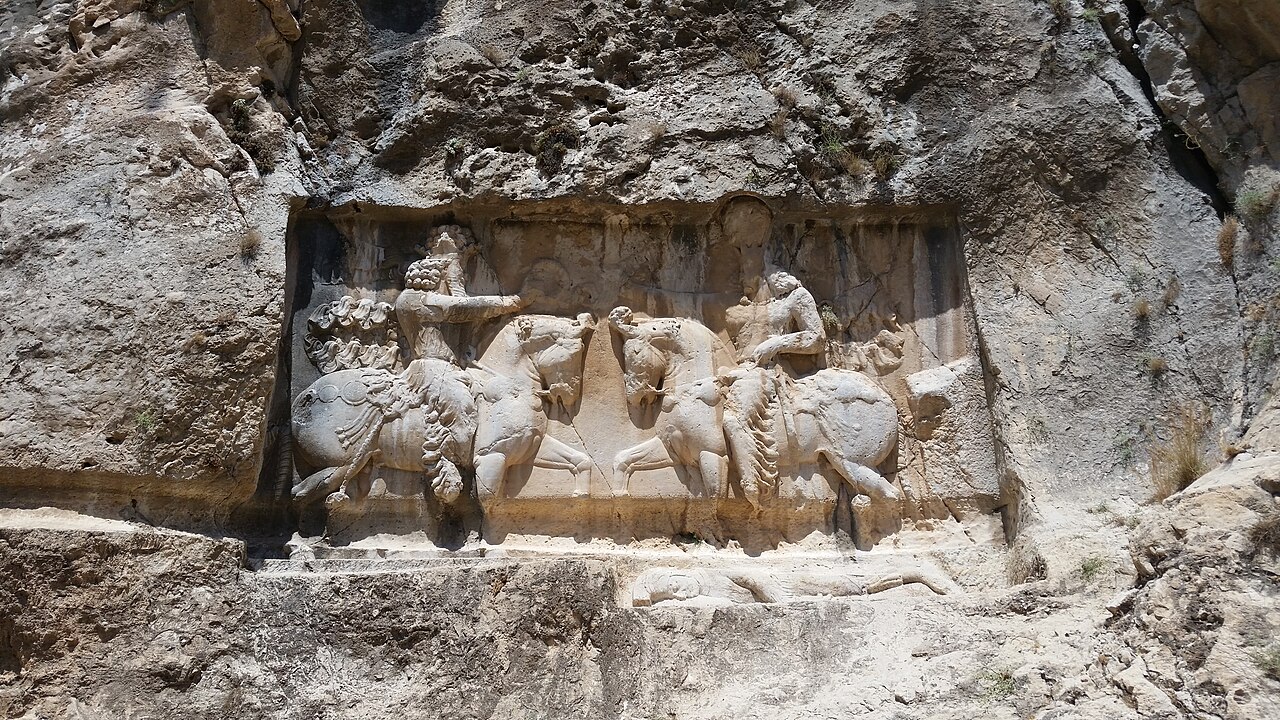
Bahram I left one great monument. In the gorge at Bishapur, on the Shapur river, he had himself carved on horseback receiving the ring of kingship from the god Ohrmazd, who rides towards him on another horse. It is among the finest Sasanian reliefs, with deep carving and flowing ribbons.
When Narseh finally won the throne, he had the Middle Persian label beside the king changed, so that it named him instead of Bahram. The figure stayed the same; only the words were altered. It is a small, telling act: Narseh treated the reign of Bahram and his son as an interruption of the proper order. See Bishapur: Shapur’s City for the other reliefs in the gorge.
Rome and the west
These years were turbulent on the western frontier, but Persia played little visible part. The Palmyrene state of Zenobia, which had grown strong by fighting Shapur, was destroyed by the emperor Aurelian in 272–273. The Greek historian Zosimus says Zenobia was captured as she tried to cross the Euphrates to seek help from the Persians. No Persian army is known to have intervened. With princes at odds over the succession, the court had reason to avoid a war.
How historians see the two reigns
Later Arabic and Persian histories, which depend on the lost Sasanian royal chronicle, say little about either king. Al-Tabari gives Hormizd a short and favourable notice and repeats the story of Mani’s death under Bahram. For modern historians the period matters as a turning point in religious policy. Under Shapur the court protected several faiths. Under Bahram I and his son Bahram II, the Zoroastrian priesthood led by Kartir gained office, property and the power to judge.
Bahram I died around 274 and was succeeded by his son, Bahram II, in whose long reign Kartir reached the height of his power. That story continues on the page on Kartir and the Zoroastrian Church, while Narseh’s revenge is told in Narseh and the Peace of Nisibis.
Persian words from this page
| هرمز | Hormoz | Hormizd (from Ohrmazd, Ahura Mazda) |
| بهرام | Bahrâm | Bahram |
| نرسی | Narsi | Narseh |
| مانی | Mâni | Mani |
| گیلان | Gilân | Gilan, Bahram’s province |
| موبد | mobad | Zoroastrian priest |
Sources and further reading
- Shapur I’s inscription on the Ka’ba-ye Zartosht (SKZ) and Kartir’s inscriptions (KKZ, KNRm)
- Al-Tabari, The History of al-Tabari, vol. 5: The Sasanids, the Byzantines, the Lakhmids, and Yemen, trans. C. E. Bosworth (1999)
- Encyclopaedia Iranica, entries on Hormozd I and Bahram I (iranicaonline.org)
- Touraj Daryaee, Sasanian Persia: The Rise and Fall of an Empire (2009)
- Zosimus, New History, Book 1 (on Zenobia)
Want to learn Persian? Get the free Starter Pack
Get the 14-page printable Starter Pack (all 32 letters, a 7-day reading plan, 100 core words and 20 survival phrases) and a short 5-email course. Free.
More in The Sasanian Empire (224–651 CE)
- The Origins of the Sasanian Family
- Ardashir I, Founder of the Sasanian Empire
- Firuzabad: Ardashir’s Round City
- Shapur I, King of Kings of Iran and Non-Iran
- Bishapur: Shapur’s City
- The Battle of Edessa and the Capture of Valerian
- The Ka’ba-ye Zartosht Inscription of Shapur I
- Mani and Manichaeism
- Hormizd I and Bahram I
- Kartir and the Zoroastrian Church
- Bahram II
- Narseh and the Peace of Nisibis
- Shapur II the Great
- Julian’s Invasion of Persia (363)
- Christians in the Sasanian Empire
- Shapur III and the Partition of Armenia
- Yazdegerd I
- Bahram V Gur
- Yazdegerd II
- The Battle of Avarayr (451)
- The Hephthalites and Iran’s Eastern Frontier
- Peroz I and the Hephthalite Disaster
- Kavad I
- Zamasp and Kavad’s Return
- Mazdak and the Mazdakite Movement
- Khosrow I Anushirvan the Just
- The Sasanian–Byzantine Wars of the 6th Century
- The Battle of Dara (530)
- Khosrow I Sacks Antioch (540)
- The Lazic War (541–562)
- The Reforms of Khosrow I
- The Academy of Gondishapur: History and Legend
- Borzuya, Chess and Kalila wa Dimna
- Taq Kasra: The Arch of Ctesiphon
- The Sasanian Conquest of Yemen
- The Sasanians and the Western Turks
- Hormizd IV
- Bahram Chobin’s Rebellion
- Khosrow II Parviz
- The Last Great War: Byzantium and Persia, 602–628
- The Siege of Constantinople (626)
- Heraclius Strikes Back
- Shirin: Queen and Legend
- Shahrbaraz, the General Who Became King
- Civil War and the Queens Boran and Azarmidokht
- Yazdegerd III, the Last Sasanian King
- The Sasanian Army
- Sasanian Society and the Class System
- Zoroastrianism under the Sasanians
- Sasanian Art: Silver, Reliefs and Silk
- The Sasanian Reliefs of Naqsh-e Rostam
- Taq-e Bostan
- Sasanian Cities, Palaces and Bridges
- Middle Persian (Pahlavi) Language and Literature
- Sasanian Coins and Silverwork
- Women in the Sasanian Empire
- Polo, Hunting and Games at the Sasanian Court
- The Sasanian Legacy