The Sasanian kings were great builders. Between 224 and 651 CE they founded dozens of cities named after themselves, raised palaces with vast brick vaults and domes set on squinches, dammed rivers with bridge-weirs like the Shadervan at Shushtar, and closed the northern frontier with long walls at Darband and Gorgan. Their two key forms, the iwan and the domed square, became basic elements of later Iranian and Islamic architecture.
| Period | 224–651 CE |
|---|---|
| Building materials | Rubble stone and gypsum mortar in Fars; fired and mud brick in Mesopotamia |
| Key forms | Iwan (vaulted hall open at one end); dome on squinches over a square; chahar taq |
| Royal cities | Ardashir-Khurrah (Firuzabad), Bishapur, Gondishapur, Weh-Ardashir |
| Engineering | Band-e Kaisar (Shadervan) at Shushtar; Darband walls; Great Wall of Gorgan |
| UNESCO | Fars sites (no. 1568, 2018); Shushtar Historical Hydraulic System (no. 1315, 2009); Derbent (no. 1070, 2003) |
Kings who founded cities
Founding a city was a royal act in Sasanian Iran. Al-Tabari and other later writers credit Ardashir I with eight cities and Shapur I with several more, and the names say who built them: Ardashir-Khurrah, “glory of Ardashir”; Weh-Ardashir, “the good (city) of Ardashir”; Ram-Hormizd, “the peace of Hormizd”. New cities gathered the population of a district, settled prisoners of war, and gave the king a base for tax collection and defence.
Round cities and grid cities
Two plans stand out. Ardashir’s city at Firuzabad was a perfect circle about 2 km across, with four gates and a tower at its centre (see Firuzabad: Ardashir’s Round City). Weh-Ardashir, built opposite Ctesiphon on the Tigris to replace ruined Seleucia, was also roughly circular. Shapur I’s foundations were different. Bishapur in Fars had straight streets crossing at right angles, and Gondishapur in Khuzestan, whose Middle Persian name meant “Shapur’s better Antioch”, was settled with captives from Roman Syria (see Bishapur: Shapur’s City). Khosrow I repeated the idea after 540, building near Ctesiphon a new town for the people of Antioch, “Khosrow’s better Antioch”.
The capital region
The real centre of the empire was not in Fars but on the Tigris, where Ctesiphon, Weh-Ardashir and neighbouring towns formed a cluster that Syriac and Arabic writers called “the cities” (in Arabic, al-Mada’in). Its great surviving monument is the brick vault of the Taq Kasra, described on its own page, Taq Kasra: the Arch of Ctesiphon.
Palaces: iwans and domes
Sasanian palaces combined two forms. The iwan (ایوان) is a large barrel-vaulted hall, closed on three sides and open at the front to a courtyard. Behind it, or beside it, a square room was covered by a dome. The difficulty of setting a round dome on a square room was solved with the squinch, a small arch or niche built across each corner, which turns the square into an octagon on which the dome can sit. The Palace of Ardashir near Firuzabad, from the early 3rd century, already shows the full arrangement, with three domed halls behind an iwan.
Builders in Fars used rough stone set in thick gypsum mortar, then covered with plaster. In Mesopotamia they used brick, and they developed a way of building vaults without wooden centring, by laying courses of brick at a slant against an end wall. That technique made the Taq Kasra possible.
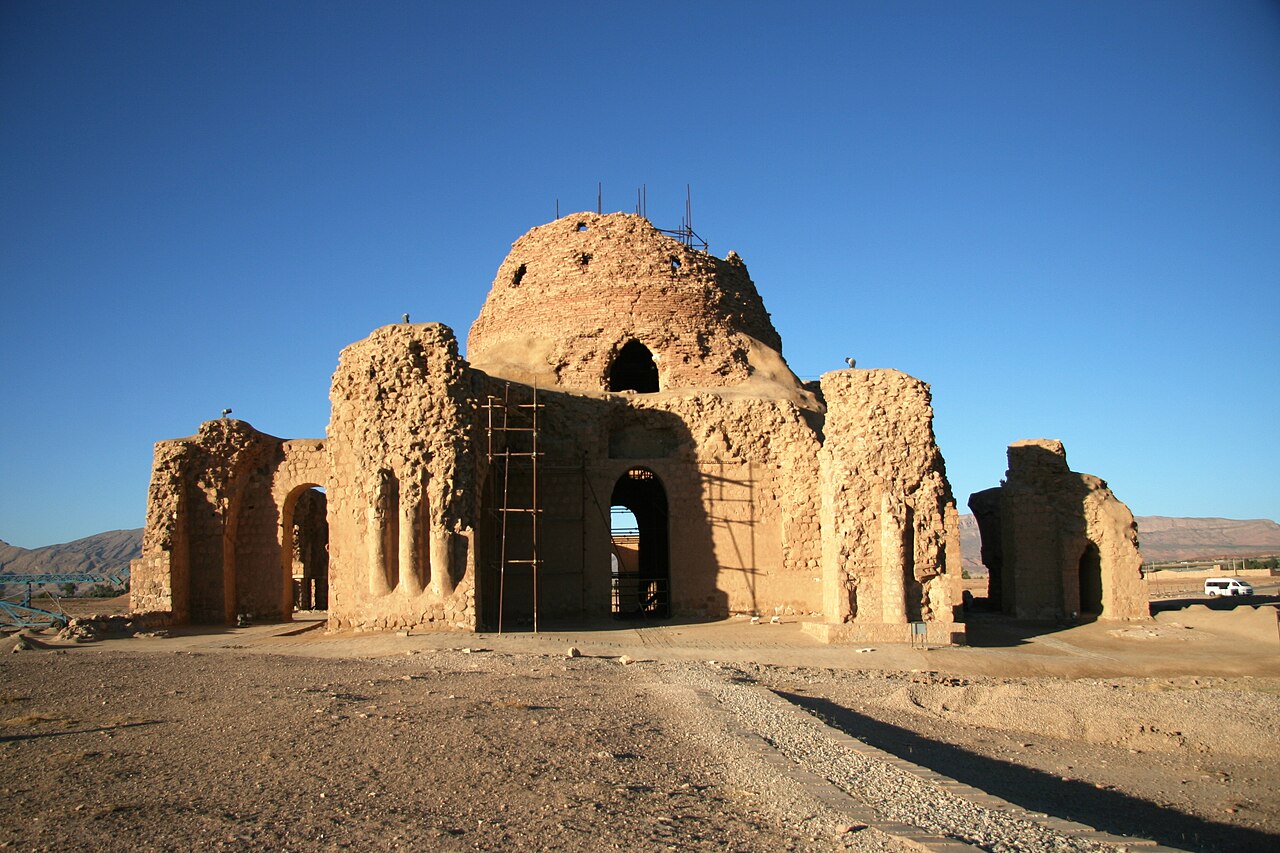

Sarvestan: a puzzle
The building at Sarvestan, south-east of Shiraz, is a compact stone structure with domes, iwans and an unusual set of piers and half-domes. It was long called a Sasanian palace of the 5th century, linked by tradition to Bahram Gur. In 1986 the architectural historian Lionel Bier argued that it is an early Islamic building, perhaps a Zoroastrian fire temple or a manor of the 8th or 9th century built in Sasanian style. The question is not settled. It is now part of the UNESCO property of Sasanian sites in Fars.
Fire temples
The chahar taq (چهارطاق), “four arches”, was a square domed pavilion open on four sides, the core of many Sasanian fire temples. Ruins survive across Iran, from Niasar near Kashan to remote valleys of Fars. The greatest sanctuary, the temple of Adur Gushnasp at Takht-e Soleyman in Azerbaijan, is treated on the page on Zoroastrianism under the Sasanians.
Dams and bridges
Water was the basis of Sasanian prosperity, and the kings invested in irrigation. The most famous work is the Band-e Kaisar, “Caesar’s dam”, at Shushtar in Khuzestan, also called the Shadervan (شادروان). It was a weir about half a kilometre long that raised the level of the Karun river to feed irrigation canals and carried a road across the top on arches. Persian and Arabic tradition says it was built by Roman prisoners taken with Valerian in 260, a story that may preserve a real memory of captive engineers. It was used for many centuries before collapsing in the 19th century. Similar weir-bridges were built at Dezful and elsewhere in Khuzestan.
Walls against the steppe
The northern frontier between the Caspian Sea and the Caucasus was a constant problem: nomadic peoples from the steppe could ride through the passes into Iran. The Sasanians answered with walls.
Darband
At Darband (Derbent, in today’s Dagestan, Russia), where the mountains come close to the Caspian shore, two parallel stone walls ran from the sea up into the mountains, closing the coastal route. The great stone fortifications are usually attributed to Khosrow I in the 6th century. The name means “closed gate” in Persian.
The Great Wall of Gorgan
East of the Caspian, the “Red Snake” wall of Gorgan runs about 195 km across the Gorgan plain, built of fired red brick with more than thirty forts along its length and a canal beside it. Excavations by Iranian and British teams since 2005 have dated it to the 5th or 6th century, far earlier than once believed, and shown that it was garrisoned by a large army. It is one of the longest defensive walls of the ancient world.
What lasted
The iwan opening onto a courtyard became the standard form of the Iranian mosque, madrasa and caravanserai, often with four iwans on the four sides. The dome on squinches developed into the domes of Seljuk and Safavid Isfahan. Many towns founded by the Sasanian kings remained centres of Islamic Iran. For the art that decorated these buildings, see Sasanian art; for visiting Firuzabad, Bishapur and Sarvestan today, see Sasanian sites of Fars.
Persian words from this page
| ایوان | eyvân | iwan, vaulted hall |
| گنبد | gonbad | dome |
| چهارطاق | chahârtâq | four-arched domed pavilion |
| بند | band | dam, weir |
| دربند | Darband | Derbent, “closed gate” |
| شوشتر | Shushtar | Shushtar |
| سروستان | Sarvestân | Sarvestan |
Sources and further reading
- Dietrich Huff, “Architecture, iii. Sasanian Period”, Encyclopaedia Iranica (iranicaonline.org)
- Lionel Bier, Sarvistan: A Study in Early Iranian Architecture (1986)
- Eberhard W. Sauer, Hamid Omrani Rekavandi, Tony J. Wilkinson, Jebrael Nokandeh et al., Persia’s Imperial Power in Late Antiquity: The Great Wall of Gorgan and Frontier Landscapes of Sasanian Iran (2013)
- UNESCO World Heritage Centre, Shushtar Historical Hydraulic System and Sassanid Archaeological Landscape of Fars Region
- Matthew P. Canepa, The Iranian Expanse (2018)
Want to learn Persian? Get the free Starter Pack
Get the 14-page printable Starter Pack (all 32 letters, a 7-day reading plan, 100 core words and 20 survival phrases) and a short 5-email course. Free.
More in The Sasanian Empire (224–651 CE)
- The Origins of the Sasanian Family
- Ardashir I, Founder of the Sasanian Empire
- Firuzabad: Ardashir’s Round City
- Shapur I, King of Kings of Iran and Non-Iran
- Bishapur: Shapur’s City
- The Battle of Edessa and the Capture of Valerian
- The Ka’ba-ye Zartosht Inscription of Shapur I
- Mani and Manichaeism
- Hormizd I and Bahram I
- Kartir and the Zoroastrian Church
- Bahram II
- Narseh and the Peace of Nisibis
- Shapur II the Great
- Julian’s Invasion of Persia (363)
- Christians in the Sasanian Empire
- Shapur III and the Partition of Armenia
- Yazdegerd I
- Bahram V Gur
- Yazdegerd II
- The Battle of Avarayr (451)
- The Hephthalites and Iran’s Eastern Frontier
- Peroz I and the Hephthalite Disaster
- Kavad I
- Zamasp and Kavad’s Return
- Mazdak and the Mazdakite Movement
- Khosrow I Anushirvan the Just
- The Sasanian–Byzantine Wars of the 6th Century
- The Battle of Dara (530)
- Khosrow I Sacks Antioch (540)
- The Lazic War (541–562)
- The Reforms of Khosrow I
- The Academy of Gondishapur: History and Legend
- Borzuya, Chess and Kalila wa Dimna
- Taq Kasra: The Arch of Ctesiphon
- The Sasanian Conquest of Yemen
- The Sasanians and the Western Turks
- Hormizd IV
- Bahram Chobin’s Rebellion
- Khosrow II Parviz
- The Last Great War: Byzantium and Persia, 602–628
- The Siege of Constantinople (626)
- Heraclius Strikes Back
- Shirin: Queen and Legend
- Shahrbaraz, the General Who Became King
- Civil War and the Queens Boran and Azarmidokht
- Yazdegerd III, the Last Sasanian King
- The Sasanian Army
- Sasanian Society and the Class System
- Zoroastrianism under the Sasanians
- Sasanian Art: Silver, Reliefs and Silk
- The Sasanian Reliefs of Naqsh-e Rostam
- Taq-e Bostan
- Sasanian Cities, Palaces and Bridges
- Middle Persian (Pahlavi) Language and Literature
- Sasanian Coins and Silverwork
- Women in the Sasanian Empire
- Polo, Hunting and Games at the Sasanian Court
- The Sasanian Legacy