Bishapur was a royal city founded by Shapur I around 266 CE in the valley of the Shapur river in Fars, about 20 km west of modern Kazerun. Laid out on a Roman-style grid and decorated with mosaics, it was built as a showpiece of Shapur’s victories over Rome, and its gorge holds six Sasanian rock reliefs. Since 2018 it has been part of the UNESCO World Heritage property “Sassanid Archaeological Landscape of Fars Region”.
| Founded | c. 266 CE, by Shapur I |
|---|---|
| Location | Shapur river valley, Fars province, near Kazerun |
| Persian name | بیشاپور (Bishâpur) |
| Main remains | Grid streets, so-called Anahita temple, palace hall, mosaic court, commemorative columns |
| Nearby | Tang-e Chogan reliefs; colossal statue of Shapur I in the Shapur cave |
| Excavated | Roman Ghirshman for the Louvre (1935–1941); Iranian teams from the late 1960s |
| UNESCO | Part of site no. 1568, inscribed 2018 |

A city for a victorious king
Shapur I spent the 240s and 250s at war with Rome, defeating three emperors in turn and capturing Valerian in 260 (see the Battle of Edessa and the capture of Valerian). He brought tens of thousands of prisoners from Syria and Anatolia and settled them in new or rebuilt cities in Khuzestan and Fars. Bishapur was the grandest of these foundations in the Persian homeland, sited where the river leaves a narrow gorge and spreads into a fertile plain.
A Middle Persian and Parthian inscription on one of two columns that stood in the city records the setting up of a statue of the king and names an official called Apasay, apparently from Harran in Roman Mesopotamia. The inscription dates the event to a year that corresponds to about 266 CE, the usual date for the founding.
The plan: a grid in Persia
The city was a rough rectangle protected on two sides by the river and the cliffs and on the others by walls and a moat. Inside, straight streets crossed at right angles. This grid contrasts sharply with the round plan of Ardashir I’s city at Firuzabad (see Firuzabad: Ardashir’s Round City), and many historians link it to the Roman builders and engineers among the captives. Excavation has uncovered only a small part of the site; most of the city still lies under fields.
The so-called Anahita temple
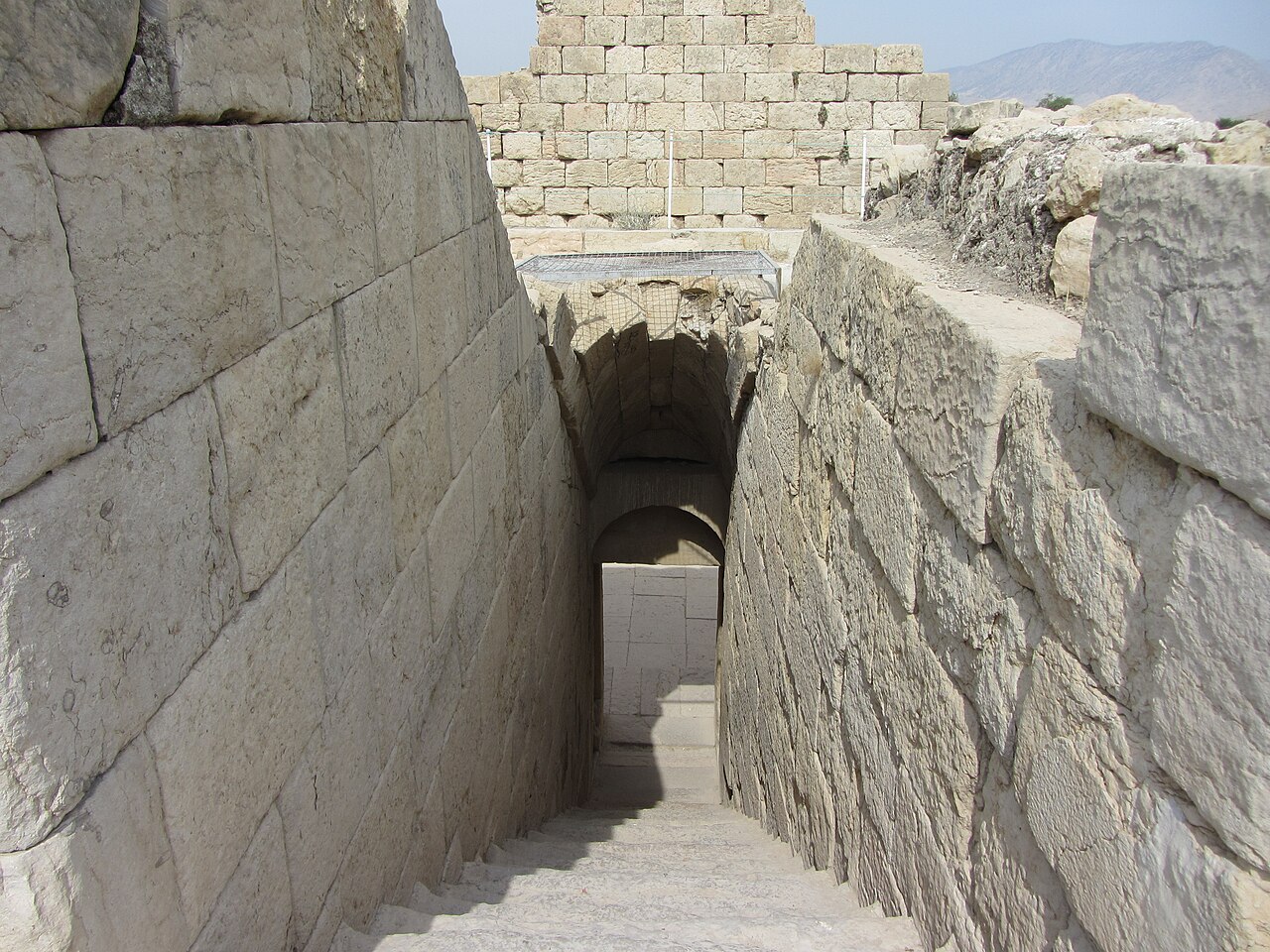
The best-preserved building is a square stone structure, about 14 m on each side, sunk some 6 m below ground level. It was built of carefully cut blocks held with iron clamps, without mortar, and corridors around it carried water channelled from the river so that it could flow around and possibly through the building. The upper parts were decorated with carved bull heads, an echo of Achaemenid column capitals at Persepolis.
The building is usually called the temple of Anahita, the goddess of the waters, whose cult the Sasanian family had long served at Istakhr. That identification is attractive but not proven: no inscription names the goddess, and some scholars have argued for a fire temple or a building of another kind. What is clear is that water was central to its design.
Palace and mosaics
Next to the temple stood a large hall with a cross-shaped plan and stucco-decorated niches, generally taken as a royal audience hall. Whether it was roofed by a dome is debated. Beside it, Ghirshman’s excavators found courtyards and porticoes floored with mosaics: courtiers, women holding flowers or garlands, a harpist, masks and geometric borders. The style is close to the mosaics of Roman Antioch, and they are often cited as the clearest artistic trace of the Roman captives. Some panels went to the Louvre in Paris and others to the National Museum of Iran in Tehran.
The Valerian legend
Local and later Persian tradition says that Bishapur, like the dam-bridge at Shushtar, was built by Valerian and his soldiers. Iranian guides still point to a building known as “Valerian’s palace”. The legend has a real basis: Shapur did settle Roman prisoners in Fars and Khuzestan, and the city’s plan and mosaics show Roman skills. But there is no evidence that the emperor himself had anything to do with it, and nothing is known of where or when he died.
The reliefs of Tang-e Chogan
Where the river comes out of the gorge of Tang-e Chogan (تنگ چوگان), six reliefs are carved on the two rock faces. They span more than a century:
- Shapur I’s investiture: the king on horseback receives the ring of kingship from Ohrmazd.
- Two triumphs of Shapur I over Rome: crowded compositions with rows of Persian cavalry and Roman figures, one usually identified as Valerian, another as Philip the Arab, and a fallen Roman often identified as Gordian III.
- Bahram I’s investiture: later relabelled with the name of Narseh (see Hormizd I and Bahram I).
- Bahram II receiving envoys who lead horses and a camel, usually taken to be Arabs.
- Shapur II enthroned, with captives and severed heads brought before him, usually read as the suppression of a revolt.
Some of the carvings have been damaged by a water channel cut along the base of the cliff in later times.
The statue in the cave
A few kilometres up the valley, a steep climb leads to a large cave. At its entrance stands a statue of Shapur I, about 7 m high, carved from a natural stalagmite pillar. It had fallen and been broken, and was set upright again in the 20th century. It is the only large free-standing royal statue known from Sasanian Iran. Shapur probably died at Bishapur around 270, and some have suggested that the cave was his burial place, but this cannot be shown.
Later history
Bishapur stayed important after the Sasanians. Arab armies took it in the conquest of Fars in the 640s, after revolts and re-conquest, and it became the chief town of one of the five districts (kura) of early Islamic Fars, named after Shapur. Over the 8th to 10th centuries its population drifted to Kazerun, and by the 12th century the city was largely abandoned. Its emptiness is why so much of it survives under the soil.
For travel advice on visiting Bishapur with Firuzabad and Sarvestan, see the places page on the Sasanian sites of Fars. For the wider building story, see Sasanian cities, palaces and bridges.
Persian words from this page
| بیشاپور | Bishâpur | Bishapur |
| شاپور | Shâpur | Shapur |
| کازرون | Kâzerun | Kazerun, the nearby town |
| آناهیتا | Ânâhitâ | Anahita, goddess of the waters |
| تنگ | tang | gorge, narrow pass |
| غار | ghâr | cave |
Sources and further reading
- R. Ghirshman, Bîchâpour, 2 vols. (1956–1971)
- Encyclopaedia Iranica, “Bishapur” (iranicaonline.org)
- UNESCO World Heritage Centre, Sassanid Archaeological Landscape of Fars Region
- Georgina Herrmann, The Iranian Revival (1977)
- Matthew P. Canepa, The Iranian Expanse: Transforming Royal Identity through Architecture, Landscape, and the Built Environment (2018)
Want to learn Persian? Get the free Starter Pack
Get the 14-page printable Starter Pack (all 32 letters, a 7-day reading plan, 100 core words and 20 survival phrases) and a short 5-email course. Free.
More in The Sasanian Empire (224–651 CE)
- The Origins of the Sasanian Family
- Ardashir I, Founder of the Sasanian Empire
- Firuzabad: Ardashir’s Round City
- Shapur I, King of Kings of Iran and Non-Iran
- Bishapur: Shapur’s City
- The Battle of Edessa and the Capture of Valerian
- The Ka’ba-ye Zartosht Inscription of Shapur I
- Mani and Manichaeism
- Hormizd I and Bahram I
- Kartir and the Zoroastrian Church
- Bahram II
- Narseh and the Peace of Nisibis
- Shapur II the Great
- Julian’s Invasion of Persia (363)
- Christians in the Sasanian Empire
- Shapur III and the Partition of Armenia
- Yazdegerd I
- Bahram V Gur
- Yazdegerd II
- The Battle of Avarayr (451)
- The Hephthalites and Iran’s Eastern Frontier
- Peroz I and the Hephthalite Disaster
- Kavad I
- Zamasp and Kavad’s Return
- Mazdak and the Mazdakite Movement
- Khosrow I Anushirvan the Just
- The Sasanian–Byzantine Wars of the 6th Century
- The Battle of Dara (530)
- Khosrow I Sacks Antioch (540)
- The Lazic War (541–562)
- The Reforms of Khosrow I
- The Academy of Gondishapur: History and Legend
- Borzuya, Chess and Kalila wa Dimna
- Taq Kasra: The Arch of Ctesiphon
- The Sasanian Conquest of Yemen
- The Sasanians and the Western Turks
- Hormizd IV
- Bahram Chobin’s Rebellion
- Khosrow II Parviz
- The Last Great War: Byzantium and Persia, 602–628
- The Siege of Constantinople (626)
- Heraclius Strikes Back
- Shirin: Queen and Legend
- Shahrbaraz, the General Who Became King
- Civil War and the Queens Boran and Azarmidokht
- Yazdegerd III, the Last Sasanian King
- The Sasanian Army
- Sasanian Society and the Class System
- Zoroastrianism under the Sasanians
- Sasanian Art: Silver, Reliefs and Silk
- The Sasanian Reliefs of Naqsh-e Rostam
- Taq-e Bostan
- Sasanian Cities, Palaces and Bridges
- Middle Persian (Pahlavi) Language and Literature
- Sasanian Coins and Silverwork
- Women in the Sasanian Empire
- Polo, Hunting and Games at the Sasanian Court
- The Sasanian Legacy