In the summer of 626 CE Constantinople was attacked from two sides at once: an Avar and Slav army besieged its land walls in Europe, while a Sasanian army under the general Shahrbaraz camped at Chalcedon on the Asian shore of the Bosporus. The siege was the high point of Khosrow II’s war against Byzantium. It failed because the Byzantine fleet kept the two allies apart, and on 7 August the Slav boats meant to carry Persian troops across the strait were destroyed.
| Date | Late June to 8 August 626; main assault 29 July to 7 August |
|---|---|
| Place | Constantinople (Istanbul) and Chalcedon (Kadıköy) across the Bosporus |
| Attackers | The Avar khagan with Slavs, Bulgars and Gepids; the Persian army of Shahrbaraz |
| Defenders | Patriarch Sergius and the patrician Bonus, for the absent Emperor Heraclius |
| Result | Avars withdraw; Persians fail to cross; city saved |
| Main sources | Chronicon Paschale; Theodore Syncellus’ homily; George of Pisidia, Bellum Avaricum |
Khosrow’s plan
By 626 Khosrow II had been at war with Byzantium for 23 years. His armies had taken Jerusalem in 614 and Egypt by 621, and Persian forces had already reached Chalcedon once, around 615. But since 622 Heraclius had been campaigning in Armenia and Azerbaijan, deep in Persian territory, and in 624 he had burned the great fire temple at Adur Gushnasp (see Heraclius strikes back). Khosrow’s answer was to strike at the heart of the enemy.
He sent two armies west. One, under Shahin, was to keep Heraclius busy in the east. The other, under Shahrbaraz, the conqueror of Jerusalem, was to march across Asia Minor to the Bosporus and join the Avars, the steppe power that dominated the Balkans and had been raiding Byzantine Thrace for years. Together they would take the city that had resisted every enemy for three centuries. The wider war is told on the last great war, 602–628.
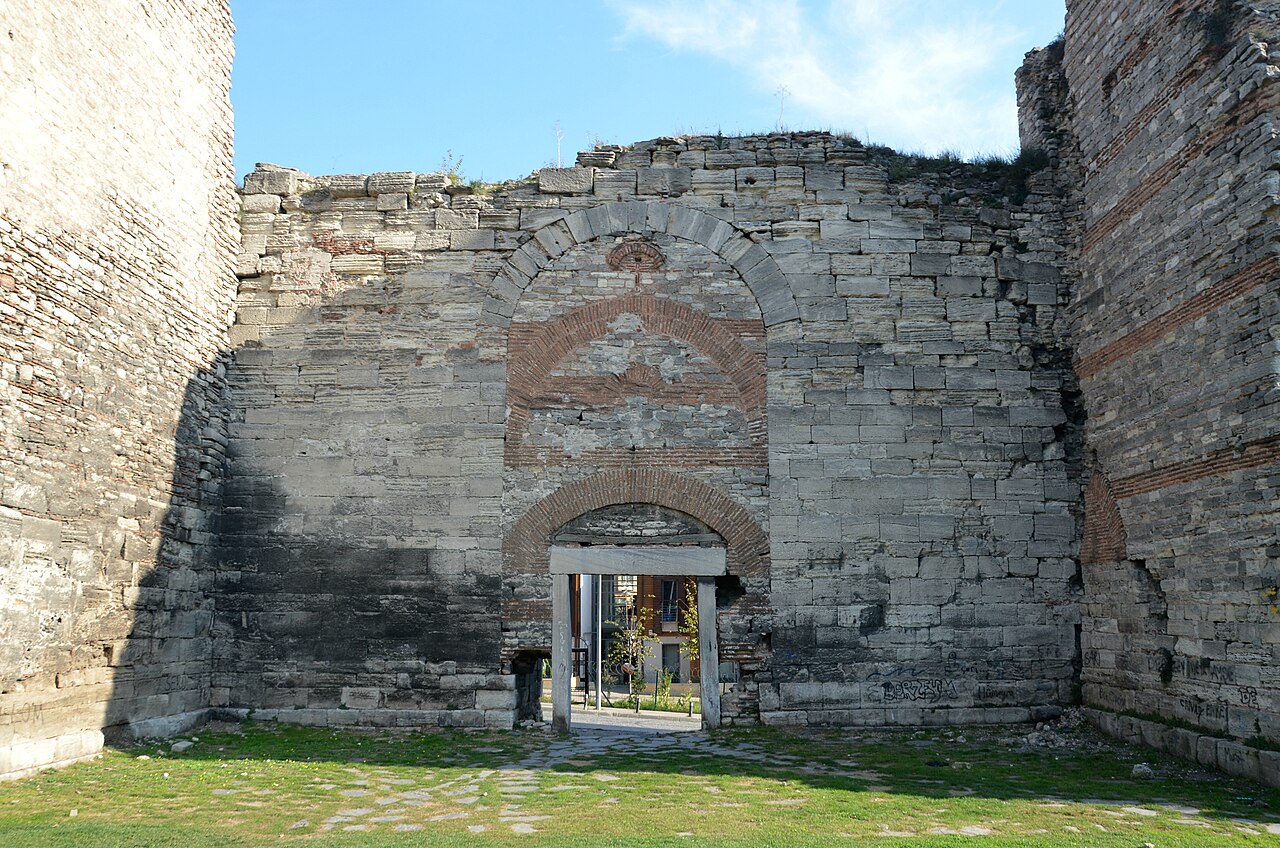

The defenders
Heraclius decided not to come back. He divided his forces, sending a body of troops to the capital, giving a second army to his brother Theodore to deal with Shahin and keeping the rest with him in the Caucasus, where he was negotiating with the Western Turks. Inside Constantinople the defence was led by the patrician Bonus, who governed for the young emperor Heraclius Constantine, and by the patriarch Sergius. Modern estimates put the garrison at around 12,000 soldiers plus the city’s own people; the attackers were many times more numerous, though the figures in the sources, up to 80,000, cannot be checked.
The siege, July and August 626
The Avar vanguard reached the walls at the end of June, and the khagan arrived with his main army on 29 July. The detailed day-by-day account in the Chronicon Paschale, a chronicle written in the city in the 630s, describes siege towers and catapults brought up against the Theodosian walls, with the heaviest pressure in the Lycus valley and near the church of the Virgin at Blachernae.
Persian envoys in the Avar camp
The Chronicon Paschale also gives a rare picture of the alliance at work. When Byzantine envoys went out to negotiate with the khagan, they found three Persian envoys, dressed in silk, seated in his tent while the Byzantines were made to stand. The khagan told them the city’s only choice was to surrender; the Persians across the water were ready to help him. On their way back, the chronicle says, the Persian envoys were intercepted at sea by the Byzantines.
The battle in the Golden Horn
The two armies could not combine as long as Byzantine warships controlled the Bosporus. The Avars had no fleet of their own, only the light dugout boats of their Slav subjects, and the plan was to use these to ferry Persian troops from the Asian shore. On 7 August, at a signal from the Avar side, the Slav boats moved out in the Golden Horn and along the Bosporus. The Byzantines, who had learned of the signal, struck first. Bonus’ ships rammed and sank the boats, and the shore was strewn with bodies. The Avar land assault the same day also failed, and on 8 August the khagan burned his siege engines and withdrew.
Shahrbaraz on the far shore
Shahrbaraz had watched all this from Chalcedon. His army was strong enough to besiege the Asian suburbs but not to cross the strait, and there is no sign that it fought seriously in the siege. Byzantine writers of the time could not believe that a general of his reputation had simply stood by, and later sources suggest that by now he had his own reasons for caution. A famous story in the chronicle of Theophanes and in Arabic sources says that the Byzantines intercepted, or forged, a letter from Khosrow ordering Shahrbaraz’s death, and that the general’s loyalty broke as a result. Historians differ over when this happened and whether the letter was real. Shahrbaraz’s career, and his later deal with Heraclius, are told on Shahrbaraz, the general who became king.
The same summer Theodore defeated Shahin’s army in Mesopotamia. The Persian strategy of 626 had failed on both fronts.
A miracle of the Virgin
For the people of Constantinople the victory was a miracle. During the siege Sergius led processions with icons of Christ and the Virgin along the walls, and Theodore Syncellus, in a sermon delivered on the first anniversary of the deliverance, gave the credit to the Mother of God, whose church at Blachernae had been in the thick of the fighting. Byzantine tradition later linked the liberation of the city with the Akathist Hymn to the Virgin, still sung in the Orthodox Church, though the link may belong to a later siege as well.
Why the siege matters for Iran
Constantinople’s survival meant that Khosrow could not win the war by a single blow, and it left Heraclius free to strike into Mesopotamia. Within eighteen months Heraclius, with Turkish allies, had won at Nineveh, and Khosrow had been overthrown by his own son. The failure of 626 was also the beginning of the break between Khosrow and his most famous general, which helped plunge Iran into the civil wars of 628–632. For the Turks’ part in the war, see the Sasanians and the Western Turks.
- c. 615 A Persian army first reaches Chalcedon
- Spring 626 Shahrbaraz marches across Asia Minor
- Late June 626 Avar vanguard at the walls
- 29 July 626 The Avar khagan arrives; assaults begin
- 7 August 626 Slav boats destroyed; land assault fails
- 8 August 626 The Avars withdraw
- December 627 Battle of Nineveh
Persian words from this page
| قسطنطنیه | Ghostantaniyeh | Constantinople |
| شهربراز | Shahrbarâz | Shahrbaraz |
| خسرو پرویز | Khosrow Parviz | Khosrow II |
| بسفر | Bosfor | the Bosporus |
| محاصره | mohâsereh | siege |
| ناوگان | nâvgân | fleet |
Sources and further reading
- Chronicon Paschale 284–628 AD, trans. Michael Whitby and Mary Whitby (Liverpool University Press, 1989).
- Theodore Syncellus, homily on the siege of 626 (Greek text ed. L. Sternbach, 1900).
- George of Pisidia, Bellum Avaricum (poem on the Avar war).
- James Howard-Johnston, “The Siege of Constantinople in 626”, in Constantinople and its Hinterland, ed. C. Mango and G. Dagron (Variorum, 1995).
- Walter E. Kaegi, Heraclius, Emperor of Byzantium (Cambridge University Press, 2003).
Want to learn Persian? Get the free Starter Pack
Get the 14-page printable Starter Pack (all 32 letters, a 7-day reading plan, 100 core words and 20 survival phrases) and a short 5-email course. Free.
More in The Sasanian Empire (224–651 CE)
- The Origins of the Sasanian Family
- Ardashir I, Founder of the Sasanian Empire
- Firuzabad: Ardashir’s Round City
- Shapur I, King of Kings of Iran and Non-Iran
- Bishapur: Shapur’s City
- The Battle of Edessa and the Capture of Valerian
- The Ka’ba-ye Zartosht Inscription of Shapur I
- Mani and Manichaeism
- Hormizd I and Bahram I
- Kartir and the Zoroastrian Church
- Bahram II
- Narseh and the Peace of Nisibis
- Shapur II the Great
- Julian’s Invasion of Persia (363)
- Christians in the Sasanian Empire
- Shapur III and the Partition of Armenia
- Yazdegerd I
- Bahram V Gur
- Yazdegerd II
- The Battle of Avarayr (451)
- The Hephthalites and Iran’s Eastern Frontier
- Peroz I and the Hephthalite Disaster
- Kavad I
- Zamasp and Kavad’s Return
- Mazdak and the Mazdakite Movement
- Khosrow I Anushirvan the Just
- The Sasanian–Byzantine Wars of the 6th Century
- The Battle of Dara (530)
- Khosrow I Sacks Antioch (540)
- The Lazic War (541–562)
- The Reforms of Khosrow I
- The Academy of Gondishapur: History and Legend
- Borzuya, Chess and Kalila wa Dimna
- Taq Kasra: The Arch of Ctesiphon
- The Sasanian Conquest of Yemen
- The Sasanians and the Western Turks
- Hormizd IV
- Bahram Chobin’s Rebellion
- Khosrow II Parviz
- The Last Great War: Byzantium and Persia, 602–628
- The Siege of Constantinople (626)
- Heraclius Strikes Back
- Shirin: Queen and Legend
- Shahrbaraz, the General Who Became King
- Civil War and the Queens Boran and Azarmidokht
- Yazdegerd III, the Last Sasanian King
- The Sasanian Army
- Sasanian Society and the Class System
- Zoroastrianism under the Sasanians
- Sasanian Art: Silver, Reliefs and Silk
- The Sasanian Reliefs of Naqsh-e Rostam
- Taq-e Bostan
- Sasanian Cities, Palaces and Bridges
- Middle Persian (Pahlavi) Language and Literature
- Sasanian Coins and Silverwork
- Women in the Sasanian Empire
- Polo, Hunting and Games at the Sasanian Court
- The Sasanian Legacy