Yazdegerd II ruled the Sasanian Empire from 439 to 457 CE. Son of Bahram V Gur, he spent much of his reign campaigning on the north-eastern frontier from a base at Nishapur, and he pursued a firmer Zoroastrian policy than his predecessors, which led to the persecution of Christians and Jews and to the great Armenian revolt of 451.
| Reign | 439–457 CE |
|---|---|
| Father | Bahram V Gur (r. 420/421–439) |
| Chief minister | Mihr-Narseh, the wuzurg framadar |
| Wars | Brief war with Rome (440–441); long campaigns against Hunnic peoples in the north-east |
| Armenia | Revolt and Battle of Avarayr (451) |
| Coinage | New legend linking the king to the legendary Kayanids |
| Successors | His sons Hormizd III and Peroz, who fought over the throne |
Heir to Bahram Gur
Yazdegerd inherited the throne from a father who became the most loved king of Persian legend, the hunter and lover Bahram Gur. The son left a very different reputation. Arabic and Persian histories, drawing on Sasanian court tradition, describe a serious, self-controlled ruler who avoided his father’s pleasures and cared for the welfare of his subjects. Some later writers call him “Yazdegerd the Gentle”. Christian and Jewish sources remember the same reign as a time of hardship. The contrast says much about who wrote the record.
A short war with Rome
In 440, early in his reign, Yazdegerd attacked the Roman frontier in Mesopotamia and Armenia. The Romans, under Theodosius II, were then threatened by the Vandals in the west and the Huns of Attila in the Balkans, and they quickly negotiated. A truce in 441 restored peace, and the two powers agreed not to build new fortresses near the border. The war barely changed the frontier, but it freed Yazdegerd to turn east.
Nishapur and the eastern frontier
The main military story of the reign was in Khorasan. Hunnic peoples, the Kidarites and then the groups that would become the Hephthalites, pressed on the frontier beyond Merv. Yazdegerd made Nishapur (نیشابور) his headquarters and fought there for years, with campaigns still under way in the early 450s. The Byzantine historian Priscus reports that in the 450s the Persians were at war with the “Kidarite Huns” over tribute the Persians refused to pay. The details of these campaigns are poorly known, and modern historians differ on which enemy was which. The longer story is told in the Hephthalites and Iran’s eastern frontier.
The long stay in the east seems to have shaped how Yazdegerd saw his own kingship.

Kings in the line of the Kayanids
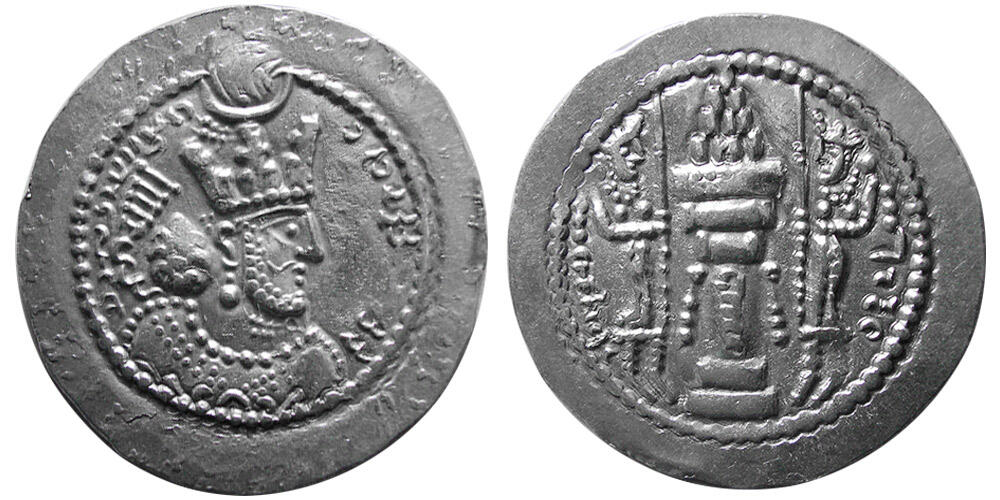
From Yazdegerd’s reign, Sasanian coins carry a new legend that calls the king kay, the title of the Kayanids, the legendary royal dynasty of the Avesta to which heroes such as Kay Khosrow and Kay Vishtasp (Goshtasp), the patron of Zoroaster, belonged. Their stories were set largely in the east, the region where Yazdegerd spent his campaigns. The coins also introduced a new reverse in which the two attendants at the fire altar stand in reverence. Historians such as Touraj Daryaee read these changes as part of a deliberate ideology: the Sasanian king presented as heir to the sacred kings of Iranian tradition. The same trend appears in the later Book of Kings tradition, in which the Kayanids form the bridge between mythical and historical Iran.
Religion and the state
Yazdegerd’s chief minister was Mihr-Narseh, who held the office of wuzurg framadar, roughly grand vizier, under three kings. He was a devout Zoroastrian and a founder of fire temples, and he is closely associated with the religious policy of the reign.
Christians
The Church of the East had been organised at the Synod of 410 under Yazdegerd I, but tolerance had already broken down at the end of that king’s reign. Under Yazdegerd II, according to Syriac sources, Christians were expelled from the army in the mid-440s, and there were martyrdoms in northern Mesopotamia, including a massacre at Karka d-Beth Slokh (modern Kirkuk), traditionally dated to 446. See Christians in the Sasanian Empire for the longer picture.
Jews
Jewish sources from Babylonia remember a decree around 455 that forbade the public observance of the Sabbath. Further pressure on the Jewish community followed under Peroz.
Armenia
In Armenia, where the nobility had been Christian for more than a century, Mihr-Narseh sent a letter, preserved by the Armenian historian Elishe, urging the nobles to accept the “Mazdean religion”. The Armenian church council refused, and Yazdegerd summoned the leading nobles to court, where some agreed to convert. When they returned, a revolt broke out under Vardan Mamikonian. It ended at the Battle of Avarayr in 451, a Persian victory followed by years of resistance, imprisonment and exile.
Why so firm a policy
Historians explain the policy in different ways. One view stresses religious zeal at court, led by Mihr-Narseh and the priests. Another, argued by Daryaee among others, sees it as part of a wider effort to centralise the empire: the Christians of the west, the Armenian nobles and the great Iranian families were all centres of power outside the king’s control, and a shared state religion was a way to bind them. The two explanations are not exclusive. What is clear is that the policy was costly. It made Armenia rebellious for a generation.
Death and a disputed succession
Yazdegerd II died in 457. His sons Hormizd III and Peroz both claimed the throne. Hormizd held it first, but Peroz, with the help of the Hephthalites, defeated him and became king in 459. The debt to the steppe powers would cost Iran dearly, as the page on Peroz I and the Hephthalite disaster shows.
Persian words from this page
| یزدگرد | Yazdgerd | Yazdegerd |
| نیشابور | Neyshâbur | Nishapur |
| کیانیان | Kiyâniyân | the Kayanids |
| کیخسرو | Keykhosrow | Kay Khosrow |
| مرو | Marv | Merv |
| پیروز | Piruz | Peroz |
Sources and further reading
- Elishe, History of Vardan and the Armenian War, trans. R. W. Thomson (1982)
- Al-Tabari, The History of al-Tabari, vol. 5, trans. C. E. Bosworth (1999)
- Priscus, fragments of his History (on the Kidarites)
- Touraj Daryaee, “Yazdegerd II”, Encyclopaedia Iranica (iranicaonline.org)
- Touraj Daryaee, Sasanian Persia: The Rise and Fall of an Empire (2009)
Want to learn Persian? Get the free Starter Pack
Get the 14-page printable Starter Pack (all 32 letters, a 7-day reading plan, 100 core words and 20 survival phrases) and a short 5-email course. Free.
More in The Sasanian Empire (224–651 CE)
- The Origins of the Sasanian Family
- Ardashir I, Founder of the Sasanian Empire
- Firuzabad: Ardashir’s Round City
- Shapur I, King of Kings of Iran and Non-Iran
- Bishapur: Shapur’s City
- The Battle of Edessa and the Capture of Valerian
- The Ka’ba-ye Zartosht Inscription of Shapur I
- Mani and Manichaeism
- Hormizd I and Bahram I
- Kartir and the Zoroastrian Church
- Bahram II
- Narseh and the Peace of Nisibis
- Shapur II the Great
- Julian’s Invasion of Persia (363)
- Christians in the Sasanian Empire
- Shapur III and the Partition of Armenia
- Yazdegerd I
- Bahram V Gur
- Yazdegerd II
- The Battle of Avarayr (451)
- The Hephthalites and Iran’s Eastern Frontier
- Peroz I and the Hephthalite Disaster
- Kavad I
- Zamasp and Kavad’s Return
- Mazdak and the Mazdakite Movement
- Khosrow I Anushirvan the Just
- The Sasanian–Byzantine Wars of the 6th Century
- The Battle of Dara (530)
- Khosrow I Sacks Antioch (540)
- The Lazic War (541–562)
- The Reforms of Khosrow I
- The Academy of Gondishapur: History and Legend
- Borzuya, Chess and Kalila wa Dimna
- Taq Kasra: The Arch of Ctesiphon
- The Sasanian Conquest of Yemen
- The Sasanians and the Western Turks
- Hormizd IV
- Bahram Chobin’s Rebellion
- Khosrow II Parviz
- The Last Great War: Byzantium and Persia, 602–628
- The Siege of Constantinople (626)
- Heraclius Strikes Back
- Shirin: Queen and Legend
- Shahrbaraz, the General Who Became King
- Civil War and the Queens Boran and Azarmidokht
- Yazdegerd III, the Last Sasanian King
- The Sasanian Army
- Sasanian Society and the Class System
- Zoroastrianism under the Sasanians
- Sasanian Art: Silver, Reliefs and Silk
- The Sasanian Reliefs of Naqsh-e Rostam
- Taq-e Bostan
- Sasanian Cities, Palaces and Bridges
- Middle Persian (Pahlavi) Language and Literature
- Sasanian Coins and Silverwork
- Women in the Sasanian Empire
- Polo, Hunting and Games at the Sasanian Court
- The Sasanian Legacy