Between 622 and 628 the Byzantine emperor Heraclius turned a losing war into victory by striking past the Persian armies in Syria and Egypt into the Caucasus, Azerbaijan and finally Mesopotamia. With Turkish allies he defeated the Sasanian army at Nineveh in December 627 and sacked Khosrow II’s palace at Dastagerd. The defeat led directly to Khosrow’s overthrow and death in February 628 and to a peace that returned all the Persian conquests.
| Dates | Spring 622 to spring 628 CE |
|---|---|
| Byzantine commander | Emperor Heraclius in person |
| Persian commanders | Shahrbaraz, Shahin, Shahraplakan, Rahzad |
| Allies | Heraclius: Western Turks (Göktürks) and Caucasian peoples; Khosrow: the Avars in Europe |
| Decisive battle | Nineveh, near modern Mosul, 12 December 627 |
| Outcome | Khosrow II deposed; peace with Kavad II in 628; True Cross returned to Jerusalem in 630 |
A new strategy
By 621 the Sasanians held Egypt, Palestine, Syria and much of eastern Asia Minor. The Byzantine state had lost its richest provinces and most of its tax revenue, and the Avars threatened Constantinople from the Balkans. Heraclius’ answer was to avoid the Persian armies of occupation and attack the Sasanian homeland instead, forcing Khosrow to recall his generals.
To pay for it, the Church lent its treasures, which were melted down for coin. In April 622, after Easter, Heraclius left Constantinople and spent the summer training his army in Asia Minor. In the autumn he outmanoeuvred Shahrbaraz and won a victory in the mountains of eastern Anatolia. It was the first Byzantine success in the field in years.
The march into Iran, 624
After a pause forced by the Avars, who nearly captured him at a meeting in 623, Heraclius set out again in March 624. This time he went east through Armenia, took Dvin and Nakhchivan, and entered Azerbaijan, the province of the Sasanians’ holiest fire.
Khosrow was at Ganzak and withdrew before him. Heraclius pressed on to the great fire temple of Adur Gushnasp at the site now called Takht-e Soleyman, a shrine to which, according to later tradition, new Sasanian kings came on foot to pray. The Byzantines destroyed it, in revenge, their writers said, for the sack of Jerusalem. The sacred fire had been taken away in time. The meaning of the attack was clear to both sides: the war had become a religious one. See Zoroastrianism under the Sasanians.

Three Persian armies, 625
Heraclius spent the winter in Caucasian Albania. In 625 Khosrow sent three armies against him, under Shahrbaraz, Shahin and Shahraplakan. Heraclius fought them one at a time, moving fast through the valleys of the Caucasus and eastern Anatolia, and beat them in turn. Later that year he crossed back into Asia Minor and fought Shahrbaraz again at the river Sarus in Cilicia, a hard battle that let him return to winter near the Black Sea.
The siege of Constantinople and the Turkish alliance, 626
Khosrow’s reply was a blow at the capital. In 626 Shahrbaraz marched across Asia Minor to Chalcedon while the Avars and Slavs besieged Constantinople from the European side. Heraclius did not return. He sent part of his army to the city and kept the rest in the east. The Avar assault failed in August, and the Persian army on the Asian shore could not cross the Bosporus because the Byzantine fleet controlled the strait. Meanwhile, Heraclius’ brother Theodore defeated Shahin’s army. The siege has its own page: the siege of Constantinople (626).
Heraclius spent 626 building an alliance with the Western Turks, whose ruler is called Ziebel in the Byzantine chronicle of Theophanes and is usually identified with the Turkish leader Tong Yabghu. In 627 a Turkish army broke through the Caspian Gates at Derbent and joined Heraclius before Tiflis in Georgia. The Turks soon went home, but the alliance tied down Persian forces in the north and gave Heraclius fresh troops. Read more in the Sasanians and the Western Turks.
Nineveh, 12 December 627
In September 627 Heraclius turned south, crossed the Zagros and entered Assyria, the plain of the upper Tigris, in winter, when no one expected an army to march. Khosrow’s general Rahzad followed him with a new army. The armies met near the ruins of ancient Nineveh, opposite modern Mosul, on 12 December. The battle lasted all day. Byzantine sources say Heraclius killed Rahzad in single combat; whatever the details, the Persian commander was killed and his army broken, though not destroyed.
Heraclius moved down the Tigris towards Ctesiphon. In early January 628 he reached Dastagerd, Khosrow’s favourite residence, which the king had abandoned days before. The Byzantines plundered the palace and its park, found treasures and exotic animals, freed prisoners and, the chronicles say, recovered some 300 Roman standards taken in earlier wars. Finding the bridges on the Nahrawan canal destroyed and Ctesiphon defended, Heraclius did not attack the capital. He withdrew north to Ganzak and waited.
The fall of Khosrow and the peace
He did not have to wait long. Khosrow, refusing to negotiate, was overthrown in February 628 by his son Kavad II with the support of the nobility, and put to death. The great general Shahrbaraz, whom Khosrow had reportedly ordered killed, had already stopped obeying the king. Kavad sent envoys to Heraclius and accepted peace on the basis of the old frontier, the return of prisoners and the return of the True Cross.
Kavad died within months. The evacuation of Egypt and Syria was negotiated with Shahrbaraz, who met Heraclius at Arabissus in Asia Minor in 629 and withdrew his troops in return for Byzantine support for his own bid for the throne. On 21 March 630, according to the usual dating, Heraclius brought the True Cross back into Jerusalem. What followed in Iran is told in civil war and the queens Boran and Azarmidokht.
Victory and its afterlife
Heraclius’ campaigns are among the most daring in late Roman history: an emperor marching his army for years far from his capital, deep in enemy land, living off the country. Historians debate how far he planned all this from the start and how far he improvised. Some, following George of Pisidia’s poems, have called the war a holy war or even a forerunner of the crusades; others stress its traditional aims of tribute, territory and the king’s overthrow.
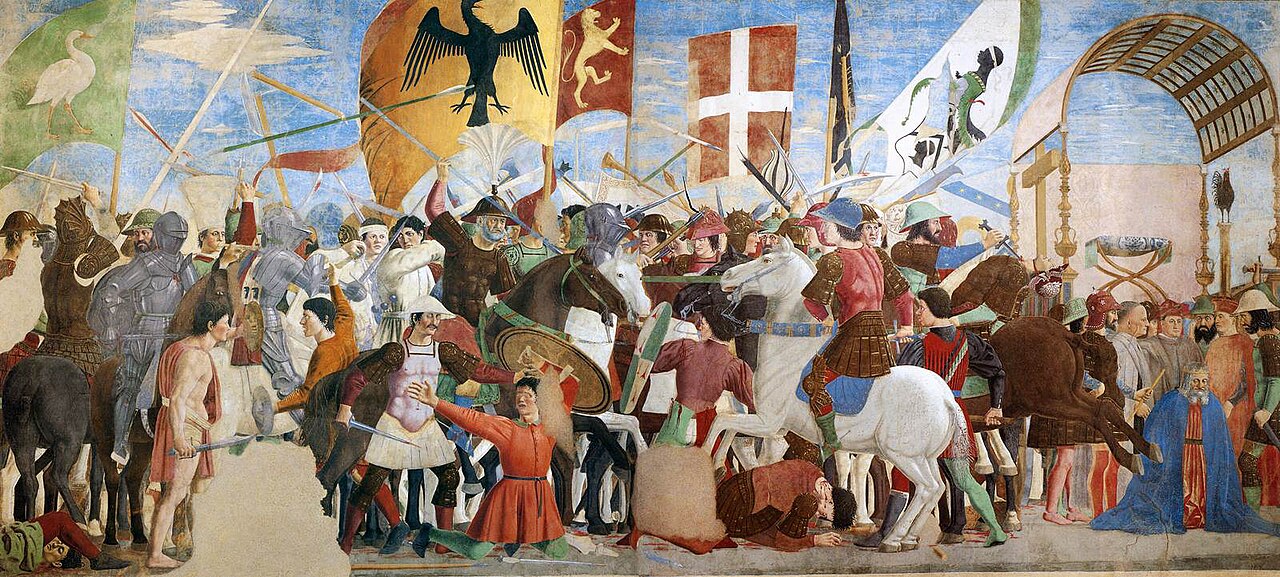
In medieval Europe the war became part of the Legend of the True Cross, in which Heraclius defeats and beheads a blasphemous Chosroes, an invented ending. It is that legend, not the history, that Piero della Francesca painted in the 15th century. Within a decade of the victory, Arab armies had taken Syria and Egypt from Byzantium and were advancing into Iran; see the overview of the war of 602–628.
Persian words from this page
| هراکلیوس | Herâkliyus | Heraclius |
| آذرگشنسپ | Âzar Goshnasp | Adur Gushnasp, the royal fire |
| تخت سلیمان | Takht-e Soleymân | Takht-e Soleyman |
| نینوا | Neynavâ | Nineveh |
| دستگرد | Dastgerd | Dastagerd |
| صلیب | salib | cross |
Sources and further reading
- The Chronicle of Theophanes Confessor, trans. Cyril Mango and Roger Scott (Oxford, 1997), entries for 622–628.
- The Armenian History attributed to Sebeos, trans. R. W. Thomson and James Howard-Johnston (Liverpool University Press, 1999).
- Walter E. Kaegi, Heraclius, Emperor of Byzantium (Cambridge University Press, 2003).
- James Howard-Johnston, The Last Great War of Antiquity (Oxford University Press, 2021).
- Geoffrey Greatrex and Samuel N. C. Lieu, The Roman Eastern Frontier and the Persian Wars, Part II: AD 363–630 (Routledge, 2002).
Want to learn Persian? Get the free Starter Pack
Get the 14-page printable Starter Pack (all 32 letters, a 7-day reading plan, 100 core words and 20 survival phrases) and a short 5-email course. Free.
More in The Sasanian Empire (224–651 CE)
- The Origins of the Sasanian Family
- Ardashir I, Founder of the Sasanian Empire
- Firuzabad: Ardashir’s Round City
- Shapur I, King of Kings of Iran and Non-Iran
- Bishapur: Shapur’s City
- The Battle of Edessa and the Capture of Valerian
- The Ka’ba-ye Zartosht Inscription of Shapur I
- Mani and Manichaeism
- Hormizd I and Bahram I
- Kartir and the Zoroastrian Church
- Bahram II
- Narseh and the Peace of Nisibis
- Shapur II the Great
- Julian’s Invasion of Persia (363)
- Christians in the Sasanian Empire
- Shapur III and the Partition of Armenia
- Yazdegerd I
- Bahram V Gur
- Yazdegerd II
- The Battle of Avarayr (451)
- The Hephthalites and Iran’s Eastern Frontier
- Peroz I and the Hephthalite Disaster
- Kavad I
- Zamasp and Kavad’s Return
- Mazdak and the Mazdakite Movement
- Khosrow I Anushirvan the Just
- The Sasanian–Byzantine Wars of the 6th Century
- The Battle of Dara (530)
- Khosrow I Sacks Antioch (540)
- The Lazic War (541–562)
- The Reforms of Khosrow I
- The Academy of Gondishapur: History and Legend
- Borzuya, Chess and Kalila wa Dimna
- Taq Kasra: The Arch of Ctesiphon
- The Sasanian Conquest of Yemen
- The Sasanians and the Western Turks
- Hormizd IV
- Bahram Chobin’s Rebellion
- Khosrow II Parviz
- The Last Great War: Byzantium and Persia, 602–628
- The Siege of Constantinople (626)
- Heraclius Strikes Back
- Shirin: Queen and Legend
- Shahrbaraz, the General Who Became King
- Civil War and the Queens Boran and Azarmidokht
- Yazdegerd III, the Last Sasanian King
- The Sasanian Army
- Sasanian Society and the Class System
- Zoroastrianism under the Sasanians
- Sasanian Art: Silver, Reliefs and Silk
- The Sasanian Reliefs of Naqsh-e Rostam
- Taq-e Bostan
- Sasanian Cities, Palaces and Bridges
- Middle Persian (Pahlavi) Language and Literature
- Sasanian Coins and Silverwork
- Women in the Sasanian Empire
- Polo, Hunting and Games at the Sasanian Court
- The Sasanian Legacy