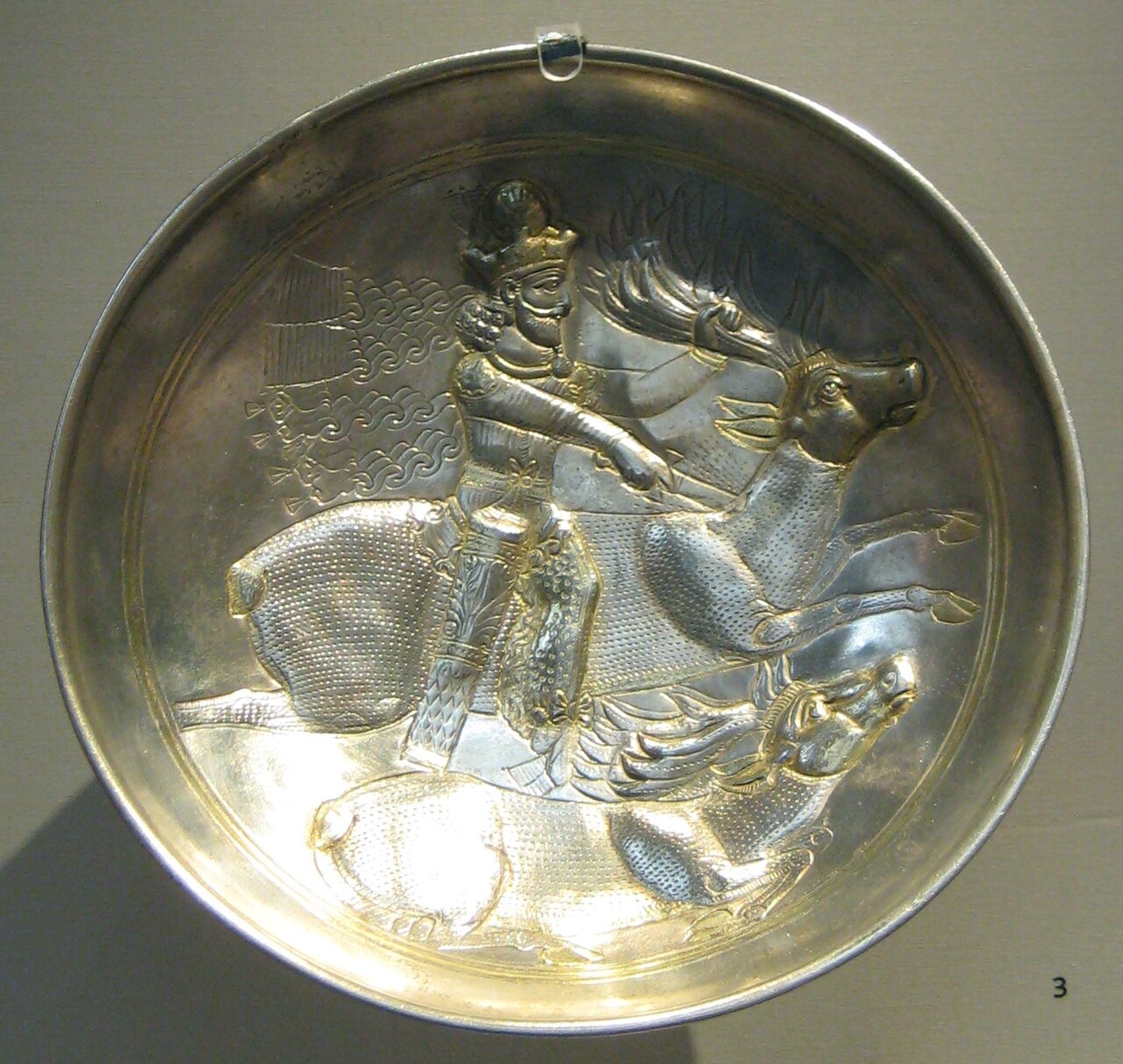
Shapur II (309 to 379 CE), called “the Great”, reigned for seventy years, longer than any other Sasanian king. Proclaimed king as an infant, he led a punitive war into Arabia as a teenager, fought Rome for a quarter of a century, held off nomad invaders in the east and, after the death of the emperor Julian in 363, won back everything his grandfather Narseh had lost.
| Reign | 309 to 379 CE |
|---|---|
| Father | Hormizd II (r. 302/303 to 309) |
| Epithets | “The Great”; in Arabic tradition Dhu’l-Aktaf, “he of the shoulders” |
| Main wars | Arabia (c. 325); Rome (337 to 363); Chionites and Kushans in the east (350s); Armenia (360s to 370s) |
| Key treaty | Peace with Jovian, 363: Nisibis, Singara and five regions beyond the Tigris returned to Iran |
| Successor | His half-brother Ardashir II |
The king crowned in the womb
When Hormizd II died in 309, the nobles set aside his adult sons. One was killed, another blinded, and a third, also named Hormizd, later escaped to the Roman Empire. They chose instead a baby, perhaps not yet born. Al-Tabari tells the famous story that the crown was placed on the belly of the pregnant queen. Whether or not that happened, the choice shows the power of the great families, who preferred a long regency to a strong adult king. For the first sixteen years of Shapur’s life, Iran was ruled in his name by the nobility and the court.
The Arab war
Around 325, when Shapur was about sixteen, he took personal command for the first time. Arab tribes from eastern Arabia had been raiding across the Persian Gulf into Fars and the lower Euphrates. According to al-Tabari, Shapur crossed the Gulf with a fleet, attacked Bahrain and the coast of eastern Arabia, and pushed inland as far as Yamama and even the approaches to Medina, killing large numbers of tribesmen. Arabic tradition gave him the nickname Dhu’l-Aktaf, said to come from his practice of piercing or dislocating the shoulders of captives, though the name may originally have meant something less grim, such as “broad-shouldered”.
To protect the Mesopotamian frontier from future raids, he is credited with building a line of ditches and forts west of the Euphrates, remembered in Arabic as the Khandaq Sabur, “Shapur’s trench”.

Twenty-five years of war with Rome
Shapur considered the Peace of Nisibis of 299 a humiliation (see Narseh and the Peace of Nisibis). After Constantine the Great died in 337, while preparing his own campaign against Persia, Shapur began a long war with Constantine’s son Constantius II.
The sieges of Nisibis
The fortress city of Nisibis, the key to Roman Mesopotamia, was Shapur’s main target. He besieged it three times, in 337 or 338, in 346 and in 350, and failed each time. In the last siege he dammed the river Mygdonius and released the water against the walls, bringing down part of them, but the defenders rebuilt the breach overnight. The Syriac poet and theologian Ephrem was in the city, and his hymns are among our sources. Persian and Roman armies also fought a hard night battle at Singara in 344 (some date it 348), which neither side clearly won.
The eastern front
In the 350s Shapur had to break off the Roman war to deal with the Chionites and other nomad peoples on his eastern frontier, in the old Kushan lands. He fought them for several years and then made them allies. In 359 their king, Grumbates, marched west with Shapur when he invaded Roman Mesopotamia again.
Amida, 359
The siege of Amida (modern Diyarbakır) is the best-described siege of antiquity, because the Roman officer and historian Ammianus Marcellinus was inside the walls. He describes how the son of Grumbates was killed by a Roman bolt early in the siege, how the Persians built siege mounds and brought up elephants, and how the city fell after 73 days. Ammianus escaped through a postern gate. Shapur went on to take Singara and Bezabde in 360. The costly victory, however, delayed his advance, and the decisive confrontation came only three years later.
Julian and the treaty of 363
In 363 the emperor Julian invaded Persia with a large army and reached the walls of Ctesiphon, but failed to take it and was killed during the retreat. His successor Jovian, trapped with a starving army on the wrong side of the Tigris, accepted Shapur’s terms: the five regions beyond the Tigris, the cities of Nisibis and Singara, and Rome’s withdrawal of support for Armenia. It was a reversal of the treaty of 299. The full story is on Julian’s Invasion of Persia (363).
Armenia
With Rome out of the picture, Shapur turned on Armenia. He lured its king, Arshak II, to his court, imprisoned him in the “Fortress of Oblivion” in Khuzestan, where Arshak later died, and invaded the country. Armenian historians remember these years as a time of destruction, deportation and resistance. Rome soon broke the spirit of the treaty by supporting Arshak’s son Pap, and the question of Armenia was settled only after Shapur’s death, by the partition of 387 described on Shapur III and the Partition of Armenia.
Religion under Shapur II
Zoroastrian tradition remembers the reign as the time when the high priest Adurbad-i Mahraspandan defended the orthodox faith against its critics by undergoing an ordeal of molten metal poured on his chest, and when the religious canon was put in order. Historians treat the story of the ordeal as legend, but the period does seem to have been one of consolidation for the Zoroastrian church.
It was also the time of the first great persecution of Christians in Iran. After Constantine made Christianity a favoured religion of the Roman state, Persian Christians were suspected of sympathy with the enemy. From around 340 Shapur imposed a double tax on them and, when the bishop of Seleucia-Ctesiphon, Simeon bar Sabba’e, refused to collect it, had him executed. Persecution continued, with intervals, for decades. See Christians in the Sasanian Empire.
Shapur II in legend
The Shahnameh and Arabic histories turned Shapur II into a folk hero. In Ferdowsi’s version he travels to Rome in disguise to spy on the Caesar, is recognised, sewn into a donkey’s skin and imprisoned, and escapes with the help of a Roman slave girl, before returning to defeat the Romans. The tale has no historical basis but shows how his long struggle with Rome was remembered. Some of his deeds were also merged with those of his ancestor Shapur I.
Shapur II died in 379. In a small rock-cut grotto at Taq-e Bostan near Kermanshah, his figure stands beside that of his son Shapur III, with inscriptions naming them both.
- 309 Shapur proclaimed king as an infant
- c. 325 Campaign against the Arabs across the Persian Gulf
- 337/338 War with Rome begins; first siege of Nisibis
- c. 340 Persecution of Christians begins
- 346, 350 Second and third sieges of Nisibis
- 350s Wars with the Chionites in the east
- 359 Siege and capture of Amida
- 363 Julian’s invasion and death; treaty with Jovian
- 379 Death of Shapur II
Persian words from this page
| شاپور دوم | Shâpur-e dovvom | Shapur II |
| ذوالاکتاف | Zo’l-aktâf | “he of the shoulders” |
| تازی | tâzi | Arab (old Persian usage) |
| خلیج فارس | Khalij-e Fârs | Persian Gulf |
| قیصر | gheysar | Caesar, the Roman emperor |
| محاصره | mohâsere | siege |
Sources and further reading
- Ammianus Marcellinus, Res Gestae, Books 14–25 (especially Books 18–19 on the siege of Amida).
- Al-Tabari, The History of al-Tabari, vol. 5, trans. C. E. Bosworth (SUNY Press, 1999).
- Encyclopaedia Iranica, “Šāpur II” by A. Sh. Shahbazi.
- Michael H. Dodgeon and Samuel N. C. Lieu, The Roman Eastern Frontier and the Persian Wars, AD 226–363 (Routledge, 1991).
- Touraj Daryaee, Sasanian Persia: The Rise and Fall of an Empire (I.B. Tauris, 2009).
Want to learn Persian? Get the free Starter Pack
Get the 14-page printable Starter Pack (all 32 letters, a 7-day reading plan, 100 core words and 20 survival phrases) and a short 5-email course. Free.
More in The Sasanian Empire (224–651 CE)
- The Origins of the Sasanian Family
- Ardashir I, Founder of the Sasanian Empire
- Firuzabad: Ardashir’s Round City
- Shapur I, King of Kings of Iran and Non-Iran
- Bishapur: Shapur’s City
- The Battle of Edessa and the Capture of Valerian
- The Ka’ba-ye Zartosht Inscription of Shapur I
- Mani and Manichaeism
- Hormizd I and Bahram I
- Kartir and the Zoroastrian Church
- Bahram II
- Narseh and the Peace of Nisibis
- Shapur II the Great
- Julian’s Invasion of Persia (363)
- Christians in the Sasanian Empire
- Shapur III and the Partition of Armenia
- Yazdegerd I
- Bahram V Gur
- Yazdegerd II
- The Battle of Avarayr (451)
- The Hephthalites and Iran’s Eastern Frontier
- Peroz I and the Hephthalite Disaster
- Kavad I
- Zamasp and Kavad’s Return
- Mazdak and the Mazdakite Movement
- Khosrow I Anushirvan the Just
- The Sasanian–Byzantine Wars of the 6th Century
- The Battle of Dara (530)
- Khosrow I Sacks Antioch (540)
- The Lazic War (541–562)
- The Reforms of Khosrow I
- The Academy of Gondishapur: History and Legend
- Borzuya, Chess and Kalila wa Dimna
- Taq Kasra: The Arch of Ctesiphon
- The Sasanian Conquest of Yemen
- The Sasanians and the Western Turks
- Hormizd IV
- Bahram Chobin’s Rebellion
- Khosrow II Parviz
- The Last Great War: Byzantium and Persia, 602–628
- The Siege of Constantinople (626)
- Heraclius Strikes Back
- Shirin: Queen and Legend
- Shahrbaraz, the General Who Became King
- Civil War and the Queens Boran and Azarmidokht
- Yazdegerd III, the Last Sasanian King
- The Sasanian Army
- Sasanian Society and the Class System
- Zoroastrianism under the Sasanians
- Sasanian Art: Silver, Reliefs and Silk
- The Sasanian Reliefs of Naqsh-e Rostam
- Taq-e Bostan
- Sasanian Cities, Palaces and Bridges
- Middle Persian (Pahlavi) Language and Literature
- Sasanian Coins and Silverwork
- Women in the Sasanian Empire
- Polo, Hunting and Games at the Sasanian Court
- The Sasanian Legacy