Below the rock-cut tombs of the Achaemenid kings at Naqsh-e Rostam, near Persepolis in Fars, Sasanian kings of the 3rd and 4th centuries CE carved a series of eight large reliefs. They show the founder Ardashir I receiving his crown from the god Ohrmazd, Shapur I’s triumph over Roman emperors, and later kings in combat or with their courts, and together they form the most important single gallery of early Sasanian royal art.
| Place | Naqsh-e Rostam, about 6 km north-west of Persepolis, Fars |
|---|---|
| Date | c. 230s to 4th century CE |
| Kings shown | Ardashir I, Shapur I, Bahram II, Narseh, Hormizd II, perhaps Shapur II |
| Inscriptions | Ardashir’s trilingual labels; Kartir’s inscription; Shapur I’s great text on the Ka’ba-ye Zartosht |
| Older layers | An Elamite relief (c. 1000 BCE or earlier) and four Achaemenid tombs |
Why here
When Ardashir I overthrew the last Parthian king in 224, he was a regional ruler from Istakhr, a few kilometres away. Naqsh-e Rostam was already ancient: the cliff held the tombs of Darius I and three later Achaemenid kings, and an Elamite relief far older still. By carving his own image beneath them, Ardashir placed the new dynasty in a landscape of past kingship, whether or not he knew exactly who the Achaemenids had been. His successors kept adding to the cliff for about a century.
The site’s modern name, “picture of Rostam”, comes from later local belief that the carvings showed the hero of the Shahnameh. For the Achaemenid tombs, see the places page on Naqsh-e Rostam, which also covers visiting.
The reliefs one by one
1. The investiture of Ardashir I
The earliest Sasanian relief at the site shows two riders facing each other. On the right, the god Ohrmazd holds out a beribboned ring, the symbol of kingship; on the left, Ardashir reaches to take it. Under the hooves of Ohrmazd’s horse lies Ahriman, the evil spirit, with snakes in his hair; under Ardashir’s lies the defeated Parthian king Ardavan IV. The meaning is plain: the victory over the Parthians mirrors the god’s victory over evil. Short labels on the horses, in Middle Persian, Parthian and Greek, name the figures. It is one of the earliest Sasanian investiture scenes and the model for many later ones (see Ardashir I).
2. Shapur I’s triumph over Rome
The most famous relief shows Shapur I on horseback. A Roman in a cloak kneels before him, and the king grips the wrist of a standing Roman. They are usually identified as Philip the Arab, who paid for peace in 244, and Valerian, captured in 260. The scene compresses twenty years of victories into one image. Its history and the debate over the figures are told on the page on the Battle of Edessa and the capture of Valerian.
3. Bahram II and his court
Bahram II had part of the old Elamite relief cut away and replaced with a frontal figure of himself, hands on a long sword, flanked by family members and nobles shown from the chest up. Traces of the Elamite carving survive at the edges. See Bahram II for this king’s unusual family-centred art.
4 and 5. Equestrian combats below the tombs
Below the tomb usually assigned to Darius II, and below that of Darius I, are three jousting scenes in two reliefs: a Sasanian king on horseback driving his lance into a mounted enemy. Below Darius I’s tomb two such scenes are stacked one above the other. Many scholars attribute them to Bahram II, fighting a Roman in one panel and an eastern enemy in another, but the attributions rest on crown shapes and are debated. These combat reliefs were new in Sasanian art and reflect the importance of the heavily armoured cavalryman.
6. The investiture of Narseh
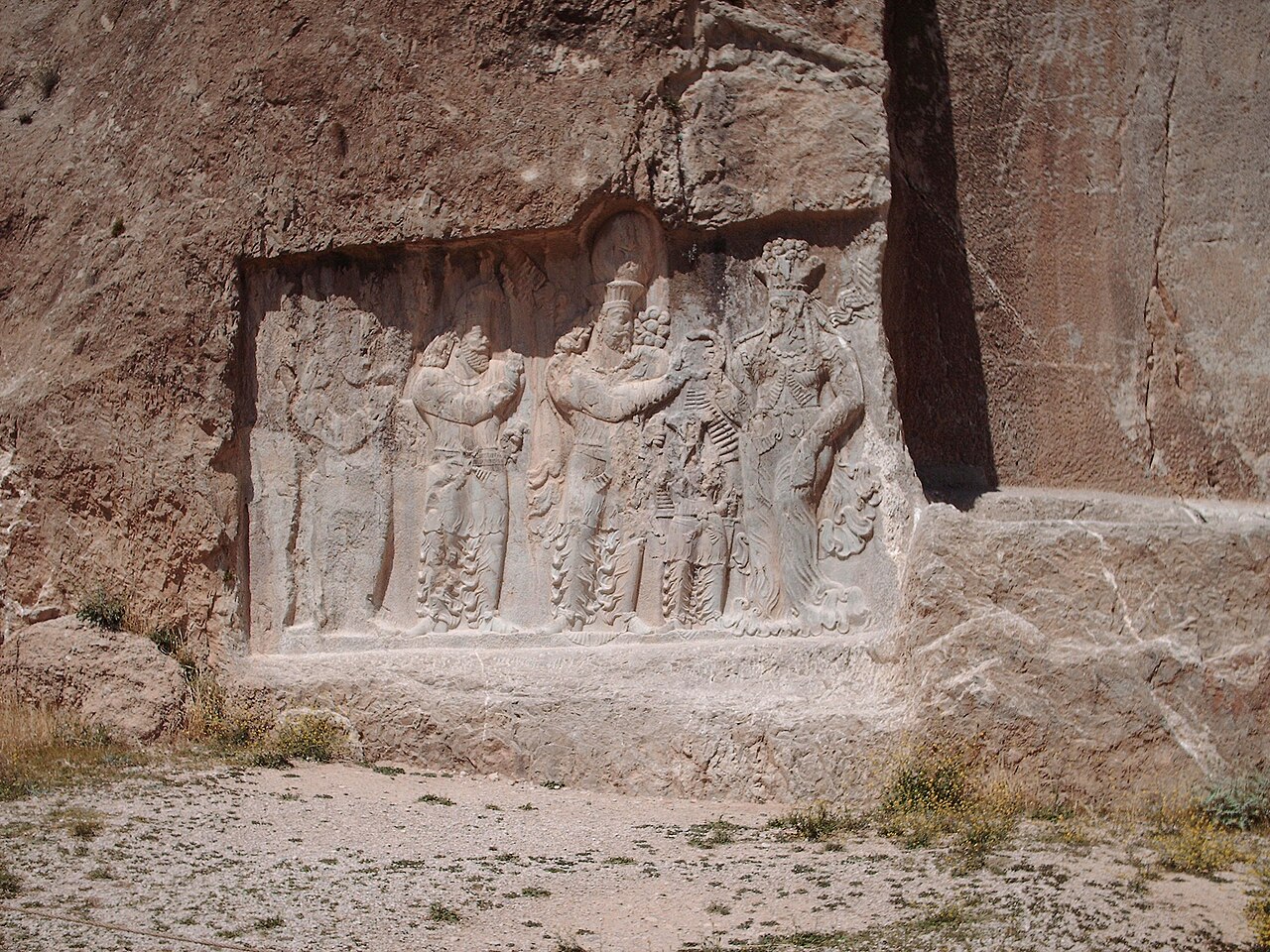
Narseh, who seized the throne in 293, is shown standing to receive the ring of kingship not from Ohrmazd but from a woman wearing a crown, usually identified as the goddess Anahita. Since the Sasanian family had served at the Anahita temple of Istakhr, this choice may stress Narseh’s claim to the family’s traditions after the line of Bahram I. A smaller figure behind him may be his heir.
7. Hormizd II unhorsing an enemy
Below one of the tombs, a king identified as Hormizd II (r. 303–309) knocks an enemy from his horse with his lance. The enemy has not been securely identified; one suggestion is an Armenian prince named Papak. As with the other jousts, the scene is about personal valour.
8. A damaged late relief
A badly worn relief, sometimes attributed to Shapur II, appears to be the last royal carving at the site. After the 4th century kings stopped carving reliefs in Fars; the later monuments of Taq-e Bostan are in the west, near Kermanshah.

Inscriptions on the cliff
The reliefs are not the only Sasanian marks at Naqsh-e Rostam. Opposite the tombs stands the Achaemenid stone tower known as the Ka’ba-ye Zartosht, on whose walls Shapur I had his long trilingual account of his wars inscribed (see the Ka’ba-ye Zartosht inscription). Later the priest Kartir added his own Middle Persian text to the same building, and another version on the cliff. Few sites anywhere combine royal images and royal texts so closely.
Carving and style
The early reliefs are carved in high relief on prepared panels of the cliff face. Figures are large, the king often the tallest, and details such as ribbons, crowns, beards and the folds of trousers are rendered with care. Crowns matter most for historians: each Sasanian king had his own crown, known from coins, and it is mainly by matching crowns that modern scholars identify who is who. Where the crowns are worn or the king may have reused an older design, identifications become uncertain.
Naqsh-e Rajab nearby
A short distance away, in a small rock recess called Naqsh-e Rajab, are four more early Sasanian reliefs: another investiture of Ardashir I, an investiture of Shapur I, Shapur on horseback followed by his nobles, and the bust of Kartir beside his inscription. For the wider story of Sasanian rock carving and silverwork, see Sasanian art: silver, reliefs and silk.
Persian words from this page
| نقش رستم | Naqsh-e Rostam | “picture of Rostam” |
| نقش رجب | Naqsh-e Rajab | Naqsh-e Rajab |
| اهورامزدا | Ahurâmazdâ | Ahura Mazda (Ohrmazd) |
| اهریمن | Ahriman | the evil spirit |
| کعبه زرتشت | Ka’be-ye Zartosht | “Cube of Zoroaster” |
| سنگنگاره | sang-negâre | rock relief |
Sources and further reading
- Erich F. Schmidt, Persepolis III: The Royal Tombs and Other Monuments (1970)
- Georgina Herrmann, The Iranian Revival (1977), and her fascicles The Sasanian Rock Reliefs at Naqsh-i Rustam (Iranische Denkmäler)
- Louis Vanden Berghe, Reliefs rupestres de l’Iran ancien (1983)
- Encyclopaedia Iranica, “Naqš-e Rostam” (iranicaonline.org)
- Matthew P. Canepa, The Two Eyes of the Earth: Art and Ritual of Kingship between Rome and Sasanian Iran (2009)
Want to learn Persian? Get the free Starter Pack
Get the 14-page printable Starter Pack (all 32 letters, a 7-day reading plan, 100 core words and 20 survival phrases) and a short 5-email course. Free.
More in The Sasanian Empire (224–651 CE)
- The Origins of the Sasanian Family
- Ardashir I, Founder of the Sasanian Empire
- Firuzabad: Ardashir’s Round City
- Shapur I, King of Kings of Iran and Non-Iran
- Bishapur: Shapur’s City
- The Battle of Edessa and the Capture of Valerian
- The Ka’ba-ye Zartosht Inscription of Shapur I
- Mani and Manichaeism
- Hormizd I and Bahram I
- Kartir and the Zoroastrian Church
- Bahram II
- Narseh and the Peace of Nisibis
- Shapur II the Great
- Julian’s Invasion of Persia (363)
- Christians in the Sasanian Empire
- Shapur III and the Partition of Armenia
- Yazdegerd I
- Bahram V Gur
- Yazdegerd II
- The Battle of Avarayr (451)
- The Hephthalites and Iran’s Eastern Frontier
- Peroz I and the Hephthalite Disaster
- Kavad I
- Zamasp and Kavad’s Return
- Mazdak and the Mazdakite Movement
- Khosrow I Anushirvan the Just
- The Sasanian–Byzantine Wars of the 6th Century
- The Battle of Dara (530)
- Khosrow I Sacks Antioch (540)
- The Lazic War (541–562)
- The Reforms of Khosrow I
- The Academy of Gondishapur: History and Legend
- Borzuya, Chess and Kalila wa Dimna
- Taq Kasra: The Arch of Ctesiphon
- The Sasanian Conquest of Yemen
- The Sasanians and the Western Turks
- Hormizd IV
- Bahram Chobin’s Rebellion
- Khosrow II Parviz
- The Last Great War: Byzantium and Persia, 602–628
- The Siege of Constantinople (626)
- Heraclius Strikes Back
- Shirin: Queen and Legend
- Shahrbaraz, the General Who Became King
- Civil War and the Queens Boran and Azarmidokht
- Yazdegerd III, the Last Sasanian King
- The Sasanian Army
- Sasanian Society and the Class System
- Zoroastrianism under the Sasanians
- Sasanian Art: Silver, Reliefs and Silk
- The Sasanian Reliefs of Naqsh-e Rostam
- Taq-e Bostan
- Sasanian Cities, Palaces and Bridges
- Middle Persian (Pahlavi) Language and Literature
- Sasanian Coins and Silverwork
- Women in the Sasanian Empire
- Polo, Hunting and Games at the Sasanian Court
- The Sasanian Legacy