The Lazic War was a twenty-year struggle between the Sasanian Empire and Byzantium, from 541 to 562 CE, for control of Lazica, a small Christian kingdom on the eastern shore of the Black Sea in what is now western Georgia. Khosrow I entered it at the invitation of its king and took the Roman fortress of Petra, hoping for a foothold on the Black Sea. The Lazi changed sides again, and after years of sieges and forest battles Persia gave up its claim in the Fifty Years’ Peace of 562.
| Dates | 541–557 (fighting); peace agreed 561–562 |
|---|---|
| Place | Lazica (ancient Colchis), western Georgia |
| Persian king | Khosrow I; commanders Mihr-Mihroe and Nachoragan |
| Roman side | Justinian I; generals Dagisthaeus, Bessas, Martin |
| Lazic kings | Gubazes II (killed c. 555), then his brother Tzath II |
| Result | Persia evacuates Lazica; Rome pays an annual sum (treaty of 562) |
| Main sources | Procopius, Wars II and VIII; Agathias, Histories II–IV |
A kingdom between two empires
Lazica was the old land of Colchis, the country of the Golden Fleece in Greek myth: a wet, forested coastal plain around the river Phasis (the modern Rioni), with mountains behind. It produced little that empires wanted except timber and slaves, but it mattered for its position. Whoever held it controlled one route from the steppe into Asia Minor and, more important, a stretch of the Black Sea coast. To the east lay Iberia (Kartli), already under firm Persian control.
The Lazic kings had been Roman clients since the 520s, when King Tzath I was baptised and crowned in Constantinople. In the 530s Justinian tightened his grip. His commander John Tzibus built a fortress at Petra on the coast and set up a trade monopoly there, so that the Lazi had to buy salt and other goods from Roman officials at high prices. Lazic resentment gave Khosrow his opening.
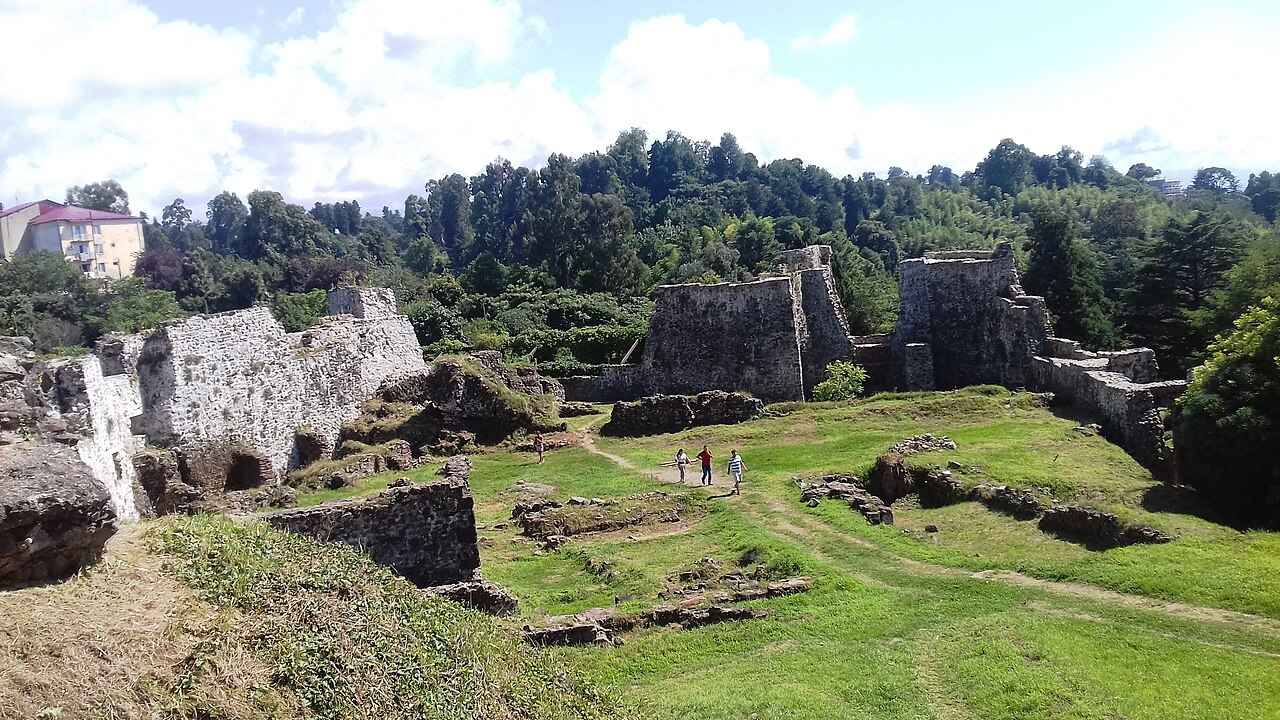

Khosrow takes Petra, 541
In 541, the year after his sack of Antioch, Khosrow answered an appeal from the Lazic king Gubazes II and led an army over the mountains from Iberia. Petra was besieged and taken; John Tzibus died in the fighting. Lazica became a Persian protectorate.
Procopius, who wrote while the war was still being fought, explains what Persia hoped to gain. With Lazica in Persian hands, he says, Khosrow could build ships from the Lazic forests and send a fleet across the Black Sea to threaten Constantinople, and he could open a route for the steppe peoples against the Roman provinces. Modern historians doubt that a Persian navy on the Black Sea was ever a practical plan, but Roman writers clearly feared it.
The Lazi change sides, 548
Persian rule proved no easier than Roman. Lazica was Christian, and Procopius reports that Zoroastrian priests were active there and that Khosrow intended to remove the Lazi from their country and settle Persians in their place. He also says Khosrow sent an officer named Phabrizus to have Gubazes murdered. Whether or not every detail is true, Gubazes believed his throne and his faith were in danger. In 548 he turned back to Justinian, who sent an army of about 8,000 men under Dagisthaeus.
The sieges of Petra
Dagisthaeus besieged Petra, whose Persian garrison held out until a relief army under Mihr-Mihroe (Greek Mermeroes), Khosrow’s most capable general in the Caucasus, broke through the passes. In 549 the Romans and Lazi destroyed a Persian supply column near the Phasis and defeated another Persian army at the river Hippis, where its commander Chorianes was killed. Petra was resupplied all the same. It finally fell in 551 to the veteran general Bessas, who stormed it after a long siege and had the walls pulled down so that it could never again serve as a Persian base.
A war of forts and forests
With Petra lost, the Persians fought for the interior. In 551 Mihr-Mihroe failed to take the Lazic stronghold of Archaeopolis (modern Nokalakevi) but captured Kutaisi (Cotais) and the fort of Uthimereos, which gave him the eastern part of the country and the mountain districts beyond. Agathias, who continued Procopius’ history, describes a war of ambushes, river crossings and wooden forts in dense woodland, fought by Persian cavalry and infantry, Roman troops, Lazic levies and allies from the Caucasus, among them the Sabirs and Alans.
In 555 Mihr-Mihroe used a feigned retreat to rout a larger Roman and Lazic army at Telephis. He died of illness soon after and was replaced by Nachoragan.
The murder of Gubazes
The worst blow to the Roman side came from its own commanders. Gubazes had quarrelled with the Roman generals and written to Justinian blaming them for the defeats. The generals Martin and Rusticus, with Rusticus’ brother John, decided to get rid of him, and John stabbed the king during a meeting. The Lazi were outraged and for a time refused to fight. Justinian ordered an inquiry, Rusticus and John were tried and executed, and Gubazes’ younger brother Tzath was made king.
The last campaigns and the peace
In 556 Nachoragan attacked the Roman base at Phasis, near the river’s mouth, and was beaten off with heavy losses. Agathias says Khosrow had him flayed alive for his failure. A truce was agreed in 557, and in 561–562 the Roman envoy Peter the Patrician and the Persian official Yazdgushnasp (in Greek, Zikh) negotiated the Fifty Years’ Peace. Persia evacuated Lazica. Rome agreed to pay 30,000 gold coins a year, with the first years paid in advance, a sum Persia could present as Rome’s share of the cost of defending the Caucasus passes. The terms are summarised on the Sasanian–Byzantine wars of the 6th century.
Who won
Neither side achieved what it set out to do. Persia failed to keep a Black Sea outlet, and Rome had to pay to keep a kingdom that had twice rebelled against it. The war showed the limits of Sasanian power in difficult country far from Mesopotamia, and also the strength of the Sasanian army in long campaigns: Mihr-Mihroe, old and lame by the end, held much of the country for years against larger forces. Lazica itself was ruined by two decades of fighting.
The two great narratives of the war, Procopius and Agathias, were written in Constantinople and are critical of Roman generals but give only the outline of Persian aims. For the Persian army that fought there, see the Sasanian army; for the king who directed it, Khosrow I Anushirvan.
- 541 Khosrow takes Petra; Lazica a Persian protectorate
- 548 Gubazes turns to Rome; first Roman siege of Petra
- 549 Persian defeats on the Phasis and the Hippis
- 551 Bessas takes Petra; Mihr-Mihroe takes Kutaisi
- 555 Persian victory at Telephis; murder of Gubazes
- 556 Nachoragan defeated at Phasis
- 557 Truce
- 562 Fifty Years’ Peace; Persia leaves Lazica
Persian words from this page
| لازیکا | Lâzikâ | Lazica |
| گرجستان | Gorjestân | Georgia |
| دریای سیاه | Daryâ-ye Siyâh | the Black Sea |
| قفقاز | Ghafghâz | the Caucasus |
| قلعه | ghal’eh | fortress |
| صلح | solh | peace |
Sources and further reading
- Procopius, History of the Wars, Book II, chapters 15–30, and Book VIII.
- Agathias, The Histories, Books II–IV, trans. Joseph D. Frendo (de Gruyter, 1975).
- Menander Protector, fragments on the peace of 562, in The History of Menander the Guardsman, ed. and trans. R. C. Blockley (Francis Cairns, 1985).
- Geoffrey Greatrex and Samuel N. C. Lieu, The Roman Eastern Frontier and the Persian Wars, Part II: AD 363–630 (Routledge, 2002).
- David Braund, Georgia in Antiquity: A History of Colchis and Transcaucasian Iberia, 550 BC–AD 562 (Oxford University Press, 1994).
Want to learn Persian? Get the free Starter Pack
Get the 14-page printable Starter Pack (all 32 letters, a 7-day reading plan, 100 core words and 20 survival phrases) and a short 5-email course. Free.
More in The Sasanian Empire (224–651 CE)
- The Origins of the Sasanian Family
- Ardashir I, Founder of the Sasanian Empire
- Firuzabad: Ardashir’s Round City
- Shapur I, King of Kings of Iran and Non-Iran
- Bishapur: Shapur’s City
- The Battle of Edessa and the Capture of Valerian
- The Ka’ba-ye Zartosht Inscription of Shapur I
- Mani and Manichaeism
- Hormizd I and Bahram I
- Kartir and the Zoroastrian Church
- Bahram II
- Narseh and the Peace of Nisibis
- Shapur II the Great
- Julian’s Invasion of Persia (363)
- Christians in the Sasanian Empire
- Shapur III and the Partition of Armenia
- Yazdegerd I
- Bahram V Gur
- Yazdegerd II
- The Battle of Avarayr (451)
- The Hephthalites and Iran’s Eastern Frontier
- Peroz I and the Hephthalite Disaster
- Kavad I
- Zamasp and Kavad’s Return
- Mazdak and the Mazdakite Movement
- Khosrow I Anushirvan the Just
- The Sasanian–Byzantine Wars of the 6th Century
- The Battle of Dara (530)
- Khosrow I Sacks Antioch (540)
- The Lazic War (541–562)
- The Reforms of Khosrow I
- The Academy of Gondishapur: History and Legend
- Borzuya, Chess and Kalila wa Dimna
- Taq Kasra: The Arch of Ctesiphon
- The Sasanian Conquest of Yemen
- The Sasanians and the Western Turks
- Hormizd IV
- Bahram Chobin’s Rebellion
- Khosrow II Parviz
- The Last Great War: Byzantium and Persia, 602–628
- The Siege of Constantinople (626)
- Heraclius Strikes Back
- Shirin: Queen and Legend
- Shahrbaraz, the General Who Became King
- Civil War and the Queens Boran and Azarmidokht
- Yazdegerd III, the Last Sasanian King
- The Sasanian Army
- Sasanian Society and the Class System
- Zoroastrianism under the Sasanians
- Sasanian Art: Silver, Reliefs and Silk
- The Sasanian Reliefs of Naqsh-e Rostam
- Taq-e Bostan
- Sasanian Cities, Palaces and Bridges
- Middle Persian (Pahlavi) Language and Literature
- Sasanian Coins and Silverwork
- Women in the Sasanian Empire
- Polo, Hunting and Games at the Sasanian Court
- The Sasanian Legacy