Shahrbaraz was the most successful Sasanian general of the last great war with Byzantium. Under Khosrow II he conquered Syria, Jerusalem and Egypt between 613 and 621 and led the Persian army to the Bosporus in 626. After Khosrow’s fall he made a deal with Emperor Heraclius, marched on Ctesiphon and in April 630 seized the throne himself, the second general in forty years, after Bahram Chobin, to do so. He was murdered after about forty days.
| Name | Farrukhan, according to al-Tabari; Shahrbaraz (Middle Persian Shahrwaraz, “Boar of the Realm”) is a title |
|---|---|
| Family | The Mihran, one of the great Parthian noble houses |
| Greek name | Sarbaros; Armenian sources call him Khoream |
| Conquests | Antioch and Damascus (613), Jerusalem (614), Egypt (618–621) |
| Reign | 27 April to 9 June 630 |
| In the Shahnameh | Farayin, the usurper Guraz |
A general’s title
The name by which history knows him was not his own. Shahrwaraz combines shahr, the realm, and waraz, the boar, the animal of the god of victory Wahram (Bahram). It was an honorific given by the king, much as the generals of other ages carried titles of office. al-Tabari gives his personal name as Farrukhan. He belonged to the Mihran family, the same house as Bahram Chobin, and Parvaneh Pourshariati has argued that his career belongs in the long story of tension between the Sasanian crown and the great Parthian families.
The conqueror of Jerusalem and Egypt
The war with Byzantium began in 602, after the murder of Khosrow’s patron Emperor Maurice, and Shahrbaraz first appears as one of the king’s commanders in the campaigns in Mesopotamia in the 600s. His great years came after 610. In 613 he defeated Heraclius’ first counter-attack outside Antioch, took the city and went on to capture Damascus. In spring 614 his army besieged Jerusalem. The city fell after about three weeks; the Christian sources describe a massacre, and the relic of the True Cross was carried off to Ctesiphon. The events and their significance for Christians and Jews in the region are covered on the last great war, 602–628.
From 618 Shahrbaraz led the conquest of Egypt. Alexandria fell in 619, and by 621 the whole province was under Persian rule for the first time since the Achaemenids. For a few years the Sasanian empire held almost all the lands that Darius I had ruled.

Defeat in Anatolia and the march to Chalcedon
When Heraclius went over to the offensive in 622, Shahrbaraz was the Persian commander sent to stop him. He was beaten in Anatolia that year and again in 625, when a night attack by Heraclius at a place called Aliovit, north of Lake Van, destroyed his camp and almost captured him. In 626 Khosrow sent him across Asia Minor to the Bosporus to join the Avars in a combined attack on Constantinople. He reached Chalcedon but could not cross the strait, and the Avars withdrew in August (see the siege of Constantinople, 626).
The letter
From here the sources tell a story of betrayal that has been retold ever since. In the Byzantine version preserved by the chronicler Theophanes, Khosrow, angry at the failure of 626, sent a letter to Shahrbaraz’s second-in-command, Kardarigan, ordering him to kill the general and bring the army home. The messengers were caught in Galatia and the letter sent to Heraclius, who showed it to Shahrbaraz. The general rewrote it so that it seemed to order the death of hundreds of his officers, read it out to them and so turned the army against the king. Arabic sources tell a different version involving Shahrbaraz and his brother. Historians are unsure whether the letter was real or a Byzantine forgery, and when the break took place, but it is clear that by 628 Shahrbaraz was no longer obeying Khosrow and kept his army in Syria and Egypt while Heraclius invaded Mesopotamia.
A deal with Heraclius
Khosrow was overthrown in February 628 by his son Kavad II, who made peace with Byzantium but died within months, leaving the throne to a child, Ardashir III. Shahrbaraz, holding the richest provinces of the old Roman East with the largest army in the empire, now negotiated on his own account. In July 629 he met Heraclius at Arabissus in Cappadocia. He agreed to withdraw from Egypt and Syria, and Byzantine sources say the two men also agreed on a marriage alliance and that Heraclius promised support for his claim to rule Iran. Shahrbaraz’s son, known as Niketas, became a Christian and later served the empire. The True Cross was returned and restored to Jerusalem by Heraclius in 630.
Forty days as king
With a force of about 6,000 men, Shahrbaraz marched on Ctesiphon in spring 630, with the support of some leading nobles. He took the capital on 27 April, and had Ardashir III and his regent Mah-Adhur Gushnasp killed. He was the first man outside the house of Sasan to sit on the throne since Bahram Chobin forty years earlier, and like Bahram he could not hold it. Many nobles and soldiers regarded a king without Sasanian blood as illegitimate.
On 9 June 630 he was killed. al-Tabari says a group of guardsmen, led by a man named Pus Farrukh and his brothers, stabbed him as he rode in procession and dragged his body through the streets. Other accounts link the murder to Farrukh Hormizd, the leader of the Parthian nobles of the north, who backed Khosrow’s daughter Boran as the next ruler. The chaos that followed is described on civil war and the queens Boran and Azarmidokht.
Shahrbaraz in memory
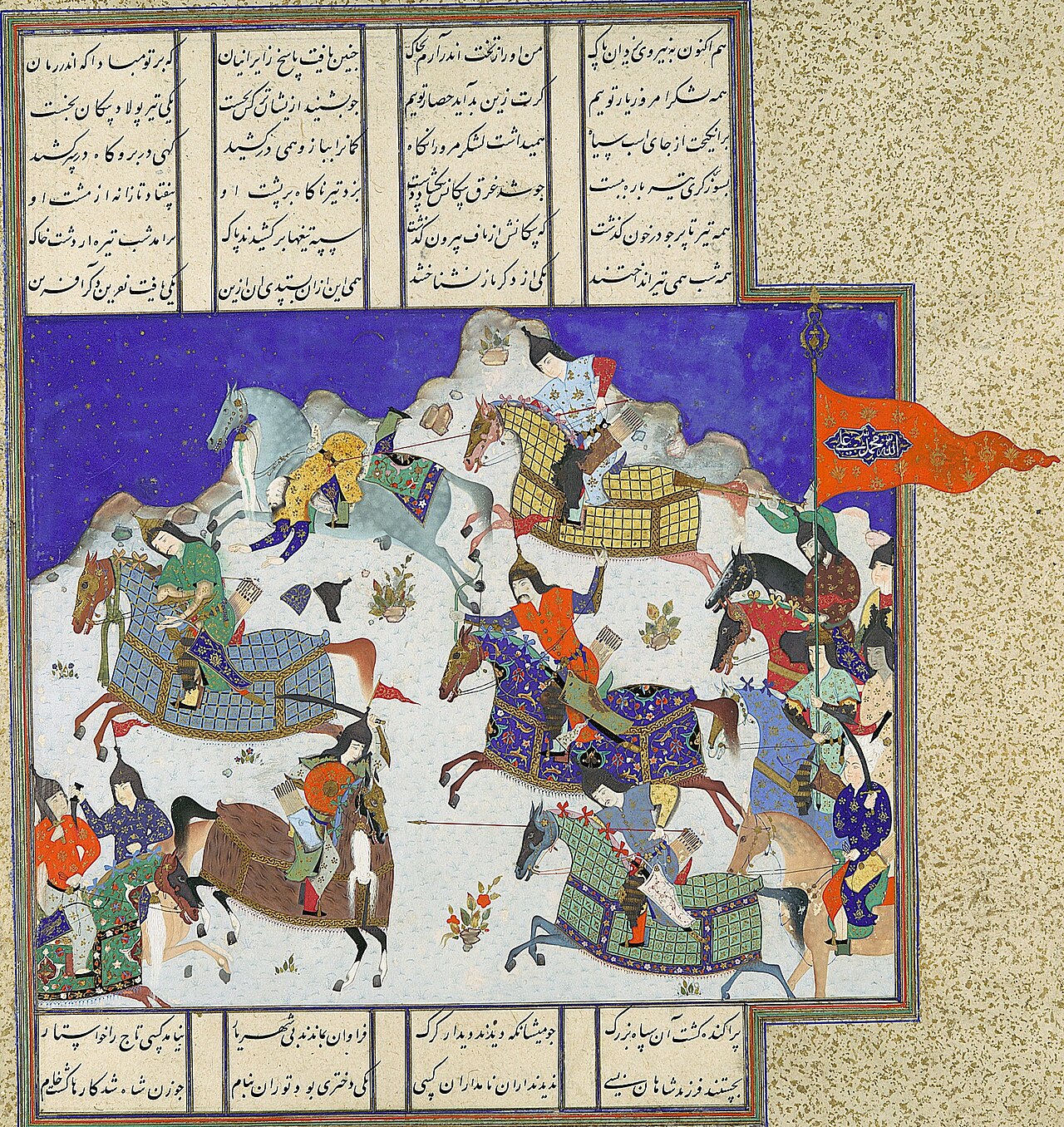
Persian tradition did not treat him kindly. In the Shahnameh, Ferdowsi turns him into Farayin, a usurper who wastes the treasury and is shot in the back by one of his own commanders while out hunting, a scene painted for Shah Tahmasp’s great 16th-century copy of the poem. Byzantine writers remembered him as the destroyer of Jerusalem who changed sides. Modern historians see a gifted commander whose army, cut off for years in foreign provinces, became a power in its own right, and whose rise showed how far royal authority had collapsed by the end of Khosrow II’s reign. The king he served is described on Khosrow II Parviz.
- 613 Victory outside Antioch; Damascus taken
- 614 Jerusalem taken; the True Cross removed
- 619 Alexandria falls
- 625 Defeated by Heraclius at Aliovit
- 626 At Chalcedon during the siege of Constantinople
- July 629 Meets Heraclius at Arabissus
- 27 April 630 Takes Ctesiphon and the throne
- 9 June 630 Murdered
Persian words from this page
| شهربراز | Shahrbarâz | Shahrbaraz |
| فرخان | Farrokhân | Farrukhan, his personal name |
| گراز | gorâz | boar |
| شهر | shahr | city (in Middle Persian, “realm”) |
| اسکندریه | Eskandariyeh | Alexandria |
| بیتالمقدس | Beyt-ol-Moghaddas | Jerusalem |
| پوراندخت | Purândokht | Boran, the next ruler |
Sources and further reading
- al-Tabari, The History of al-Tabari, vol. 5, trans. C. E. Bosworth (SUNY Press, 1999).
- The Chronicle of Theophanes Confessor, trans. Cyril Mango and Roger Scott (Oxford University Press, 1997).
- The Armenian History attributed to Sebeos, trans. R. W. Thomson and James Howard-Johnston (Liverpool University Press, 1999).
- Parvaneh Pourshariati, Decline and Fall of the Sasanian Empire (I.B. Tauris, 2008).
- Walter E. Kaegi, Heraclius, Emperor of Byzantium (Cambridge University Press, 2003).
- Encyclopaedia Iranica, “Šahrbarāz”.
Want to learn Persian? Get the free Starter Pack
Get the 14-page printable Starter Pack (all 32 letters, a 7-day reading plan, 100 core words and 20 survival phrases) and a short 5-email course. Free.
More in The Sasanian Empire (224–651 CE)
- The Origins of the Sasanian Family
- Ardashir I, Founder of the Sasanian Empire
- Firuzabad: Ardashir’s Round City
- Shapur I, King of Kings of Iran and Non-Iran
- Bishapur: Shapur’s City
- The Battle of Edessa and the Capture of Valerian
- The Ka’ba-ye Zartosht Inscription of Shapur I
- Mani and Manichaeism
- Hormizd I and Bahram I
- Kartir and the Zoroastrian Church
- Bahram II
- Narseh and the Peace of Nisibis
- Shapur II the Great
- Julian’s Invasion of Persia (363)
- Christians in the Sasanian Empire
- Shapur III and the Partition of Armenia
- Yazdegerd I
- Bahram V Gur
- Yazdegerd II
- The Battle of Avarayr (451)
- The Hephthalites and Iran’s Eastern Frontier
- Peroz I and the Hephthalite Disaster
- Kavad I
- Zamasp and Kavad’s Return
- Mazdak and the Mazdakite Movement
- Khosrow I Anushirvan the Just
- The Sasanian–Byzantine Wars of the 6th Century
- The Battle of Dara (530)
- Khosrow I Sacks Antioch (540)
- The Lazic War (541–562)
- The Reforms of Khosrow I
- The Academy of Gondishapur: History and Legend
- Borzuya, Chess and Kalila wa Dimna
- Taq Kasra: The Arch of Ctesiphon
- The Sasanian Conquest of Yemen
- The Sasanians and the Western Turks
- Hormizd IV
- Bahram Chobin’s Rebellion
- Khosrow II Parviz
- The Last Great War: Byzantium and Persia, 602–628
- The Siege of Constantinople (626)
- Heraclius Strikes Back
- Shirin: Queen and Legend
- Shahrbaraz, the General Who Became King
- Civil War and the Queens Boran and Azarmidokht
- Yazdegerd III, the Last Sasanian King
- The Sasanian Army
- Sasanian Society and the Class System
- Zoroastrianism under the Sasanians
- Sasanian Art: Silver, Reliefs and Silk
- The Sasanian Reliefs of Naqsh-e Rostam
- Taq-e Bostan
- Sasanian Cities, Palaces and Bridges
- Middle Persian (Pahlavi) Language and Literature
- Sasanian Coins and Silverwork
- Women in the Sasanian Empire
- Polo, Hunting and Games at the Sasanian Court
- The Sasanian Legacy