In 260 CE the Sasanian king Shapur I defeated a Roman army near Edessa (modern Şanlıurfa in south-east Turkey) and captured the emperor Valerian, the first and only Roman emperor ever taken prisoner by a foreign enemy. Valerian died in Persian captivity, and Shapur had the scene carved on rock reliefs in Fars that can still be seen today.
| Date | 260 CE, probably spring or early summer |
|---|---|
| Place | Between Carrhae (Harran) and Edessa, in Roman Mesopotamia |
| Sasanian commander | Shapur I |
| Roman commander | Emperor Valerian (r. 253–260) |
| Roman army | 70,000 according to Shapur’s inscription; no reliable Roman figure |
| Result | Sasanian victory; Valerian, his praetorian prefect and senior officers captured |
The road to Edessa
By the late 250s the Roman East was in crisis. Shapur had destroyed a Roman army at Barbalissos and sacked Antioch a few years earlier (see Shapur I). The empire was also fighting Goths and other peoples on the Danube and in Asia Minor, and plague was spreading through its armies and cities. Valerian, an elderly senator who became emperor in 253, left his son Gallienus in charge of the West and came east himself to restore order.
When Shapur invaded Mesopotamia again in 260 and besieged Carrhae and Edessa, Valerian marched to relieve them. What happened next is told in very different ways by the two sides.
Shapur’s version
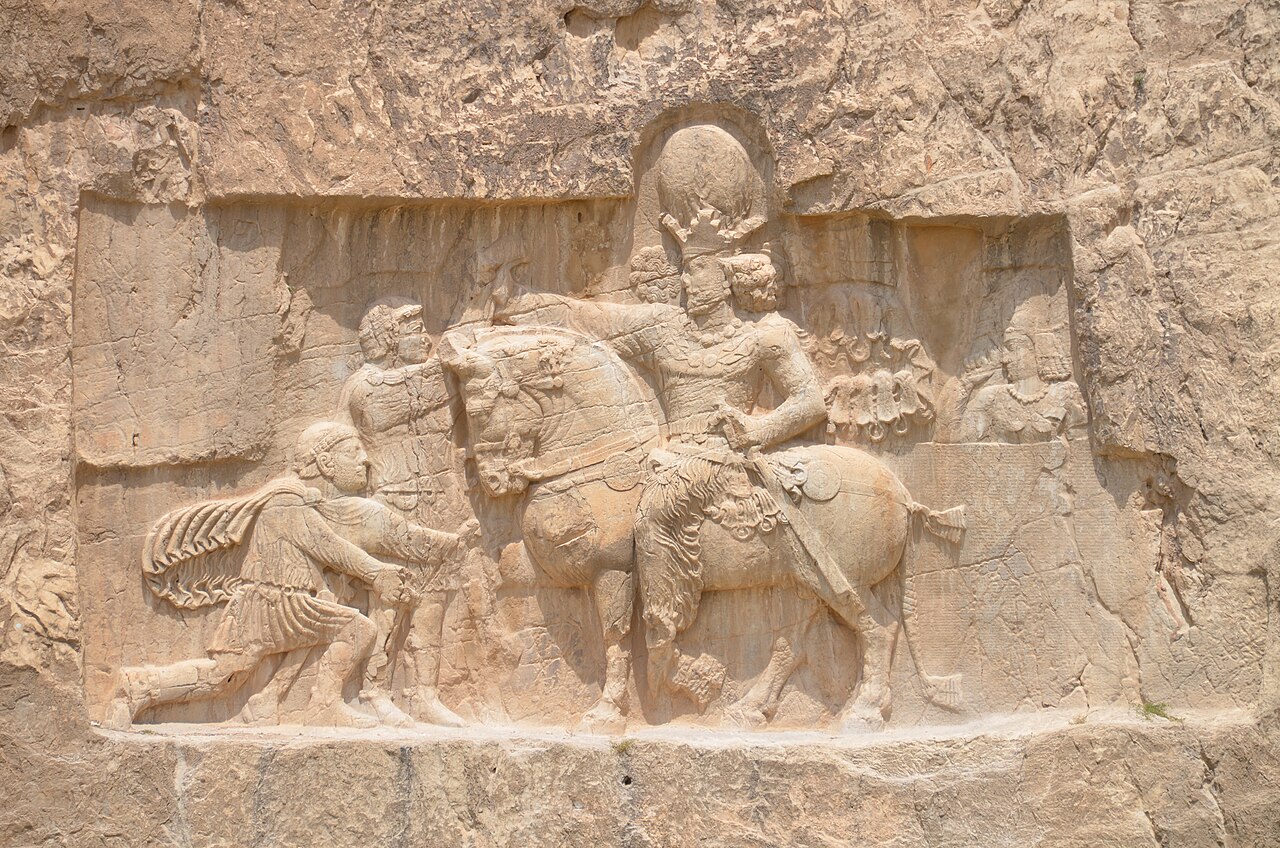
Shapur’s account survives in his great trilingual inscription on the Ka’ba-ye Zartosht at Naqsh-e Rostam. He lists the provinces from which Valerian’s army came, from Germania and Raetia to Syria, Mauretania and Arabia, to show that the whole Roman world had been mobilised against him. Then, in the Greek version, he says that beyond Carrhae and Edessa there was a great battle, and that he took Valerian prisoner “with our own hands”, together with the praetorian prefect, senators and officers. The phrase matters: it explains why the reliefs show Shapur gripping the emperor by the wrist. The full text is discussed on The Ka’ba-ye Zartosht Inscription of Shapur I.
Roman versions
Roman writers, most of them writing long afterwards, are embarrassed and inconsistent. The Greek historian Zosimus, writing around 500, says the Roman army was weakened by plague and that Valerian, trying to buy peace, went to meet Shapur with a small escort and was seized. Others suggest he was trapped while trying to escape from a mutinous army in Edessa. Some mention betrayal. None says plainly that he lost a battle.
Modern historians generally accept both elements: there was a military defeat, probably including a siege or blockade, and the capture may have happened during negotiations. What is not in doubt is the outcome. A Roman emperor and much of his staff were prisoners in Iran.

What happened to Valerian
Valerian never returned. We do not know when or how he died. Christian writers, who saw him as a persecutor of the Church (he had ordered the execution of Christian clergy in 257–258), turned his fate into a moral lesson. Lactantius, writing around 315, claims Shapur used the emperor as a footstool to mount his horse, and that after his death his skin was flayed, dyed red and hung in a temple as a warning to Roman envoys. Historians treat these stories as polemic. They have no support in Iranian sources and are written with obvious satisfaction at a persecutor’s punishment.
Persian and Arabic tradition remembered the captives in a more practical way: as builders. Stories link Valerian and his soldiers to the dam and bridge called the Band-e Kaisar at Shushtar and to the building of Bishapur. These links are traditional rather than proven, but Shapur certainly settled large numbers of Roman prisoners in Khuzestan and Fars.
The aftermath in the Roman East
After the victory Persian forces raided Syria, Cilicia and Cappadocia, taking Antioch again according to Shapur’s list, along with Tarsus and Caesarea in Cappadocia. But the Romans recovered quickly. A Roman officer named Callistus (also called Ballista) defeated Persian detachments on the coast of Cilicia, and Odaenathus, the ruler of Palmyra, attacked Shapur’s army as it withdrew across the Euphrates. In Rome, Gallienus made no attempt to rescue his father. The crisis encouraged usurpers in the East and helped Palmyra become, for a decade, a power of its own.
The reliefs
Shapur commemorated the victory more than any other event of his reign. The best-known relief is at Naqsh-e Rostam, carved below the Achaemenid royal tombs. The king, on horseback, grips the wrist of a standing Roman, while a second Roman kneels before the horse with his hands outstretched. Further versions appear at Bishapur, where the scene is crowded with Persian cavalry and Roman soldiers, and at Darabgerd. A large sardonyx cameo in the Bibliothèque nationale de France in Paris shows Shapur and a Roman emperor on horseback, the king seizing the emperor’s arm.
Who is who
The identification of the Romans has been debated for more than a century. The most widely accepted reading is that the standing figure held by the wrist is Valerian, captured “with our own hands”, and the kneeling figure is Philip the Arab, who sued for peace in 244. In the Bishapur reliefs a third Roman lying under the horse’s hooves is usually taken to be Gordian III, whose death Shapur claimed at Misiche. Some scholars prefer to see the kneeling figure as Valerian, or read the reliefs as symbolic compositions rather than portraits of specific moments. The reliefs are discussed further on The Sasanian Reliefs of Naqsh-e Rostam.
How historians see it
For Rome, Edessa was a humiliation that later writers handled with silence or moralising. For the Sasanians, it was proof that the new dynasty had surpassed the Parthians, who had beaten Roman generals such as Crassus at Carrhae but never captured an emperor. Shapur’s titles and monuments made the point to his own people: the king of kings of Iran had overcome the ruler of the West. In the long history of Persia and Rome, the capture of Valerian is the high-water mark of Iranian success.
- 253 Valerian becomes emperor
- 257–258 Valerian’s edicts against Christian clergy
- 260 Shapur invades Mesopotamia; Valerian captured near Edessa
- 260–261 Persian raids into Syria, Cilicia and Cappadocia; Odaenathus attacks the retreating army
- After 260 Valerian dies in captivity, date unknown
Persian words from this page
| والرین | Vâleriyan | Valerian |
| قیصر | gheysar | Caesar, the Roman emperor |
| روم | Rum | Rome, the Roman world |
| نقش رستم | Naghsh-e Rostam | Naqsh-e Rostam |
| بند قیصر | Band-e Gheysar | Caesar’s Dam at Shushtar |
| پیروزی | piruzi | victory |
Sources and further reading
- Shapur I, inscription at the Ka’ba-ye Zartosht (ŠKZ), in Dodgeon and Lieu (below).
- Zosimus, New History, Book 1; Lactantius, On the Deaths of the Persecutors, ch. 5.
- Michael H. Dodgeon and Samuel N. C. Lieu, The Roman Eastern Frontier and the Persian Wars, AD 226–363: A Documentary History (Routledge, 1991).
- Encyclopaedia Iranica, “Šāpur I: History” by A. Sh. Shahbazi.
- Beate Dignas and Engelbert Winter, Rome and Persia in Late Antiquity: Neighbours and Rivals (Cambridge University Press, 2007).
Want to learn Persian? Get the free Starter Pack
Get the 14-page printable Starter Pack (all 32 letters, a 7-day reading plan, 100 core words and 20 survival phrases) and a short 5-email course. Free.
More in The Sasanian Empire (224–651 CE)
- The Origins of the Sasanian Family
- Ardashir I, Founder of the Sasanian Empire
- Firuzabad: Ardashir’s Round City
- Shapur I, King of Kings of Iran and Non-Iran
- Bishapur: Shapur’s City
- The Battle of Edessa and the Capture of Valerian
- The Ka’ba-ye Zartosht Inscription of Shapur I
- Mani and Manichaeism
- Hormizd I and Bahram I
- Kartir and the Zoroastrian Church
- Bahram II
- Narseh and the Peace of Nisibis
- Shapur II the Great
- Julian’s Invasion of Persia (363)
- Christians in the Sasanian Empire
- Shapur III and the Partition of Armenia
- Yazdegerd I
- Bahram V Gur
- Yazdegerd II
- The Battle of Avarayr (451)
- The Hephthalites and Iran’s Eastern Frontier
- Peroz I and the Hephthalite Disaster
- Kavad I
- Zamasp and Kavad’s Return
- Mazdak and the Mazdakite Movement
- Khosrow I Anushirvan the Just
- The Sasanian–Byzantine Wars of the 6th Century
- The Battle of Dara (530)
- Khosrow I Sacks Antioch (540)
- The Lazic War (541–562)
- The Reforms of Khosrow I
- The Academy of Gondishapur: History and Legend
- Borzuya, Chess and Kalila wa Dimna
- Taq Kasra: The Arch of Ctesiphon
- The Sasanian Conquest of Yemen
- The Sasanians and the Western Turks
- Hormizd IV
- Bahram Chobin’s Rebellion
- Khosrow II Parviz
- The Last Great War: Byzantium and Persia, 602–628
- The Siege of Constantinople (626)
- Heraclius Strikes Back
- Shirin: Queen and Legend
- Shahrbaraz, the General Who Became King
- Civil War and the Queens Boran and Azarmidokht
- Yazdegerd III, the Last Sasanian King
- The Sasanian Army
- Sasanian Society and the Class System
- Zoroastrianism under the Sasanians
- Sasanian Art: Silver, Reliefs and Silk
- The Sasanian Reliefs of Naqsh-e Rostam
- Taq-e Bostan
- Sasanian Cities, Palaces and Bridges
- Middle Persian (Pahlavi) Language and Literature
- Sasanian Coins and Silverwork
- Women in the Sasanian Empire
- Polo, Hunting and Games at the Sasanian Court
- The Sasanian Legacy