The Western Turks, the western half of the Göktürk empire, were Sasanian Iran’s neighbours in Central Asia from about 560 CE until the fall of the dynasty. Khosrow I first allied with them to destroy the Hephthalites, then quarrelled with them over the Oxus frontier and the silk trade. In the following seventy years the Turks fought Persia in the east in 588–589 and the 610s, and in 627 joined Heraclius to break through the Caucasus, helping to bring down Khosrow II.
| Period | c. 557–630 CE |
|---|---|
| Turkish rulers | Istämi (Sizabul in Greek), d. c. 576; later Tong Yabghu (d. c. 630) |
| Persian kings | Khosrow I, Hormizd IV, Khosrow II |
| Frontiers | The Oxus (Amu Darya) in the east; the Caucasus passes in the north |
| Key wars | c. 560 (with the Turks, against the Hephthalites); 588–589; c. 614–617; 627–629 |
| Main sources | Menander Protector; Theophylact Simocatta; Sebeos; al-Tabari; the Shahnameh |
A new power on the steppe
In the 550s the Türks, a people from the Altai mountains, overthrew their overlords the Rouran and built an empire across the Eurasian steppe. Its western half was ruled by the yabghu Istämi, the younger brother of the founder Bumin, whom Greek writers call Sizabul or Silzibul. By the late 550s his horsemen had reached the borders of Sogdiana and the lands of the Hephthalites, the power that had killed the Sasanian king Peroz in 484 and taken tribute from Iran for decades (see the Hephthalites and Iran’s eastern frontier).
Allies against the Hephthalites, c. 560
Khosrow I saw his chance. Persian and Turkish forces attacked the Hephthalites from two sides, and around 560 the Turks crushed them in a great battle near Bukhara, which the Shahnameh places at a site it calls Gol-Zarriun. The Hephthalite lands were divided. The Turks took Sogdiana north of the Oxus, and Khosrow claimed lands to the south, including at least part of Bactria, so that the river became the line between the two powers. Later Persian and Arabic tradition says the alliance was sealed by a marriage: Khosrow took a daughter of the Turkish khagan as a wife, and their son was the future Hormizd IV, whom his enemies later called Turkzad, “son of a Turk”. The Shahnameh tells a long romance of how the king won the bride.

The quarrel over silk
The alliance did not last. The Sogdians, the merchant people of Samarkand and Bukhara who now lived under Turkish rule, wanted to sell Chinese silk directly in Iran and beyond. Around 568 the Byzantine historian Menander tells us that a Sogdian named Maniakh led a Turkish embassy to Khosrow to ask for free trade. Khosrow, advised by a Hephthalite in his service, bought the silk and burned it in front of the envoys, to show that he did not want it. A second embassy, Menander says, was poisoned, and Khosrow let it be said that the envoys had died of the climate.
The story is told from a Byzantine point of view, but the Persian motive is clear. Iran controlled the overland routes between China and Rome and profited from them; a Sogdian trade passing freely through its territory, or around it, threatened that. Maniakh instead went to Constantinople, and in 569 the Byzantine envoy Zemarchus travelled to Istämi’s camp in the mountains of Central Asia. For the next sixty years Byzantium and the Western Turks were intermittent allies against Persia, an alliance that Khosrow could not break.
Bahram Chobin and the war of 588–589
The first major war came under Hormizd IV. In 588 a large Turkish army, with Hephthalite allies, crossed into Khorasan at the same time as the Byzantines were fighting in the west. Hormizd gave command to Bahram Chobin, a general of the Mihran family, who, according to al-Tabari and the Shahnameh, set out with a small picked force of 12,000 veteran horsemen. Near Herat he defeated the invaders and killed their leader, whom the Persian sources call Shaba or Saba and whose identity among the Turkish princes is still debated. In 589 Bahram crossed the Oxus, defeated the dead leader’s son and sent vast booty to Ctesiphon.
The victory made Bahram a hero and, soon after, a rebel. A quarrel with the king over the booty and a defeat in the Caucasus led to his revolt in 590, the overthrow of Hormizd and the first, short exile of Khosrow II. That story belongs to Bahram Chobin’s rebellion; the reign is described on Hormizd IV.
The eastern wars of Khosrow II
The north-eastern frontier stayed dangerous throughout the reign of Khosrow II. The Armenian history attributed to Sebeos describes the campaigns of Smbat Bagratuni, an Armenian prince who served Khosrow as governor of Hyrcania (Gorgan). In the 610s, according to Sebeos, Kushan and Hephthalite princes rebelled with Turkish support, a Persian army was defeated and the invaders raided deep into Iran, as far as Rey and Isfahan. Smbat later won a victory over the Hephthalites and their allies and was rewarded with high honours at court. Sebeos gives an army of 300,000 Turks, a figure no historian accepts, and his dates are uncertain, but the picture of a long and costly war in the east is credible. It shows how much of Persia’s strength was tied down far from the war with Byzantium that Khosrow was fighting at the same time.
The Turks and the fall of Khosrow II, 627–629
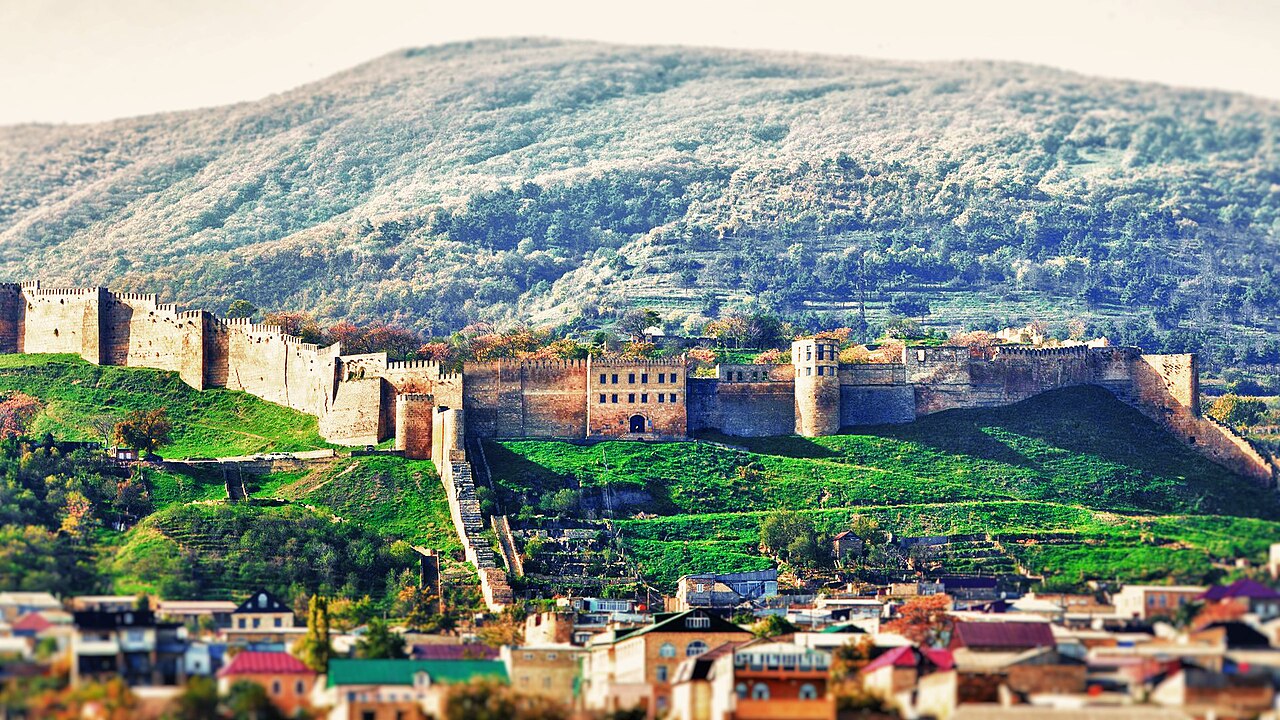
The decisive intervention came in the Caucasus. In 626, during the siege of Constantinople, Heraclius made an alliance with the Western Turks, now led by Tong Yabghu, whom the Byzantine chronicler Theophanes calls Ziebel. In 627 a Turkish army under the khagan’s nephew, known in the Armenian sources as Shad, broke through the Caspian Gates at Derbent, the Sasanian wall that had kept the steppe peoples out for a century, and plundered Caucasian Albania. Turks and Byzantines then met outside Tiflis in Georgia and besieged it together.
The Turks went home for the winter, but their attack tied down Persian forces in the north while Heraclius marched south to his victory at Nineveh in December 627 (see Heraclius strikes back). The Turks returned in 628 and took Tiflis, and in 629 they invaded Armenia and defeated a Persian army. The pressure ended only when Tong Yabghu was murdered around 630 and the Western Turkish empire fell into civil war.
Seventy years in perspective
The Western Turks never tried to conquer Iran, and Persia never tried to destroy them. As with Byzantium, the wars were fought for frontiers, tribute and trade. But the Turks changed the strategic position of the Sasanians. Iran now faced two great powers, one on each side, which could and did combine against it. The great Sasanian defensive walls, in the Caucasus at Derbent and on the Gorgan plain, belong to this world. Later Persian literature remembered the struggle with Turan in the Shahnameh, where Turks and Turanians become the age-old enemies of Iran, and the line between history and epic is often hard to draw.
- c. 557–560 Persian–Turkish alliance destroys the Hephthalites
- c. 568 Sogdian silk embassy to Khosrow I rejected
- 569 Zemarchus’ embassy from Constantinople to Istämi
- 588 Bahram Chobin defeats the Turks near Herat
- 589 Bahram crosses the Oxus
- 610s Turkish and Hephthalite invasions of Khorasan; campaigns of Smbat Bagratuni
- 627 Turks break through at Derbent and join Heraclius at Tiflis
- 628 Tiflis taken
- c. 630 Death of Tong Yabghu
Persian words from this page
| ترک | tork | Turk |
| خاقان | khâghân | khagan, the Turkish ruler |
| جیحون | Jeyhun | the Oxus (Amu Darya) |
| ابریشم | abrisham | silk |
| سغد | Soghd | Sogdiana |
| دربند | Darband | Derbent (literally “closed gate”) |
| توران | Turân | Turan, the land beyond the Oxus in the Shahnameh |
Sources and further reading
- Menander Protector, The History of Menander the Guardsman, ed. and trans. R. C. Blockley (Francis Cairns, 1985), on Maniakh and Zemarchus.
- The Armenian History attributed to Sebeos, trans. R. W. Thomson with commentary by James Howard-Johnston (Liverpool University Press, 1999).
- al-Tabari, The History of al-Tabari, vol. 5, trans. C. E. Bosworth (SUNY Press, 1999), on Hormizd IV and Bahram Chobin.
- Encyclopaedia Iranica, “Hephthalites” and “Bahrām Čōbīn”.
- Étienne de la Vaissière, Sogdian Traders: A History (Brill, 2005).
- James Howard-Johnston, The Last Great War of Antiquity (Oxford University Press, 2021).
Want to learn Persian? Get the free Starter Pack
Get the 14-page printable Starter Pack (all 32 letters, a 7-day reading plan, 100 core words and 20 survival phrases) and a short 5-email course. Free.
More in The Sasanian Empire (224–651 CE)
- The Origins of the Sasanian Family
- Ardashir I, Founder of the Sasanian Empire
- Firuzabad: Ardashir’s Round City
- Shapur I, King of Kings of Iran and Non-Iran
- Bishapur: Shapur’s City
- The Battle of Edessa and the Capture of Valerian
- The Ka’ba-ye Zartosht Inscription of Shapur I
- Mani and Manichaeism
- Hormizd I and Bahram I
- Kartir and the Zoroastrian Church
- Bahram II
- Narseh and the Peace of Nisibis
- Shapur II the Great
- Julian’s Invasion of Persia (363)
- Christians in the Sasanian Empire
- Shapur III and the Partition of Armenia
- Yazdegerd I
- Bahram V Gur
- Yazdegerd II
- The Battle of Avarayr (451)
- The Hephthalites and Iran’s Eastern Frontier
- Peroz I and the Hephthalite Disaster
- Kavad I
- Zamasp and Kavad’s Return
- Mazdak and the Mazdakite Movement
- Khosrow I Anushirvan the Just
- The Sasanian–Byzantine Wars of the 6th Century
- The Battle of Dara (530)
- Khosrow I Sacks Antioch (540)
- The Lazic War (541–562)
- The Reforms of Khosrow I
- The Academy of Gondishapur: History and Legend
- Borzuya, Chess and Kalila wa Dimna
- Taq Kasra: The Arch of Ctesiphon
- The Sasanian Conquest of Yemen
- The Sasanians and the Western Turks
- Hormizd IV
- Bahram Chobin’s Rebellion
- Khosrow II Parviz
- The Last Great War: Byzantium and Persia, 602–628
- The Siege of Constantinople (626)
- Heraclius Strikes Back
- Shirin: Queen and Legend
- Shahrbaraz, the General Who Became King
- Civil War and the Queens Boran and Azarmidokht
- Yazdegerd III, the Last Sasanian King
- The Sasanian Army
- Sasanian Society and the Class System
- Zoroastrianism under the Sasanians
- Sasanian Art: Silver, Reliefs and Silk
- The Sasanian Reliefs of Naqsh-e Rostam
- Taq-e Bostan
- Sasanian Cities, Palaces and Bridges
- Middle Persian (Pahlavi) Language and Literature
- Sasanian Coins and Silverwork
- Women in the Sasanian Empire
- Polo, Hunting and Games at the Sasanian Court
- The Sasanian Legacy