Kavad I was king of Sasanian Iran twice, from 488 to 496 and again from about 498 to 531 CE. Deposed by the nobles, he escaped from prison, returned with a Hephthalite army and went on to rule for more than thirty years, restoring royal power after the disaster of 484. His reign covers the Mazdakite upheaval, the first great wars with Byzantium in a century, and the start of the reforms usually credited to his son Khosrow I.
| First reign | 488–496 CE |
|---|---|
| Interval | Rule of his brother Zamasp, c. 496–498 |
| Second reign | c. 498/499–531 CE |
| Father | Peroz I |
| Persian name | Ghobad (Middle Persian Kawad) |
| Wars | Anastasian War with Rome, 502–506; Iberian War, 526–532 |
| Died | September 531; succeeded by Khosrow I |
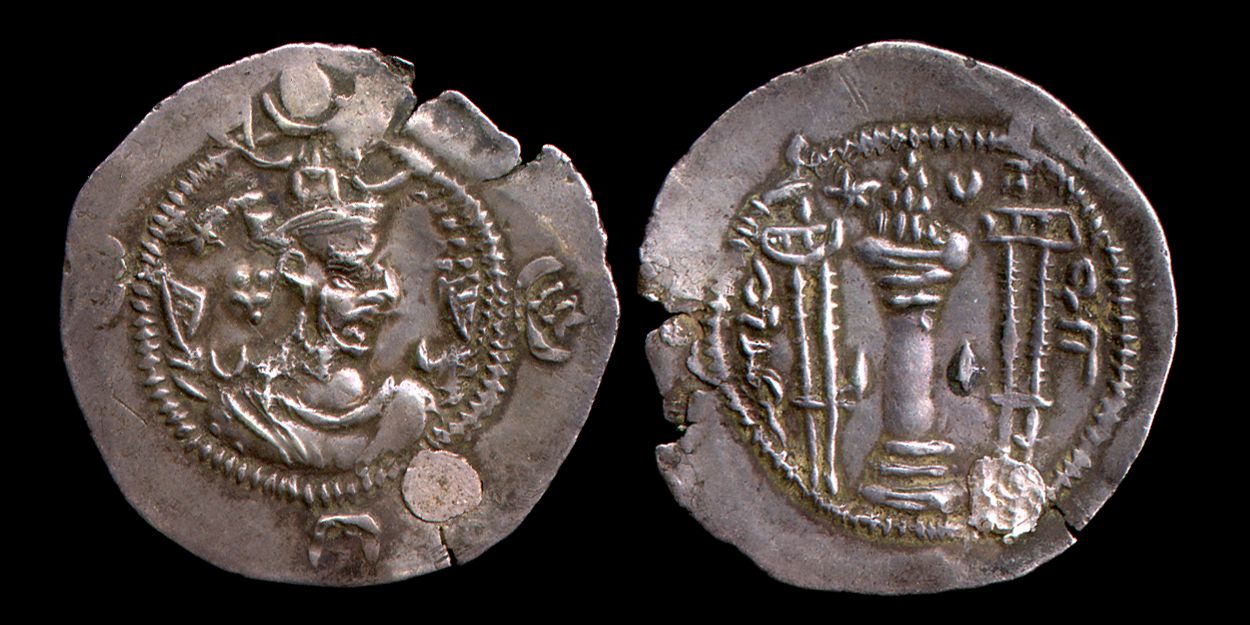

A king without power
Kavad grew up in difficult times. As a boy he spent about two years as a hostage at the court of the Hephthalites, a guarantee for the ransom his father Peroz owed them. After Peroz was killed in 484, his brother Balash reigned for four years, and in 488 the magnates removed Balash and put the young Kavad on the throne.
The real ruler at first was Sukhra, the noble of the Karen family who had saved the eastern frontier. The treasury was empty, tribute was still due to the Hephthalites, and the countryside was in distress after years of war and famine. Kavad’s first move to free himself came in the early 490s: with the help of a rival lord, Shapur of the Mihran family, he had Sukhra arrested and put to death.
Mazdak and the first deposition
During his first reign Kavad became linked with the religious teacher Mazdak, whose followers preached a more equal sharing of wealth. The hostile sources say the king adopted Mazdak’s doctrines, including measures against the property and households of the nobility. Many historians think Kavad saw in the movement a weapon against the great families and the priests, the same groups who had dominated the crown since 484.
If that was his aim, it failed at first. In 496 the nobles and priests deposed him and raised his brother Zamasp to the throne. Procopius says Kavad was imprisoned in a fortress the Persians called the “Castle of Oblivion”, where state prisoners were held and even speaking their names was forbidden.
Escape and return
The sources tell different stories of his escape. Procopius says his wife was allowed to visit him and that they exchanged clothes, so that Kavad walked out dressed as a woman. The Persian tradition preserved by al-Tabari gives the credit to his sister. In either version a loyal nobleman, Siyavush, helped him reach the Hephthalites.
The Hephthalite king, whose court Kavad knew from his years as a hostage, gave him his daughter in marriage and an army. Around 498 or 499 Kavad marched back into Iran. Zamasp gave up the throne without a fight and, unusually for a Sasanian rival, was allowed to live. The circumstances of the return are covered more fully on the page on Zamasp and Kavad’s Return.
War with Rome
Kavad owed the Hephthalites money and needed silver. Rome had long contributed to the defence of the Caucasus passes, and when the emperor Anastasius refused to pay, Kavad invaded Roman Mesopotamia in 502. He took Theodosiopolis and laid siege to the great fortress-city of Amida (modern Diyarbakır). After about three months the city fell in January 503, and many of its people were carried off to Iran. Kavad settled them in a new city in Fars named Weh-az-Amid-Kawad, “Kavad’s better than Amida”, later known as Arrajan.
The war ended in a truce in 506. To guard the frontier the Romans then built the fortress of Dara close to the border, which the Persians saw as a breach of earlier agreements. The war that broke out in the 520s, the Iberian War, began in the Caucasus when the king of Iberia sought Roman protection, and it brought the battles of Dara in 530 and Callinicum in 531. These campaigns are told together on The Sasanian–Byzantine Wars of the 6th Century.
The adoption that never happened
In the early 520s Kavad made an unusual proposal to the emperor Justin I. Worried about the succession, he asked Justin to adopt his favourite son Khosrow, so that Rome would recognise and protect him. According to Procopius, Justin’s adviser Proclus warned that a formal adoption might give a Persian prince a claim to the Roman throne. Justin offered only adoption “in the barbarian manner”, by the giving of arms, which the Persians took as an insult. The talks broke down, and relations worsened.
The end of the Mazdakites and the succession
In his second reign Kavad distanced himself from the Mazdakites. Late in the reign, probably around 528, Kavad called the sect’s leaders to a council that proved to be a trap, and Khosrow led a massacre of the sect’s leaders, and Mazdak himself was executed. The suppression removed a rival group around Kavad’s eldest son, Kawus, who was associated with the movement. Another son, Zam, was barred from rule because he had lost an eye. Kavad named Khosrow as his heir, and when he died in September 531, in the middle of the war with Rome, Khosrow succeeded him.
A reign of rebuilding
Later writers praised Khosrow I as the great reformer, but several of the changes began under Kavad. Arab geographers credit Kavad with starting the land survey that made the new tax system possible, and historians now see the reorganisation of the army and administration as a project of father and son together (see The Reforms of Khosrow I). Kavad also brought the noble houses back under royal control. When he came to the throne in 488 the crown was the weakest it had been in Sasanian history; when he died it was strong enough for Khosrow to rule for nearly fifty years.
- 488 Kavad made king after the removal of Balash
- c. 493 Execution of Sukhra
- 496 Deposed and imprisoned; Zamasp king
- c. 498–499 Returns with a Hephthalite army
- 502–503 Invasion of Roman Mesopotamia; fall of Amida
- 506 Truce with Rome
- c. 520–525 Failed request for Justin I to adopt Khosrow
- 526–531 Iberian War; Dara 530, Callinicum 531
- 531 Death of Kavad
Persian words from this page
| قباد | Ghobâd | Kavad |
| جاماسپ | Jâmâsp | Zamasp |
| سوخرا | Sukhrâ | Sukhra |
| زندان | zendân | prison |
| ارجان | Arrajân | Arrajan |
| خسرو | Khosrow | Khosrow |
Sources and further reading
- Procopius, History of the Wars, Book 1, chapters 3–11.
- The Chronicle of Pseudo-Joshua the Stylite, trans. F. R. Trombley and J. W. Watt (Liverpool University Press, 2000), on the war of 502–506.
- Al-Tabari, The History of al-Tabari, vol. V, trans. C. E. Bosworth (SUNY Press, 1999).
- Nikolaus Schindel, “Kawād I i. Reign”, Encyclopaedia Iranica, iranicaonline.org.
- Geoffrey Greatrex and Samuel N. C. Lieu, The Roman Eastern Frontier and the Persian Wars, Part II: AD 363–630 (Routledge, 2002).
Want to learn Persian? Get the free Starter Pack
Get the 14-page printable Starter Pack (all 32 letters, a 7-day reading plan, 100 core words and 20 survival phrases) and a short 5-email course. Free.
More in The Sasanian Empire (224–651 CE)
- The Origins of the Sasanian Family
- Ardashir I, Founder of the Sasanian Empire
- Firuzabad: Ardashir’s Round City
- Shapur I, King of Kings of Iran and Non-Iran
- Bishapur: Shapur’s City
- The Battle of Edessa and the Capture of Valerian
- The Ka’ba-ye Zartosht Inscription of Shapur I
- Mani and Manichaeism
- Hormizd I and Bahram I
- Kartir and the Zoroastrian Church
- Bahram II
- Narseh and the Peace of Nisibis
- Shapur II the Great
- Julian’s Invasion of Persia (363)
- Christians in the Sasanian Empire
- Shapur III and the Partition of Armenia
- Yazdegerd I
- Bahram V Gur
- Yazdegerd II
- The Battle of Avarayr (451)
- The Hephthalites and Iran’s Eastern Frontier
- Peroz I and the Hephthalite Disaster
- Kavad I
- Zamasp and Kavad’s Return
- Mazdak and the Mazdakite Movement
- Khosrow I Anushirvan the Just
- The Sasanian–Byzantine Wars of the 6th Century
- The Battle of Dara (530)
- Khosrow I Sacks Antioch (540)
- The Lazic War (541–562)
- The Reforms of Khosrow I
- The Academy of Gondishapur: History and Legend
- Borzuya, Chess and Kalila wa Dimna
- Taq Kasra: The Arch of Ctesiphon
- The Sasanian Conquest of Yemen
- The Sasanians and the Western Turks
- Hormizd IV
- Bahram Chobin’s Rebellion
- Khosrow II Parviz
- The Last Great War: Byzantium and Persia, 602–628
- The Siege of Constantinople (626)
- Heraclius Strikes Back
- Shirin: Queen and Legend
- Shahrbaraz, the General Who Became King
- Civil War and the Queens Boran and Azarmidokht
- Yazdegerd III, the Last Sasanian King
- The Sasanian Army
- Sasanian Society and the Class System
- Zoroastrianism under the Sasanians
- Sasanian Art: Silver, Reliefs and Silk
- The Sasanian Reliefs of Naqsh-e Rostam
- Taq-e Bostan
- Sasanian Cities, Palaces and Bridges
- Middle Persian (Pahlavi) Language and Literature
- Sasanian Coins and Silverwork
- Women in the Sasanian Empire
- Polo, Hunting and Games at the Sasanian Court
- The Sasanian Legacy