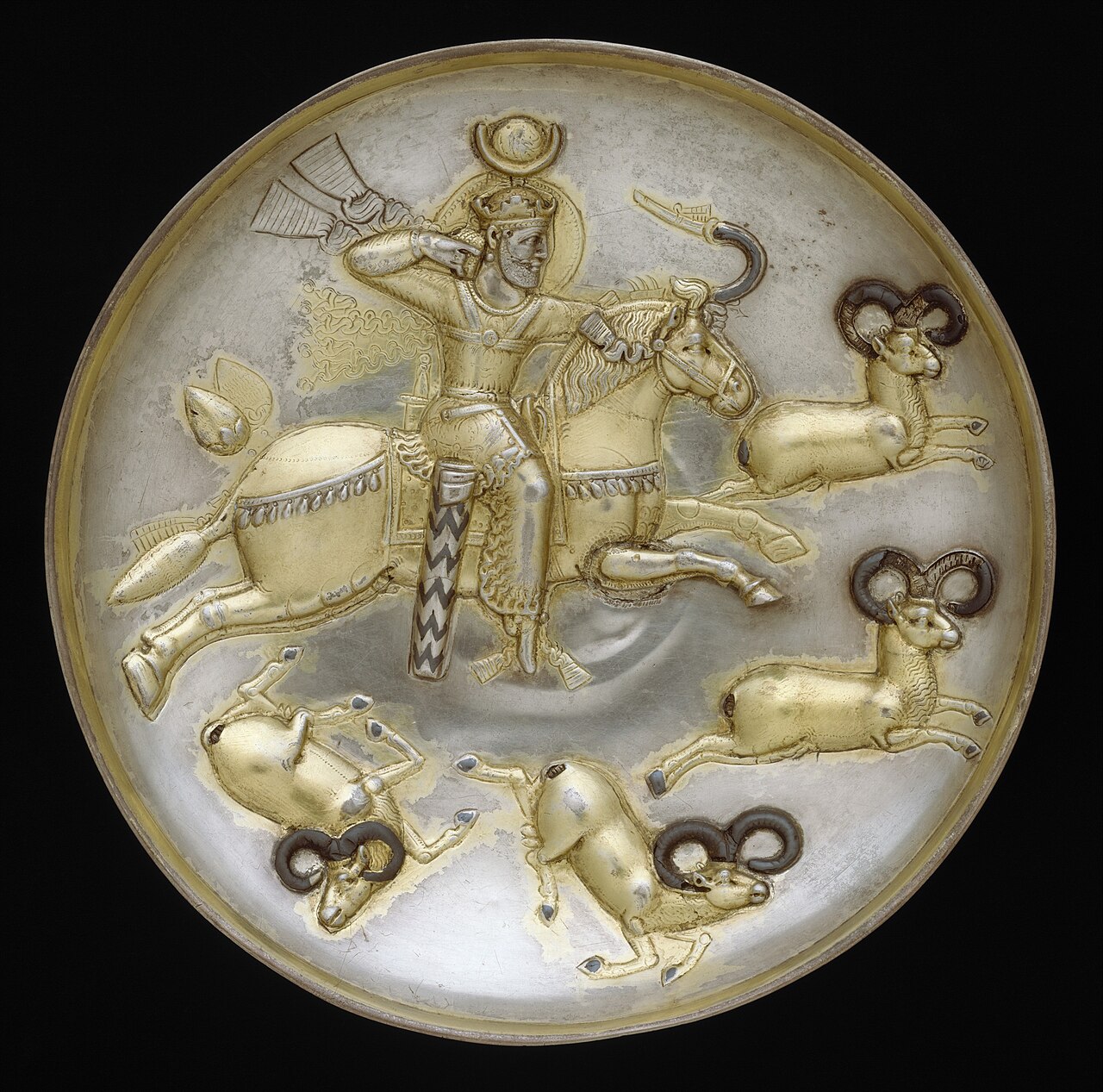
Peroz I was king of Sasanian Iran from 459 to 484 CE. His reign began with a civil war and a long drought, and ended in one of the worst defeats in Iranian history, when he and much of his army were killed by the Hephthalites in Central Asia. The disaster left Iran paying tribute in the east and opened decades of upheaval inside the empire.
| Reign | 459–484 CE (his rule is sometimes counted from his father’s death in 457) |
|---|---|
| Father | Yazdegerd II |
| Name | Middle Persian Peroz, “victorious”; modern Persian Piruz |
| Main enemies | The Kidarites and the Hephthalites in the east; Armenian and Iberian rebels in the Caucasus |
| Death | Killed in battle against the Hephthalites, 484, probably in northern Afghanistan |
| Successor | His brother Balash (484–488) |
A contested succession
When Yazdegerd II died in 457, he left two sons and no settled heir. Hormizd III took the crown at Ray, while Peroz gathered an army in the northeast and their mother Denag held the capital. The later Persian tradition says Peroz fled to the king of the Hephthalites and returned with his troops. Armenian historians writing closer to the events give the credit to the powerful Mihran family, whose general captured and executed Hormizd in 459. Many modern historians prefer the Armenian account, though the two versions may both hold some truth.
Either way, Peroz came to power owing a debt to others: to the great noble houses, and perhaps to the eastern neighbours he would spend his reign fighting.
Seven years of drought
Soon after his accession Iran suffered a severe drought. The Persian and Arabic histories describe a famine lasting about seven years, from around 461 to 467, during which rivers and springs dried up. Al-Tabari, drawing on the Persian royal tradition, praises Peroz for his response: he suspended taxes, opened the royal granaries, ordered the rich to share their stores, and threatened to punish any town where someone died of hunger. The tradition claims that only one person starved in the whole empire. The figure is plainly a pious exaggeration, but the story shows how the episode was remembered: as a test that the king passed.

Wars in the east
Peroz’s main concern was the northeastern frontier. In the 460s he fought the Kidarites, a Hunnic people who held Bactria, and defeated them around 466, issuing coins in gold at Balkh to mark his success. In that war the Hephthalites were his allies. With the Kidarites gone, they became his rivals.
Two humiliating defeats
Peroz invaded Hephthalite territory at least twice before his final campaign, and each time he was outmanoeuvred. Procopius tells how the Hephthalites led the Persian army into country where it could neither advance nor retreat, and Peroz had to accept peace on their terms. After the second defeat, according to the reconstruction of modern historians, the ransom was set at thirty mule-loads of silver drachms. Peroz could raise only twenty, left his son Kavad as a hostage, and paid the rest by imposing a special tax. Kavad’s years at the Hephthalite court would later shape his own career.
The trench
In 484 Peroz broke the peace and marched east again. Procopius gives the best-known account of what followed. The Hephthalite king, called Akhshunwar in Arabic sources and Khoshnavaz in the Shahnameh, had a long, deep trench dug across the plain and hidden with reeds and earth, leaving a narrow way through. He sent a small force to show itself and then flee across the hidden path. The Persian cavalry charged after it, fell into the trench and was destroyed. Peroz was killed, and his body was never found. One of his daughters was captured and married to the Hephthalite king.
The place of the battle is uncertain; many historians put it near Balkh, others further west near Herat. A Syriac chronicle attributed to Joshua the Stylite suggests that Peroz may have escaped the trench and died later. The Byzantines, who disliked Peroz, wrote of the defeat as the punishment of an oath-breaker.
Revolt in the Caucasus
While Peroz looked east, the Caucasus rose in revolt. In 482 Vakhtang, king of Iberia (eastern Georgia), killed the Persian-backed viceroy of his land, and in Armenia the noble Vahan Mamikonian led a rising that drove out the Persian governor. Persian armies won several battles, but the revolt was still alive when the news of Peroz’s death arrived and the troops were withdrawn. His brother and successor Balash made peace, granted Armenian Christians freedom of worship, and made Vahan governor. This settlement closed the struggle that had begun at Avarayr in 451.
Religion and the Church of the East
Peroz’s reign saw hardship for some religious minorities. Jewish sources record persecution in Babylonia, including the execution of the exilarch around 470, though the Persian sources tell a different story of Jews attacking priests. At the same time the Church of the East moved further away from Byzantine Christianity. At a synod held at Beth Lapat (Gondishapur) in 484, its bishops adopted the teaching associated with Nestorius, which made them less suspect to the Persian crown. See Christians in the Sasanian Empire.
What the defeat cost Iran
The death of the king and the loss of his army left the empire exposed. The Hephthalites took over parts of Khorasan for a time and Iran paid them tribute for decades. The great noble Sukhra, of the Karen family, gathered a new army in the east and stabilised the frontier, and he and the Mihran general Shapur then placed Balash on the throne. Real power lay with these magnates. The treasury was empty, the eastern provinces were insecure, and the ground was prepared for the crisis of the next reigns, when Kavad I and the movement of Mazdak shook the old order.
Several cities were credited to Peroz, among them foundations named Ram-Peroz near Ray and Shahram-Peroz, identified with Ardabil in Azerbaijan. They show that his reign was not only one of failure, though the final defeat is what the sources remember.
- 457 Death of Yazdegerd II; war between Hormizd III and Peroz
- 459 Hormizd III killed; Peroz sole king
- c. 461–467 Drought and famine
- c. 466 Victory over the Kidarites
- 470s–early 480s Two defeats by the Hephthalites; Kavad held as a hostage
- 482 Revolts in Iberia and Armenia
- 484 Peroz killed in battle; Balash becomes king
Persian words from this page
| پیروز | Piruz | Peroz; “victorious” |
| خشکسالی | khoshksâli | drought |
| قحطی | ghahti | famine |
| خوشنواز | Khoshnavâz | the Hephthalite king in the Shahnameh |
| سوخرا | Sukhrâ | Sukhra, the noble who restored order |
| اردبیل | Ardabil | Ardabil |
Sources and further reading
- Procopius, History of the Wars, Book 1, chapters 3–4 (the Hephthalite wars and the trench).
- Al-Tabari, The History of al-Tabari, vol. V, trans. C. E. Bosworth (SUNY Press, 1999).
- Ghazar Parpetsi (Łazar P’arpec’i), History of the Armenians, on the revolt of Vahan Mamikonian.
- Richard Payne, “The Reinvention of Iran: The Sasanian Empire and the Huns”, in M. Maas (ed.), The Cambridge Companion to the Age of Attila (2015).
- Khodadad Rezakhani, ReOrienting the Sasanians: East Iran in Late Antiquity (Edinburgh University Press, 2017).
Want to learn Persian? Get the free Starter Pack
Get the 14-page printable Starter Pack (all 32 letters, a 7-day reading plan, 100 core words and 20 survival phrases) and a short 5-email course. Free.
More in The Sasanian Empire (224–651 CE)
- The Origins of the Sasanian Family
- Ardashir I, Founder of the Sasanian Empire
- Firuzabad: Ardashir’s Round City
- Shapur I, King of Kings of Iran and Non-Iran
- Bishapur: Shapur’s City
- The Battle of Edessa and the Capture of Valerian
- The Ka’ba-ye Zartosht Inscription of Shapur I
- Mani and Manichaeism
- Hormizd I and Bahram I
- Kartir and the Zoroastrian Church
- Bahram II
- Narseh and the Peace of Nisibis
- Shapur II the Great
- Julian’s Invasion of Persia (363)
- Christians in the Sasanian Empire
- Shapur III and the Partition of Armenia
- Yazdegerd I
- Bahram V Gur
- Yazdegerd II
- The Battle of Avarayr (451)
- The Hephthalites and Iran’s Eastern Frontier
- Peroz I and the Hephthalite Disaster
- Kavad I
- Zamasp and Kavad’s Return
- Mazdak and the Mazdakite Movement
- Khosrow I Anushirvan the Just
- The Sasanian–Byzantine Wars of the 6th Century
- The Battle of Dara (530)
- Khosrow I Sacks Antioch (540)
- The Lazic War (541–562)
- The Reforms of Khosrow I
- The Academy of Gondishapur: History and Legend
- Borzuya, Chess and Kalila wa Dimna
- Taq Kasra: The Arch of Ctesiphon
- The Sasanian Conquest of Yemen
- The Sasanians and the Western Turks
- Hormizd IV
- Bahram Chobin’s Rebellion
- Khosrow II Parviz
- The Last Great War: Byzantium and Persia, 602–628
- The Siege of Constantinople (626)
- Heraclius Strikes Back
- Shirin: Queen and Legend
- Shahrbaraz, the General Who Became King
- Civil War and the Queens Boran and Azarmidokht
- Yazdegerd III, the Last Sasanian King
- The Sasanian Army
- Sasanian Society and the Class System
- Zoroastrianism under the Sasanians
- Sasanian Art: Silver, Reliefs and Silk
- The Sasanian Reliefs of Naqsh-e Rostam
- Taq-e Bostan
- Sasanian Cities, Palaces and Bridges
- Middle Persian (Pahlavi) Language and Literature
- Sasanian Coins and Silverwork
- Women in the Sasanian Empire
- Polo, Hunting and Games at the Sasanian Court
- The Sasanian Legacy