The Sasanian army was built around heavily armoured cavalry, the savaran (horsemen), backed by mounted archers, war elephants, infantry from the mountains and allied contingents from Arabia, Armenia and Central Asia. For four centuries it fought Rome and Byzantium on equal terms and held the eastern frontier against nomad empires. Its engineers were among the best siege specialists of late antiquity, able to take great Roman fortresses such as Amida and Dara.
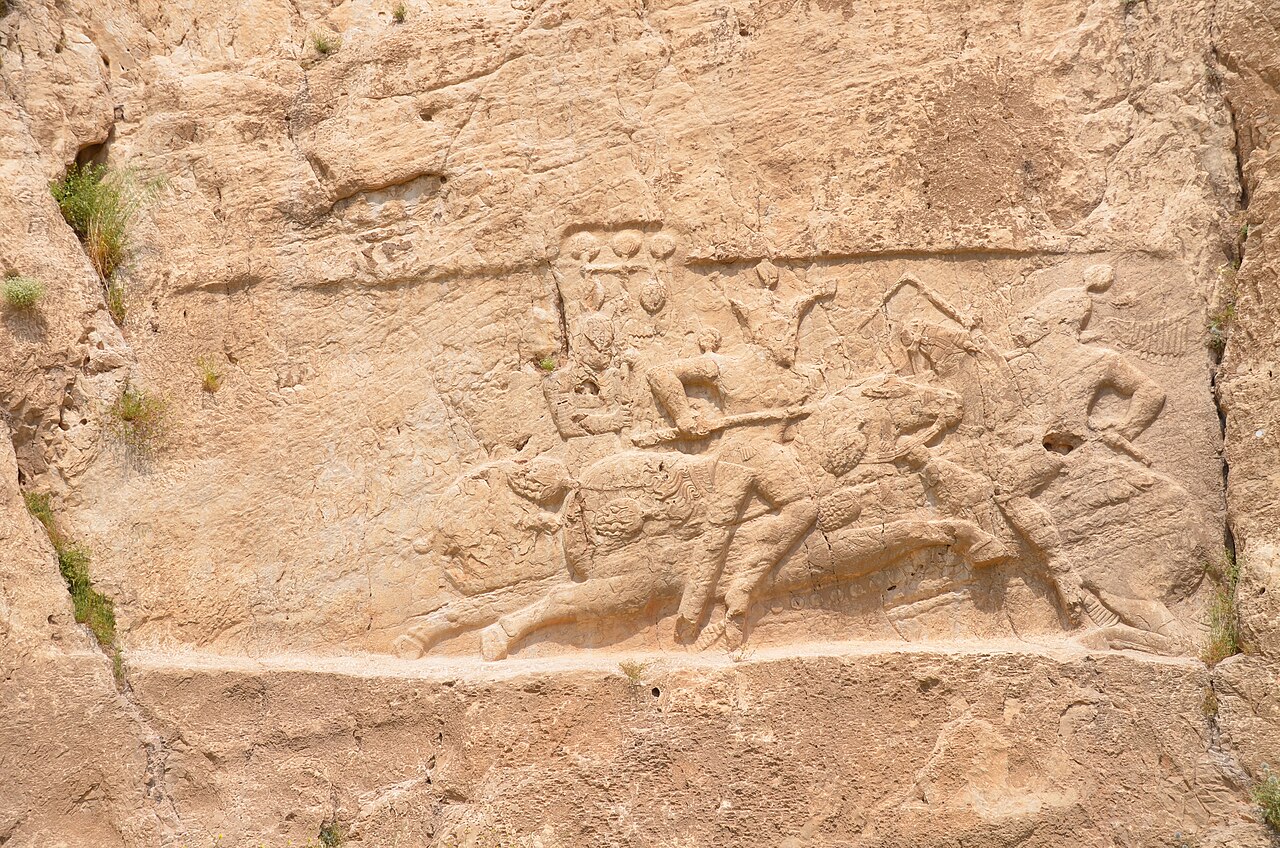

| Period | 224–651 CE |
|---|---|
| Core troops | Armoured noble cavalry (Middle Persian aswārān, Persian savârân) |
| Other arms | Horse archers, war elephants, Daylamite and other infantry, siege engineers |
| Commanders | Eran-spahbed (supreme commander) until the 6th century; then four regional spahbeds |
| Main enemies | Rome and Byzantium; Kushans, Chionites, Hephthalites and Turks in the east; Arabs |
| Main sources | Ammianus Marcellinus, Procopius, the Strategikon of Maurice, al-Tabari, rock reliefs |
The horsemen
The heart of the army was the armoured cavalryman, drawn at first from the great families and the lesser nobility. Roman writers called such troops clibanarii, from a word for an oven, because of the heat of their iron. Ammianus Marcellinus, a Roman officer who fought against Shapur II in the 350s and 360s, describes Persian horsemen covered in plates of iron so closely fitted that their bodies seemed to move like statues, and horses protected by coats of leather or mail.
Their main weapons were the long lance, used two-handed in a charge, the sword, the mace and the bow. The rock relief of Ardashir I at Firuzabad shows the king and his son unhorsing their enemies with lances in single combats, and the reliefs of Bahram II at Naqsh-e Rostam show similar duels. At Taq-e Bostan, a life-size armoured horseman, usually identified as Khosrow II, wears a mail hood and carries a lance and shield. See Taq-e Bostan and the Sasanian reliefs of Naqsh-e Rostam.
Al-Tabari preserves a list of the equipment a cavalryman had to bring to the muster under Khosrow I. It includes horse armour, a coat of mail and breastplate, leg armour, a sword, a lance, a shield, a mace, an axe or club, a bow case with two bows and spare strings, thirty arrows and two plaited cords. In the story attached to it, the official in charge of the review turned away the king himself until he had shown his spare bowstrings.
Archers and tactics
The Persians were famous for their archery. Procopius, describing the battles of Justinian’s wars, says that Persian archers shot much faster than the Romans, though Roman bows were stronger and their arrows hit harder. The Strategikon, a Byzantine manual of around 600 attributed to the emperor Maurice, gives advice on how to fight the Persians. It describes them as disciplined and orderly, skilled at using rough ground, fond of fortified camps and of drawn-out battles in which their arrows could wear down the enemy, and less willing to face a fast close charge.
Tactics combined both kinds of horsemen: archers to break up enemy formations and armoured lancers to charge at the right moment. The king or his commander stood at the centre with the royal standard, the Derafsh-e Kaviani of later tradition, and the loss of the standard or the commander often decided a battle.
Elephants and infantry
War elephants, brought from India, appear in Persian armies from the 3rd century to the end of the empire. Roman writers describe them carrying towers with archers and frightening horses unused to them. Ammianus saw them during Julian’s invasion of 363, and they fought at al-Qadisiyyah in the 630s, where the Arab armies learned to attack their eyes and trunks.
The infantry are less visible in the sources, and Roman authors often dismissed them as poorly armed peasants. That was not the whole picture. The Daylamites, mountaineers from the south-west shore of the Caspian, were prized foot soldiers armed with spears, shields and battle axes, and they appear in many campaigns of the 6th and 7th centuries. Infantry also garrisoned the fortresses and worked the siege engines.
Siege warfare
The Parthians had been weak at sieges; the Sasanians were not. Shapur I took Dura-Europos on the Euphrates around 256 using mines and a great ramp. Excavations found the bodies of Roman soldiers in a tunnel, and the archaeologist Simon James has argued that the Persians filled the countermine with toxic smoke from sulphur and bitumen, one of the earliest known uses of chemical warfare. In 359 Shapur II besieged Amida (modern Diyarbakır). Ammianus, who was inside, describes siege towers, ramps and elephants during a siege of seventy-three days that ended in the city’s capture.
In the 6th and 7th centuries Persian armies took Antioch (540), Dara (573 and again in 604 or 605), Jerusalem (614) and Alexandria (619). Sasanian engineers built rams, towers, catapults and mines and learned from Roman techniques.
Allies, mercenaries and frontiers
Every large Sasanian army included allied troops: Arab horsemen of the Lakhmid kingdom of al-Hira, Armenian and Albanian nobles from the Caucasus, Chionites, Hephthalites and Turks from Central Asia at different times. At Amida in 359 the king of the Chionites, Grumbates, fought alongside Shapur II and lost his son under the walls.
The empire also built long fixed defences. The Great Wall of Gorgan, running about 195 kilometres from the Caspian coast across the Gorgan plain, and the walls at Derbent on the Caspian shore of the Caucasus, blocked the nomad routes from the north. These works are covered with other Sasanian building in Sasanian cities, palaces and bridges.
Organisation and pay
In the early empire the army was led by the king or by the Eran-spahbed, the “army chief of Iran”, and the great families raised many of the troops. Under Khosrow I the command was divided among four generals, one for each quarter of the empire, and a paid cavalry recruited from the lesser landholders, the dehqans, became more important. These changes are described in the reforms of Khosrow I. Military offices also had a scribal side: rolls of soldiers, pay and equipment were kept by officials whose seals survive.
Strength and weakness
The army’s victories show its quality: three Roman emperors defeated by Shapur I, Julian’s invasion turned back, the long wars of the 6th century fought to a draw, and the conquests of 603–621. Its weakness was political. Its best troops belonged to great families who could turn them against the king, as Bahram Chobin and Shahrbaraz did, and after the losses of 627–628 and the civil wars the empire could not replace them. Read more in the last great war and the Battle of al-Qadisiyyah.
Persian words from this page
| سواران | savârân | horsemen, cavalry |
| سپهبد | sepahbod | army commander |
| سپاه | sepâh | army |
| کمان | kamân | bow |
| تیر | tir | arrow |
| نیزه | neyze | lance, spear |
| دیلم | Deylam | Daylam, home of the Daylamites |
Sources and further reading
- Ammianus Marcellinus, Res Gestae, books 18–19 (siege of Amida) and 23–25 (Julian’s campaign).
- Procopius, History of the Wars, books 1–2 (the Persian Wars).
- Maurice’s Strategikon, trans. George T. Dennis (University of Pennsylvania Press, 1984), book 11.
- Kaveh Farrokh, Sassanian Elite Cavalry AD 224–642 (Osprey, 2005).
- Simon James, “Stratagems, Combat, and ‘Chemical Warfare’ in the Siege Mines of Dura-Europos”, American Journal of Archaeology 115 (2011).
- “Army i. Pre-Islamic Iran”, Encyclopaedia Iranica.
Want to learn Persian? Get the free Starter Pack
Get the 14-page printable Starter Pack (all 32 letters, a 7-day reading plan, 100 core words and 20 survival phrases) and a short 5-email course. Free.
More in The Sasanian Empire (224–651 CE)
- The Origins of the Sasanian Family
- Ardashir I, Founder of the Sasanian Empire
- Firuzabad: Ardashir’s Round City
- Shapur I, King of Kings of Iran and Non-Iran
- Bishapur: Shapur’s City
- The Battle of Edessa and the Capture of Valerian
- The Ka’ba-ye Zartosht Inscription of Shapur I
- Mani and Manichaeism
- Hormizd I and Bahram I
- Kartir and the Zoroastrian Church
- Bahram II
- Narseh and the Peace of Nisibis
- Shapur II the Great
- Julian’s Invasion of Persia (363)
- Christians in the Sasanian Empire
- Shapur III and the Partition of Armenia
- Yazdegerd I
- Bahram V Gur
- Yazdegerd II
- The Battle of Avarayr (451)
- The Hephthalites and Iran’s Eastern Frontier
- Peroz I and the Hephthalite Disaster
- Kavad I
- Zamasp and Kavad’s Return
- Mazdak and the Mazdakite Movement
- Khosrow I Anushirvan the Just
- The Sasanian–Byzantine Wars of the 6th Century
- The Battle of Dara (530)
- Khosrow I Sacks Antioch (540)
- The Lazic War (541–562)
- The Reforms of Khosrow I
- The Academy of Gondishapur: History and Legend
- Borzuya, Chess and Kalila wa Dimna
- Taq Kasra: The Arch of Ctesiphon
- The Sasanian Conquest of Yemen
- The Sasanians and the Western Turks
- Hormizd IV
- Bahram Chobin’s Rebellion
- Khosrow II Parviz
- The Last Great War: Byzantium and Persia, 602–628
- The Siege of Constantinople (626)
- Heraclius Strikes Back
- Shirin: Queen and Legend
- Shahrbaraz, the General Who Became King
- Civil War and the Queens Boran and Azarmidokht
- Yazdegerd III, the Last Sasanian King
- The Sasanian Army
- Sasanian Society and the Class System
- Zoroastrianism under the Sasanians
- Sasanian Art: Silver, Reliefs and Silk
- The Sasanian Reliefs of Naqsh-e Rostam
- Taq-e Bostan
- Sasanian Cities, Palaces and Bridges
- Middle Persian (Pahlavi) Language and Literature
- Sasanian Coins and Silverwork
- Women in the Sasanian Empire
- Polo, Hunting and Games at the Sasanian Court
- The Sasanian Legacy