Yazdegerd I ruled the Sasanian Empire from 399 to 420 CE. He kept a long peace with Rome, allowed the Christians of Iran to organise an official church in 410, and favoured the Jewish community, which won him praise in Christian and Jewish writings. The Persian nobility and priesthood remembered him very differently, as Yazdegerd “the Sinner”.
| Reign | 399–420 CE |
|---|---|
| Predecessor | Bahram IV (388–399) |
| Successor | Bahram V Gur, after a short disputed succession |
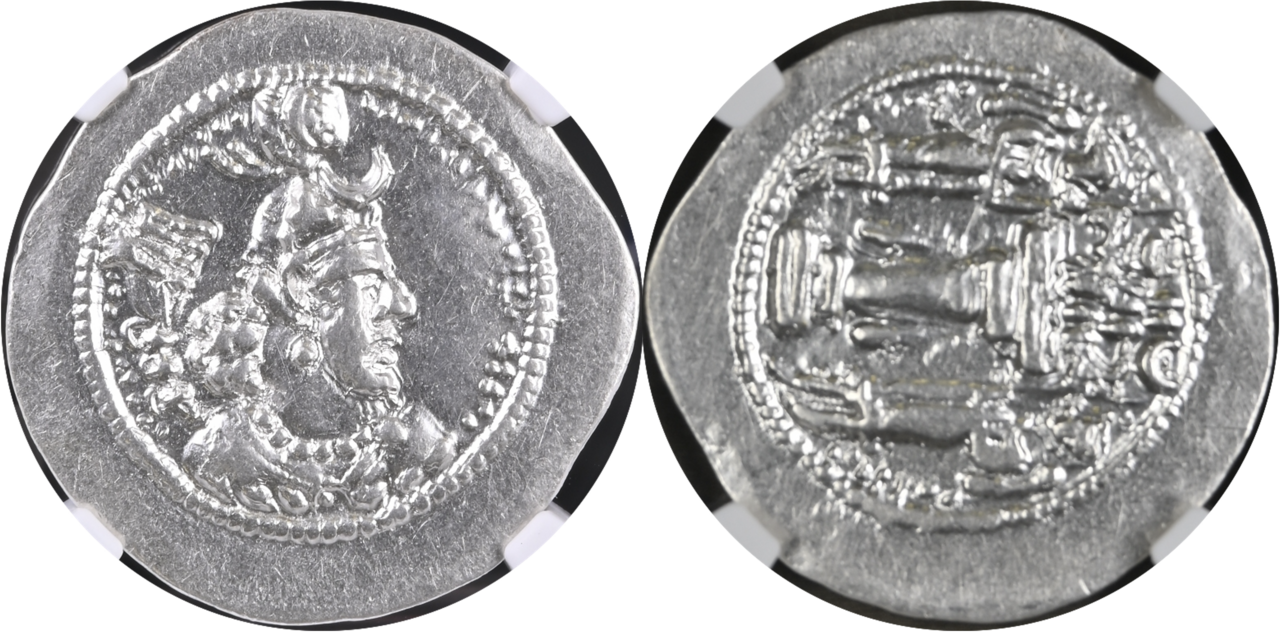
| Epithets | “the Sinner” (Persian bezeh-gar, Arabic al-athim) in later Persian and Arabic histories; “peace in the realm” (Ramshahr) on his own coins |
| Known for | Peace with Rome, the Synod of Seleucia-Ctesiphon (410), conflict with the nobles |
| Died | 420, in the northeast of the empire; the circumstances are disputed |

A king between two reputations
Few Sasanian kings have such a split record. Syriac Christian writers called Yazdegerd “the victorious” and “the good”. Jewish tradition remembered a friendly king who honoured the rabbis. The Persian royal histories, which reached us through Arabic writers such as al-Tabari in the 10th century, describe a harsh, suspicious ruler who despised advice, humiliated the great families and punished at whim.
Both pictures come from interested parties. The Christian and Jewish authors were grateful for his protection. The Persian tradition was shaped by the priests and the noble houses, the very groups Yazdegerd tried to keep in check. Most modern historians, including A. Shapur Shahbazi in the Encyclopaedia Iranica, read the “sinner” label as the verdict of an aristocracy that lost influence under him rather than as a sober judgement of his rule.
The nobles and the crown
When Yazdegerd came to the throne the monarchy was weak. Three kings in a row, Ardashir II, Shapur III and Bahram IV, had been deposed or killed in the space of about twenty years, and the great noble houses and the Zoroastrian priests had grown used to making and unmaking kings. Yazdegerd set out to reverse this. The sources say he kept the magnates away from court, executed or dismissed powerful men and refused to let the priests dictate policy.
His tolerance of other religions was part of the same struggle. A king who protected Christians and Jews gained loyal subjects who owed nothing to the Persian nobility, and he reduced the hold of a priesthood that had pressed his predecessors to persecute. Seen this way, his religious policy was as much about royal power as about personal conviction.
Peace with Rome and the guardian story
Relations with the Eastern Roman Empire were unusually calm. Rome and Persia had just divided Armenia between them in the 380s (see Shapur III and the Partition of Armenia), and Yazdegerd kept that settlement for twenty years.
The most famous story about him comes from the Byzantine historian Procopius, writing over a century later. According to Procopius, the emperor Arcadius, dying in 408 and fearing for his young son Theodosius II, named Yazdegerd as the boy’s guardian in his will. Yazdegerd accepted, threatened war on anyone who plotted against the child, and sent a tutor named Antiochus to the Roman court. Historians are divided. Some accept that Arcadius asked for Persian goodwill and that Yazdegerd gave it; others think the story grew from the real friendship of the two courts into a legend. Earlier and nearer sources do not mention the will, which is the main reason for doubt.
The Christian church gets a charter
The Roman bishop Marutha of Maypherqat came to Ctesiphon as an envoy and, according to the church historian Socrates, won the king’s trust partly by treating his illness. With Yazdegerd’s approval a synod met at Seleucia-Ctesiphon in 410. It recognised the bishop of the capital as head of the Christians in the empire and organised the church into provinces under royal protection. The king’s officials attended and announced that Christians might worship openly and rebuild churches destroyed under Shapur II. The story of that synod and of the Church of the East that grew from it is told in Christians in the Sasanian Empire.
The peace did not last to the end of the reign. Around 419 or 420 a priest named Abdas burned a fire temple in Khuzestan and refused to rebuild it. Yazdegerd had him executed, and a new wave of persecution began, which continued under his successor. Whether the king changed his mind or simply lost the ability to resist the priests is not clear.
Yazdegerd and the Jews
Jewish sources describe Yazdegerd as a friend of the community in Babylonia, and the Talmud records rabbis at his court. A later Middle Persian text on the cities of Iran says that his wife Shushandukht, daughter of the Jewish exilarch, was the mother of Bahram V, and that she asked for Jews to be settled in Isfahan and other towns. Historians treat this as tradition rather than proven fact, but it shows how the Jews of Iran later remembered the reign. For the longer story, see The Jews of Iran.
A mysterious death
Yazdegerd died in 420 far from the capital, in the northeast. Al-Tabari and Ferdowsi tell the same tale: a magnificent riderless horse appeared from a spring, let no one but the king approach, and killed him with a kick before vanishing into the water. Persian tradition saw it as divine punishment. Modern historians, Shahbazi among them, see a cover story and suspect that nobles murdered him.
The nobles then tried to keep his sons off the throne. Shapur, whom Yazdegerd had made king of Persian Armenia, hurried to Ctesiphon and was killed. The magnates crowned a distant relative named Khosrow. A younger son, Bahram, who had been raised at the Arab court of al-Hira, came back with an Arab army and forced his way to power. That story continues on the page on Bahram V Gur.
- 399 Yazdegerd succeeds Bahram IV
- 408 Death of Arcadius; Procopius later claims Yazdegerd became guardian of Theodosius II
- 410 Synod of Seleucia-Ctesiphon under royal protection
- c. 419–420 Burning of a fire temple; persecution of Christians resumes
- 420 Death of Yazdegerd; succession struggle won by Bahram V
How historians see the reign
Recent work, for example Touraj Daryaee’s history of the Sasanians, treats Yazdegerd I as one of several 5th-century kings who tried to make the crown independent of the great families. His methods were peace abroad and new allies at home. The cost was a lasting hostility from the people who wrote Iran’s own record of its kings, which is why the Persian tradition and the foreign sources still disagree so sharply about him.
Persian words from this page
| یزدگرد | Yazdgerd | Yazdegerd |
| بزهگر | bezeh-gar | sinner, wrongdoer |
| بهرام | Bahrâm | Bahram |
| تیسفون | Tisfun | Ctesiphon |
| حیره | Hireh | al-Hira |
| آتشکده | âtashkadeh | fire temple |
Sources and further reading
- Procopius, History of the Wars, Book 1, chapter 2 (the guardianship story).
- Al-Tabari, The History of al-Tabari, vol. V: The Sasanids, the Byzantines, the Lakhmids, and Yemen, trans. C. E. Bosworth (SUNY Press, 1999).
- A. Shapur Shahbazi, “Yazdegerd I”, Encyclopaedia Iranica, iranicaonline.org.
- Socrates Scholasticus, Ecclesiastical History, Book 7 (Marutha at the Persian court).
- Touraj Daryaee, Sasanian Persia: The Rise and Fall of an Empire (I.B. Tauris, 2009).
Want to learn Persian? Get the free Starter Pack
Get the 14-page printable Starter Pack (all 32 letters, a 7-day reading plan, 100 core words and 20 survival phrases) and a short 5-email course. Free.
More in The Sasanian Empire (224–651 CE)
- The Origins of the Sasanian Family
- Ardashir I, Founder of the Sasanian Empire
- Firuzabad: Ardashir’s Round City
- Shapur I, King of Kings of Iran and Non-Iran
- Bishapur: Shapur’s City
- The Battle of Edessa and the Capture of Valerian
- The Ka’ba-ye Zartosht Inscription of Shapur I
- Mani and Manichaeism
- Hormizd I and Bahram I
- Kartir and the Zoroastrian Church
- Bahram II
- Narseh and the Peace of Nisibis
- Shapur II the Great
- Julian’s Invasion of Persia (363)
- Christians in the Sasanian Empire
- Shapur III and the Partition of Armenia
- Yazdegerd I
- Bahram V Gur
- Yazdegerd II
- The Battle of Avarayr (451)
- The Hephthalites and Iran’s Eastern Frontier
- Peroz I and the Hephthalite Disaster
- Kavad I
- Zamasp and Kavad’s Return
- Mazdak and the Mazdakite Movement
- Khosrow I Anushirvan the Just
- The Sasanian–Byzantine Wars of the 6th Century
- The Battle of Dara (530)
- Khosrow I Sacks Antioch (540)
- The Lazic War (541–562)
- The Reforms of Khosrow I
- The Academy of Gondishapur: History and Legend
- Borzuya, Chess and Kalila wa Dimna
- Taq Kasra: The Arch of Ctesiphon
- The Sasanian Conquest of Yemen
- The Sasanians and the Western Turks
- Hormizd IV
- Bahram Chobin’s Rebellion
- Khosrow II Parviz
- The Last Great War: Byzantium and Persia, 602–628
- The Siege of Constantinople (626)
- Heraclius Strikes Back
- Shirin: Queen and Legend
- Shahrbaraz, the General Who Became King
- Civil War and the Queens Boran and Azarmidokht
- Yazdegerd III, the Last Sasanian King
- The Sasanian Army
- Sasanian Society and the Class System
- Zoroastrianism under the Sasanians
- Sasanian Art: Silver, Reliefs and Silk
- The Sasanian Reliefs of Naqsh-e Rostam
- Taq-e Bostan
- Sasanian Cities, Palaces and Bridges
- Middle Persian (Pahlavi) Language and Literature
- Sasanian Coins and Silverwork
- Women in the Sasanian Empire
- Polo, Hunting and Games at the Sasanian Court
- The Sasanian Legacy