The Sasanian Archaeological Landscape of Fars is a UNESCO World Heritage Site, inscribed in 2018, made up of eight sites in three areas of southern Fars: Firuzabad, Bishapur and Sarvestan. Together they hold the round city, fortress and palace of Ardashir I, founder of the Sasanian Empire in 224 CE, the city and rock reliefs of his son Shapur I, and the domed building at Sarvestan, and they can all be reached on day trips from Shiraz.
| UNESCO name | Sassanid Archaeological Landscape of Fars Region (inscribed 2018) |
|---|---|
| Firuzabad | Round city of Ardashir-Khwarrah, Qal’eh Dokhtar, Palace of Ardashir, rock reliefs; about 110 km south of Shiraz |
| Bishapur | City of Shapur I, reliefs of Tang-e Chowgan, Shapur Cave; near Kazerun, west of Shiraz |
| Sarvestan | Domed brick monument; about 90 km south-east of Shiraz |
| Period | 3rd to 7th century CE, with Sarvestan’s date debated |
The history of these places is told in our history section: Firuzabad: Ardashir’s Round City, Bishapur: Shapur’s City and, for the wider picture, Sasanian Cities, Palaces and Bridges. This page is a guide to visiting them.

Why these sites belong together
Fars was the homeland of the Sasanian family. Ardashir rose here as a local ruler and built his first capital in a valley south of Shiraz before he defeated the last Parthian king. His son Shapur I founded Bishapur after his victories over Rome. UNESCO’s description stresses how these places use the natural landscape, with fortresses on ridges and cities in river valleys, and how they combine Achaemenid and Parthian traditions with Roman influence, in architecture that later shaped the buildings of the Islamic period.
For a visitor, the attraction is seeing the beginnings of Iranian domed architecture in the places where it was invented, often with very few other people around.
Firuzabad: Ardashir’s first capital
The road south from Shiraz drops through a narrow gorge, the Tang-ab, before opening into the Firuzabad plain. In the gorge, on the cliffs above the river, are two of Ardashir’s rock reliefs, one showing him receiving the ring of kingship from the god Ahura Mazda, the other a mounted battle with the Parthians.
On a ridge above the gorge stands Qal’eh Dokhtar (قلعه دختر, “the Maiden’s Castle”), Ardashir’s early fortress-palace, reached by a steep climb from the road. Further on, beside a spring-fed pool, is the Palace of Ardashir, whose three great domes on squinches are among the earliest surviving domes of this kind. The round city itself, with its central tower, is best understood from above; on the ground you see the line of the circular wall and the stump of the tower in the fields.
Bishapur and the Shapur Cave
Bishapur lies beside the Shapur river near Kazerun, on the old road from Shiraz to the Persian Gulf coast. The excavated city has a grid plan, the remains of a palace hall, and a deep, square stone building often identified as a water temple, perhaps dedicated to Anahita. Mosaics found here, in a style influenced by Roman work, are now in museums in Tehran and Paris.
Across the river, the cliffs of the Tang-e Chowgan gorge carry six large rock reliefs of Sasanian kings, including Shapur I’s triumph over the Romans. High above the gorge is the Shapur Cave (غار شاپور), where a statue of Shapur about seven metres tall, carved from a natural column of rock, stands in the cave mouth. Reaching it is a stiff hike and climb of a couple of hours each way, best done with a local guide and not in the summer heat.
Sarvestan: a building that keeps its secrets
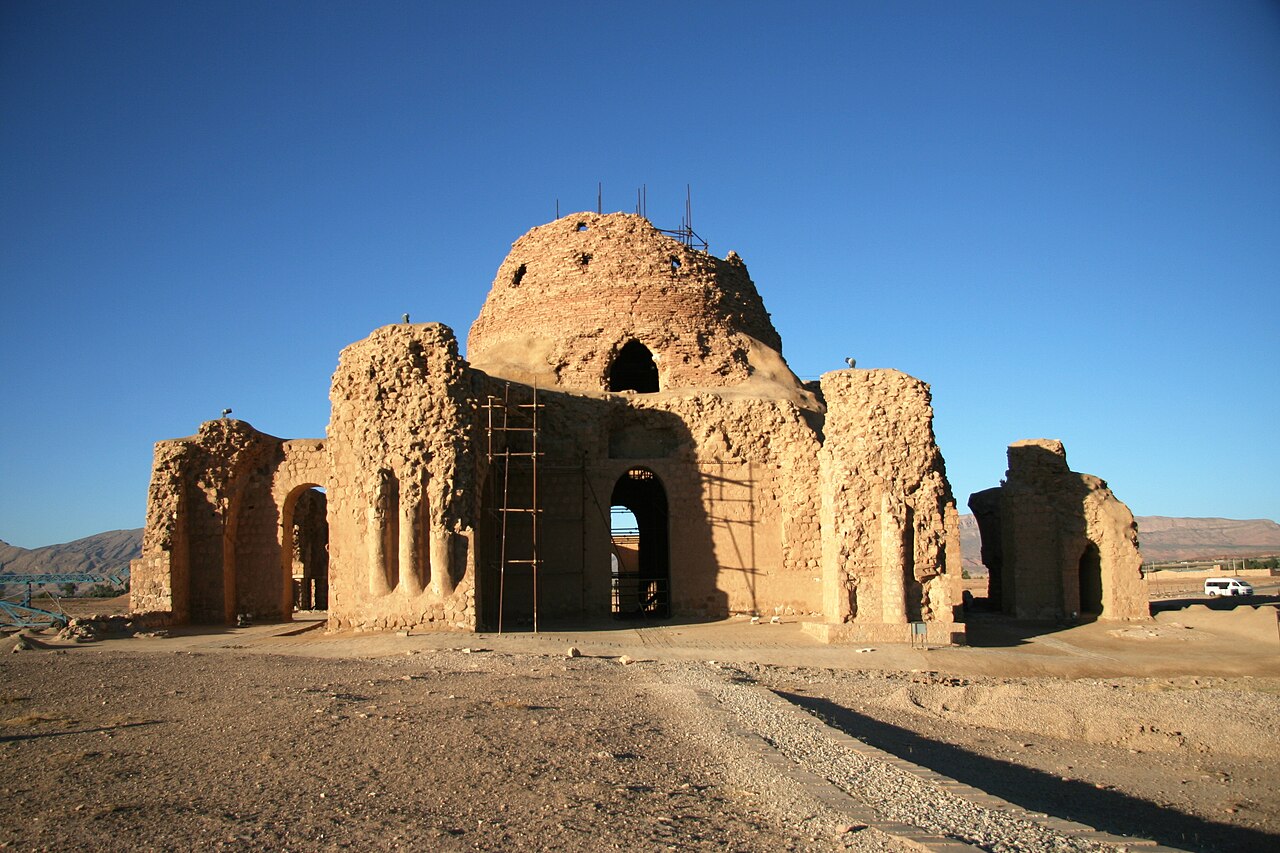
The Sarvestan monument (سروستان) stands alone on a plain south-east of Shiraz. Its brick dome rises over a square hall entered through three arches, with courtyards and smaller rooms around it. It is usually called a palace, but its purpose is uncertain: it may have been a residence, a hunting lodge or a religious building.
Its date is just as debated. Older studies placed it in the 5th century, linking it to the reign of Bahram V. Lionel Bier’s detailed survey, published in 1986, argued that it belongs to the early Islamic period, and other scholars place it at the very end of Sasanian rule or just after. Whichever is right, it shows how long Sasanian building methods continued after the empire fell. Look up into the dome and side halls to see how the builders carried heavy brick vaults on piers and squinches.
Planning a visit
- Each area is a separate day trip from Shiraz. Firuzabad and Sarvestan are each about one and a half to two hours away; Bishapur is usually combined with Kazerun.
- Qal’eh Dokhtar and the Shapur Cave involve steep, rough climbs. Allow time, carry water and wear proper shoes.
- The best months are spring and autumn. Summer in southern Fars is very hot, especially on exposed sites.
- Opening times and entry arrangements change; check current information locally.
- Follow your own government’s current travel advice for Iran.
Combine these sites with the Achaemenid and Sasanian tombs and reliefs at Naqsh-e Rostam and with Persepolis for a full picture of ancient Fars.
Persian words from this page
| ساسانی | Sâsâni | Sasanian |
| کاخ | kâkh | palace |
| قلعه دختر | Qal’e Dokhtar | the Maiden’s Castle |
| گنبد | gonbad | dome |
| تنگ | tang | gorge, narrow pass |
| غار | ghâr | cave |
| سروستان | Sarvestân | Sarvestan (“place of cypresses”) |
Sources and further reading
- UNESCO World Heritage Centre, Sassanid Archaeological Landscape of Fars Region (inscribed 2018).
- Encyclopaedia Iranica, “Fīrūzābād”.
- Encyclopaedia Iranica, “Bīšāpūr”.
- Lionel Bier, Sarvistan: A Study in Early Iranian Architecture (Pennsylvania State University Press, 1986).
- Dietrich Huff, “Architecture, iii. Sasanian Period”, Encyclopaedia Iranica.
Want to learn Persian? Get the free Starter Pack
Get the 14-page printable Starter Pack (all 32 letters, a 7-day reading plan, 100 core words and 20 survival phrases) and a short 5-email course. Free.
More in Top Places to Visit in Iran
- Naqsh-e Jahan Square
- Shah (Imam) Mosque, Isfahan
- Sheikh Lotfollah Mosque
- Ali Qapu Palace
- Jameh Mosque of Isfahan
- Si-o-se Pol and Khaju Bridge
- Vank Cathedral
- Hasht Behesht Palace
- Naqsh-e Rostam
- Eram Garden, Shiraz
- Nasir al-Molk (Pink) Mosque
- Tomb of Hafez (Hafezieh)
- Tomb of Saadi (Saadieh)
- Shah Cheragh Shrine
- Arg of Karim Khan
- Fin Garden, Kashan
- Historic Houses of Kashan
- Jameh Mosque of Yazd
- Yazd Fire Temple and Towers of Silence
- Dowlatabad Garden and Windcatcher
- Amir Chakhmaq Complex
- Golestan Palace
- National Museum of Iran
- Treasury of National Jewels
- Tehran Grand Bazaar
- Milad Tower
- Imam Reza Shrine, Mashhad
- Tomb of Ferdowsi, Tus
- Tomb of Omar Khayyam, Neyshabur
- Tomb of Avicenna, Hamadan
- Ganjnameh Inscriptions, Hamadan
- Behistun (Bisotun): Visiting the Site
- Taq-e Bostan: Visiting the Site
- Tabriz Historic Bazaar
- Takht-e Soleyman
- Armenian Monastic Ensembles of Iran
- Sheikh Safi al-Din Shrine, Ardabil
- Dome of Soltaniyeh
- Alamut Castle
- Falak-ol-Aflak Castle
- Shushtar Historical Hydraulic System
- Chogha Zanbil: Visiting the Ziggurat
- Susa Archaeological Site
- Arg-e Bam
- Ganjali Khan Complex, Kerman
- Shazdeh Garden, Mahan
- Rayen Castle
- Dasht-e Lut (Lut Desert)
- Maranjab Desert and Caravanserai
- Varzaneh Desert
- Mount Damavand
- Hyrcanian Forests
- Lake Urmia
- Badab-e Surt Springs
- Ali Sadr Cave
- The Kaluts of Shahdad
- Qeshm Geopark
- Hormuz Island Colours
- Visiting Persepolis: A Day Trip from Shiraz
- Visiting Pasargadae
- Persian Caravanserais
- The Qanat of Gonabad
- Meymand Village
- Sasanian Sites of Fars: Firuzabad, Bishapur and Sarvestan
- Gonbad-e Qabus: Visiting the Tower
- Zayandeh Rud and Isfahan’s Bridges
- Tochal and Darband: Hiking Above Tehran
- Mount Sabalan
- Skiing in Iran: Dizin and Shemshak
- Golestan National Park