Naqsh-e Rostam (نقش رستم) is a cliff about six kilometres north-west of Persepolis in Fars province, where four Achaemenid kings, Darius the Great among them, were buried in cross-shaped tombs cut high in the rock in the 5th century BCE. Below them, Sasanian kings carved huge reliefs of their coronations and victories some 700 years later. It is a short stop on the way from Shiraz to Persepolis, and one of the most impressive ancient sites in Iran.
| Persian name | Naqsh-e Rostam, “the picture of Rostam” |
|---|---|
| Location | Hossein Kuh cliff, Marvdasht plain, about 60 km north of Shiraz |
| Periods | Elamite traces; Achaemenid tombs (5th century BCE); Sasanian reliefs (3rd–4th centuries CE) |
| What is there | Four royal tombs, the Ka’ba-ye Zartosht tower, eight Sasanian reliefs, inscriptions |
| Time to allow | About an hour |
| Nearby | Naqsh-e Rajab (3 km), Persepolis (6 km), Pasargadae (about 80 km) |
Two history pages cover the site in depth: The Achaemenid Tombs of Naqsh-e Rostam, on the tombs and Darius’s inscriptions, and The Sasanian Reliefs of Naqsh-e Rostam, which describes each relief in turn. This page is a practical guide to seeing the site.
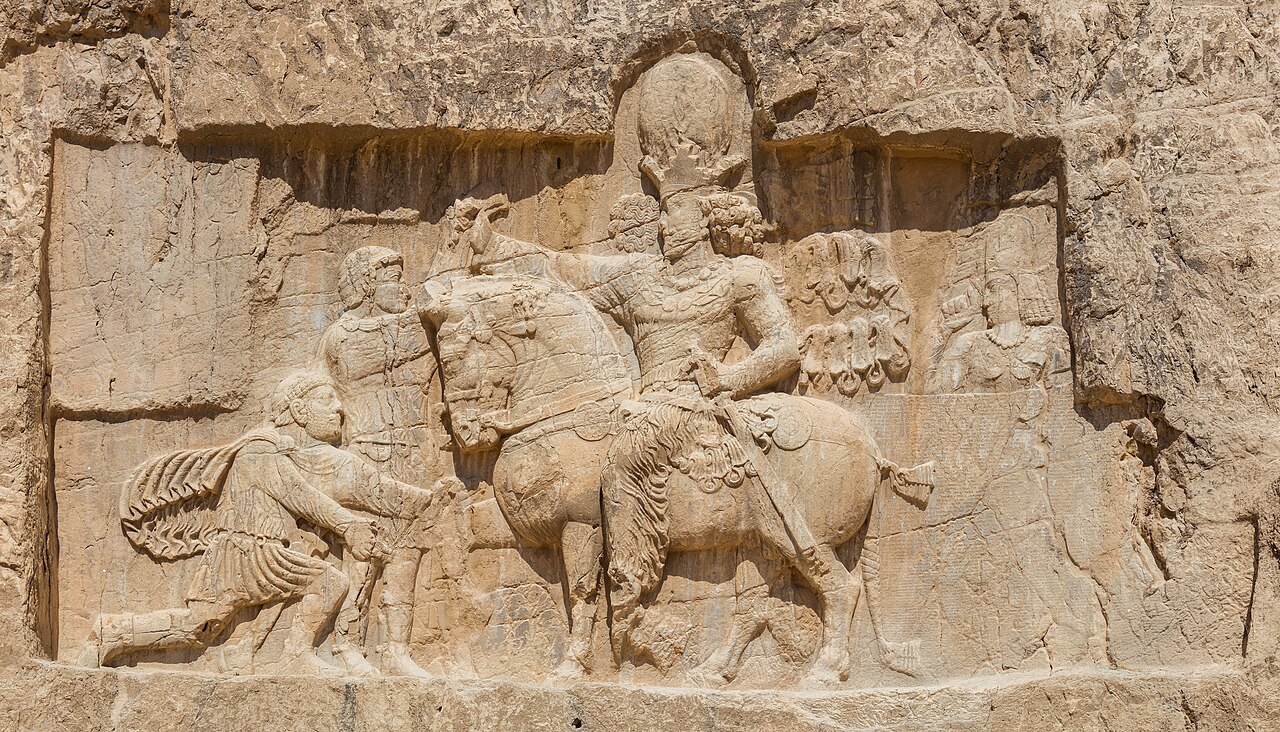

What you see when you arrive
From the entrance you face a long, sheer wall of pale grey limestone. Four great crosses are cut into it, high above the ground, each with a carved facade in the centre. Lower down, at eye level and just above, are the Sasanian reliefs: horsemen, kings and gods, many of them several metres across. In front of the cliff, on lower ground, stands a square stone tower with a staircase, the Ka’ba-ye Zartosht. The path runs along the foot of the cliff, so you can see everything in a single walk.
The four tombs
The tombs look almost identical. Each is a cross about 20 metres high. The lower arm of the cross is blank; the horizontal arm imitates the front of a palace, with four columns and a doorway leading into a small rock chamber; the upper arm shows the king standing on a platform held up by figures representing the peoples of the empire, facing a fire altar, with a winged symbol above.
From left to right, they are usually given to Darius II, Artaxerxes I, Darius I and Xerxes I. Only one, the third from the left, names its owner: it is the tomb of Darius the Great, whose long inscriptions are carved around the facade. The tombs are too high to reach, and the chambers inside were looted long ago, but even from the ground you can make out the column capitals with paired bulls, the same design as at Persepolis, and the rows of small figures holding up the king’s throne.
Things to look for
- The throne-bearers on the upper part of each tomb. On Darius’s tomb, labels name each people, from Persians and Medes to Ethiopians and Indians.
- The cuneiform inscriptions beside the facade of Darius’s tomb, in Old Persian, Elamite and Babylonian. A pair of binoculars helps.
- The doorways: only the lower part of each door was opened; the rest is carved stone.
The Sasanian reliefs
When the Sasanian dynasty rose in Fars in the 3rd century CE, its kings chose this cliff, beside the tombs of the old Persian kings, for their own monuments. Eight reliefs survive. The most famous shows Shapur I on horseback, with a Roman emperor kneeling before him and another held by the wrist, recording his victories over Rome in the mid-3rd century; see The Battle of Edessa and the Capture of Valerian. Another shows Ardashir I, founder of the dynasty, receiving the ring of kingship from the god Ahura Mazda, both on horseback, with their defeated enemies under the horses’ hooves.
The reliefs are much closer to the ground than the tombs, and you can see details of crowns, hair, ribbons and armour. Each king of the dynasty had his own crown, which is how historians identify them. Low sun, early or late in the day, brings out the carving far better than flat midday light. Beside the relief of Bahram II and his court, look for traces of a much older Elamite carving that the Sasanian sculptors largely cut away.
The Ka’ba-ye Zartosht
The square tower in front of the cliff, the “Cube of Zoroaster”, was built in the Achaemenid period, and nobody knows for certain what it was for. It has a single room reached by a stone staircase, and its walls are decorated with blind windows in dark stone. On its lower walls, Shapur I had a long inscription carved in Middle Persian, Parthian and Greek, one of the most important texts of Sasanian history. See The Ka’ba-ye Zartosht Inscription of Shapur I.
Naqsh-e Rajab, on the way
About three kilometres away, on the road towards Persepolis, a small hollow in the rock called Naqsh-e Rajab holds four more early Sasanian reliefs, including an investiture of Ardashir I and a relief of the priest Kartir with his inscription. It takes only 15 minutes and is often skipped, which is a pity: the carvings are in good condition and you can stand right in front of them.
Planning a visit
- Most visitors come on a day trip from Shiraz, combining Naqsh-e Rostam, Naqsh-e Rajab and Persepolis; some add Pasargadae further north. See Visiting Persepolis and Visiting Pasargadae.
- Visiting Naqsh-e Rostam early in the morning, before Persepolis, avoids the heat and the crowds, and the morning light is good on the cliff. Late afternoon is the other good time.
- There is little shade. Bring water and a hat, especially from May to September.
- Opening hours and tickets change; check current information locally. Taxis and tours from Shiraz are easy to arrange.
For the city that most visitors use as a base, see our Shiraz city guide.
Persian words from this page
| نقش | naqsh | picture, design, relief |
| رستم | Rostam | Rostam, hero of the Shahnameh |
| آرامگاه | ârâmgâh | tomb, resting place |
| سنگنگاره | sang-negâre | rock relief |
| کعبه زرتشت | Ka’ba-ye Zartosht | “Cube of Zoroaster” |
| داریوش | Dâriush | Darius |
| شاپور | Shâpur | Shapur |
Sources and further reading
- Erich F. Schmidt, Persepolis III: The Royal Tombs and Other Monuments (University of Chicago Press, 1970).
- Encyclopaedia Iranica, “Naqš-e Rostam”.
- Pierre Briant, From Cyrus to Alexander: A History of the Persian Empire (Eisenbrauns, 2002).
- Touraj Daryaee, Sasanian Persia: The Rise and Fall of an Empire (I.B. Tauris, 2009).
- Darius I, Naqsh-e Rostam inscriptions DNa and DNb, in Amélie Kuhrt, The Persian Empire: A Corpus of Sources from the Achaemenid Period (Routledge, 2007).
Want to learn Persian? Get the free Starter Pack
Get the 14-page printable Starter Pack (all 32 letters, a 7-day reading plan, 100 core words and 20 survival phrases) and a short 5-email course. Free.
More in Top Places to Visit in Iran
- Naqsh-e Jahan Square
- Shah (Imam) Mosque, Isfahan
- Sheikh Lotfollah Mosque
- Ali Qapu Palace
- Jameh Mosque of Isfahan
- Si-o-se Pol and Khaju Bridge
- Vank Cathedral
- Hasht Behesht Palace
- Naqsh-e Rostam
- Eram Garden, Shiraz
- Nasir al-Molk (Pink) Mosque
- Tomb of Hafez (Hafezieh)
- Tomb of Saadi (Saadieh)
- Shah Cheragh Shrine
- Arg of Karim Khan
- Fin Garden, Kashan
- Historic Houses of Kashan
- Jameh Mosque of Yazd
- Yazd Fire Temple and Towers of Silence
- Dowlatabad Garden and Windcatcher
- Amir Chakhmaq Complex
- Golestan Palace
- National Museum of Iran
- Treasury of National Jewels
- Tehran Grand Bazaar
- Milad Tower
- Imam Reza Shrine, Mashhad
- Tomb of Ferdowsi, Tus
- Tomb of Omar Khayyam, Neyshabur
- Tomb of Avicenna, Hamadan
- Ganjnameh Inscriptions, Hamadan
- Behistun (Bisotun): Visiting the Site
- Taq-e Bostan: Visiting the Site
- Tabriz Historic Bazaar
- Takht-e Soleyman
- Armenian Monastic Ensembles of Iran
- Sheikh Safi al-Din Shrine, Ardabil
- Dome of Soltaniyeh
- Alamut Castle
- Falak-ol-Aflak Castle
- Shushtar Historical Hydraulic System
- Chogha Zanbil: Visiting the Ziggurat
- Susa Archaeological Site
- Arg-e Bam
- Ganjali Khan Complex, Kerman
- Shazdeh Garden, Mahan
- Rayen Castle
- Dasht-e Lut (Lut Desert)
- Maranjab Desert and Caravanserai
- Varzaneh Desert
- Mount Damavand
- Hyrcanian Forests
- Lake Urmia
- Badab-e Surt Springs
- Ali Sadr Cave
- The Kaluts of Shahdad
- Qeshm Geopark
- Hormuz Island Colours
- Visiting Persepolis: A Day Trip from Shiraz
- Visiting Pasargadae
- Persian Caravanserais
- The Qanat of Gonabad
- Meymand Village
- Sasanian Sites of Fars: Firuzabad, Bishapur and Sarvestan
- Gonbad-e Qabus: Visiting the Tower
- Zayandeh Rud and Isfahan’s Bridges
- Tochal and Darband: Hiking Above Tehran
- Mount Sabalan
- Skiing in Iran: Dizin and Shemshak
- Golestan National Park