Persepolis (تخت جمشید, Takht-e Jamshid) lies on the Marvdasht plain about 60 km north-east of Shiraz, and most travellers see it on a day trip that also takes in the royal tombs of Naqsh-e Rostam, the Sasanian reliefs of Naqsh-e Rajab and, further north, Pasargadae. This guide sets out how to plan that day: the order of stops, how long each needs, where to walk inside Persepolis, and what to bring.
| Start | Shiraz |
|---|---|
| Stops | Persepolis, Naqsh-e Rajab, Naqsh-e Rostam, Pasargadae |
| Distances | Shiraz to Persepolis about 60 km by road; Naqsh-e Rajab and Naqsh-e Rostam within about 6 km of Persepolis; Pasargadae about 40 km north-east of Persepolis as the crow flies, further by road |
| Time needed | A full day for all four; half a day for Persepolis and Naqsh-e Rostam |
| UNESCO | Persepolis (1979); Pasargadae (2004) |
| Best season | March to May and October to November |

Choosing the order of the day
There are two sensible ways to run the route. Both start early.
Option 1: Persepolis first
Leave Shiraz soon after sunrise and be at Persepolis when it opens. The terrace has almost no shade, so the first hours are the coolest and the quietest, and the low light brings out the carving on the staircases. Then drive the short distance north to Naqsh-e Rajab and Naqsh-e Rostam, have lunch in Marvdasht or at a roadside restaurant, and continue to Pasargadae in the afternoon. You reach Cyrus’s tomb in the warm evening light and return to Shiraz after dark.
Option 2: Pasargadae first
Drive straight to Pasargadae, the furthest point, and work back towards Shiraz: Naqsh-e Rostam, Naqsh-e Rajab, then Persepolis in the late afternoon. This suits photographers who want Persepolis in the golden hour, but it means walking the terrace when you are tired, and in the warm months the middle of the day at Naqsh-e Rostam is very hot.
If you only have half a day, do Persepolis and Naqsh-e Rostam, with Naqsh-e Rajab on the way. Pasargadae deserves its own unhurried visit; see Visiting Pasargadae.
Persepolis: a walking plan
Allow two and a half to three hours. Our article on Persepolis and its palaces describes each building in detail, and the history of how it was built under Darius and Xerxes is on Building Persepolis. Here is one way to walk it.
- The Great Stairway. Climb the double flight of shallow steps on the west side, built so that people could walk up in procession, and look back over the plain.
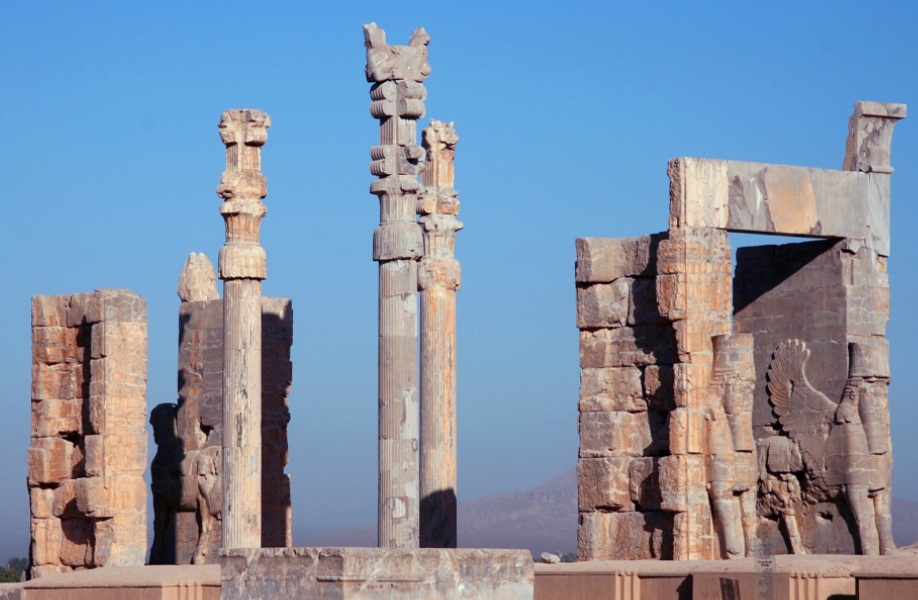
- The Gate of All Nations. Xerxes’ gateway, guarded by huge bull figures. Look for the trilingual inscription of Xerxes and, on the stone, graffiti carved by 19th-century travellers.
- The Apadana. The great audience hall. Its eastern staircase carries the most famous reliefs at Persepolis: delegations from across the empire, Medes and Persians, Lydians, Bactrians, Ethiopians and others, bringing gifts. Take your time here; it is the highlight.
- The Tachara and Hadish. The palaces of Darius and Xerxes on the south side, with carved doorways showing the king and attendants.
- The Hall of a Hundred Columns. Now a forest of column bases, it shows the scale of the throne halls.
- The museum. Housed in a reconstructed part of the so-called Harem of Xerxes, it holds finds from the site.
- The royal tombs on the hill. Above the terrace, rock tombs usually attributed to Artaxerxes II and III are cut into Kuh-e Rahmat. The short, steep path gives the best overview of the whole terrace.
The site was burned in 330 BCE when Alexander occupied it; the debate over why is told on The Burning of Persepolis. South of the terrace you can still see traces of the tent city built for the Shah’s 2,500-year celebration of 1971.
Naqsh-e Rajab: a 20-minute stop
A few kilometres north of Persepolis, beside the road, a small rock recess holds four early Sasanian reliefs from the 3rd century CE: the investiture of Ardashir I by the god Ahura Mazda, the investiture of Shapur I, Shapur I on horseback followed by nine courtiers, and a bust of the Zoroastrian high priest Kerdir with a long Middle Persian inscription. It is easy to miss, so ask your driver to stop. Read about the men in the reliefs on Ardashir I and Kartir.
Naqsh-e Rostam: about an hour
About 6 km north-west of Persepolis, four Achaemenid kings, including Darius the Great, lie in cross-shaped tombs high in the cliff, with Sasanian victory and investiture reliefs below. Walk the length of the cliff from the tower of Ka’ba-ye Zartosht to the last tomb. Our visitor page on Naqsh-e Rostam explains what to look for; the history is on The Royal Tombs of Naqsh-e Rostam.
Pasargadae: one to two hours
The drive north to Pasargadae crosses farmland and a river gorge. Cyrus the Great’s capital is spread out over a wide plain: tomb, palaces, gardens and a citadel hill, linked by long walks. Our separate Pasargadae visiting guide suggests a route.
Practical notes
- Transport. Most visitors hire a car and driver or join a tour from Shiraz; public transport does not link the sites conveniently. Agree the stops and timing with the driver in advance.
- Guides. A licensed guide makes the reliefs much more rewarding. Information boards on site are brief.
- Heat and sun. From May to September, midday temperatures on the plain are high and shade is scarce. Bring a hat, sunscreen and plenty of water.
- Footwear. Stone surfaces are uneven and the tomb path is steep and loose.
- Tickets and hours. Each site sells its own tickets. Opening hours, prices and photography rules change; check current official information before you go.
- Respect the stone. Do not touch or lean on carvings, and do not climb on column bases.
- Safety. Follow your own government’s travel advice for Iran.
Base yourself in Shiraz, which has its own gardens, shrines and poets’ tombs for the days either side.
Persian words from this page
| تخت جمشید | Takht-e Jamshid | Persepolis, “Throne of Jamshid” |
| نقش رستم | Naqsh-e Rostam | “picture of Rostam” |
| نقش رجب | Naqsh-e Rajab | Naqsh-e Rajab |
| پاسارگاد | Pâsârgâd | Pasargadae |
| مرودشت | Marvdasht | the plain and town near Persepolis |
| بلیت | belit | ticket |
| راهنما | râhnamâ | guide |
Sources and further reading
- UNESCO World Heritage Centre, “Persepolis”, whc.unesco.org/en/list/114.
- UNESCO World Heritage Centre, “Pasargadae”, whc.unesco.org/en/list/1106.
- Encyclopaedia Iranica, “Persepolis” and “Naqš-e Rajab”.
- Erich F. Schmidt, Persepolis, 3 vols. (Oriental Institute, Chicago, 1953 to 1970).
- Lindsay Allen, The Persian Empire (British Museum Press, 2005), for a readable account of the sites.
Want to learn Persian? Get the free Starter Pack
Get the 14-page printable Starter Pack (all 32 letters, a 7-day reading plan, 100 core words and 20 survival phrases) and a short 5-email course. Free.
More in Top Places to Visit in Iran
- Naqsh-e Jahan Square
- Shah (Imam) Mosque, Isfahan
- Sheikh Lotfollah Mosque
- Ali Qapu Palace
- Jameh Mosque of Isfahan
- Si-o-se Pol and Khaju Bridge
- Vank Cathedral
- Hasht Behesht Palace
- Naqsh-e Rostam
- Eram Garden, Shiraz
- Nasir al-Molk (Pink) Mosque
- Tomb of Hafez (Hafezieh)
- Tomb of Saadi (Saadieh)
- Shah Cheragh Shrine
- Arg of Karim Khan
- Fin Garden, Kashan
- Historic Houses of Kashan
- Jameh Mosque of Yazd
- Yazd Fire Temple and Towers of Silence
- Dowlatabad Garden and Windcatcher
- Amir Chakhmaq Complex
- Golestan Palace
- National Museum of Iran
- Treasury of National Jewels
- Tehran Grand Bazaar
- Milad Tower
- Imam Reza Shrine, Mashhad
- Tomb of Ferdowsi, Tus
- Tomb of Omar Khayyam, Neyshabur
- Tomb of Avicenna, Hamadan
- Ganjnameh Inscriptions, Hamadan
- Behistun (Bisotun): Visiting the Site
- Taq-e Bostan: Visiting the Site
- Tabriz Historic Bazaar
- Takht-e Soleyman
- Armenian Monastic Ensembles of Iran
- Sheikh Safi al-Din Shrine, Ardabil
- Dome of Soltaniyeh
- Alamut Castle
- Falak-ol-Aflak Castle
- Shushtar Historical Hydraulic System
- Chogha Zanbil: Visiting the Ziggurat
- Susa Archaeological Site
- Arg-e Bam
- Ganjali Khan Complex, Kerman
- Shazdeh Garden, Mahan
- Rayen Castle
- Dasht-e Lut (Lut Desert)
- Maranjab Desert and Caravanserai
- Varzaneh Desert
- Mount Damavand
- Hyrcanian Forests
- Lake Urmia
- Badab-e Surt Springs
- Ali Sadr Cave
- The Kaluts of Shahdad
- Qeshm Geopark
- Hormuz Island Colours
- Visiting Persepolis: A Day Trip from Shiraz
- Visiting Pasargadae
- Persian Caravanserais
- The Qanat of Gonabad
- Meymand Village
- Sasanian Sites of Fars: Firuzabad, Bishapur and Sarvestan
- Gonbad-e Qabus: Visiting the Tower
- Zayandeh Rud and Isfahan’s Bridges
- Tochal and Darband: Hiking Above Tehran
- Mount Sabalan
- Skiing in Iran: Dizin and Shemshak
- Golestan National Park