The Nasir al-Molk Mosque (مسجد نصیرالملک) in the old centre of Shiraz was built in 1876–1888 for Mirza Hasan Ali Nasir al-Molk, a member of the city’s powerful Qavam family. It is known as the Pink Mosque for the rose-coloured tiles that cover its courtyard, and above all for its winter prayer hall, where early morning sun pours through stained-glass windows and spreads patches of coloured light across the carpets and columns.
| Persian name | Masjed-e Nasir ol-Molk; popularly Masjed-e Surati, “the Pink Mosque” |
|---|---|
| Built | 1876–1888, in the reign of Naser al-Din Shah |
| Patron | Mirza Hasan Ali Nasir al-Molk |
| Architects | Mohammad Hasan Memar and Mohammad Reza Kashi-paz Shirazi (as usually given) |
| Location | Old quarter of Shiraz, a short walk from the Shah Cheragh shrine |
| Best time | From sunrise to mid-morning, on a clear day |
A Qajar mosque in a Qajar city
By the late 19th century Shiraz was governed in practice by a few great families, and the Qavams were the most important of them. Their buildings, such as the Narenjestan house and the Eram Garden estate, are among the finest of Qajar Shiraz. The mosque was their public and religious statement: a neighbourhood mosque, not a royal one, but built with the best craftsmen of the city. The wider setting of the period is described in Naser al-Din Shah and Qajar Art, Photography and Society.
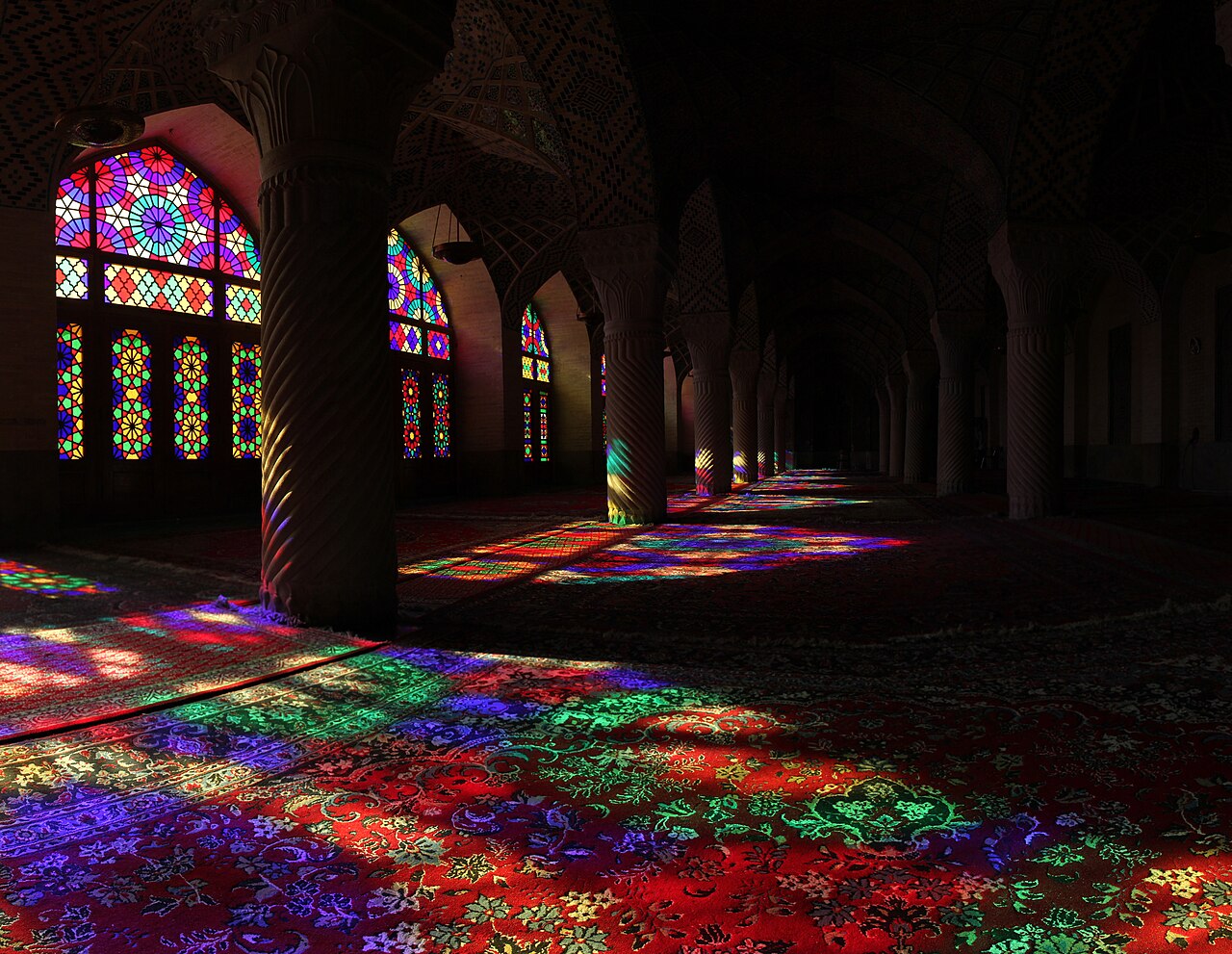

The winter prayer hall and its windows
The reason most visitors come is the shabestân on the west side of the courtyard, the hall used for prayer in winter. Its east wall, facing the courtyard, is a row of tall wooden doors and windows filled with coloured glass in red, blue, green and yellow, set in geometric wooden frames. This kind of window is called an orsi, and it is common in Qajar houses, where it lit and ventilated the main rooms. Here it is used on a grand scale.
Because the windows face east, the effect depends on the morning sun. From sunrise until about the middle of the morning, light passes through the glass and falls in coloured patterns across the Persian carpets, the stone floor and the columns. As the sun climbs, the patches move and shorten, and by late morning the effect is mostly gone. On a cloudy day it hardly happens at all, and in winter, when the sun is low, the light reaches deepest into the hall.
The hall itself is worth looking at apart from the light. Its roof rests on rows of stone columns carved with spiral fluting, and the vaults above are covered in painted tiles. The combination of carpet, stone, tile and coloured glass makes it one of the most photographed interiors in Iran.
The courtyard and its tiles
Outside the prayer hall, the courtyard has a rectangular pool in the centre and two iwans facing each other on the north and south sides. The northern iwan has a deep vault of moqarnas, the stepped cells of Iranian architecture, covered in tile.
Look closely at the tile panels. They are painted in the Qajar style, with pink, rose and yellow tones that were rare in earlier Iranian tilework, as well as the more usual blues. Among the floral designs are roses, irises and vases, and in places you can see small landscapes and buildings, including scenes that seem to draw on European pictures. The overall effect of the pink tones gives the mosque its popular name. This palette is typical of late 19th-century Shiraz and contrasts strongly with the blue and turquoise of Safavid Isfahan, such as the Shah Mosque.
Visiting
- Arrive early. The coloured light is at its best soon after the mosque opens, and the hall becomes crowded with photographers quickly. Opening times change, so check locally the day before.
- Season: autumn and winter give the longest and deepest light in the hall; summer mornings are shorter-lived but still beautiful on a clear day.
- Behaviour: it is a working mosque. Dress modestly; women should cover their hair, and chadors are usually available. Shoes come off on the carpets. Be considerate when photographing, and avoid photographing people at prayer.
- Time to allow: 45 minutes to an hour. The east prayer hall across the courtyard and a small museum display, when open, are quieter.
- Combining it: the mosque is in the old quarter, a short walk from the Shah Cheragh shrine and the Vakil bazaar. A good morning in Shiraz is Nasir al-Molk at opening, then the bazaar and the Arg of Karim Khan, and the Shah Cheragh shrine.
Tickets and rules change; check current information locally. For safety, refer to your own government’s travel advice. For the rest of the city, see our Shiraz city guide.
Persian words from this page
| صورتی | surati | pink |
| شبستان | shabestân | covered prayer hall |
| ارسی | orsi | sash window with coloured glass |
| شیشه | shishe | glass |
| رنگی | rangi | coloured |
| قالی | qâli | carpet |
Sources and further reading
- Encyclopaedia Iranica, “Shiraz” (history and monuments of the city).
- Jennifer M. Scarce, “The Arts of the Eighteenth to Twentieth Centuries”, in The Cambridge History of Iran, vol. 7 (1991).
- Abbas Amanat, Iran: A Modern History (Yale University Press, 2017), on Qajar Shiraz and its notables.
Want to learn Persian? Get the free Starter Pack
Get the 14-page printable Starter Pack (all 32 letters, a 7-day reading plan, 100 core words and 20 survival phrases) and a short 5-email course. Free.
More in Top Places to Visit in Iran
- Naqsh-e Jahan Square
- Shah (Imam) Mosque, Isfahan
- Sheikh Lotfollah Mosque
- Ali Qapu Palace
- Jameh Mosque of Isfahan
- Si-o-se Pol and Khaju Bridge
- Vank Cathedral
- Hasht Behesht Palace
- Naqsh-e Rostam
- Eram Garden, Shiraz
- Nasir al-Molk (Pink) Mosque
- Tomb of Hafez (Hafezieh)
- Tomb of Saadi (Saadieh)
- Shah Cheragh Shrine
- Arg of Karim Khan
- Fin Garden, Kashan
- Historic Houses of Kashan
- Jameh Mosque of Yazd
- Yazd Fire Temple and Towers of Silence
- Dowlatabad Garden and Windcatcher
- Amir Chakhmaq Complex
- Golestan Palace
- National Museum of Iran
- Treasury of National Jewels
- Tehran Grand Bazaar
- Milad Tower
- Imam Reza Shrine, Mashhad
- Tomb of Ferdowsi, Tus
- Tomb of Omar Khayyam, Neyshabur
- Tomb of Avicenna, Hamadan
- Ganjnameh Inscriptions, Hamadan
- Behistun (Bisotun): Visiting the Site
- Taq-e Bostan: Visiting the Site
- Tabriz Historic Bazaar
- Takht-e Soleyman
- Armenian Monastic Ensembles of Iran
- Sheikh Safi al-Din Shrine, Ardabil
- Dome of Soltaniyeh
- Alamut Castle
- Falak-ol-Aflak Castle
- Shushtar Historical Hydraulic System
- Chogha Zanbil: Visiting the Ziggurat
- Susa Archaeological Site
- Arg-e Bam
- Ganjali Khan Complex, Kerman
- Shazdeh Garden, Mahan
- Rayen Castle
- Dasht-e Lut (Lut Desert)
- Maranjab Desert and Caravanserai
- Varzaneh Desert
- Mount Damavand
- Hyrcanian Forests
- Lake Urmia
- Badab-e Surt Springs
- Ali Sadr Cave
- The Kaluts of Shahdad
- Qeshm Geopark
- Hormuz Island Colours
- Visiting Persepolis: A Day Trip from Shiraz
- Visiting Pasargadae
- Persian Caravanserais
- The Qanat of Gonabad
- Meymand Village
- Sasanian Sites of Fars: Firuzabad, Bishapur and Sarvestan
- Gonbad-e Qabus: Visiting the Tower
- Zayandeh Rud and Isfahan’s Bridges
- Tochal and Darband: Hiking Above Tehran
- Mount Sabalan
- Skiing in Iran: Dizin and Shemshak
- Golestan National Park