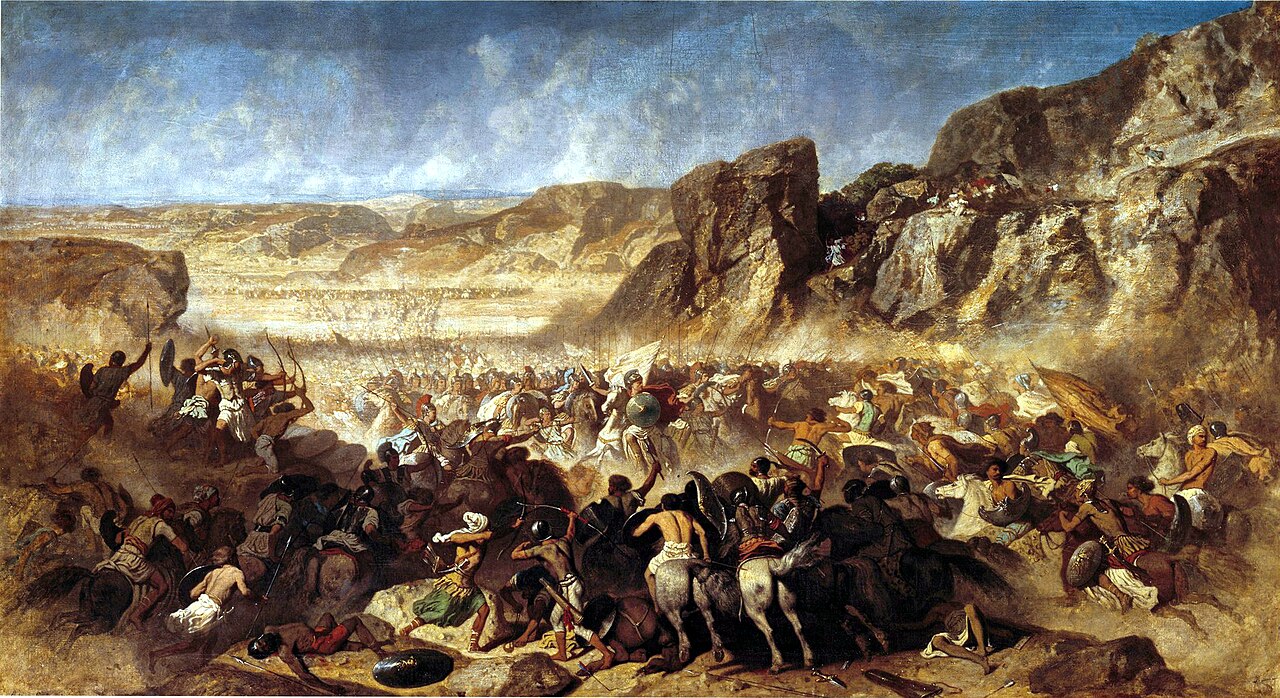
The Battle of Cunaxa was fought in late summer 401 BCE on the Euphrates north of Babylon, between King Artaxerxes II and his younger brother Cyrus the Younger, who had marched from Asia Minor to take the throne. The Greek mercenaries in Cyrus’s army won their part of the field, but Cyrus was killed charging at the king, and the revolt collapsed. The retreat of those Greeks, the “Ten Thousand”, told by Xenophon in his Anabasis, became one of the most famous stories of antiquity.
| Date | Late summer 401 BCE (often given as September) |
|---|---|
| Place | Cunaxa, on the Euphrates, about 80 km north of Babylon (Plutarch gives 500 stades); exact site unknown |
| Royal army | Artaxerxes II; commanders Tissaphernes, Gobryas, Arbaces (Abrocomas arrived too late) |
| Rebel army | Cyrus the Younger; about 10,400 Greek hoplites and 2,500 light troops under Clearchus, plus Cyrus’s Asian forces under Ariaeus |
| Numbers | Xenophon: 900,000 for the king and 100,000 Asians for Cyrus; modern estimates far lower |
| Result | Victory for Artaxerxes; Cyrus killed |
| Main source | Xenophon, an eyewitness on Cyrus’s side; Ctesias, an eyewitness on the king’s side |

Why Cyrus rebelled
Cyrus the Younger was the favourite son of Darius II and Parysatis. Sent to Sardis in 407 BCE as commander of the western provinces, he had funded the Spartan fleet that won the Peloponnesian War (see Darius II). When his elder brother Arsaces became king as Artaxerxes II in 404 BCE, Tissaphernes accused Cyrus of plotting murder at the coronation. Saved by his mother, Cyrus returned west determined to take the throne.
He had money, a network of Greek friends from the war, and, Xenophon insists, the qualities of a king: generosity, courage and a reputation for keeping his word. He hired Greek soldiers in small groups through different commanders, the Spartan exile Clearchus, Proxenus of Boeotia, Menon of Thessaly and others, under pretexts such as a war against the Pisidians in the mountains or a quarrel with Tissaphernes. Sparta quietly allowed it.
The march to Babylon
The army left Sardis in the spring of 401 BCE. It crossed Phrygia and passed through the Cilician Gates into Cilicia, where at Tarsus the Greeks, suspecting the truth, refused to go further; Clearchus talked them round with tears and tricks. At Thapsacus on the Euphrates Cyrus finally told them the goal, promised extra pay, and the army followed the river south through the desert, killing wild asses and ostriches for food when supplies ran low.
Two episodes on the way show the strains in a Persian rebel army. Orontas, a Persian noble of royal blood, was caught writing to the king and was tried in Cyrus’s tent and killed. And the royal forces, instead of meeting Cyrus at the frontier, let him come: a great ditch dug across the plain to block him was left unguarded.
The battle
The two lines
The king’s army appeared on the afternoon of the expected day, Xenophon writes, first as a white cloud of dust, then as a dark mass with bronze glinting in it. In front were scythed chariots with blades on their axles. Artaxerxes held the centre with his guard of 6,000 horse, and his line was so long that his centre extended beyond Cyrus’s left wing.
Cyrus wanted the Greeks, on his right by the river, to strike at the king’s centre, where victory would be decided. Clearchus refused to leave the Euphrates and expose his flank. It was the decision that lost the battle.
The Greek victory and Cyrus’s charge
The Greeks advanced singing the war song and broke into a run. The troops facing them fled before they came within bowshot; the chariots, many without drivers, ran through gaps the hoplites opened in their ranks. Xenophon says only one Greek was hit by an arrow. The Greeks chased the enemy for kilometres, out of sight of the rest of the field.
Meanwhile, the king’s centre began to wheel round Cyrus’s left. Cyrus, with some 600 horsemen around him, charged the royal guard, broke it, and killed its commander Artagerses with his own hand. Then he saw his brother. “I see the man”, Xenophon reports him shouting. He rode at Artaxerxes and struck him through the breastplate, wounding him in the chest. Ctesias, who says he treated the wound himself, describes it. In the same moment a javelin hit Cyrus under the eye and he fell. His head and right hand were cut off, the Persian punishment for rebels.
Who killed Cyrus
Plutarch, using Ctesias, says a young Persian named Mithridates struck the first blow and a Carian soldier the second; both later boasted of it, and both died horribly at the order of Parysatis. Artaxerxes himself wished it to be known that he had killed his brother. The story of the mother’s revenge is told on the page on Women of the Achaemenid Court.
The retreat of the Ten Thousand
The Greeks returned to camp to find Cyrus dead and his Persian commander Ariaeus negotiating with the king. They refused to surrender their arms; they had won, they said. For weeks they marched north under a truce, escorted by Tissaphernes. Then, on the Greater Zab river, Tissaphernes invited the generals to a meeting and seized them. Clearchus, Proxenus, Menon and others were executed.
The army chose new leaders, among them the young Athenian Xenophon. They fought their way north through the mountains of the Carduchians, across Armenia in deep winter snow, and in early 400 BCE reached a mountain from which they saw the Black Sea; the cry “Thalatta! Thalatta!” (“The sea! The sea!”) became famous. From Trapezus (Trabzon) they worked their way west, and many survivors later joined a Spartan army fighting the Persians in Asia Minor.
Numbers and sources
Xenophon gives the king 1,200,000 men in four armies, of which 900,000 were on the field, and Cyrus 100,000 Asian troops beside the Greeks. No modern historian accepts these figures; armies of that size could not have been supplied on the Euphrates. Estimates of the royal army now usually run to some tens of thousands. Xenophon’s numbers for the Greeks, taken from a review, are more reliable.
The Anabasis was written decades after the event, in part to defend Xenophon’s own conduct, and it sees the battle from one wing. Ctesias saw it from the king’s side, but his work survives only in summaries and in Plutarch’s Life of Artaxerxes. Diodorus gives a third version based on other Greek writers.
What Cunaxa meant
For Persia, Cunaxa was a victory. The king survived, the rebellion ended in one day, and the Greeks left. But Greek writers drew a different lesson: a small Greek army had marched to the heart of the empire, beaten the troops in front of it and walked home. The orator Isocrates later used the march as proof that Persia could be conquered, and the story was known to Alexander. Historians now warn against reading the retreat as a sign of Persian weakness: the Greeks escaped, but the Persian state that let them go was strong enough to win back the Greek cities of Asia fourteen years later, in the King’s Peace. For the Persian army of the time, see the Immortals and the Achaemenid army.
Persian words from this page
| کوروش کوچک | Kurosh-e Kuchak | Cyrus the Younger |
| فرات | Forât | Euphrates |
| بابل | Bâbel | Babylon |
| سپاه | sepâh | army |
| مزدور | mozdur | mercenary |
| ارابه | arâbeh | chariot |
| برادر | barâdar | brother |
Sources and further reading
- Xenophon, Anabasis, Books 1–2 (march, battle, death of the generals) and Book 4 (the sea).
- Plutarch, Life of Artaxerxes, chapters 6–17.
- Diodorus Siculus, Library of History, Book 14.
- Robin Lane Fox (ed.), The Long March: Xenophon and the Ten Thousand (Yale, 2004).
- John W. I. Lee, A Greek Army on the March (Cambridge, 2007).
- Encyclopaedia Iranica, “Cunaxa”.
Want to learn Persian? Get the free Starter Pack
Get the 14-page printable Starter Pack (all 32 letters, a 7-day reading plan, 100 core words and 20 survival phrases) and a short 5-email course. Free.
More in The Achaemenid Empire (550–330 BCE)
- Achaemenes, Teispes and the Early Persian Kings of Anshan
- Cyrus the Great: Birth, Legends and Rise to Power
- Cyrus Conquers Lydia: Croesus and the Battle of Thymbra
- The Persian Conquest of Ionia and Asia Minor
- Cyrus Takes Babylon (539 BCE)
- The Cyrus Cylinder
- Cyrus and the Return of the Jews
- The Death of Cyrus and the Massagetae
- Pasargadae: Cyrus’s Capital and Tomb
- The Tomb of Cyrus through History
- Cambyses II
- Cambyses Conquers Egypt: The Battle of Pelusium
- Bardiya and Gaumata: The Usurper Question
- Darius the Great Takes the Throne
- The Great Revolts of 522–521 BCE
- The Behistun Inscription
- The Persian Conquest of the Indus Valley
- Darius’s Scythian Campaign
- Darius’s Canal from the Nile to the Red Sea
- Darius’s Reforms: Satrapies, Taxes and Law
- The Royal Road and the Persian Postal System
- The Daric: Achaemenid Coinage and Economy
- The Ionian Revolt (499–493 BCE)
- The Greco-Persian Wars: An Overview
- Mardonius and the First Persian Expedition to Greece (492 BCE)
- The Battle of Marathon (490 BCE)
- The Death of Darius I and the Succession of Xerxes
- The Royal Tombs of Naqsh-e Rostam
- Xerxes I: King of Kings (486–465 BCE)
- Xerxes’ Invasion of Greece (480–479 BCE)
- The Battle of Thermopylae (480 BCE)
- The Battle of Artemisium (480 BCE)
- The Persian Capture of Athens (480–479 BCE)
- The Battle of Salamis (480 BCE)
- The Battle of Plataea and the End of the Invasion (479 BCE)
- The Palace of Darius at Susa
- Building Persepolis: How Darius and Xerxes Built Parsa
- The Persepolis Fortification and Treasury Tablets
- Herodotus and the Persians
- The Apadana Reliefs: Nations Bringing Gifts
- The Achaemenid Paradise Gardens
- The Persian Immortals and the Achaemenid Army
- The Achaemenid Navy
- Religion of the Achaemenid Kings
- Women of the Achaemenid Court
- Old Persian Language and Cuneiform
- Egypt under Persian Rule
- Babylon under Persian Rule
- Artaxerxes I
- The Peace of Callias
- Darius II and the Peloponnesian War
- Famous Satraps of the Persian Empire
- Artaxerxes II Mnemon
- Cyrus the Younger and the Battle of Cunaxa
- The King’s Peace (387 BCE)
- The Great Satraps’ Revolt
- Artaxerxes III and the Reconquest of Egypt
- Darius III, the Last Achaemenid King
- The Battle of the Granicus (334 BCE)
- The Battle of Issus (333 BCE)
- Alexander Takes Tyre, Gaza and Egypt (332 BCE)
- The Battle of Gaugamela (331 BCE)
- Ariobarzanes and the Battle of the Persian Gate
- The Burning of Persepolis (330 BCE)
- The Death of Darius III and Bessus
- The Legacy of the Achaemenid Empire