The Battle of Marathon was fought in late summer 490 BCE on the coastal plain of Marathon, about 40 kilometres northeast of Athens, between a Persian seaborne force under Datis and Artaphernes and the citizen army of Athens with its ally Plataea. The Athenians won and the Persians sailed home. For Greeks it became the founding legend of Athenian greatness; for the Persian Empire it was a setback at the end of a campaign that had otherwise met most of its goals.
| Date | August or September 490 BCE (the exact day is debated) |
|---|---|
| Place | Plain of Marathon, Attica |
| Persian commanders | Datis the Mede and Artaphernes, nephew of Darius I |
| Greek commanders | Ten Athenian generals including Miltiades; the polemarch Callimachus |
| Forces | Athenians perhaps 9,000 to 10,000 with about 1,000 Plataeans (later sources); Persians unknown, modern estimates mostly 15,000 to 30,000 |
| Losses (Herodotus) | 192 Athenians, 6,400 on the Persian side |
| Result | Athenian victory; Persian force withdraws to Asia |

A punitive expedition across the Aegean
After the expedition of Mardonius in 492 BCE had secured Thrace and Macedon by land, Darius I tried a different approach. In 490 he sent a fleet straight across the Aegean. Herodotus gives it 600 triremes, together with transport ships built to carry horses. Its commanders were Datis, a Mede, and Artaphernes, son of the satrap of Sardis who had fought the Ionian Revolt and nephew of the king.
Datis is one of the few figures of these wars who appears in a Persian document. A tablet from the Persepolis Fortification archive, dated to early 494 BCE, records wine rations for a Datiya who had travelled from Sardis to the king carrying a sealed document. The historian David Lewis argued that this is the same man, which would make him a senior officer already trusted with the western front.
Naxos, Delos and Eretria
The fleet sailed from Cilicia to Samos and then struck west through the islands. Naxos, which had defied a Persian siege in 499, was taken and its town and temples burned. At Delos, sacred to Apollo and Artemis, Datis did the opposite: Herodotus says he forbade his men to land on the island and offered 300 talents’ weight of frankincense on the altar. The contrast fits Persian practice elsewhere. Rebels were punished, but sanctuaries that did not resist were respected.
The fleet then crossed to Euboea. Carystus was forced to submit. Eretria, one of the two cities that had helped burn Sardis, held out for six days until two of its citizens betrayed it. Its temples were burned in revenge for the temples of Sardis and its people were deported. Herodotus says Darius later settled them at Ardericca in Cissia, a district near Susa, where they still spoke Greek in his own day. This was a standard Persian measure: whole communities of rebels were moved to the heartland, where they worked the king’s land.
Landing at Marathon
The Persians were guided by Hippias, the former tyrant of Athens, who had been expelled in 510 BCE and hoped to return as a Persian client. He chose Marathon because the plain suited cavalry and lay near the old power base of his family. The Athenians marched out to meet them and camped at the edge of the plain. A runner, Philippides (or Pheidippides), was sent to Sparta and, Herodotus says, arrived the day after he left Athens, a distance of about 240 kilometres. The Spartans agreed to help but said religious law prevented them from marching before the full moon. Only Plataea, a small Boeotian town allied to Athens, sent its full force.
The two armies faced each other for several days. The ten Athenian generals were divided about whether to attack, and Herodotus says Miltiades persuaded the polemarch Callimachus to cast his vote for battle. Miltiades knew the Persians well: he had ruled the Chersonese in Thrace as a Persian vassal and had fled when the Ionian Revolt failed.
The battle
Herodotus describes a simple plan. The Athenians thinned their centre to match the length of the Persian line and made their wings strong. They then advanced at a run over the last stretch, about eight stades (some 1.5 kilometres), which Herodotus says no Greeks had done before; modern scholars doubt that men in armour ran so far and think the running covered only the final few hundred metres. In the centre the Persians and the Saka, the best troops in the Persian line, broke through. On both wings the Athenians and Plataeans won, then turned inward and attacked the victorious Persian centre.
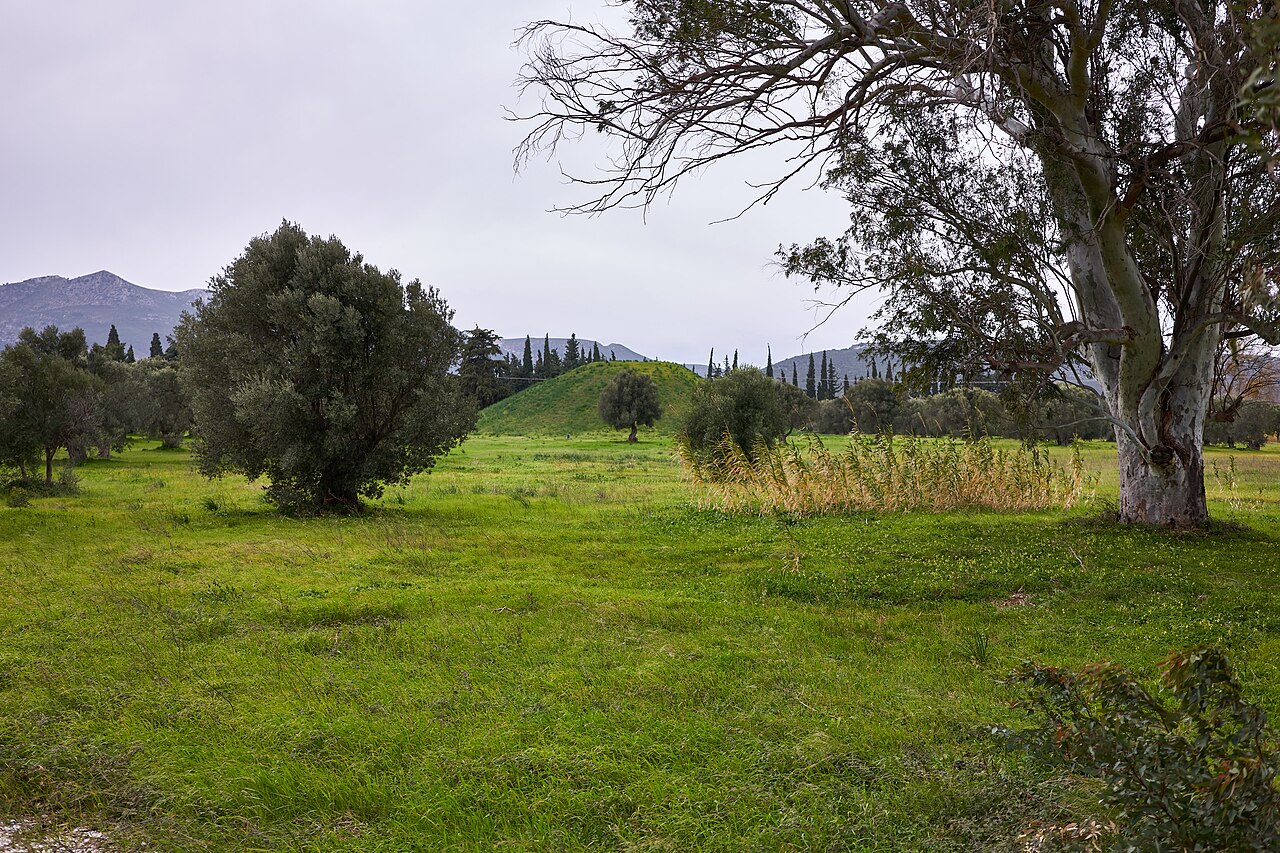
The Persians fled to their ships. Fighting at the water’s edge, the Athenians captured seven ships; Callimachus was killed, and so was Cynegirus, brother of the playwright Aeschylus. Herodotus counts 6,400 dead on the Persian side and 192 Athenians. The Athenian figure is reliable, since the names were inscribed on monuments at the mound. The Persian figure may be an estimate or a later round number.
The puzzle of the Persian cavalry
Herodotus says Marathon was chosen for its cavalry, yet horsemen play no part in his account of the fighting. Historians have proposed that the cavalry had been re-embarked, perhaps to sail for Athens, which would explain why the Athenians chose that moment to attack. A short entry in the Byzantine Suda lexicon, which explains a proverb as “the cavalry are away”, is often cited in support, but it was written about 1,400 years later and its value is debated.
After the battle
The Persian fleet sailed round Cape Sunium towards Phalerum, the harbour of Athens. Herodotus reports a shield flashed as a signal from the hills, a story used against the Alcmaeonid family. The Athenian army marched back in time to guard the city, and the Persians, finding it defended, sailed for Asia. The Spartans, 2,000 strong, arrived after the battle and could only view the dead. The famous run from Marathon to Athens with the news of victory does not appear in Herodotus; it is first found in writers of the Roman period, such as Plutarch and Lucian, and inspired the modern marathon race in 1896.
How the Persians would have seen it
No Persian source mentions Marathon. That silence is normal: royal inscriptions record the king’s order and victories, not the fortunes of a regional force. Seen from Susa, the campaign of 490 had punished Naxos and Eretria, brought the Cyclades and Carystus under Persian control, and lost a battle in Attica. It was not a full invasion led by the king; the main royal army never left Asia. Herodotus himself says Darius took the news as a reason to prepare a larger war, which was delayed by the Egyptian revolt and his death in 486 BCE.
For Athens, Marathon became a source of pride for generations. Aeschylus’s epitaph mentions Marathon rather than his plays, and the battle was painted in the Stoa Poikile in the Athenian Agora. This later prestige shaped the way the war was told, including Herodotus’s account, written some sixty years after the event. Compare the Persian and Greek views in the overview of the Greco-Persian Wars and see Herodotus and the Persians on how far his account can be trusted. The larger invasion that followed is told in Xerxes’ invasion of Greece.
Persian words from this page
| ماراتن | Mârâton | Marathon |
| آتن | Âten | Athens |
| اسپارت | Espârt | Sparta |
| سواره نظام | savâreh nezâm | cavalry |
| پیروزی | piruzi | victory |
| شکست | shekast | defeat |
Sources and further reading
- Herodotus, Histories, Book 6, chapters 94–120.
- D. M. Lewis, “Datis the Mede”, Journal of Hellenic Studies 100 (1980).
- Peter Krentz, The Battle of Marathon (2010).
- Pierre Briant, From Cyrus to Alexander: A History of the Persian Empire (2002).
- The Cambridge Ancient History, vol. 4 (2nd ed., 1988).
Want to learn Persian? Get the free Starter Pack
Get the 14-page printable Starter Pack (all 32 letters, a 7-day reading plan, 100 core words and 20 survival phrases) and a short 5-email course. Free.
More in The Achaemenid Empire (550–330 BCE)
- Achaemenes, Teispes and the Early Persian Kings of Anshan
- Cyrus the Great: Birth, Legends and Rise to Power
- Cyrus Conquers Lydia: Croesus and the Battle of Thymbra
- The Persian Conquest of Ionia and Asia Minor
- Cyrus Takes Babylon (539 BCE)
- The Cyrus Cylinder
- Cyrus and the Return of the Jews
- The Death of Cyrus and the Massagetae
- Pasargadae: Cyrus’s Capital and Tomb
- The Tomb of Cyrus through History
- Cambyses II
- Cambyses Conquers Egypt: The Battle of Pelusium
- Bardiya and Gaumata: The Usurper Question
- Darius the Great Takes the Throne
- The Great Revolts of 522–521 BCE
- The Behistun Inscription
- The Persian Conquest of the Indus Valley
- Darius’s Scythian Campaign
- Darius’s Canal from the Nile to the Red Sea
- Darius’s Reforms: Satrapies, Taxes and Law
- The Royal Road and the Persian Postal System
- The Daric: Achaemenid Coinage and Economy
- The Ionian Revolt (499–493 BCE)
- The Greco-Persian Wars: An Overview
- Mardonius and the First Persian Expedition to Greece (492 BCE)
- The Battle of Marathon (490 BCE)
- The Death of Darius I and the Succession of Xerxes
- The Royal Tombs of Naqsh-e Rostam
- Xerxes I: King of Kings (486–465 BCE)
- Xerxes’ Invasion of Greece (480–479 BCE)
- The Battle of Thermopylae (480 BCE)
- The Battle of Artemisium (480 BCE)
- The Persian Capture of Athens (480–479 BCE)
- The Battle of Salamis (480 BCE)
- The Battle of Plataea and the End of the Invasion (479 BCE)
- The Palace of Darius at Susa
- Building Persepolis: How Darius and Xerxes Built Parsa
- The Persepolis Fortification and Treasury Tablets
- Herodotus and the Persians
- The Apadana Reliefs: Nations Bringing Gifts
- The Achaemenid Paradise Gardens
- The Persian Immortals and the Achaemenid Army
- The Achaemenid Navy
- Religion of the Achaemenid Kings
- Women of the Achaemenid Court
- Old Persian Language and Cuneiform
- Egypt under Persian Rule
- Babylon under Persian Rule
- Artaxerxes I
- The Peace of Callias
- Darius II and the Peloponnesian War
- Famous Satraps of the Persian Empire
- Artaxerxes II Mnemon
- Cyrus the Younger and the Battle of Cunaxa
- The King’s Peace (387 BCE)
- The Great Satraps’ Revolt
- Artaxerxes III and the Reconquest of Egypt
- Darius III, the Last Achaemenid King
- The Battle of the Granicus (334 BCE)
- The Battle of Issus (333 BCE)
- Alexander Takes Tyre, Gaza and Egypt (332 BCE)
- The Battle of Gaugamela (331 BCE)
- Ariobarzanes and the Battle of the Persian Gate
- The Burning of Persepolis (330 BCE)
- The Death of Darius III and Bessus
- The Legacy of the Achaemenid Empire