After Cyrus took Sardis, around 547 BCE, his generals spent several years conquering the Greek cities of the Aegean coast of Asia Minor and their neighbours in Caria and Lycia. The Median commander Harpagus finished the work, city by city, using siege mounds against their walls. The conquest brought the Ionian Greeks under Persian rule for half a century and set the scene for the Ionian Revolt and the Persian Wars.
| Date | c. 546–540 BCE (no exact year is recorded) |
|---|---|
| Persian commanders | Mazares, then Harpagus, both Medes |
| Regions | Ionia and Aeolis on the Aegean coast; Caria and Lycia in the south-west |
| Main source | Herodotus, Histories 1.141–177 |
| Result | Greek cities of Asia Minor ruled through local tyrants under the Persian governor at Sardis |
A fable for the Ionians
The Greek cities of Ionia, among them Miletus, Ephesus, Phocaea, Teos and Priene, had been subjects of Lydia and paid tribute to Croesus. Before the war, Cyrus had invited them to desert Croesus and they refused. Once Sardis fell, they sent envoys asking to serve Cyrus on the same terms as before.
Herodotus (1.141) says Cyrus answered with a fable. A piper played to the fish in the sea, hoping they would come ashore. They did not, so he cast a net, hauled them in and watched them leap about. Then he told them it was too late to dance now, since they had refused to dance when he played. Only Miletus, the largest Ionian city, received a treaty on the terms it had had with Croesus. The rest began repairing their walls.
A warning from Sparta
The Ionians met at the Panionium, their shared sanctuary, and asked Sparta for help. The Spartans refused to send an army but dispatched a ship and an envoy, Lacrines, to tell Cyrus not to harm any Greek city. Herodotus (1.153) says Cyrus asked who the Spartans were. On being told, he replied that he had never feared men who set aside a place in the middle of their city where they met to cheat one another on oath, a jab at the Greek marketplace. The story shows how Greeks later imagined the Persian view of them: small, quarrelsome traders.
The revolt of Pactyes
Cyrus himself left the west for Ecbatana, with Babylon, Bactria and the eastern peoples still before him. He left a Persian, Tabalus, in command at Sardis and gave a Lydian, Pactyes, charge of the gold. As soon as the king was gone, Pactyes hired Greek soldiers from the coast and besieged Tabalus in the citadel.
Cyrus sent a Median general, Mazares, to crush the revolt. Herodotus says Croesus, now at Cyrus’s side, persuaded him not to enslave the Lydians but to disarm them and push them towards music and shopkeeping, so they would never rebel again. The tale is moralising, and it became a Greek stereotype of the soft, luxurious Lydians.
Pactyes fled to Cyme, then to Mytilene on Lesbos, and finally to Chios. The Chians handed him over to the Persians in exchange for the mainland district of Atarneus. Mazares then punished the cities that had helped him: he enslaved the people of Priene and plundered the Maeander valley and Magnesia, before dying of illness.

Harpagus and the siege mounds
Command passed to Harpagus, the Mede who, in Herodotus’s story, had saved the infant Cyrus and later helped him overthrow Astyages (see Cyrus the Great: Birth, Legends and Rise to Power). Greek cities trusted to their walls. Harpagus’s answer was to drive the defenders inside and then pile up great ramps of earth against the walls until his troops could fight their way over. City after city fell this way.
The Phocaeans sail away
At Phocaea, Harpagus offered easy terms: knock down one tower of the wall and dedicate one house to the king. The Phocaeans asked for a day to think, used it to load their families, goods and temple statues onto their ships, and sailed away. Most of them settled at Alalia on Corsica, where they had founded a colony earlier; after a costly sea battle with Etruscans and Carthaginians, the survivors moved on and founded Elea (Velia) in southern Italy. Herodotus says more than half of the emigrants grew homesick and went back to Phocaea, breaking their oath.
Teos and the other cities
The people of Teos did the same, sailing to Thrace to refound the city of Abdera. The other mainland Ionians fought, were defeated and submitted. The Ionians on the islands, Herodotus says, gave themselves up without a fight. He also records two proposals that might have changed Ionian history: Thales of Miletus had once urged the cities to form a single government with its council at Teos, and Bias of Priene now urged them all to sail together to Sardinia and found one great city. Neither plan was followed.
Caria and Lycia
Harpagus then marched south with Ionian and Aeolian troops in his army. The Carians submitted with little resistance. The people of Cnidus tried to turn their peninsula into an island by cutting a channel across its neck, but stopped when the Delphic oracle told them that if Zeus had wanted an island, he would have made one. The Pedasians held out on a fortified mountain for a time before they too were taken.
Lycia gave the hardest fight. Herodotus (1.176) says the men of Xanthos met the Persians on the plain, were driven back into the city, gathered their wives, children, slaves and possessions on the acropolis and set it on fire. Then they went out and fought until every one of them was killed. The Xanthians of his own day, he says, were descended from eighty families who had been away from home. The people of Caunus acted much the same way.
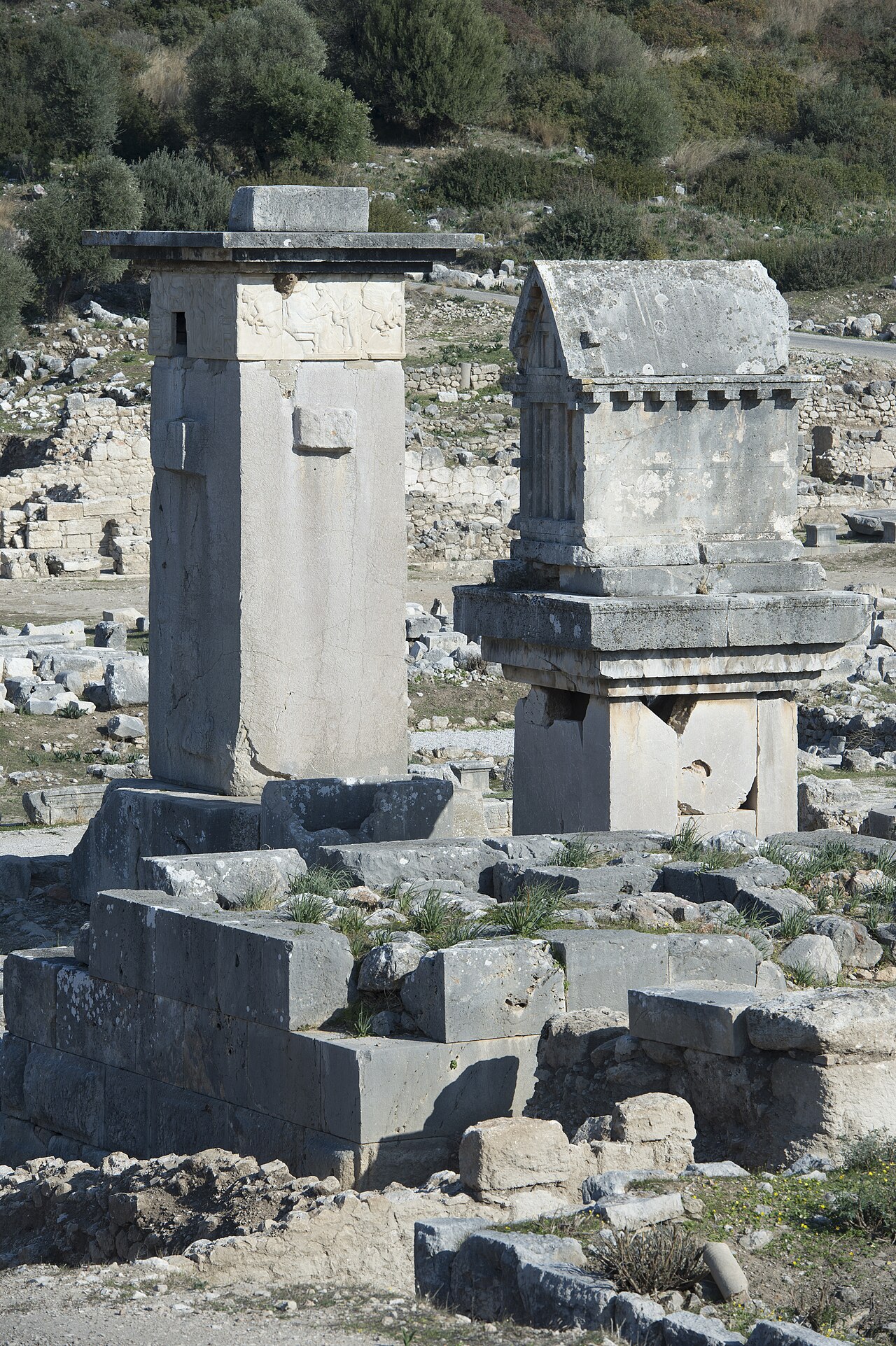
Xanthos was rebuilt and flourished under Persian rule. Its later rulers erected the tall pillar tombs seen in the photograph. The texts on the city’s Inscribed Pillar, carved around 400 BCE, describe the local dynast as a son of a man named Harpagus. Some historians have taken this as a sign that the conqueror’s family ruled Lycia as Persian vassals; others think the name is a coincidence.
How Persia ruled the Greek cities
Persia did not station large armies in each city. The coast was governed from Sardis, which became the seat of a satrap, and each city paid tribute and supplied troops and ships when called on. Persia usually worked through local Greek tyrants who owed their position to the king. This arrangement held for about fifty years, until in 499 BCE the tyrant of Miletus led the cities into the Ionian Revolt, the event that drew Athens into war with Persia. The wider conflict is outlined on The Greco-Persian Wars: An Overview.
The name the Persians gave these Greeks lived on in the Persian language. Old Persian inscriptions call them Yauna, from “Ionians”, and modern Persian still calls Greece یونان Yunân.
Persian words from this page
| یونان | Yunân | Greece (from Old Persian Yauna, “Ionians”) |
| یونانی | yunâni | Greek |
| آسیای صغیر | Âsiyâ-ye Saghir | Asia Minor |
| هارپاگ | Hârpâg | Harpagus |
| کشتی | keshti | ship |
| دریا | daryâ | sea |
Sources and further reading
- Herodotus, Histories 1.141–177.
- Pierre Briant, From Cyrus to Alexander: A History of the Persian Empire (Eisenbrauns, 2002), chapter 1.
- J. M. Cook, The Persian Empire (Dent, 1983).
- Amélie Kuhrt, The Persian Empire: A Corpus of Sources from the Achaemenid Period (Routledge, 2007).
- The Cambridge Ancient History, vol. IV: Persia, Greece and the Western Mediterranean c. 525 to 479 B.C. (2nd ed., 1988).
Want to learn Persian? Get the free Starter Pack
Get the 14-page printable Starter Pack (all 32 letters, a 7-day reading plan, 100 core words and 20 survival phrases) and a short 5-email course. Free.
More in The Achaemenid Empire (550–330 BCE)
- Achaemenes, Teispes and the Early Persian Kings of Anshan
- Cyrus the Great: Birth, Legends and Rise to Power
- Cyrus Conquers Lydia: Croesus and the Battle of Thymbra
- The Persian Conquest of Ionia and Asia Minor
- Cyrus Takes Babylon (539 BCE)
- The Cyrus Cylinder
- Cyrus and the Return of the Jews
- The Death of Cyrus and the Massagetae
- Pasargadae: Cyrus’s Capital and Tomb
- The Tomb of Cyrus through History
- Cambyses II
- Cambyses Conquers Egypt: The Battle of Pelusium
- Bardiya and Gaumata: The Usurper Question
- Darius the Great Takes the Throne
- The Great Revolts of 522–521 BCE
- The Behistun Inscription
- The Persian Conquest of the Indus Valley
- Darius’s Scythian Campaign
- Darius’s Canal from the Nile to the Red Sea
- Darius’s Reforms: Satrapies, Taxes and Law
- The Royal Road and the Persian Postal System
- The Daric: Achaemenid Coinage and Economy
- The Ionian Revolt (499–493 BCE)
- The Greco-Persian Wars: An Overview
- Mardonius and the First Persian Expedition to Greece (492 BCE)
- The Battle of Marathon (490 BCE)
- The Death of Darius I and the Succession of Xerxes
- The Royal Tombs of Naqsh-e Rostam
- Xerxes I: King of Kings (486–465 BCE)
- Xerxes’ Invasion of Greece (480–479 BCE)
- The Battle of Thermopylae (480 BCE)
- The Battle of Artemisium (480 BCE)
- The Persian Capture of Athens (480–479 BCE)
- The Battle of Salamis (480 BCE)
- The Battle of Plataea and the End of the Invasion (479 BCE)
- The Palace of Darius at Susa
- Building Persepolis: How Darius and Xerxes Built Parsa
- The Persepolis Fortification and Treasury Tablets
- Herodotus and the Persians
- The Apadana Reliefs: Nations Bringing Gifts
- The Achaemenid Paradise Gardens
- The Persian Immortals and the Achaemenid Army
- The Achaemenid Navy
- Religion of the Achaemenid Kings
- Women of the Achaemenid Court
- Old Persian Language and Cuneiform
- Egypt under Persian Rule
- Babylon under Persian Rule
- Artaxerxes I
- The Peace of Callias
- Darius II and the Peloponnesian War
- Famous Satraps of the Persian Empire
- Artaxerxes II Mnemon
- Cyrus the Younger and the Battle of Cunaxa
- The King’s Peace (387 BCE)
- The Great Satraps’ Revolt
- Artaxerxes III and the Reconquest of Egypt
- Darius III, the Last Achaemenid King
- The Battle of the Granicus (334 BCE)
- The Battle of Issus (333 BCE)
- Alexander Takes Tyre, Gaza and Egypt (332 BCE)
- The Battle of Gaugamela (331 BCE)
- Ariobarzanes and the Battle of the Persian Gate
- The Burning of Persepolis (330 BCE)
- The Death of Darius III and Bessus
- The Legacy of the Achaemenid Empire