The Ionian Revolt was a rising of the Greek cities of western Asia Minor, with Cyprus and parts of Caria and the Hellespont, against Persian rule from 499 to 493 BCE. Led at first by Aristagoras of Miletus and helped briefly by Athens and Eretria, the rebels burned Sardis in 498 but were crushed at the sea battle of Lade in 494, after which Miletus was sacked. Athenian involvement gave Darius I his motive for the expeditions against Greece that followed.
| Dates | 499–493 BCE |
|---|---|
| Rebels | Ionian Greek cities, Aeolians, Carians, Cypriots, Hellespont cities; Athens (20 ships) and Eretria (5) in 498 |
| Persian leaders | Artaphernes, satrap at Sardis and half-brother of Darius; generals Daurises, Hymaees, Otanes, Artybius; later Mardonius |
| Key events | Burning of Sardis (498); Cyprus retaken (497); Battle of Lade (494); fall of Miletus (494) |
| Result | Persian victory; reorganisation of Ionia under Artaphernes and Mardonius |
| Main source | Herodotus, Books 5.28–126 and 6.1–42 |
Ionia under Persia
The Greek cities of the Ionian coast, among them Miletus, Ephesus, Samos and Chios, had been under Persian rule since the 540s (see the Persian conquest of Ionia). Persia governed them through local Greek tyrants loyal to the king, and they paid tribute to the satrap at Sardis. Their ships served in Persian fleets: Ionians had built Darius’s bridge over the Danube in the Scythian campaign.
The reasons for the revolt are disputed. Herodotus explains it mainly through the ambitions of two men, Histiaeus and Aristagoras. Modern historians add wider causes: dislike of the tyrants, the weight of tribute, the loss of trade as Persia advanced in the north Aegean, and a sense, after the Scythian expedition, that Persia was not unbeatable.
The failure at Naxos
The trigger, in Herodotus’s account, was an attack on the island of Naxos. In 499 BCE Aristagoras, deputy ruler of Miletus while his father-in-law Histiaeus was kept at Susa as Darius’s adviser, offered to conquer Naxos for Persia. Artaphernes and Darius agreed and gave him 200 ships under a Persian commander, Megabates. The two quarrelled, Herodotus says, and Megabates warned the Naxians. After a four-month siege the expedition failed.
Facing ruin, Aristagoras chose rebellion. Herodotus adds the famous story that Histiaeus, wanting to be sent home, shaved the head of a trusted slave, tattooed a message on his scalp, waited for the hair to grow and sent him to Aristagoras with the order: revolt.

Help from Greece and the burning of Sardis
Aristagoras gave up his tyranny, removed the tyrants of the other cities and went to mainland Greece for help. At Sparta, Herodotus says, he showed King Cleomenes a bronze map and promised easy riches, but lost his case when he admitted that Susa was three months’ march from the sea. Athens agreed to send twenty ships and Eretria five. Herodotus calls those ships “the beginning of evils” for Greeks and barbarians.
In 498 BCE the rebels and their allies marched inland and took Sardis, the capital of the satrapy, though Artaphernes held the citadel. A fire started in a house with a reed roof spread through the city, burning the temple of the Lydian goddess Cybebe. The Greeks withdrew to the coast, were defeated by a Persian army near Ephesus, and the Athenians sailed home and took no further part. The Persians later cited the burned temple as a reason for burning Greek temples in 480.
“Remember the Athenians”
When Darius heard that Athenians had helped burn Sardis, Herodotus says he asked who they were, shot an arrow into the sky and prayed for revenge, and ordered a servant to say to him three times at every dinner, “Master, remember the Athenians.” The scene is almost certainly a Greek invention, but it expresses the link Greeks saw between this revolt and the later wars.
The revolt spreads
After Sardis, the revolt spread north to Byzantium and the Hellespont cities, south to Caria and across the sea to Cyprus, where all the cities except Amathus joined under Onesilus of Salamis. The Persians answered region by region:
- Cyprus. A Persian army under Artybius landed on the island. The Ionian fleet beat the Phoenicians at sea, but on land the Cypriots lost when some of their own forces changed sides, and Onesilus and Artybius were both killed. Cyprus was retaken within about a year.
- The Hellespont. Daurises took several cities in quick succession.
- Caria. The Carians lost two pitched battles, then ambushed and destroyed a Persian army at night near Pedasus, killing Daurises and other commanders. Caria held out for some time.
Aristagoras himself left for Thrace, where he was killed besieging a town around 497 BCE. Histiaeus, released by Darius on the promise of ending the revolt, came to Sardis, where Artaphernes told him, in Herodotus’s words, that Histiaeus had stitched the shoe and Aristagoras had put it on. Histiaeus fled and ended up a pirate operating from Byzantium.
The Battle of Lade, 494 BCE
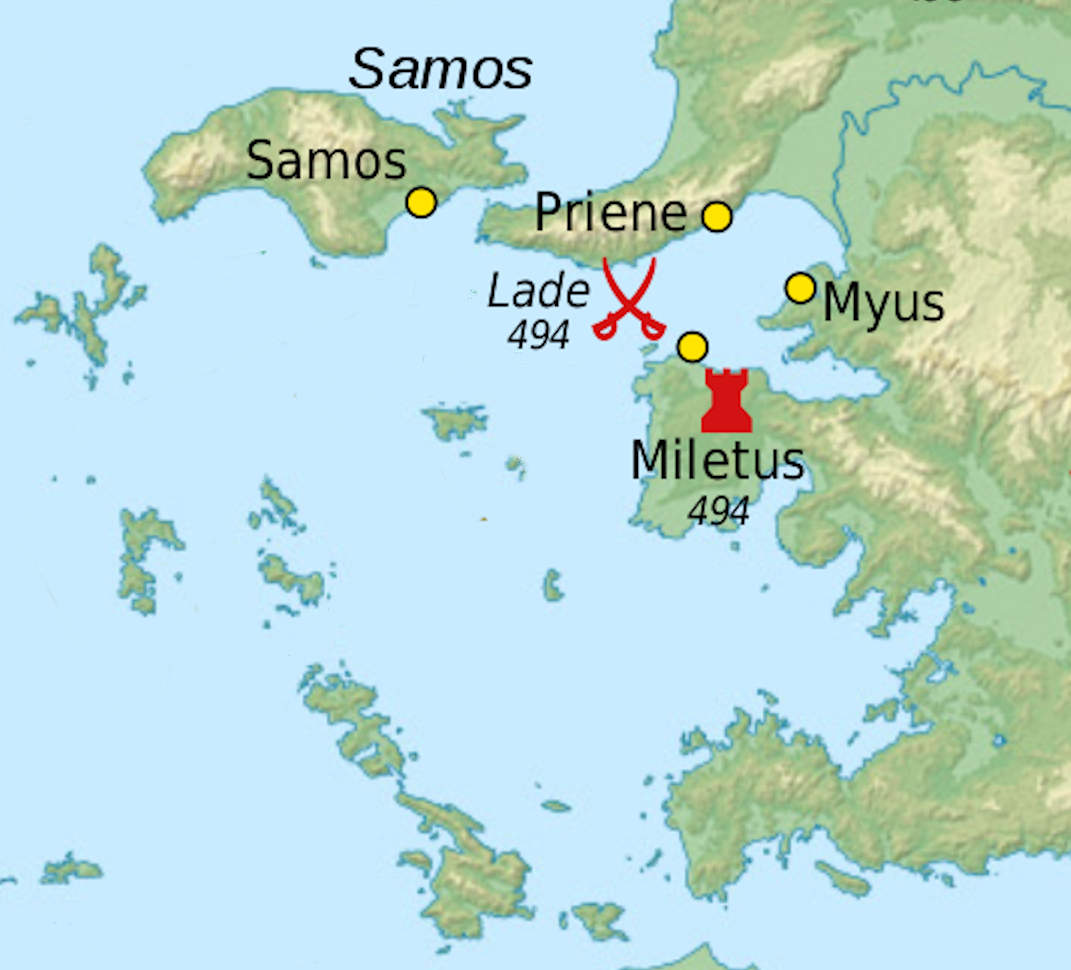
By 494 the Persians were ready to strike at Miletus, the heart of the revolt. They gathered a fleet Herodotus puts at 600 ships, from Phoenicia, Cyprus, Cilicia and Egypt. The Ionians gathered 353 triremes at the small island of Lade off Miletus: 100 from Chios, 80 from Miletus, 70 from Lesbos, 60 from Samos and smaller squadrons.
Herodotus describes a fleet that lost its discipline. Dionysius of Phocaea drilled the crews hard for a week, until they refused to go on. Persian agents, working through the exiled tyrants, offered the cities pardon if they deserted. When battle came, most of the Samian ships sailed away, the Lesbians followed, and the rest of the line collapsed. The Chians fought hard and suffered heavy losses. It was the decisive Persian victory of the war.
The fall of Miletus
Miletus was then besieged by land and sea and taken by mining under its walls. Herodotus says most of the men were killed, and the women and children were enslaved and taken to Susa; Darius settled the captives at Ampe, near the mouth of the Tigris on the Persian Gulf. The temple of Apollo at Didyma was plundered and burned. In Athens, when the playwright Phrynichus staged a tragedy called The Capture of Miletus, the audience burst into tears, and he was fined a thousand drachmas for reminding them of their own troubles.
In 493 the Persian fleet took the islands of Chios, Lesbos and Tenedos and the remaining cities of the Hellespont. Histiaeus was captured and executed at Sardis by Artaphernes; Herodotus says Darius, who would have pardoned him, had his head buried with honour.
The settlement
The Persian response after victory was not only harsh. Artaphernes made the Ionian cities agree to settle their disputes by arbitration rather than war, and had their land measured in parasangs to fix the tribute, which Herodotus says stayed at about the same level as before and lasted into his own day. In 492 Darius’s son-in-law Mardonius removed the tyrants of the Ionian cities and allowed democracies, which Herodotus finds remarkable. Mardonius then marched on into Thrace and Macedon, the expedition told on Mardonius and the first Persian expedition to Greece, and two years later came Marathon. The wars as a whole are surveyed on the Greco-Persian Wars: an overview.
Persian words from this page
| یونان | Yunân | Greece (from Old Persian Yauna, “Ionians”) |
| یونانی | Yunâni | Greek |
| آتن | Âten | Athens |
| ناوگان | nâvgân | fleet |
| جزیره | jazire | island |
| شورش | shuresh | revolt |
Sources and further reading
- Herodotus, Histories, Book 5, chapters 28–126, and Book 6, chapters 1–45.
- Pierre Briant, From Cyrus to Alexander (2002), chapter 4.
- The Cambridge Ancient History, vol. 4, Persia, Greece and the Western Mediterranean c. 525 to 479 B.C. (2nd ed., 1988).
- Amélie Kuhrt, The Persian Empire: A Corpus of Sources (2007).
- Encyclopaedia Iranica, “Ionia”.
Want to learn Persian? Get the free Starter Pack
Get the 14-page printable Starter Pack (all 32 letters, a 7-day reading plan, 100 core words and 20 survival phrases) and a short 5-email course. Free.
More in The Achaemenid Empire (550–330 BCE)
- Achaemenes, Teispes and the Early Persian Kings of Anshan
- Cyrus the Great: Birth, Legends and Rise to Power
- Cyrus Conquers Lydia: Croesus and the Battle of Thymbra
- The Persian Conquest of Ionia and Asia Minor
- Cyrus Takes Babylon (539 BCE)
- The Cyrus Cylinder
- Cyrus and the Return of the Jews
- The Death of Cyrus and the Massagetae
- Pasargadae: Cyrus’s Capital and Tomb
- The Tomb of Cyrus through History
- Cambyses II
- Cambyses Conquers Egypt: The Battle of Pelusium
- Bardiya and Gaumata: The Usurper Question
- Darius the Great Takes the Throne
- The Great Revolts of 522–521 BCE
- The Behistun Inscription
- The Persian Conquest of the Indus Valley
- Darius’s Scythian Campaign
- Darius’s Canal from the Nile to the Red Sea
- Darius’s Reforms: Satrapies, Taxes and Law
- The Royal Road and the Persian Postal System
- The Daric: Achaemenid Coinage and Economy
- The Ionian Revolt (499–493 BCE)
- The Greco-Persian Wars: An Overview
- Mardonius and the First Persian Expedition to Greece (492 BCE)
- The Battle of Marathon (490 BCE)
- The Death of Darius I and the Succession of Xerxes
- The Royal Tombs of Naqsh-e Rostam
- Xerxes I: King of Kings (486–465 BCE)
- Xerxes’ Invasion of Greece (480–479 BCE)
- The Battle of Thermopylae (480 BCE)
- The Battle of Artemisium (480 BCE)
- The Persian Capture of Athens (480–479 BCE)
- The Battle of Salamis (480 BCE)
- The Battle of Plataea and the End of the Invasion (479 BCE)
- The Palace of Darius at Susa
- Building Persepolis: How Darius and Xerxes Built Parsa
- The Persepolis Fortification and Treasury Tablets
- Herodotus and the Persians
- The Apadana Reliefs: Nations Bringing Gifts
- The Achaemenid Paradise Gardens
- The Persian Immortals and the Achaemenid Army
- The Achaemenid Navy
- Religion of the Achaemenid Kings
- Women of the Achaemenid Court
- Old Persian Language and Cuneiform
- Egypt under Persian Rule
- Babylon under Persian Rule
- Artaxerxes I
- The Peace of Callias
- Darius II and the Peloponnesian War
- Famous Satraps of the Persian Empire
- Artaxerxes II Mnemon
- Cyrus the Younger and the Battle of Cunaxa
- The King’s Peace (387 BCE)
- The Great Satraps’ Revolt
- Artaxerxes III and the Reconquest of Egypt
- Darius III, the Last Achaemenid King
- The Battle of the Granicus (334 BCE)
- The Battle of Issus (333 BCE)
- Alexander Takes Tyre, Gaza and Egypt (332 BCE)
- The Battle of Gaugamela (331 BCE)
- Ariobarzanes and the Battle of the Persian Gate
- The Burning of Persepolis (330 BCE)
- The Death of Darius III and Bessus
- The Legacy of the Achaemenid Empire