The King’s Peace of 387/386 BCE, also called the Peace of Antalcidas, was a settlement imposed on the warring Greek city-states by the Persian king Artaxerxes II. It gave the king the Greek cities of Asia Minor and Cyprus, declared all other Greek cities autonomous, and threatened war on anyone who refused. A century after Xerxes’ defeat, Persia had become the arbiter of Greek politics without sending an army into Greece.
| Date | Announced at Sardis in 387 BCE; sworn in 386 BCE |
|---|---|
| Imposed by | Artaxerxes II, through the satrap Tiribazus |
| Negotiated by | Antalcidas of Sparta |
| Ended | The Corinthian War (395–387 BCE) |
| Persia gained | The Greek cities of Asia, Clazomenae and Cyprus |
| Main source | Xenophon, Hellenica 5.1 |
How Persia got here
After Xerxes’ invasion failed in 479 BCE, the Greek cities on the Asian coast passed into the Athenian empire. Persia never accepted the loss. The chance to recover them came at the end of the Peloponnesian War, when Persian money paid for the Spartan fleet that defeated Athens (see Darius II). But victorious Sparta then turned on Persia, and from 400 BCE its armies campaigned in western Anatolia.
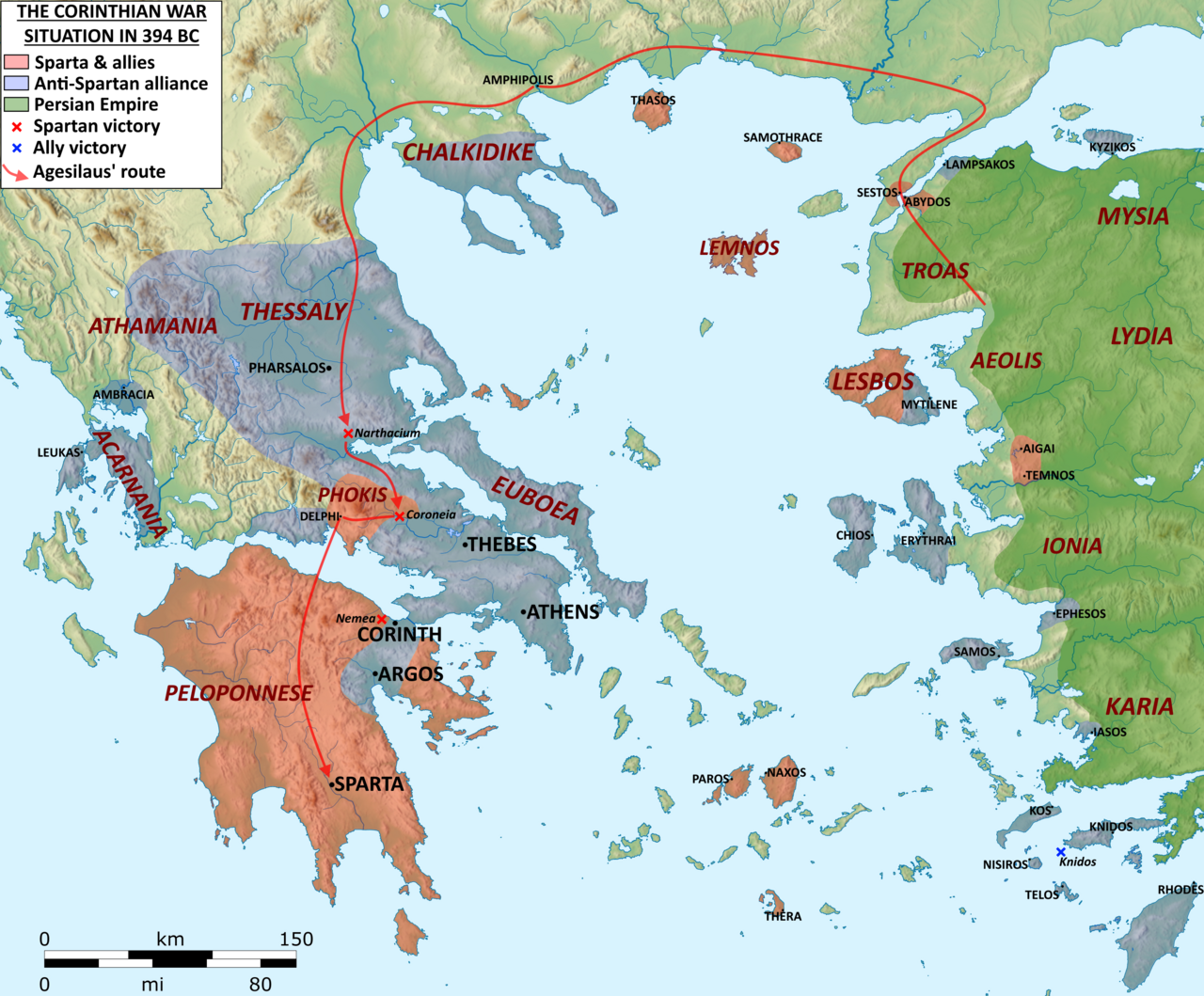
Artaxerxes II replied with silver and ships. Persian gold, carried by a Rhodian agent named Timocrates, encouraged Thebes, Corinth, Argos and Athens to declare war on Sparta in 395 BCE, the start of the Corinthian War. In 394 BCE a Persian fleet under Pharnabazus and the Athenian Conon destroyed the Spartan navy at Cnidus. The next year Pharnabazus sailed into Greek waters and gave Conon money to rebuild the Long Walls between Athens and its harbour.

Changing sides
Persia’s support for Athens soon looked like a mistake. With its walls rebuilt, Athens began to restore its old influence in the Aegean. In 390 and 389 BCE the general Thrasybulus sailed to the Hellespont and the coast of Asia, collecting dues from cities that Persia regarded as its own, and Athens made friends with two of the king’s enemies: Evagoras of Cyprus, then at war with Persia, and the rebel king of Egypt.
Sparta saw an opening. In 392 BCE it sent Antalcidas to Tiribazus, the Persian commander at Sardis, with a simple offer: Sparta would give up all claim to the Greek cities of Asia if the king would make the other Greeks accept a general peace. A conference at Sardis failed, because Athens, Thebes and Argos would not give up their gains. Tiribazus arrested Conon, but the king, not yet ready to change sides, replaced Tiribazus with a satrap friendlier to Athens.
By 388 BCE the picture had changed. Antalcidas travelled with Tiribazus to the court at Susa and won the king over. Back in the Aegean, Antalcidas gathered some 80 ships, from Sparta’s allies, from Persian satraps and from the tyrant Dionysius of Syracuse, and closed the Hellespont, through which Athens received its grain from the Black Sea. Athens, afraid of a second starvation like that of 404 BCE, was ready to talk.
The king’s message
In 387 BCE Tiribazus summoned envoys of the Greek cities to Sardis. Xenophon says he showed them the king’s seal and read out the text, which he records. In substance it said:
- The king considers it just that the cities in Asia should belong to him, and of the islands, Clazomenae and Cyprus.
- All other Greek cities, small and great, are to be left autonomous, except Lemnos, Imbros and Scyros, which are to belong to Athens as in the past.
- Whoever does not accept this peace, the king, with those who accept it, will make war on, by land and sea, with ships and with money.
The form is striking. It is not a treaty between equals, but a royal decision announced to the Greeks, in the voice of the king. The envoys took it home, and in 386 BCE the cities swore to it at Sparta. Thebes tried to swear on behalf of all Boeotia and was forced to give that up.
Who gained what
Persia
For Artaxerxes II the peace was a clear success. The Greek cities of Ionia, Aeolis and Caria returned to Persian rule after a century, and with them their tribute. Cyprus was declared the king’s, which freed his hand against Evagoras, who soon had to accept vassal status. Not least, no Greek state could now ally with Egypt or Cyprus against Persia without breaking a peace guaranteed by the king.
Sparta
Sparta became the enforcer of the peace, and used the autonomy clause to break up any Greek league that might rival it. The Boeotian League was dissolved, the city of Mantinea was split into villages in 385 BCE, and in 382 BCE a Spartan force seized the citadel of Thebes. For about fifteen years, with the king’s backing, Sparta dominated Greece.
Athens and Thebes
Athens kept its walls, its fleet and its three islands, but lost the gains of Thrasybulus. Thebes lost its leadership of Boeotia, for a time.
How the Greeks remembered it
Many Greeks regarded the peace as a national disgrace. The Athenian orator Isocrates, in his Panegyricus of 380 BCE, complained that the barbarian now decided Greek affairs and that the cities of Asia had been handed over to slavery. Plutarch, much later, described the peace as a betrayal of the Greeks in Asia. These voices helped form the call for a united Greek war against Persia, which Philip II and Alexander would later take up.
A Persian view is not recorded, but the outcome speaks for it: by diplomacy and money, Artaxerxes had achieved what Darius and Xerxes had failed to achieve by invasion.
The idea of a common peace
The King’s Peace was the first “common peace”, a settlement for all Greek states at once rather than a treaty between two sides. It was renewed several times in the following decades, in 375 and 371 BCE, with the king’s approval. In 367 BCE Thebes, then the strongest Greek power, sent its leader Pelopidas to Susa to ask the king for a new rescript in its favour. Greek cities were competing for the backing of the Persian king, a sign of how far the balance had moved since the age of Salamis and the Peace of Callias.
Persian words from this page
| صلح | solh | peace |
| فرمان | farmân | royal decree |
| یونان | Yunân | Greece |
| قبرس | Ghebres | Cyprus |
| آسیای صغیر | Âsiâ-ye saghir | Asia Minor |
| مهر | mohr | seal |
Sources and further reading
- Xenophon, Hellenica, Books 4.8 and 5.1 (text of the peace at 5.1.31).
- Diodorus Siculus, Library of History, Book 14.110.
- Plutarch, Life of Artaxerxes 21–22 and Life of Agesilaus 23.
- Isocrates, Panegyricus.
- T. T. B. Ryder, Koine Eirene: General Peace and Local Independence in Ancient Greece (Oxford, 1965).
- David M. Lewis, Sparta and Persia (Leiden, 1977).
Want to learn Persian? Get the free Starter Pack
Get the 14-page printable Starter Pack (all 32 letters, a 7-day reading plan, 100 core words and 20 survival phrases) and a short 5-email course. Free.
More in The Achaemenid Empire (550–330 BCE)
- Achaemenes, Teispes and the Early Persian Kings of Anshan
- Cyrus the Great: Birth, Legends and Rise to Power
- Cyrus Conquers Lydia: Croesus and the Battle of Thymbra
- The Persian Conquest of Ionia and Asia Minor
- Cyrus Takes Babylon (539 BCE)
- The Cyrus Cylinder
- Cyrus and the Return of the Jews
- The Death of Cyrus and the Massagetae
- Pasargadae: Cyrus’s Capital and Tomb
- The Tomb of Cyrus through History
- Cambyses II
- Cambyses Conquers Egypt: The Battle of Pelusium
- Bardiya and Gaumata: The Usurper Question
- Darius the Great Takes the Throne
- The Great Revolts of 522–521 BCE
- The Behistun Inscription
- The Persian Conquest of the Indus Valley
- Darius’s Scythian Campaign
- Darius’s Canal from the Nile to the Red Sea
- Darius’s Reforms: Satrapies, Taxes and Law
- The Royal Road and the Persian Postal System
- The Daric: Achaemenid Coinage and Economy
- The Ionian Revolt (499–493 BCE)
- The Greco-Persian Wars: An Overview
- Mardonius and the First Persian Expedition to Greece (492 BCE)
- The Battle of Marathon (490 BCE)
- The Death of Darius I and the Succession of Xerxes
- The Royal Tombs of Naqsh-e Rostam
- Xerxes I: King of Kings (486–465 BCE)
- Xerxes’ Invasion of Greece (480–479 BCE)
- The Battle of Thermopylae (480 BCE)
- The Battle of Artemisium (480 BCE)
- The Persian Capture of Athens (480–479 BCE)
- The Battle of Salamis (480 BCE)
- The Battle of Plataea and the End of the Invasion (479 BCE)
- The Palace of Darius at Susa
- Building Persepolis: How Darius and Xerxes Built Parsa
- The Persepolis Fortification and Treasury Tablets
- Herodotus and the Persians
- The Apadana Reliefs: Nations Bringing Gifts
- The Achaemenid Paradise Gardens
- The Persian Immortals and the Achaemenid Army
- The Achaemenid Navy
- Religion of the Achaemenid Kings
- Women of the Achaemenid Court
- Old Persian Language and Cuneiform
- Egypt under Persian Rule
- Babylon under Persian Rule
- Artaxerxes I
- The Peace of Callias
- Darius II and the Peloponnesian War
- Famous Satraps of the Persian Empire
- Artaxerxes II Mnemon
- Cyrus the Younger and the Battle of Cunaxa
- The King’s Peace (387 BCE)
- The Great Satraps’ Revolt
- Artaxerxes III and the Reconquest of Egypt
- Darius III, the Last Achaemenid King
- The Battle of the Granicus (334 BCE)
- The Battle of Issus (333 BCE)
- Alexander Takes Tyre, Gaza and Egypt (332 BCE)
- The Battle of Gaugamela (331 BCE)
- Ariobarzanes and the Battle of the Persian Gate
- The Burning of Persepolis (330 BCE)
- The Death of Darius III and Bessus
- The Legacy of the Achaemenid Empire