In spring 480 BCE Xerxes I led the largest army the ancient Mediterranean had seen across the Hellespont into Europe, aiming to bring mainland Greece under Persian rule and to punish Athens for its part in the Ionian Revolt. Years of preparation went into it: a canal cut through the Athos peninsula, two bridges of boats across the straits, and supply depots along the coast of Thrace. The invasion took Athens but ended in defeat at Salamis in 480 and Plataea in 479.
| Dates | Spring 480 to late summer 479 BCE |
|---|---|
| Persian king | Xerxes I; later Mardonius in command |
| Preparation | 484–481 BCE |
| Assembly | Critalla in Cappadocia, then winter at Sardis (481/480) |
| Army size | Herodotus: 1,700,000 infantry; modern estimates far lower (see below) |
| Fleet | 1,207 triremes in Herodotus and Aeschylus |
| Greek alliance | About 30 states led by Sparta, with Athens supplying the largest fleet |
| Main battles | Thermopylae, Artemisium, Salamis, Plataea, Mycale |
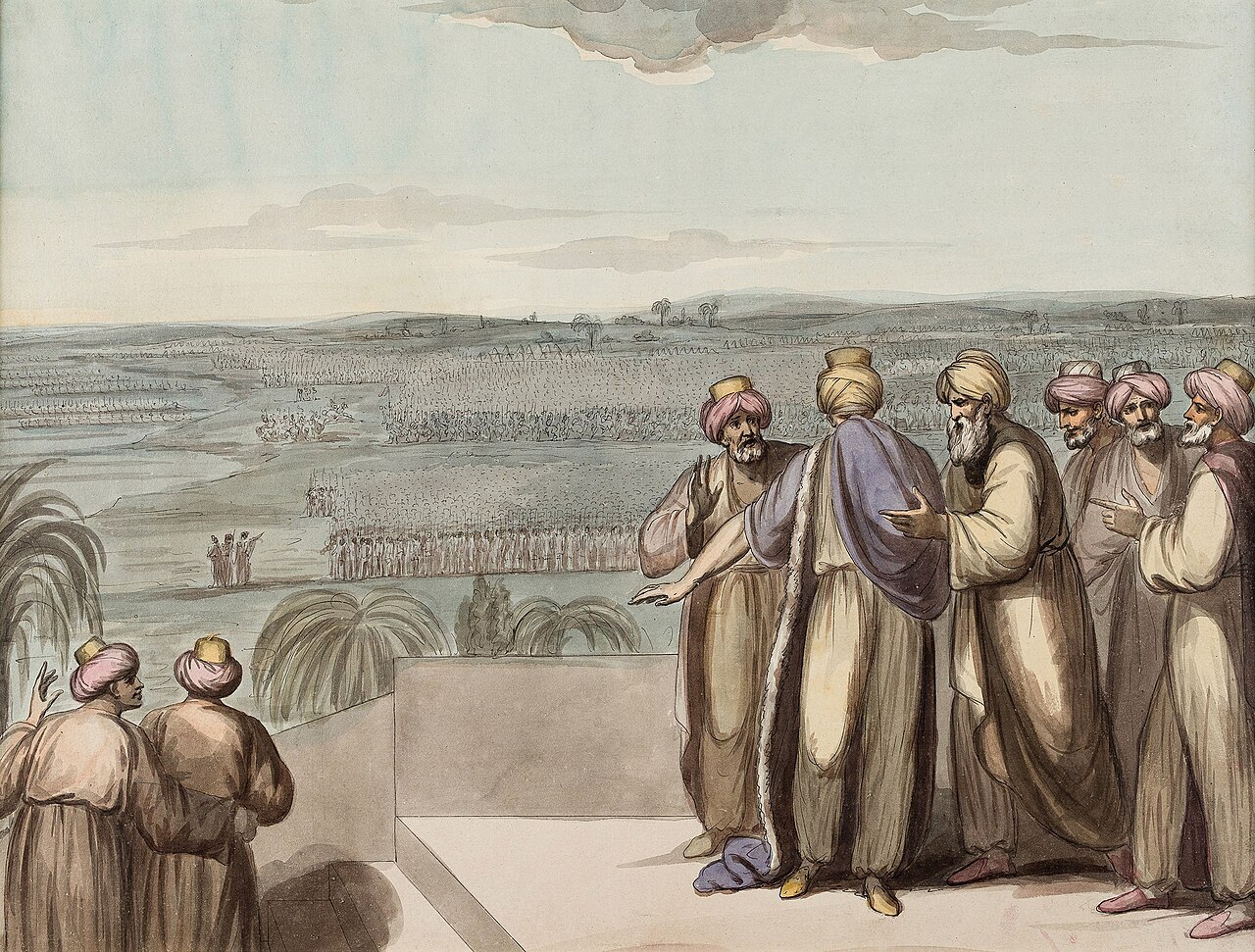

Why invade again
Darius I had planned a second war against Athens after the defeat at Marathon in 490 BCE, but revolt in Egypt and his death in 486 left the task to his son. Herodotus builds a famous scene around the decision: a council where Mardonius urges war, Xerxes’s uncle Artabanus warns against it, and the king is pushed on by repeated dreams. The scene is a piece of storytelling about pride and fate, and Herodotus could not have known what was said in the Persian council. What the evidence does show is that the war continued a policy already decades old: control of the Aegean coasts, the security of Ionia, and the punishment of states that had defied the king.
Persian sources say nothing about the campaign. Xerxes’s inscriptions list Yauna, Greeks, among the subject peoples of the empire, but do not describe a war in Europe. Everything we know of the expedition comes from Greek writers, above all Herodotus, who wrote about fifty years later, and from Aeschylus’s play The Persians of 472 BCE.
Four years of preparation
The Athos canal
The wreck of the Persian fleet off Mount Athos in 492 BCE (see the expedition of Mardonius) led Xerxes to have a canal dug across the neck of the Athos peninsula. Herodotus says the work took about three years, using gangs from the army and the local population under Persian supervisors, and that the canal was wide enough for two triremes to row side by side. He thought it an act of vanity, since the ships could have been dragged across. Modern geophysical surveys by a British and Greek team have confirmed that the canal existed and ran about two kilometres across the isthmus, a substantial piece of engineering.
The bridges over the Hellespont
To get the army into Europe, engineers built two bridges of boats between Abydos on the Asian shore and the European side, near Sestos, where the straits are a little over a kilometre wide. The first bridges, held by cables of flax and papyrus made by Phoenician and Egyptian workers, were destroyed by a storm. Herodotus tells how Xerxes ordered the water to be given three hundred lashes and a pair of fetters thrown into it, and had the overseers beheaded. New bridges were then built using, he says, 360 ships for one and 314 for the other, anchored in lines with their cables drawn tight by windlasses, and covered with a roadway of planks and earth. The army took seven days and seven nights to cross.
The lashing story has made Xerxes a symbol of arrogance, but it may misunderstand a Persian ritual act of purifying or punishing a hostile water. Either way, the engineering itself impressed even hostile Greek observers.
Supplies
Food depots were set up along the coast of Thrace and Macedon, at places such as Doriscus and Eion. Rivers were bridged, and roads cut through the forests. These preparations show how the Persian administration, the same system that appears in the Persepolis Fortification tablets, could move grain and animals on a vast scale.
How big was the army
Herodotus says the infantry was counted at Doriscus in Thrace by packing 10,000 men into an enclosure again and again, and that it came to 1,700,000. He gives a list of 46 nations, each with its own dress and weapons, a list that resembles the lists of peoples in Persian royal inscriptions and may draw on Persian information. Adding the fleet, cavalry and the European levies, he reaches a total of 2,641,610 fighting men and over five million with servants and camp followers.
No modern historian accepts these numbers. An army of that size could not have been fed or watered, and it would have stretched for hundreds of kilometres on the march. Modern estimates for the land army vary widely, usually between about 70,000 and 300,000 fighting men, and many historians favour figures towards the lower half of that range. The fleet figure of 1,207 triremes, which also appears in Aeschylus, is taken more seriously, although some scholars think the real number nearer 600. Even the lowest estimates make it a very large force for its time. For the army’s structure, see The Persian Immortals and the Achaemenid Army; for the fleet, The Achaemenid Navy.
The Greek response
In autumn 481 BCE representatives of Greek states opposed to Persia met at the Isthmus of Corinth and formed an alliance under Spartan leadership. It was far from all of Greece. Thessaly, most of Boeotia including Thebes, and several other states submitted to Xerxes, giving earth and water. Argos stayed neutral. The oracle at Delphi gave Athens a grim answer, advising flight, and then a second answer promising that a “wooden wall” would save them. Themistocles argued that this meant the fleet. Athens had recently built some 200 triremes with silver from the mines at Laurion, which made it the leading Greek naval power.
The allies first sent about 10,000 hoplites to hold the Vale of Tempe in northern Thessaly, but withdrew on learning that the position could be bypassed. They then chose a joint land and sea defence at Thermopylae and Artemisium.
The course of the invasion
- 481 BCE Xerxes winters at Sardis; heralds sent to demand earth and water.
- Spring 480 The army crosses the Hellespont and marches through Thrace and Macedon.
- August or September 480 Thermopylae and Artemisium.
- September 480 The Persians capture Athens and burn the Acropolis.
- September 480 Persian fleet defeated at Salamis; Xerxes returns to Asia.
- Summer 479 Mardonius reoccupies Athens, then is defeated and killed at Plataea; Persian defeat at Mycale.
Looking at it from both sides
For Greek writers the failure of the invasion proved that free citizens could beat the subjects of a despot, and Herodotus’s whole history was built around that contrast. For the empire, the campaign was costly but not a catastrophe. Xerxes held Athens for a time, Persian power in the north Aegean lasted for some years more, and the king continued to rule from Persepolis for fifteen years. The Greek wars were one frontier problem among many. The overall shape of the conflict is in The Greco-Persian Wars: An Overview, and the king himself is the subject of Xerxes I: King of Kings.
Persian words from this page
| پل | pol | bridge |
| تنگه | tangeh | strait |
| سپاه | sepâh | army |
| ناوگان | nâvgân | fleet |
| لشکرکشی | lashkarkeshi | military campaign, invasion |
| سارد | Sârd | Sardis |
Sources and further reading
- Herodotus, Histories, Book 7.
- Aeschylus, The Persians (472 BCE).
- Pierre Briant, From Cyrus to Alexander: A History of the Persian Empire (2002).
- J. F. Lazenby, The Defence of Greece, 490–479 BC (1993).
- Peter Green, The Greco-Persian Wars (1996).
- Encyclopaedia Iranica, “Xerxes I”.
Want to learn Persian? Get the free Starter Pack
Get the 14-page printable Starter Pack (all 32 letters, a 7-day reading plan, 100 core words and 20 survival phrases) and a short 5-email course. Free.
More in The Achaemenid Empire (550–330 BCE)
- Achaemenes, Teispes and the Early Persian Kings of Anshan
- Cyrus the Great: Birth, Legends and Rise to Power
- Cyrus Conquers Lydia: Croesus and the Battle of Thymbra
- The Persian Conquest of Ionia and Asia Minor
- Cyrus Takes Babylon (539 BCE)
- The Cyrus Cylinder
- Cyrus and the Return of the Jews
- The Death of Cyrus and the Massagetae
- Pasargadae: Cyrus’s Capital and Tomb
- The Tomb of Cyrus through History
- Cambyses II
- Cambyses Conquers Egypt: The Battle of Pelusium
- Bardiya and Gaumata: The Usurper Question
- Darius the Great Takes the Throne
- The Great Revolts of 522–521 BCE
- The Behistun Inscription
- The Persian Conquest of the Indus Valley
- Darius’s Scythian Campaign
- Darius’s Canal from the Nile to the Red Sea
- Darius’s Reforms: Satrapies, Taxes and Law
- The Royal Road and the Persian Postal System
- The Daric: Achaemenid Coinage and Economy
- The Ionian Revolt (499–493 BCE)
- The Greco-Persian Wars: An Overview
- Mardonius and the First Persian Expedition to Greece (492 BCE)
- The Battle of Marathon (490 BCE)
- The Death of Darius I and the Succession of Xerxes
- The Royal Tombs of Naqsh-e Rostam
- Xerxes I: King of Kings (486–465 BCE)
- Xerxes’ Invasion of Greece (480–479 BCE)
- The Battle of Thermopylae (480 BCE)
- The Battle of Artemisium (480 BCE)
- The Persian Capture of Athens (480–479 BCE)
- The Battle of Salamis (480 BCE)
- The Battle of Plataea and the End of the Invasion (479 BCE)
- The Palace of Darius at Susa
- Building Persepolis: How Darius and Xerxes Built Parsa
- The Persepolis Fortification and Treasury Tablets
- Herodotus and the Persians
- The Apadana Reliefs: Nations Bringing Gifts
- The Achaemenid Paradise Gardens
- The Persian Immortals and the Achaemenid Army
- The Achaemenid Navy
- Religion of the Achaemenid Kings
- Women of the Achaemenid Court
- Old Persian Language and Cuneiform
- Egypt under Persian Rule
- Babylon under Persian Rule
- Artaxerxes I
- The Peace of Callias
- Darius II and the Peloponnesian War
- Famous Satraps of the Persian Empire
- Artaxerxes II Mnemon
- Cyrus the Younger and the Battle of Cunaxa
- The King’s Peace (387 BCE)
- The Great Satraps’ Revolt
- Artaxerxes III and the Reconquest of Egypt
- Darius III, the Last Achaemenid King
- The Battle of the Granicus (334 BCE)
- The Battle of Issus (333 BCE)
- Alexander Takes Tyre, Gaza and Egypt (332 BCE)
- The Battle of Gaugamela (331 BCE)
- Ariobarzanes and the Battle of the Persian Gate
- The Burning of Persepolis (330 BCE)
- The Death of Darius III and Bessus
- The Legacy of the Achaemenid Empire