Artaxerxes II, called Mnemon (“the mindful”), was king of Persia from 404 to 358 BCE, the longest reign of any Achaemenid ruler. He defeated the rebellion of his brother Cyrus the Younger at Cunaxa, used Persian money to turn the Greek city-states against each other until they accepted his terms in the King’s Peace, rebuilt the palace of Darius at Susa, and was the first king to name the gods Anahita and Mithra beside Ahuramazda. He also lost Egypt and faced a wave of revolts by his own satraps.
| Reign | 404–358 BCE |
|---|---|
| Birth name | Arsaces (Greek form) |
| Modern Persian | اردشیر دوم (Ardeshir-e dovvom) |
| Parents | Darius II and Parysatis |
| Queen | Stateira |
| Main events | Cunaxa (401 BCE); war with Sparta (400–386); Cnidus (394); King’s Peace (387); failed attempts on Egypt (385–383, 373); revolts of the satraps (360s) |
| Successor | His son Ochus, as Artaxerxes III |
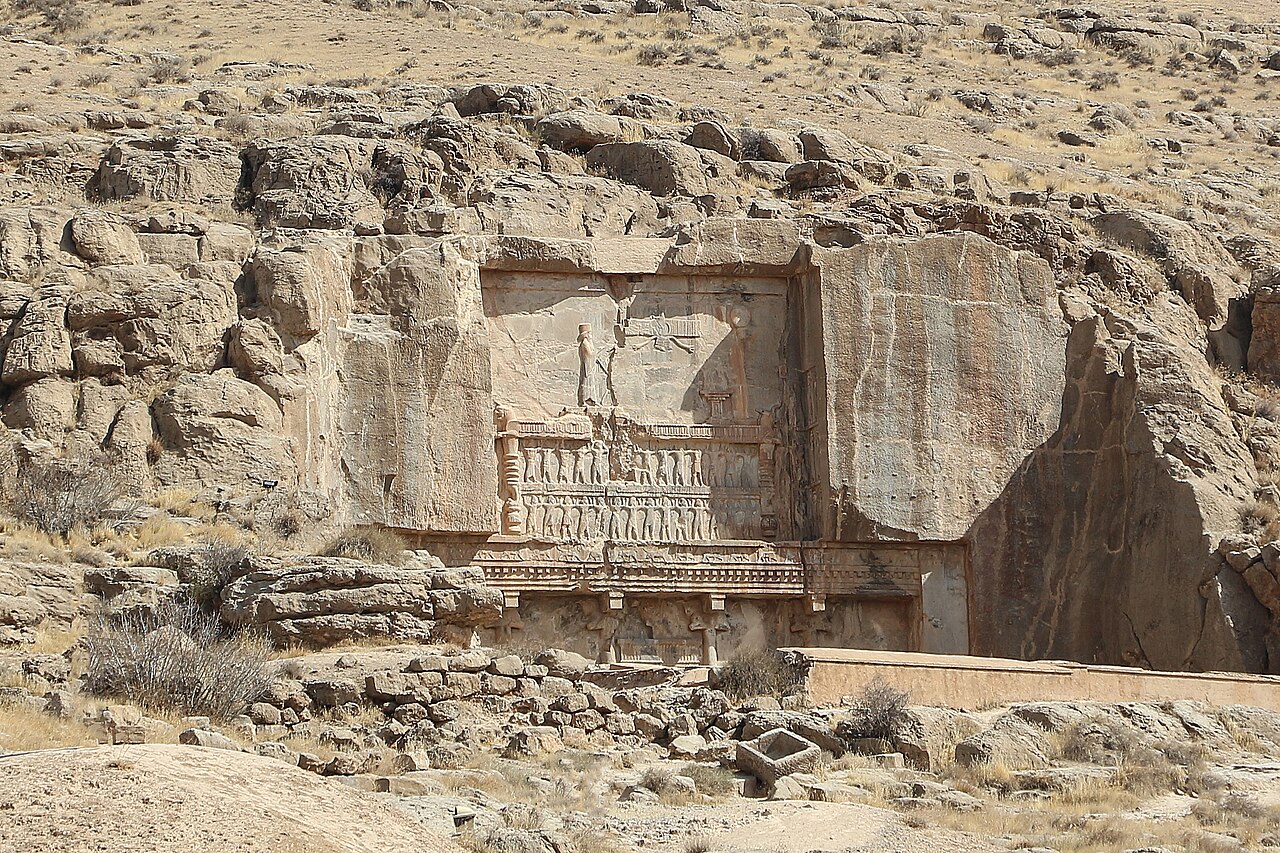
| Tomb | Rock tomb above Persepolis (conventional attribution) |
Sources for the reign
We know Artaxerxes II better than most Persian kings, and almost entirely through Greek eyes. The doctor Ctesias of Cnidus served at his court and wrote a history of Persia, now lost but summarised by later writers. Xenophon marched with the king’s enemies in 401 BCE. Plutarch wrote a Life of Artaxerxes five centuries later using both. From the Persian side come building inscriptions at Susa and Hamadan, and Babylonian dated documents.
Coronation and a brother’s revolt
Plutarch describes the coronation at Pasargadae: the new king entered a sanctuary, took off his own robe and put on the robe Cyrus the Great had worn before he became king, ate a cake of figs, chewed terebinth and drank a cup of sour milk. The details may be garbled, but the link between royal ritual and the memory of Cyrus is plausible.
At the ceremony, Tissaphernes accused the king’s younger brother Cyrus of planning to kill him. Their mother Parysatis saved Cyrus, who returned to his command in Asia Minor and raised an army including more than 10,000 Greek mercenaries. In 401 BCE the brothers met near Babylon. Cyrus broke through to the king, wounded him, and was killed. The campaign, and the long march home of the Greeks, are told on the page on the Battle of Cunaxa.

War with Sparta and the King’s Peace
Sparta had backed Cyrus, and now claimed to protect the Greek cities of Asia. From 400 BCE Spartan armies campaigned in western Anatolia, and in 396 the Spartan king Agesilaus arrived and raided Lydia and Phrygia. Artaxerxes answered in two ways. He had Tissaphernes, who had failed to stop Agesilaus, arrested and executed in 395 BCE. And he sent money to Greece: gold went to Thebes, Corinth, Argos and Athens, who rose against Sparta in the Corinthian War. Agesilaus was recalled. Plutarch has him joke that he was driven out of Asia by the king’s “archers”, meaning the gold darics stamped with the image of the king with a bow.
At sea, a Persian fleet commanded by Pharnabazus and the Athenian exile Conon destroyed the Spartan navy at Cnidus in 394 BCE. When the Greek war dragged on, Artaxerxes changed sides again and agreed terms with Sparta. In 387/386 BCE the King’s Peace gave him the Greek cities of Asia and made him the guarantor of peace in Greece.
Egypt, Cyprus and the Cadusians
Egypt had broken away at the very end of Darius II’s reign, and it stayed free throughout this one. A Persian invasion in the 380s failed. A second, in 373 BCE, led by Pharnabazus with the Athenian general Iphicrates, reached the Nile delta and then fell apart in quarrels between the commanders while the river rose. Egypt would not be reconquered until 343 BCE under Artaxerxes III.
Closer to home, the king fought a long war against Evagoras, king of Salamis in Cyprus, who had built up power on the island with Athenian and Egyptian help. It ended around 380 BCE with Evagoras keeping his own city as a vassal. Plutarch also describes a campaign against the Cadusians, a mountain people by the Caspian, in which the army nearly starved and the king marched on foot with his men, carrying his own quiver and shield.
Rebuilding at Susa
Artaxerxes was a builder. At Susa, an inscription in his name says that the great columned hall built by his great-great-grandfather Darius had burned in the time of his grandfather Artaxerxes I, and that he rebuilt it. He also built a new palace on lower ground by the Shaur river, west of the old citadel. At Hamadan, the old Median capital Ecbatana, inscriptions show building work as well. See the archaeological site of Susa for what survives.
Anahita and Mithra
The Susa and Hamadan inscriptions are the first royal texts to ask for the protection not only of Ahuramazda but also of Anahita and Mithra. The Babylonian writer Berossus, as quoted later, says Artaxerxes was the first to set up statues of Anahita, in Babylon, Susa, Ecbatana, Persepolis, Bactra, Damascus and Sardis, and to require their worship. Historians debate whether this was a religious reform, a recognition of gods long worshipped in Iran, or a policy to bind the provinces to the king through a shared cult. The wider background is on the page on the religion of the Achaemenid kings.
The court and the succession
The Greek writers fill the court with drama. Parysatis poisoned the queen Stateira. The king, Plutarch says, married two of his own daughters, Atossa and Amestris. He is credited with a vast number of sons by concubines, but three sons by the queen mattered. The eldest, Darius, was proclaimed heir and later plotted against his father, after a quarrel over a concubine, and was executed. The second, Ariaspes, killed himself after being frightened by false reports of his father’s anger. A favourite illegitimate son, Arsames, was murdered. The youngest legitimate son, Ochus, was behind much of this, the Greek sources say, and succeeded as Artaxerxes III when his father died, at a great age, in 358 BCE.
A long reign, judged two ways
For older historians the reign showed decline: Egypt lost, satraps in revolt, a king ruled by women and eunuchs. More recent work points to the other side. Artaxerxes survived a dangerous civil war, regained the Greek cities of Asia that Xerxes had lost, made himself arbiter of Greek affairs without fighting a major battle in Greece, and handed on an empire intact enough for his son to reconquer Egypt. The revolts of the 360s, described on the page on the Great Satraps’ Revolt, ended with every rebel dead or reconciled.
He was buried not at Naqsh-e Rostam but in a new rock tomb cut into the mountain above Persepolis, the model for the tombs of his successors there.
Persian words from this page
| اردشیر | Ardeshir | Artaxerxes |
| ناهید | Nâhid | Anahita |
| مهر | Mehr | Mithra |
| شوش | Shush | Susa |
| پاسارگاد | Pâsârgâd | Pasargadae |
| تاجگذاری | tâjgozâri | coronation |
| آرامگاه | ârâmgâh | tomb |
Sources and further reading
- Plutarch, Life of Artaxerxes.
- Xenophon, Anabasis and Hellenica, Books 3–5.
- Ctesias, Persica, in Lloyd Llewellyn-Jones and James Robson, Ctesias’ History of Persia (2010).
- Artaxerxes II, inscriptions from Susa and Hamadan, in Amélie Kuhrt, The Persian Empire: A Corpus of Sources from the Achaemenid Period (2007).
- Encyclopaedia Iranica, “Artaxerxes II”.
- Pierre Briant, From Cyrus to Alexander: A History of the Persian Empire (2002).
Want to learn Persian? Get the free Starter Pack
Get the 14-page printable Starter Pack (all 32 letters, a 7-day reading plan, 100 core words and 20 survival phrases) and a short 5-email course. Free.
More in The Achaemenid Empire (550–330 BCE)
- Achaemenes, Teispes and the Early Persian Kings of Anshan
- Cyrus the Great: Birth, Legends and Rise to Power
- Cyrus Conquers Lydia: Croesus and the Battle of Thymbra
- The Persian Conquest of Ionia and Asia Minor
- Cyrus Takes Babylon (539 BCE)
- The Cyrus Cylinder
- Cyrus and the Return of the Jews
- The Death of Cyrus and the Massagetae
- Pasargadae: Cyrus’s Capital and Tomb
- The Tomb of Cyrus through History
- Cambyses II
- Cambyses Conquers Egypt: The Battle of Pelusium
- Bardiya and Gaumata: The Usurper Question
- Darius the Great Takes the Throne
- The Great Revolts of 522–521 BCE
- The Behistun Inscription
- The Persian Conquest of the Indus Valley
- Darius’s Scythian Campaign
- Darius’s Canal from the Nile to the Red Sea
- Darius’s Reforms: Satrapies, Taxes and Law
- The Royal Road and the Persian Postal System
- The Daric: Achaemenid Coinage and Economy
- The Ionian Revolt (499–493 BCE)
- The Greco-Persian Wars: An Overview
- Mardonius and the First Persian Expedition to Greece (492 BCE)
- The Battle of Marathon (490 BCE)
- The Death of Darius I and the Succession of Xerxes
- The Royal Tombs of Naqsh-e Rostam
- Xerxes I: King of Kings (486–465 BCE)
- Xerxes’ Invasion of Greece (480–479 BCE)
- The Battle of Thermopylae (480 BCE)
- The Battle of Artemisium (480 BCE)
- The Persian Capture of Athens (480–479 BCE)
- The Battle of Salamis (480 BCE)
- The Battle of Plataea and the End of the Invasion (479 BCE)
- The Palace of Darius at Susa
- Building Persepolis: How Darius and Xerxes Built Parsa
- The Persepolis Fortification and Treasury Tablets
- Herodotus and the Persians
- The Apadana Reliefs: Nations Bringing Gifts
- The Achaemenid Paradise Gardens
- The Persian Immortals and the Achaemenid Army
- The Achaemenid Navy
- Religion of the Achaemenid Kings
- Women of the Achaemenid Court
- Old Persian Language and Cuneiform
- Egypt under Persian Rule
- Babylon under Persian Rule
- Artaxerxes I
- The Peace of Callias
- Darius II and the Peloponnesian War
- Famous Satraps of the Persian Empire
- Artaxerxes II Mnemon
- Cyrus the Younger and the Battle of Cunaxa
- The King’s Peace (387 BCE)
- The Great Satraps’ Revolt
- Artaxerxes III and the Reconquest of Egypt
- Darius III, the Last Achaemenid King
- The Battle of the Granicus (334 BCE)
- The Battle of Issus (333 BCE)
- Alexander Takes Tyre, Gaza and Egypt (332 BCE)
- The Battle of Gaugamela (331 BCE)
- Ariobarzanes and the Battle of the Persian Gate
- The Burning of Persepolis (330 BCE)
- The Death of Darius III and Bessus
- The Legacy of the Achaemenid Empire