The Achaemenid navy was the war fleet of the Persian kings, built and crewed by the seafaring peoples they ruled: Phoenicians above all, but also Egyptians, Cypriots, Cilicians, Carians and the Greeks of Ionia. A land empire with no sea tradition of its own became, from the 520s BCE, the greatest naval power of the eastern Mediterranean, and for two centuries its fleets shaped wars from the Nile delta to the Aegean.
| Active | c. 525–332 BCE |
|---|---|
| Main contingents | Phoenicia (Sidon, Tyre, Arwad), Egypt, Cyprus, Cilicia, Caria, Ionia |
| Main warship | The trireme |
| Largest fleet recorded | 1,207 triremes for Xerxes in 480 BCE (Herodotus, Aeschylus); modern estimates are much lower |
| Victories | Lade (494 BCE), the Nile (c. 454 BCE), Cnidus (394 BCE) |
| Defeats | Salamis (480 BCE), Mycale (479 BCE), Eurymedon (c. 466 BCE) |
The great naval battles of Xerxes’ invasion have their own pages: Artemisium and Salamis. This page follows the fleet as an institution, from its creation to its end.

A land power goes to sea
Cyrus the Great conquered Lydia, the Greek cities of Asia Minor and Babylon without a fleet. The turning point came when the Phoenician cities on the coast of today’s Lebanon, with centuries of shipbuilding behind them, accepted Persian rule after the fall of Babylon in 539 BCE. Cyprus followed. When Cambyses marched on Egypt in 525 BCE, Herodotus says that the Phoenicians and Cypriots sailed with him, and that Polycrates of Samos sent ships as well. Herodotus also tells that the Phoenicians refused to sail against Carthage, their own colony, and that Cambyses did not force them: an early sign that the king’s fleet rested on the goodwill of its builders.
Under Darius I the fleet became a regular instrument of rule. A Greek from Caria, Scylax, sailed down the Indus and around Arabia on Darius’s orders; ships of the Ionian Greeks guarded the bridge of boats on the Danube during the Scythian campaign; and the Nile to Red Sea canal was meant to let ships pass between Egypt and Persia.
How the fleet was raised
The Persian king did not own a standing navy in the modern sense. When a campaign was planned, the coastal satrapies were ordered to build and man a set number of ships, and the king paid for the work. Each city or people sent its own squadron under its own leaders: the kings of Sidon, Tyre and Arwad, the kings of the Cypriot cities, Greek tyrants from Ionia, and in 480 BCE a woman, Artemisia, ruler of Halicarnassus.
Over these local commanders stood Persian admirals, usually close relatives of the king. Herodotus names the four admirals of 480 BCE: Ariabignes, a son of Darius, who commanded the Ionians and Carians and was killed at Salamis; Achaemenes, Xerxes’ brother, at the head of the Egyptians; and two Persian nobles, Prexaspes and Megabazus, over the rest. Each ship also carried a body of marines, Persians, Medes and Sakas, to fight in boarding actions and, not least, to watch over the loyalty of the crews.
Ships and crews
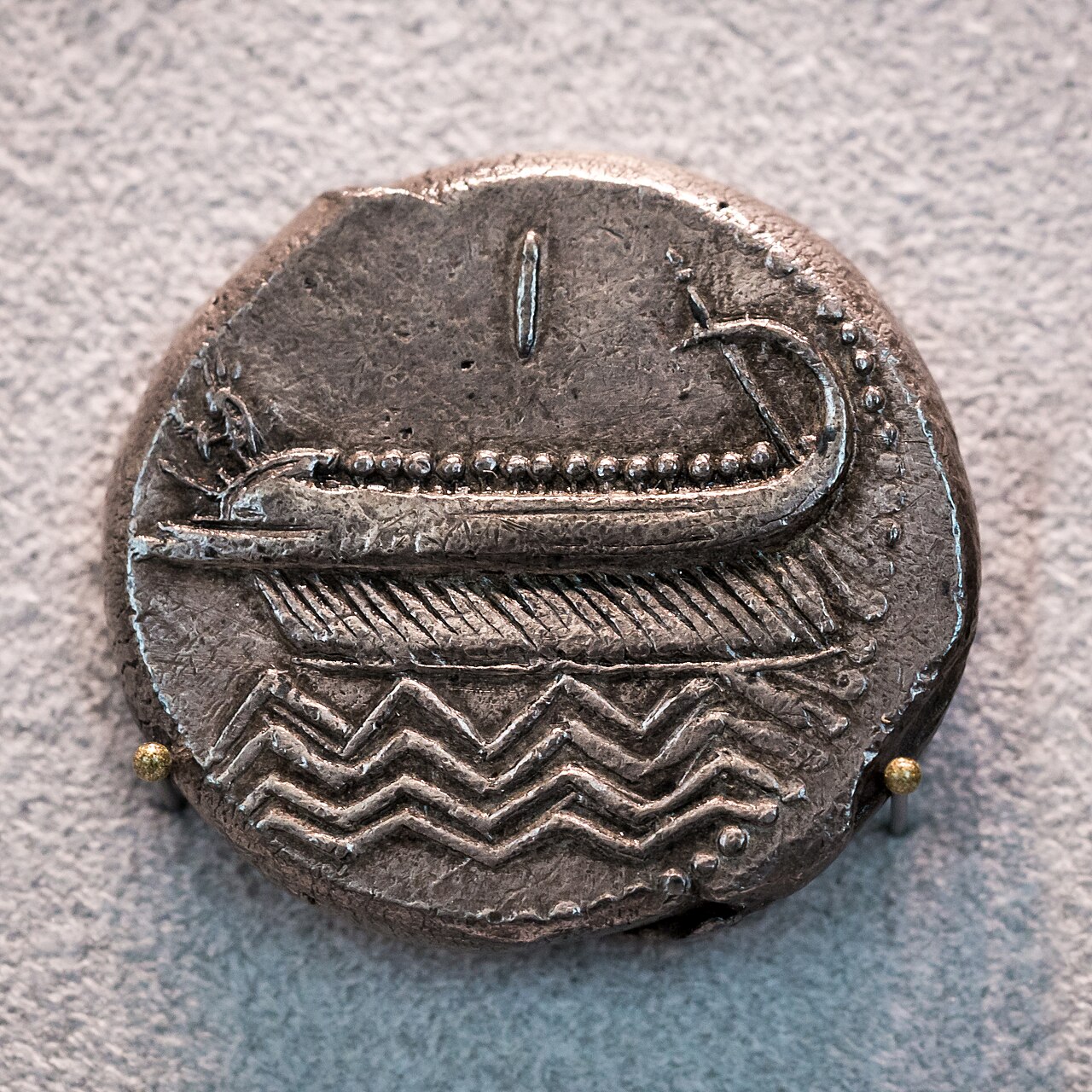
The main warship was the trireme, a long, narrow galley with three banks of oars and a bronze ram at the bow, rowed by about 170 men. Herodotus judged the Phoenician ships, and those of Sidon in particular, to be the best in Xerxes’ fleet, and says Xerxes chose a Sidonian ship for himself. Phoenician triremes seem to have carried higher decks and more fighting men than Athenian ones. The fleet also used special horse transports, first mentioned for the expedition of Datis and Artaphernes in 490 BCE, which carried the cavalry that landed at Marathon.
The fleet of 480 BCE
For Xerxes’ invasion Herodotus gives a total of 1,207 triremes, and lists them by people: 300 from Phoenicia and Syria, 200 from Egypt, 150 from Cyprus, 100 from Cilicia, 100 from Ionia, 100 from the Hellespont, 70 from Caria, 60 from Aeolis, 50 from Lycia, 30 from Pamphylia, 30 from the Dorians of Asia and 17 from the islands. The playwright Aeschylus, who fought at Salamis, gives the same figure. Modern historians mostly think the real fleet was between 600 and 800 ships, though some accept a figure near Herodotus’s. Storms off Magnesia and Euboea destroyed part of it before the battles began.
A fleet of this size was a vast logistic undertaking. It needed shipyards, timber from Lebanon and Cilicia, food for perhaps 150,000 rowers, and harbours along the route. Its job was to move with the army and supply it; the plan of 480 BCE depended on the two advancing side by side.
After Salamis: fifty years of Aegean war
The defeat at Salamis and the destruction of the beached fleet at Mycale in 479 BCE ended Persian control of the Aegean. The Delian League under Athens now took the war to Persian coasts. At the Eurymedon river in Pamphylia, around 466 BCE, the Athenian general Cimon destroyed a Phoenician fleet and the army camped beside it. But the Persian fleet was not finished. When Athens sent some 200 ships to help the Egyptian rebel Inaros, a Persian army and a Phoenician fleet trapped and destroyed the Athenian force in the Nile delta around 454 BCE, one of the worst disasters in Athenian history (see Artaxerxes I).
Gold instead of ships
During the last phase of the Peloponnesian War, Persia found it cheaper to pay others to fight at sea. The satraps Tissaphernes and Pharnabazus funded the Spartan fleet, and in 411 BCE Tissaphernes brought a Phoenician fleet as far as Aspendus in Pamphylia and then sent it home without fighting. Thucydides could not decide why. Persian silver paid Spartan rowers until the Athenian fleet was destroyed at Aegospotami in 405 BCE (see Darius II).
Then the roles turned. When Sparta invaded Asia Minor, Persia built a new fleet in Cyprus and Phoenicia and gave it to an Athenian exile, Conon, alongside the satrap Pharnabazus. In 394 BCE they destroyed the Spartan fleet off Cnidus. Persian ships then sailed into Greek waters, and Persian money rebuilt the walls of Athens. The King’s Peace of 387 BCE followed.
The last campaigns
In the fourth century the fleet fought mostly to hold or regain its own coasts: against Evagoras of Cyprus in the 380s, against rebel Egypt, and against Sidon when it revolted in the 340s. In 334 and 333 BCE, after Alexander had crossed into Asia, the Persian fleet under Memnon of Rhodes still controlled the Aegean and took Chios and much of Lesbos. Memnon died during the siege of Mytilene, and Alexander answered sea power on land: he seized the harbours one by one. When the Phoenician and Cypriot kings learned that their cities were in his hands, they brought their squadrons over to him at the siege of Tyre in 332 BCE. The Achaemenid navy ended not in a sea battle but by changing sides.
What the navy shows about the empire
The fleet worked because the Persian kings left their maritime subjects their kings, their cities and their trade, and paid them well. It failed when that bargain broke, or when, as at Salamis, it was asked to fight in narrow water where its numbers did not count. Historians such as H. T. Wallinga have argued that the Persian fleet, by its very size, pushed the Greeks into building navies of their own, so that the Athenian sea power that defeated Persia was in part a Persian creation.
Persian words from this page
| کشتی | keshti | ship |
| ناوگان | nâvgân | fleet |
| دریاسالار | daryâsâlâr | admiral |
| دریا | daryâ | sea |
| پارو | pâru | oar |
| بندر | bandar | port |
Sources and further reading
- Herodotus, Histories, Book 3.19 and Book 7.89–100.
- Aeschylus, The Persians (472 BCE).
- Thucydides, History of the Peloponnesian War, Books 1 and 8.
- Xenophon, Hellenica, Book 4, on Cnidus.
- H. T. Wallinga, Ships and Sea-Power before the Great Persian War (1993) and Xerxes’ Greek Adventure: The Naval Perspective (2005).
- Pierre Briant, From Cyrus to Alexander: A History of the Persian Empire (2002).
Want to learn Persian? Get the free Starter Pack
Get the 14-page printable Starter Pack (all 32 letters, a 7-day reading plan, 100 core words and 20 survival phrases) and a short 5-email course. Free.
More in The Achaemenid Empire (550–330 BCE)
- Achaemenes, Teispes and the Early Persian Kings of Anshan
- Cyrus the Great: Birth, Legends and Rise to Power
- Cyrus Conquers Lydia: Croesus and the Battle of Thymbra
- The Persian Conquest of Ionia and Asia Minor
- Cyrus Takes Babylon (539 BCE)
- The Cyrus Cylinder
- Cyrus and the Return of the Jews
- The Death of Cyrus and the Massagetae
- Pasargadae: Cyrus’s Capital and Tomb
- The Tomb of Cyrus through History
- Cambyses II
- Cambyses Conquers Egypt: The Battle of Pelusium
- Bardiya and Gaumata: The Usurper Question
- Darius the Great Takes the Throne
- The Great Revolts of 522–521 BCE
- The Behistun Inscription
- The Persian Conquest of the Indus Valley
- Darius’s Scythian Campaign
- Darius’s Canal from the Nile to the Red Sea
- Darius’s Reforms: Satrapies, Taxes and Law
- The Royal Road and the Persian Postal System
- The Daric: Achaemenid Coinage and Economy
- The Ionian Revolt (499–493 BCE)
- The Greco-Persian Wars: An Overview
- Mardonius and the First Persian Expedition to Greece (492 BCE)
- The Battle of Marathon (490 BCE)
- The Death of Darius I and the Succession of Xerxes
- The Royal Tombs of Naqsh-e Rostam
- Xerxes I: King of Kings (486–465 BCE)
- Xerxes’ Invasion of Greece (480–479 BCE)
- The Battle of Thermopylae (480 BCE)
- The Battle of Artemisium (480 BCE)
- The Persian Capture of Athens (480–479 BCE)
- The Battle of Salamis (480 BCE)
- The Battle of Plataea and the End of the Invasion (479 BCE)
- The Palace of Darius at Susa
- Building Persepolis: How Darius and Xerxes Built Parsa
- The Persepolis Fortification and Treasury Tablets
- Herodotus and the Persians
- The Apadana Reliefs: Nations Bringing Gifts
- The Achaemenid Paradise Gardens
- The Persian Immortals and the Achaemenid Army
- The Achaemenid Navy
- Religion of the Achaemenid Kings
- Women of the Achaemenid Court
- Old Persian Language and Cuneiform
- Egypt under Persian Rule
- Babylon under Persian Rule
- Artaxerxes I
- The Peace of Callias
- Darius II and the Peloponnesian War
- Famous Satraps of the Persian Empire
- Artaxerxes II Mnemon
- Cyrus the Younger and the Battle of Cunaxa
- The King’s Peace (387 BCE)
- The Great Satraps’ Revolt
- Artaxerxes III and the Reconquest of Egypt
- Darius III, the Last Achaemenid King
- The Battle of the Granicus (334 BCE)
- The Battle of Issus (333 BCE)
- Alexander Takes Tyre, Gaza and Egypt (332 BCE)
- The Battle of Gaugamela (331 BCE)
- Ariobarzanes and the Battle of the Persian Gate
- The Burning of Persepolis (330 BCE)
- The Death of Darius III and Bessus
- The Legacy of the Achaemenid Empire