Artaxerxes III, born Ochus, ruled the Achaemenid Empire from 359/358 to 338 BCE. He came to the throne after a bloody purge of his own family, crushed revolts in Asia Minor and Phoenicia, and in about 343 BCE won back Egypt, which had been independent for some sixty years. He left the empire stronger than he found it, but he was murdered, and within eight years of his death the dynasty had fallen to Alexander.
| Reign | 359/358 to 338 BCE |
|---|---|
| Birth name | Ochus (the Greek form of his personal name) |
| Father | Artaxerxes II |
| Main events | Satraps disarmed, revolt of Artabazus, sack of Sidon, reconquest of Egypt |
| Death | 338 BCE, poisoned by Bagoas according to Diodorus |
| Persian name | اردشیر سوم (Ardeshir-e sevvom) |
A violent succession
The long reign of Artaxerxes II ended in a family struggle. Of his many sons, the heir Darius was executed for plotting against his father, another son, Ariaspes, killed himself after being frightened by court rumours, and a third, Arsames, was murdered. The Roman historian Justin and Plutarch both make Ochus the hand behind these deaths. When he took the throne he is said to have killed most of the remaining royal kin; Justin and Valerius Maximus give wildly large figures for the brothers and relatives who died. The numbers are not reliable, but the picture of a king who cleared away every rival was common to all the Greek and Roman writers.
Like his predecessors he took a throne name. Ochus became Artaxerxes, the name of his father and great-grandfather, a sign that he presented himself as the continuation of a stable line rather than a usurper.

Taming the satraps
Artaxerxes II had faced the great revolts of the satraps in Asia Minor in the 360s. His son drew a practical conclusion. A note in an ancient commentary on Demosthenes says he ordered the satraps of the coast to dismiss their mercenary armies, since private armies of Greek soldiers were what had made the governors dangerous.
Not everyone obeyed. Artabazus, satrap of Hellespontine Phrygia, rebelled in the 350s with help from Athenian and Theban mercenaries. He was defeated and fled to the court of Philip II of Macedon, with his brother-in-law Memnon of Rhodes. Both were later pardoned and returned to Persian service, and Memnon would lead the defence against Alexander in 334 BCE. The episode shows how closely the Persian and Macedonian worlds were already tied a generation before the invasion.
First failure in Egypt and the revolt of Phoenicia
Egypt had broken away around 404 BCE and had beaten off several Persian attempts to recover it. Artaxerxes III’s first campaign, around 351/350 BCE, also failed. The defeat encouraged others. The Phoenician cities, led by Sidon and its king Tennes, rose in revolt, and some Cypriot kings joined them. Sidon received Greek mercenaries from Egypt.
Artaxerxes took personal command. According to Diodorus (Book 16), Tennes betrayed his own city in the hope of saving himself, and the king had him killed anyway. When the Sidonians saw the Persian army inside the walls they burned their ships and set fire to their houses, and Diodorus says some 40,000 people died. Whatever the true figure, the destruction of Sidon, around 345 BCE, was meant as a warning to the rest of Phoenicia, and it worked.
The reconquest of Egypt
The second Egyptian campaign is usually dated to 343 BCE, though some scholars prefer 340/339 BCE. Artaxerxes assembled a large army with thousands of Greek mercenaries, recruited partly from Thebes and Argos, and with the Greek commander Mentor of Rhodes, brother of Memnon, who had served the rebels at Sidon and changed sides. The eunuch Bagoas, a trusted courtier, was one of the leading Persian commanders.
The Egyptian pharaoh Nectanebo II had his own Greek mercenaries and a line of fortifications in the eastern Delta around Pelusium, the same gateway where Cambyses had won Egypt in 525 BCE. The Persian forces outflanked his positions, the garrisons began to surrender, and Nectanebo withdrew to Memphis and then fled south, probably to Upper Egypt or Nubia. He was the last native Egyptian pharaoh for more than two thousand years.
Egypt became a satrapy again; Egyptologists call this phase the Thirty-first Dynasty. Greek writers say Artaxerxes plundered temples and killed the sacred Apis bull, the same accusation Herodotus had made against Cambyses. The charge may repeat an old literary pattern, and historians treat it with caution.
Persia and the rise of Macedon
With Egypt back, the empire reached its old frontiers. Artaxerxes now watched Philip II, who was taking over the Greek world. When Philip besieged Perinthus on the Sea of Marmara in 340 BCE, Persian satraps in Asia Minor sent troops and supplies to help the city, and the siege failed. Arrian later preserved a letter in which Alexander accused the Persians of this interference. It became one of the grievances Macedon used to justify war.
Murder by Bagoas
Diodorus says that in 338 BCE Bagoas, by then the most powerful man at court, had the king poisoned by a physician and placed Artaxerxes’ young son Arses on the throne as Artaxerxes IV. Two years later Bagoas poisoned Arses too, and chose a member of a side branch of the royal family, who became Darius III. The story of an all-powerful eunuch comes only from Greek sources, which liked tales of harem plots, but the rapid deaths of two kings point to a real crisis at the centre.
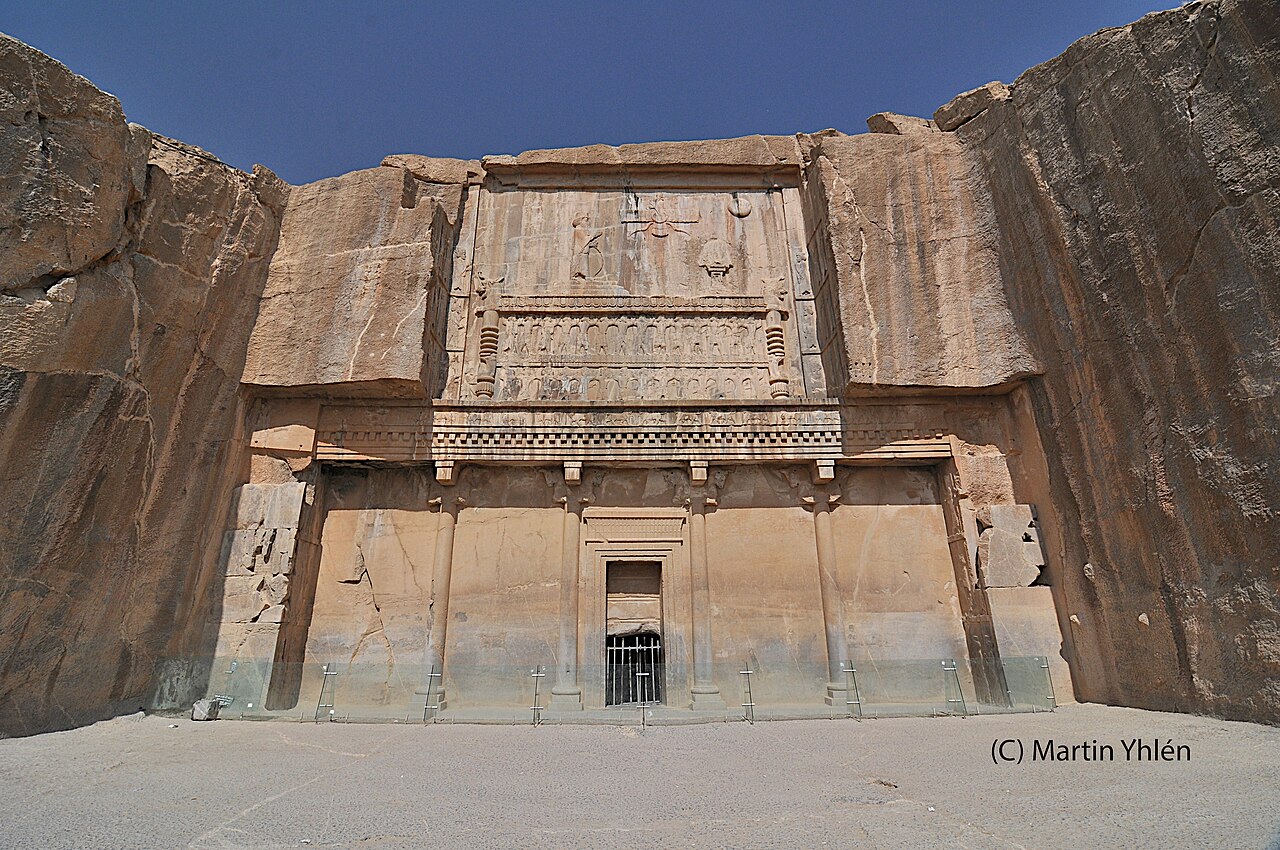
His tomb is generally identified with one of the two rock tombs cut into the mountain above Persepolis, made in the same design as the tombs of his ancestors at Naqsh-e Rostam. An inscription of Artaxerxes III on a staircase of the Persepolis terrace lists his ancestors king by king back to Hystaspes and Arsames, the father and grandfather of Darius I, an unusual effort to show his place in the royal line.
- 359/358 BCE Ochus succeeds Artaxerxes II as Artaxerxes III
- 350s BCE Revolt of Artabazus; he flees to Macedon
- c. 351/350 BCE First attempt on Egypt fails
- c. 345 BCE Revolt and destruction of Sidon
- 343 BCE (or 340/339) Egypt reconquered; Nectanebo II flees
- 340 BCE Persian help saves Perinthus from Philip II
- 338 BCE Artaxerxes III dies, by poison according to Diodorus
How historians judge him
The ancient image is of a cruel king, and his treatment of his family and of Sidon gives grounds for it. Modern historians such as Pierre Briant also stress his success: he restored royal control over the satraps and recovered the richest province the empire had lost. The idea, once common, that the empire Alexander attacked was a decaying giant fits poorly with the reign of Artaxerxes III. The weakness came from the succession crisis after his death, not from a long decline. The next pages follow that story through Darius III and the war with Alexander.
Persian words from this page
| اردشیر | Ardeshir | Artaxerxes |
| مصر | Mesr | Egypt |
| صیدا | Seydâ | Sidon |
| شهربان | shahrbân | satrap, provincial governor |
| تخت جمشید | Takht-e Jamshid | Persepolis |
| آرامگاه | ârâmgâh | tomb, resting place |
Sources and further reading
- Diodorus of Sicily, Library of History, Book 16 (Sidon and Egypt) and Book 17.5 (death of the king)
- Encyclopaedia Iranica, “Artaxerxes III“
- Pierre Briant, From Cyrus to Alexander: A History of the Persian Empire (2002), chapter 15
- Amélie Kuhrt, The Persian Empire: A Corpus of Sources from the Achaemenid Period (2007)
- The Cambridge History of Iran, vol. 2 (1985)
Want to learn Persian? Get the free Starter Pack
Get the 14-page printable Starter Pack (all 32 letters, a 7-day reading plan, 100 core words and 20 survival phrases) and a short 5-email course. Free.
More in The Achaemenid Empire (550–330 BCE)
- Achaemenes, Teispes and the Early Persian Kings of Anshan
- Cyrus the Great: Birth, Legends and Rise to Power
- Cyrus Conquers Lydia: Croesus and the Battle of Thymbra
- The Persian Conquest of Ionia and Asia Minor
- Cyrus Takes Babylon (539 BCE)
- The Cyrus Cylinder
- Cyrus and the Return of the Jews
- The Death of Cyrus and the Massagetae
- Pasargadae: Cyrus’s Capital and Tomb
- The Tomb of Cyrus through History
- Cambyses II
- Cambyses Conquers Egypt: The Battle of Pelusium
- Bardiya and Gaumata: The Usurper Question
- Darius the Great Takes the Throne
- The Great Revolts of 522–521 BCE
- The Behistun Inscription
- The Persian Conquest of the Indus Valley
- Darius’s Scythian Campaign
- Darius’s Canal from the Nile to the Red Sea
- Darius’s Reforms: Satrapies, Taxes and Law
- The Royal Road and the Persian Postal System
- The Daric: Achaemenid Coinage and Economy
- The Ionian Revolt (499–493 BCE)
- The Greco-Persian Wars: An Overview
- Mardonius and the First Persian Expedition to Greece (492 BCE)
- The Battle of Marathon (490 BCE)
- The Death of Darius I and the Succession of Xerxes
- The Royal Tombs of Naqsh-e Rostam
- Xerxes I: King of Kings (486–465 BCE)
- Xerxes’ Invasion of Greece (480–479 BCE)
- The Battle of Thermopylae (480 BCE)
- The Battle of Artemisium (480 BCE)
- The Persian Capture of Athens (480–479 BCE)
- The Battle of Salamis (480 BCE)
- The Battle of Plataea and the End of the Invasion (479 BCE)
- The Palace of Darius at Susa
- Building Persepolis: How Darius and Xerxes Built Parsa
- The Persepolis Fortification and Treasury Tablets
- Herodotus and the Persians
- The Apadana Reliefs: Nations Bringing Gifts
- The Achaemenid Paradise Gardens
- The Persian Immortals and the Achaemenid Army
- The Achaemenid Navy
- Religion of the Achaemenid Kings
- Women of the Achaemenid Court
- Old Persian Language and Cuneiform
- Egypt under Persian Rule
- Babylon under Persian Rule
- Artaxerxes I
- The Peace of Callias
- Darius II and the Peloponnesian War
- Famous Satraps of the Persian Empire
- Artaxerxes II Mnemon
- Cyrus the Younger and the Battle of Cunaxa
- The King’s Peace (387 BCE)
- The Great Satraps’ Revolt
- Artaxerxes III and the Reconquest of Egypt
- Darius III, the Last Achaemenid King
- The Battle of the Granicus (334 BCE)
- The Battle of Issus (333 BCE)
- Alexander Takes Tyre, Gaza and Egypt (332 BCE)
- The Battle of Gaugamela (331 BCE)
- Ariobarzanes and the Battle of the Persian Gate
- The Burning of Persepolis (330 BCE)
- The Death of Darius III and Bessus
- The Legacy of the Achaemenid Empire