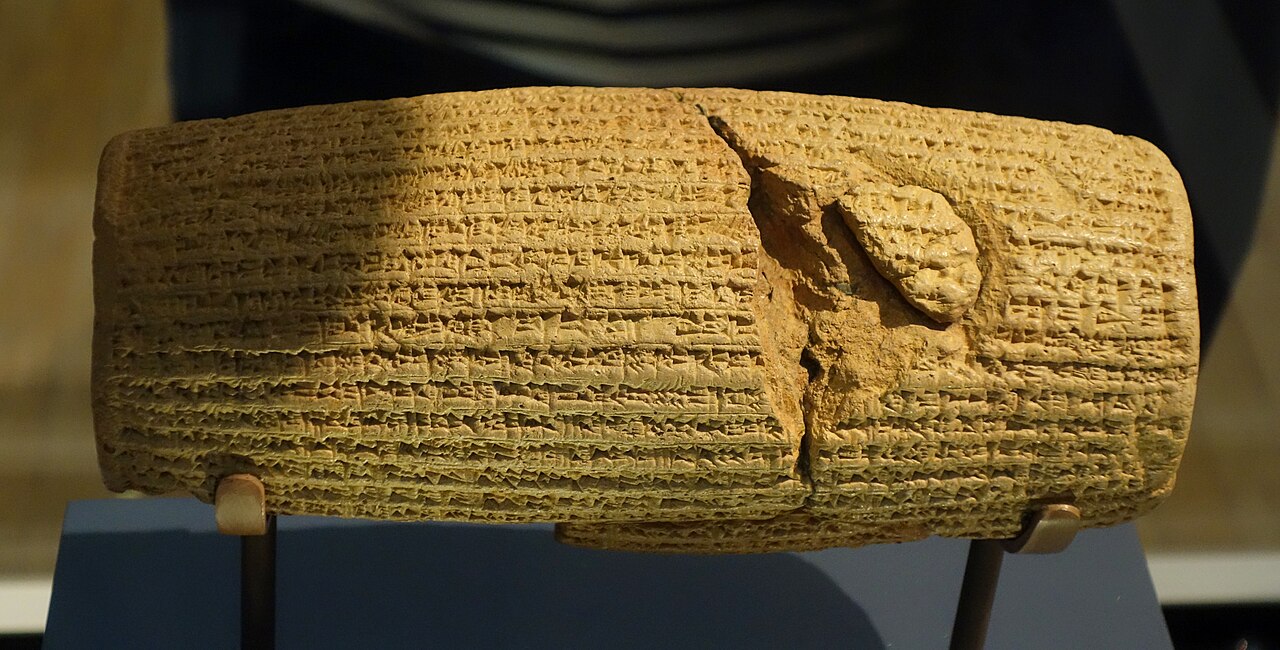
The Cyrus Cylinder is a barrel-shaped clay object about 22.5 cm long, inscribed in Babylonian cuneiform soon after Cyrus the Great captured Babylon in 539 BCE. Found at Babylon in 1879 and now in the British Museum, it presents Cyrus as the king chosen by the god Marduk to replace the impious Nabonidus, and records that he restored temples and sent deported gods and peoples home. It is often called the first charter of human rights; most historians read it instead as a traditional Mesopotamian royal inscription, which makes it no less valuable as evidence of how Cyrus wanted to be seen.
| Date | c. 539–538 BCE |
|---|---|
| Language and script | Akkadian (Babylonian dialect), cuneiform |
| Material and size | Baked clay, about 22.5 × 10 cm; 45 lines, many damaged |
| Found | March 1879 by Hormuzd Rassam, at Babylon, in the area of Marduk’s temple Esagila |
| Museum | British Museum, London (BM 90920) |
| Persian name | استوانه کوروش Ostovâne-ye Kurosh, also called منشور کوروش Manshur-e Kurosh |

How it was found and pieced together
The cylinder was dug up in March 1879 by Hormuzd Rassam, a Mosul-born archaeologist excavating for the British Museum. His own accounts of the exact findspot differ, but it came from Babylon, from the foundations around the temple of Marduk. Henry Rawlinson announced the find later that year, at first mistakenly placing it at Borsippa.
The cylinder was incomplete. A fragment bought by the American collector J. B. Nies ended up at Yale University and was published in 1920 without anyone recognising what it was. In 1970 the German scholar Paul-Richard Berger identified it as part of the Cyrus Cylinder, and the two pieces were reunited in 1972.
A second surprise came in January 2010, when the British Museum announced that Wilfred Lambert and Irving Finkel had identified two fragments of a clay tablet in its collections carrying the same text. They came from Dailem, near Babylon. The find showed that the text was copied and circulated, not only buried in a foundation.
What the text says
The inscription falls into two parts. The first is a narrative about the gods and Babylon; the second is spoken by Cyrus himself.
Part one: Marduk chooses a new king
The opening lines are badly damaged, but enough survives to follow the argument. Nabonidus is accused of corrupting the worship of Marduk, interrupting the daily offerings and forcing the people of Babylon into labour. Marduk, angered, searches all lands for a just ruler, calls Cyrus, king of Anshan, by name and makes the Gutians and the Medes bow before him. Marduk then orders him to march on Babylon and walks beside him “like a friend”, letting him enter the city without a battle.
Part two: Cyrus speaks
From line 20 the voice changes. “I am Cyrus, king of the universe, great king, mighty king,” the text begins, followed by the titles of Babylonian kingship and his genealogy back to Teispes. Cyrus says he entered Babylon in peace, relieved its people of their burdens and was blessed by Marduk; kings from the Upper Sea to the Lower Sea brought him tribute.
The best-known passage lists cities across the Tigris, including Ashur, Susa, Akkad, Eshnunna, Der and the land of the Gutians, whose sanctuaries had long been in ruins. Cyrus returned their gods to their temples, “gathered all their people and returned them to their settlements”, and restored to their shrines the gods Nabonidus had brought into Babylon. The text ends with a prayer for Cyrus and his son Cambyses and a record of repairs to Babylon’s wall. Cyrus notes that during the work he saw an inscription of Ashurbanipal, “a king who preceded me”.
A Babylonian document in a Babylonian tradition
Everything about the cylinder is Mesopotamian. It is written in Akkadian by Babylonian scribes, follows the pattern of earlier royal building inscriptions, praises Marduk rather than any Iranian god, and was meant to be placed in a foundation where the gods and future kings would read it. The reference to Ashurbanipal is a deliberate signal: Cyrus presents himself as the latest in a line of rightful kings of Babylon, and the bad king he replaced as the exception.
That is why historians speak of it as propaganda, a word that describes its purpose, not its truthfulness. The account of Nabonidus is one-sided and was probably written with the help of Marduk’s priests. The claim of a peaceful entry is true for the city of Babylon but silent about the bloody battle at Opis a few weeks before, described on Cyrus Takes Babylon (539 BCE). At the same time, the restoration of gods and the return of displaced communities match what other sources say Cyrus did, and Irving Finkel and others argue that the text reflects a real policy of restoring local cults.
What the cylinder does not say
Much of what is said about the cylinder online is not in it. The text does not:
- mention human rights, individual freedoms, or freedom of religion as a principle;
- abolish slavery or set wages, as some widely shared “translations” claim;
- mention Ahura Mazda; its god is Marduk;
- mention the Jews, Judah or Jerusalem. The return of exiles it describes concerns named cities in Mesopotamia and western Iran. The biblical account of the Jews’ return is a separate source, discussed on Cyrus and the Return of the Jews.
The invented versions often include lines such as Cyrus declaring that every country may decide for itself whether to accept his rule. These sentences have no basis in the cuneiform text. Scholars from Iran and abroad, including Irving Finkel of the British Museum, have repeatedly pointed this out.
A symbol in modern Iran
The cylinder became a national symbol in the twentieth century. During the 2,500-year celebration of the Persian monarchy in October 1971, Mohammad Reza Shah called it the world’s first charter of human rights, and it was lent to Iran and displayed in Tehran. On 14 October 1971 Princess Ashraf Pahlavi presented a replica to the United Nations Secretary-General, U Thant, and it is still kept at the UN headquarters in New York. The event is described on The 2,500-Year Celebration of the Persian Empire.
Its popularity did not depend on the monarchy. When the British Museum lent the cylinder to the National Museum of Iran from September 2010 to January 2011, about half a million people came to see it. In 2013 it toured five museums in the United States. Many Iranians, inside and outside the country, treat it as a symbol of tolerance and national pride, and an unofficial “Cyrus Day” is marked by some on 29 October (7 Aban), the anniversary of Cyrus’s entry into Babylon.
Historians generally accept the cylinder as a sign of a deliberate and comparatively tolerant Persian way of ruling conquered peoples. What most reject is reading it as a modern declaration of rights. The lasting reputation it helped create is part of The Legacy of the Achaemenid Empire, and the site’s main article on Cyrus the Great places it within his reign.
Persian words from this page
| استوانه کوروش | Ostovâne-ye Kurosh | the Cyrus Cylinder |
| منشور | manshur | charter, decree |
| حقوق بشر | hoghugh-e bashar | human rights |
| خط میخی | khatt-e mikhi | cuneiform script |
| موزه بریتانیا | Muze-ye Beritâniyâ | the British Museum |
| بابل | Bâbel | Babylon |
Sources and further reading
- Irving Finkel (ed.), The Cyrus Cylinder: The King of Persia’s Proclamation from Ancient Babylon (I. B. Tauris, 2013), with a full translation.
- British Museum collection record, Cyrus Cylinder, BM 90920 (registration 1880,0617.1941).
- Amélie Kuhrt, “The Cyrus Cylinder and Achaemenid Imperial Policy”, Journal for the Study of the Old Testament 25 (1983).
- Encyclopaedia Iranica, “Cyrus iii. Cyrus II the Great”.
- Neil MacGregor, A History of the World in 100 Objects (2010), chapter on the Cyrus Cylinder.
Want to learn Persian? Get the free Starter Pack
Get the 14-page printable Starter Pack (all 32 letters, a 7-day reading plan, 100 core words and 20 survival phrases) and a short 5-email course. Free.
More in The Achaemenid Empire (550–330 BCE)
- Achaemenes, Teispes and the Early Persian Kings of Anshan
- Cyrus the Great: Birth, Legends and Rise to Power
- Cyrus Conquers Lydia: Croesus and the Battle of Thymbra
- The Persian Conquest of Ionia and Asia Minor
- Cyrus Takes Babylon (539 BCE)
- The Cyrus Cylinder
- Cyrus and the Return of the Jews
- The Death of Cyrus and the Massagetae
- Pasargadae: Cyrus’s Capital and Tomb
- The Tomb of Cyrus through History
- Cambyses II
- Cambyses Conquers Egypt: The Battle of Pelusium
- Bardiya and Gaumata: The Usurper Question
- Darius the Great Takes the Throne
- The Great Revolts of 522–521 BCE
- The Behistun Inscription
- The Persian Conquest of the Indus Valley
- Darius’s Scythian Campaign
- Darius’s Canal from the Nile to the Red Sea
- Darius’s Reforms: Satrapies, Taxes and Law
- The Royal Road and the Persian Postal System
- The Daric: Achaemenid Coinage and Economy
- The Ionian Revolt (499–493 BCE)
- The Greco-Persian Wars: An Overview
- Mardonius and the First Persian Expedition to Greece (492 BCE)
- The Battle of Marathon (490 BCE)
- The Death of Darius I and the Succession of Xerxes
- The Royal Tombs of Naqsh-e Rostam
- Xerxes I: King of Kings (486–465 BCE)
- Xerxes’ Invasion of Greece (480–479 BCE)
- The Battle of Thermopylae (480 BCE)
- The Battle of Artemisium (480 BCE)
- The Persian Capture of Athens (480–479 BCE)
- The Battle of Salamis (480 BCE)
- The Battle of Plataea and the End of the Invasion (479 BCE)
- The Palace of Darius at Susa
- Building Persepolis: How Darius and Xerxes Built Parsa
- The Persepolis Fortification and Treasury Tablets
- Herodotus and the Persians
- The Apadana Reliefs: Nations Bringing Gifts
- The Achaemenid Paradise Gardens
- The Persian Immortals and the Achaemenid Army
- The Achaemenid Navy
- Religion of the Achaemenid Kings
- Women of the Achaemenid Court
- Old Persian Language and Cuneiform
- Egypt under Persian Rule
- Babylon under Persian Rule
- Artaxerxes I
- The Peace of Callias
- Darius II and the Peloponnesian War
- Famous Satraps of the Persian Empire
- Artaxerxes II Mnemon
- Cyrus the Younger and the Battle of Cunaxa
- The King’s Peace (387 BCE)
- The Great Satraps’ Revolt
- Artaxerxes III and the Reconquest of Egypt
- Darius III, the Last Achaemenid King
- The Battle of the Granicus (334 BCE)
- The Battle of Issus (333 BCE)
- Alexander Takes Tyre, Gaza and Egypt (332 BCE)
- The Battle of Gaugamela (331 BCE)
- Ariobarzanes and the Battle of the Persian Gate
- The Burning of Persepolis (330 BCE)
- The Death of Darius III and Bessus
- The Legacy of the Achaemenid Empire