In the year after he seized the throne in September 522 BCE, Darius I faced rebellions across almost the whole Iranian heartland of the empire, from Babylon to Margiana in Central Asia. By his own count he fought nineteen battles and captured nine “lying kings” within a single year. The victories, told in detail on the Behistun cliff, decided that the empire would survive under his line.
| Dates | Autumn 522 to late 521 BCE, with further campaigns in Elam and against the Saka in 520–519 |
|---|---|
| Rebel regions | Elam, Babylonia (twice), Media, Armenia, Parthia and Hyrcania, Sagartia, Margiana, Persia, Arachosia |
| Darius’s claim | 19 battles, 9 kings captured “in one and the same year” (Behistun IV.52) |
| Main generals | Hydarnes, Dadarshi (two men of this name), Vaumisa, Hystaspes, Artavardiya, Vivana, Intaphernes, Takhmaspada |
| Source | Behistun inscription, columns I–IV, with Babylonian dated tablets |
Why the empire broke apart
The empire Darius inherited was barely a generation old. Cyrus and Cambyses had joined together kingdoms with long histories of their own: Media had ruled the Persians fifty years earlier, Babylon had been the greatest city of the Near East, and Elam was older than both. When the king recognised everywhere, the ruler Darius called Gaumata, was killed by a group of nobles, the bond of loyalty broke. Local leaders took the chance, often claiming descent from the old royal houses.
Darius describes all the rebels in the same terms: each one “lied”, saying “I am king”, and the people followed him. In his religious language the Lie, drauga, had spread through the lands, and Ahura Mazda helped him put it down.
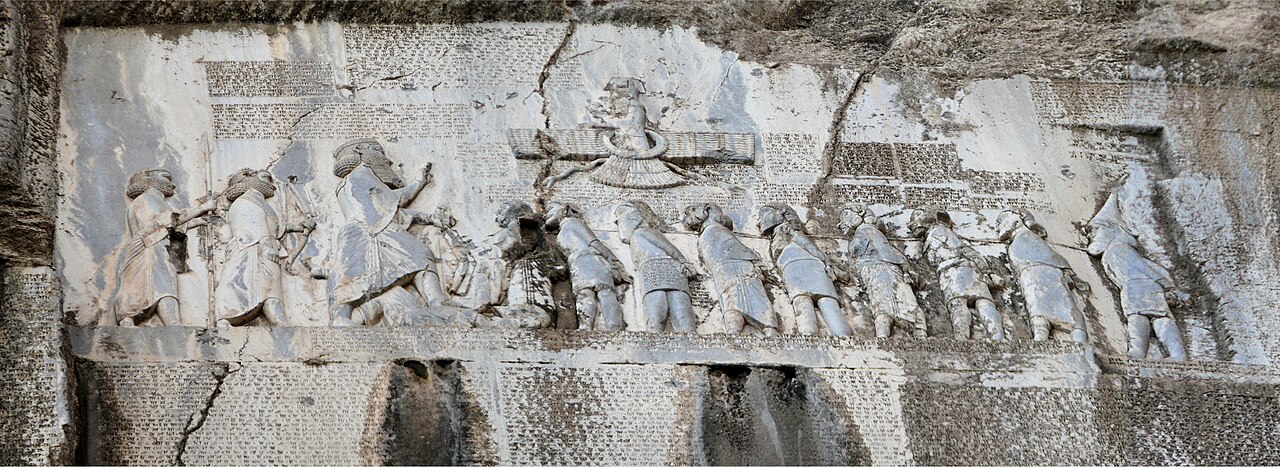

The nine kings
The figures on the Behistun relief are labelled, so we can match faces to names. The nine, in order of their rising, were:
- Gaumata the Magian, who claimed to be Bardiya, killed in Media in September 522; he lies under Darius’s foot on the relief.
- Açina in Elam, who rose in autumn 522 and was quickly brought to Darius in chains and killed.
- Nidintu-Bel in Babylon, who called himself Nebuchadnezzar, son of Nabonidus (Nebuchadnezzar III in modern lists).
- Martiya, a second Elamite pretender, killed by the Elamites themselves when Darius approached.
- Fravartish (Phraortes) in Media, who claimed descent from the Median king Cyaxares.
- Chissantakhma in Sagartia, who made the same Median claim.
- Vahyazdata in Persia, who claimed, like Gaumata, to be Bardiya son of Cyrus.
- Frada in Margiana, around modern Merv.
- Arakha, an Armenian, who seized Babylon as a second “Nebuchadnezzar, son of Nabonidus”.
Babylon first
Darius marched himself against the most dangerous rebel, Nidintu-Bel. Babylonian tablets show that Babylon recognised the new Nebuchadnezzar from early October 522. The rebel army held the line of the Tigris, so Darius put part of his army on inflated skins, camels and horses and forced a crossing. A second battle followed at Zazana on the Euphrates in December 522. Nidintu-Bel fled into Babylon with a few horsemen; the city was taken and he was executed.
The war for Media
While Darius was in Babylon, the revolt that threatened the empire most broke out in Media. Fravartish took Ecbatana, and Armenia and Parthia went with him or rose separately. Darius sent the conspirator Hydarnes to Media, where an indecisive battle bought time, and sent the Armenian noble Dadarshi and the Persian Vaumisa to fight several battles in Armenia.
In spring 521 Darius himself came up from Babylon and defeated Fravartish at Kunduru. The Median king fled to Raga, the city of Rey near modern Tehran (see the historic city of Rey), where he was caught. Darius describes his punishment without embarrassment: he cut off his nose, ears and tongue, put out an eye, kept him chained at the palace gate for all to see, and then impaled him at Ecbatana with his chief followers. Chissantakhma of Sagartia met the same fate at Arbela.
Hystaspes in Parthia
In Parthia and Hyrcania, the people had joined Fravartish. Darius’s father Hystaspes, governor there, fought the rebels twice. After the Median victory Darius sent him reinforcements from Raga, and the Parthian revolt ended in summer 521.
A second Bardiya in Persia
The revolt of Vahyazdata was especially awkward because it came from Persia itself, the king’s homeland, and repeated the claim that Cyrus’s son was alive. Darius sent the Persian Artavardiya against him; after two defeats Vahyazdata was captured and impaled. He had also sent an army east to Arachosia, in modern southern Afghanistan, where the loyal satrap Vivana beat it in two battles.
The last risings
In Margiana, Frada was defeated by Dadarshi, the satrap of Bactria, in a battle in which, the Old Persian text says, thousands of rebels died. The Babylonian and Elamite versions give large casualty figures, and they do not always agree with each other.
The final rebel of the “one year” was Arakha, who took Babylon in summer 521. Darius’s companion Intaphernes captured him in late November 521, and he was impaled at Babylon. Darius’s year, counted from the death of Gaumata, was over.
How true is “one year”?
Darius stresses that all this happened in a single year, and the dated battles do fit into about fourteen months if one counts from the end of September 522. The claim is accurate enough, but it is also a boast: the speed proved that Ahura Mazda was with him. Historians note that the inscription names only the generals Darius wished to honour and gives only his side.
The fighting did not quite end. A fifth column, added to the Behistun text later, records a new revolt in Elam and a campaign against the Saka with pointed caps in Central Asia, whose leader Skunkha was added to the relief. Herodotus, for his part, tells of a long siege of Babylon under Darius, won by the noble Zopyrus, who cut off his own nose and ears to pass as a deserter. It is not clear which, if any, of the known revolts this story reflects.
What the victory meant
The war fixed the shape of Darius’s reign. The surviving conspirators, generals and satraps who had stayed loyal became the backbone of the new court, and the experience may lie behind the administrative reforms described on Darius’s reforms. Most visibly, Darius had the story carved, with the rebels in a line before him, on the cliff described on the Behistun Inscription; its modern visitor site is covered on Behistun (Bisotun).
Persian words from this page
| شورش | shuresh | revolt |
| بابل | Bâbel | Babylon |
| ماد | Mâd | Media |
| ری | Rey | Rey (ancient Raga) |
| اکباتان | Ekbâtân | Ecbatana, modern Hamadan |
| نبرد | nabard | battle |
Sources and further reading
- Behistun inscription of Darius I, columns I–V, translated in Amélie Kuhrt, The Persian Empire: A Corpus of Sources (2007).
- Herodotus, Histories, Book 3, chapters 150–160 (the siege of Babylon).
- Pierre Briant, From Cyrus to Alexander (2002), chapter 3.
- M. A. Dandamaev, A Political History of the Achaemenid Empire (1989).
- Encyclopaedia Iranica, “Bisotun iii. Darius’s inscriptions”.
Want to learn Persian? Get the free Starter Pack
Get the 14-page printable Starter Pack (all 32 letters, a 7-day reading plan, 100 core words and 20 survival phrases) and a short 5-email course. Free.
More in The Achaemenid Empire (550–330 BCE)
- Achaemenes, Teispes and the Early Persian Kings of Anshan
- Cyrus the Great: Birth, Legends and Rise to Power
- Cyrus Conquers Lydia: Croesus and the Battle of Thymbra
- The Persian Conquest of Ionia and Asia Minor
- Cyrus Takes Babylon (539 BCE)
- The Cyrus Cylinder
- Cyrus and the Return of the Jews
- The Death of Cyrus and the Massagetae
- Pasargadae: Cyrus’s Capital and Tomb
- The Tomb of Cyrus through History
- Cambyses II
- Cambyses Conquers Egypt: The Battle of Pelusium
- Bardiya and Gaumata: The Usurper Question
- Darius the Great Takes the Throne
- The Great Revolts of 522–521 BCE
- The Behistun Inscription
- The Persian Conquest of the Indus Valley
- Darius’s Scythian Campaign
- Darius’s Canal from the Nile to the Red Sea
- Darius’s Reforms: Satrapies, Taxes and Law
- The Royal Road and the Persian Postal System
- The Daric: Achaemenid Coinage and Economy
- The Ionian Revolt (499–493 BCE)
- The Greco-Persian Wars: An Overview
- Mardonius and the First Persian Expedition to Greece (492 BCE)
- The Battle of Marathon (490 BCE)
- The Death of Darius I and the Succession of Xerxes
- The Royal Tombs of Naqsh-e Rostam
- Xerxes I: King of Kings (486–465 BCE)
- Xerxes’ Invasion of Greece (480–479 BCE)
- The Battle of Thermopylae (480 BCE)
- The Battle of Artemisium (480 BCE)
- The Persian Capture of Athens (480–479 BCE)
- The Battle of Salamis (480 BCE)
- The Battle of Plataea and the End of the Invasion (479 BCE)
- The Palace of Darius at Susa
- Building Persepolis: How Darius and Xerxes Built Parsa
- The Persepolis Fortification and Treasury Tablets
- Herodotus and the Persians
- The Apadana Reliefs: Nations Bringing Gifts
- The Achaemenid Paradise Gardens
- The Persian Immortals and the Achaemenid Army
- The Achaemenid Navy
- Religion of the Achaemenid Kings
- Women of the Achaemenid Court
- Old Persian Language and Cuneiform
- Egypt under Persian Rule
- Babylon under Persian Rule
- Artaxerxes I
- The Peace of Callias
- Darius II and the Peloponnesian War
- Famous Satraps of the Persian Empire
- Artaxerxes II Mnemon
- Cyrus the Younger and the Battle of Cunaxa
- The King’s Peace (387 BCE)
- The Great Satraps’ Revolt
- Artaxerxes III and the Reconquest of Egypt
- Darius III, the Last Achaemenid King
- The Battle of the Granicus (334 BCE)
- The Battle of Issus (333 BCE)
- Alexander Takes Tyre, Gaza and Egypt (332 BCE)
- The Battle of Gaugamela (331 BCE)
- Ariobarzanes and the Battle of the Persian Gate
- The Burning of Persepolis (330 BCE)
- The Death of Darius III and Bessus
- The Legacy of the Achaemenid Empire