In 332 BCE, after his victory at Issus, Alexander took the Persian Empire’s Mediterranean provinces one by one. Tyre held out for seven months and Gaza for two, but by the end of the year Phoenicia, Palestine and Egypt were his. The loss of the Phoenician ports destroyed the Persian navy, and with it Darius III’s best hope of fighting the war in the west.
| Date | January to late 332 BCE (Tyre about January to July or August; Gaza about September to November); Egypt late 332 to spring 331 |
|---|---|
| Places | Tyre and Sidon (Lebanon), Gaza, Memphis and Siwa (Egypt) |
| Persian side | King Azemilcus of Tyre; Batis at Gaza; Mazaces, satrap of Egypt |
| Result | Persia loses the Levant, Egypt and its fleet |
Why Alexander turned south
After Issus, Darius III was beyond the Euphrates raising a new army. Alexander did not follow him. Arrian gives his reasoning in a speech: while the Persian fleet held the sea, an advance inland would leave Greece and Macedon open to attack. The fleet’s ships and crews came above all from Phoenicia, Cyprus and Egypt. Take their home ports, and the fleet would melt away.
The plan worked fast. Arados, Byblos and Sidon opened their gates. At Sidon, which had suffered terribly when Artaxerxes III crushed its revolt about thirteen years earlier, the pro-Persian king Straton was removed and a new king put in his place.
The siege of Tyre
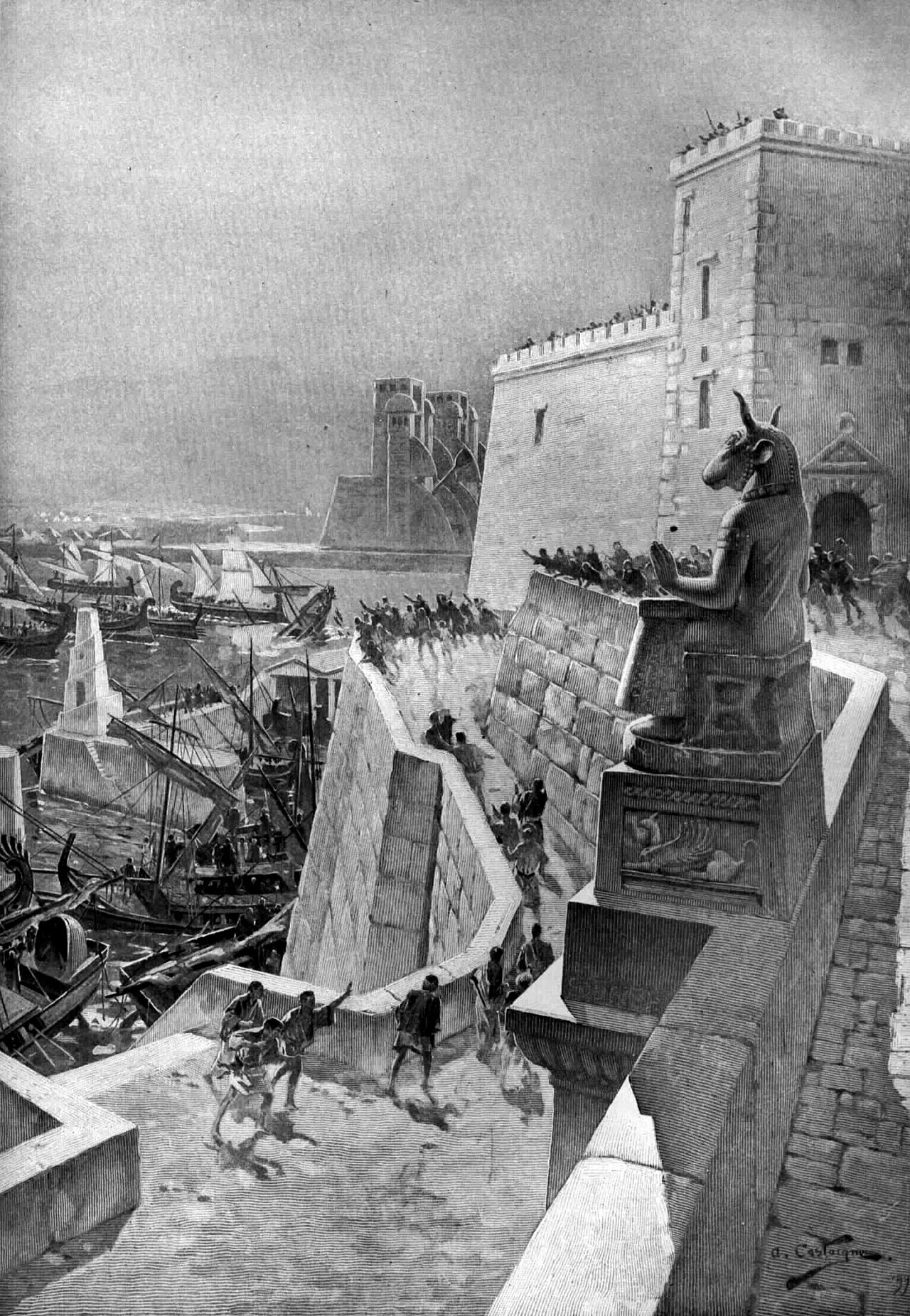
Tyre stood on an island about 800 metres off the coast, with walls rising straight from the sea. Its king, Azemilcus, was away with the Persian fleet. The Tyrians offered to submit, but refused to let Alexander into the island city to sacrifice at the temple of Melqart, the god the Greeks called Heracles. They said he could sacrifice at the old temple on the mainland. Alexander took the refusal as a declaration of war.
His engineers began a mole, a causeway of stones and timber, across the strait. The Tyrians fought back from their ships and walls. They sent a fire ship loaded with pitch and sulphur against the siege towers at the end of the mole and burned them, then raided the works. A storm wrecked part of the causeway. Carthage, Tyre’s colony, promised help but sent none.
The fleet changes sides
The siege turned when the Persian navy broke apart. The kings of Arados and Byblos, whose cities now belonged to Alexander, sailed their squadrons back to him; the kings of Cyprus followed with about 120 ships. Arrian counts more than 200 warships now on Alexander’s side. The Tyrian fleet was shut in its harbours, and the island could be attacked from every side.
Rams mounted on ships opened a breach in the south wall in the summer of 332, and Alexander led the assault in person. Arrian says 8,000 Tyrians were killed in the fighting and about 30,000 people, many of them women and children, were sold as slaves. Curtius adds that 2,000 men were crucified along the shore. Azemilcus, who had returned to defend his city, and Carthaginian envoys who had taken refuge in the temple of Melqart were spared. The mole Alexander built joined the island to the mainland permanently, and modern Tyre still stands on the isthmus that formed around it.

Darius offers half the empire
During the siege a second letter came from Darius. According to Arrian he offered 10,000 talents for his family, all the land west of the Euphrates, and his daughter in marriage. Parmenion is said to have remarked that if he were Alexander he would accept, and Alexander to have answered that so would he, if he were Parmenion. Arrian places this offer at Tyre; Curtius and Diodorus tell of a later offer before Gaugamela, so the exact number and timing of the letters is uncertain. The offer itself fits Persian practice: kings had often traded territory for peace on the western frontier.
Gaza
The last city to resist on the road south was Gaza, a fortress on a high mound near the edge of the desert. Its commander Batis had hired Arab troops and laid in supplies. Alexander’s engineers built earth ramps around the city to bring the siege engines up to the walls, and the siege lasted about two months. Alexander was wounded in the shoulder by a catapult bolt. When the city fell, the men were killed and the women and children sold.
Curtius says Alexander had Batis dragged alive behind a chariot around the walls, imitating Achilles with Hector. Arrian does not mention it, and many historians suspect it was invented. A Jewish legend preserved by Josephus has Alexander visiting Jerusalem around this time and bowing before the high priest; it is not found in any of the Alexander historians.
Egypt changes hands without a fight
Egypt had been back under Persian rule for only about ten years. Its satrap Sabaces had been killed at Issus, and his successor Mazaces had no army able to resist. When Alexander reached Pelusium late in 332 he surrendered the country and its treasury. The Persian rule that Cambyses began in 525 BCE was over.
Alexander went to Memphis and sacrificed to the Apis bull, a pointed contrast to the stories Greeks told of Persian kings insulting Egyptian gods. Early in 331 he founded Alexandria on the coast and travelled to the oracle of Ammon at the Siwa oasis, where the priest greeted him as the god’s son. In spring 331 he marched back north towards the heart of the empire.
What Persia lost
The western war ended badly elsewhere too. Persian commanders who had escaped from Issus tried to win back Anatolia and were beaten by Alexander’s general Antigonus. In the Aegean, Macedonian admirals retook the islands that Memnon had captured. By 331 Persia held nothing west of the Euphrates, and Darius had to fight the next battle with the forces of Iran, Mesopotamia and Central Asia alone. That battle was Gaugamela.
For the Persian navy before its collapse, see the Achaemenid Navy.
- Winter 333/332 BCE Arados, Byblos and Sidon submit
- c. January 332 Tyre refuses Alexander; the siege begins
- Spring 332 Phoenician and Cypriot squadrons change sides
- July or August 332 Tyre stormed
- c. September to November 332 Siege of Gaza
- Late 332 Mazaces surrenders Egypt
- Early 331 Foundation of Alexandria; visit to Siwa
Persian words from this page
| صور | Sur | Tyre |
| غزه | Ghazze | Gaza |
| فنیقیه | Finiqiye | Phoenicia |
| اسکندریه | Eskandariye | Alexandria |
| ناوگان | nâvgân | fleet |
| محاصره | mohâsere | siege |
Sources and further reading
- Arrian, Anabasis of Alexander 2.15 to 3.5
- Quintus Curtius Rufus, History of Alexander, Book 4; Diodorus of Sicily 17.40 to 17.52
- Josephus, Jewish Antiquities 11.8 (the Jerusalem legend)
- Pierre Briant, From Cyrus to Alexander: A History of the Persian Empire (2002), chapter 18
- A. B. Bosworth, Conquest and Empire: The Reign of Alexander the Great (1988)
Want to learn Persian? Get the free Starter Pack
Get the 14-page printable Starter Pack (all 32 letters, a 7-day reading plan, 100 core words and 20 survival phrases) and a short 5-email course. Free.
More in The Achaemenid Empire (550–330 BCE)
- Achaemenes, Teispes and the Early Persian Kings of Anshan
- Cyrus the Great: Birth, Legends and Rise to Power
- Cyrus Conquers Lydia: Croesus and the Battle of Thymbra
- The Persian Conquest of Ionia and Asia Minor
- Cyrus Takes Babylon (539 BCE)
- The Cyrus Cylinder
- Cyrus and the Return of the Jews
- The Death of Cyrus and the Massagetae
- Pasargadae: Cyrus’s Capital and Tomb
- The Tomb of Cyrus through History
- Cambyses II
- Cambyses Conquers Egypt: The Battle of Pelusium
- Bardiya and Gaumata: The Usurper Question
- Darius the Great Takes the Throne
- The Great Revolts of 522–521 BCE
- The Behistun Inscription
- The Persian Conquest of the Indus Valley
- Darius’s Scythian Campaign
- Darius’s Canal from the Nile to the Red Sea
- Darius’s Reforms: Satrapies, Taxes and Law
- The Royal Road and the Persian Postal System
- The Daric: Achaemenid Coinage and Economy
- The Ionian Revolt (499–493 BCE)
- The Greco-Persian Wars: An Overview
- Mardonius and the First Persian Expedition to Greece (492 BCE)
- The Battle of Marathon (490 BCE)
- The Death of Darius I and the Succession of Xerxes
- The Royal Tombs of Naqsh-e Rostam
- Xerxes I: King of Kings (486–465 BCE)
- Xerxes’ Invasion of Greece (480–479 BCE)
- The Battle of Thermopylae (480 BCE)
- The Battle of Artemisium (480 BCE)
- The Persian Capture of Athens (480–479 BCE)
- The Battle of Salamis (480 BCE)
- The Battle of Plataea and the End of the Invasion (479 BCE)
- The Palace of Darius at Susa
- Building Persepolis: How Darius and Xerxes Built Parsa
- The Persepolis Fortification and Treasury Tablets
- Herodotus and the Persians
- The Apadana Reliefs: Nations Bringing Gifts
- The Achaemenid Paradise Gardens
- The Persian Immortals and the Achaemenid Army
- The Achaemenid Navy
- Religion of the Achaemenid Kings
- Women of the Achaemenid Court
- Old Persian Language and Cuneiform
- Egypt under Persian Rule
- Babylon under Persian Rule
- Artaxerxes I
- The Peace of Callias
- Darius II and the Peloponnesian War
- Famous Satraps of the Persian Empire
- Artaxerxes II Mnemon
- Cyrus the Younger and the Battle of Cunaxa
- The King’s Peace (387 BCE)
- The Great Satraps’ Revolt
- Artaxerxes III and the Reconquest of Egypt
- Darius III, the Last Achaemenid King
- The Battle of the Granicus (334 BCE)
- The Battle of Issus (333 BCE)
- Alexander Takes Tyre, Gaza and Egypt (332 BCE)
- The Battle of Gaugamela (331 BCE)
- Ariobarzanes and the Battle of the Persian Gate
- The Burning of Persepolis (330 BCE)
- The Death of Darius III and Bessus
- The Legacy of the Achaemenid Empire