Persepolis, called Pârsa in Old Persian, was built on a vast stone terrace below the Kuh-e Rahmat in Fars, starting around 518 BCE under Darius I. Most of its great halls were completed by Xerxes I and Artaxerxes I over the following seventy years, and building went on in places until the city was burned in 330 BCE. Clay tablets, foundation inscriptions and the stones themselves show how it was done: by teams of workers from across the empire, paid in rations by the royal administration.
| Old Persian name | Pârsa |
|---|---|
| Modern Persian | تخت جمشید (Takht-e Jamshid) |
| Begun | About 518 BCE, under Darius I |
| Main phases | Darius I (522–486), Xerxes I (486–465), Artaxerxes I (465–424); later additions to 330 BCE |
| Terrace | About 455 × 300 metres |
| Materials | Local grey limestone, mud brick, cedar beams |
| UNESCO | World Heritage Site since 1979 |
This page looks at how Persepolis was built. For a building-by-building tour of the ruins, see our guide to the monuments of Persepolis and Persepolis, the ancient city of Persia.
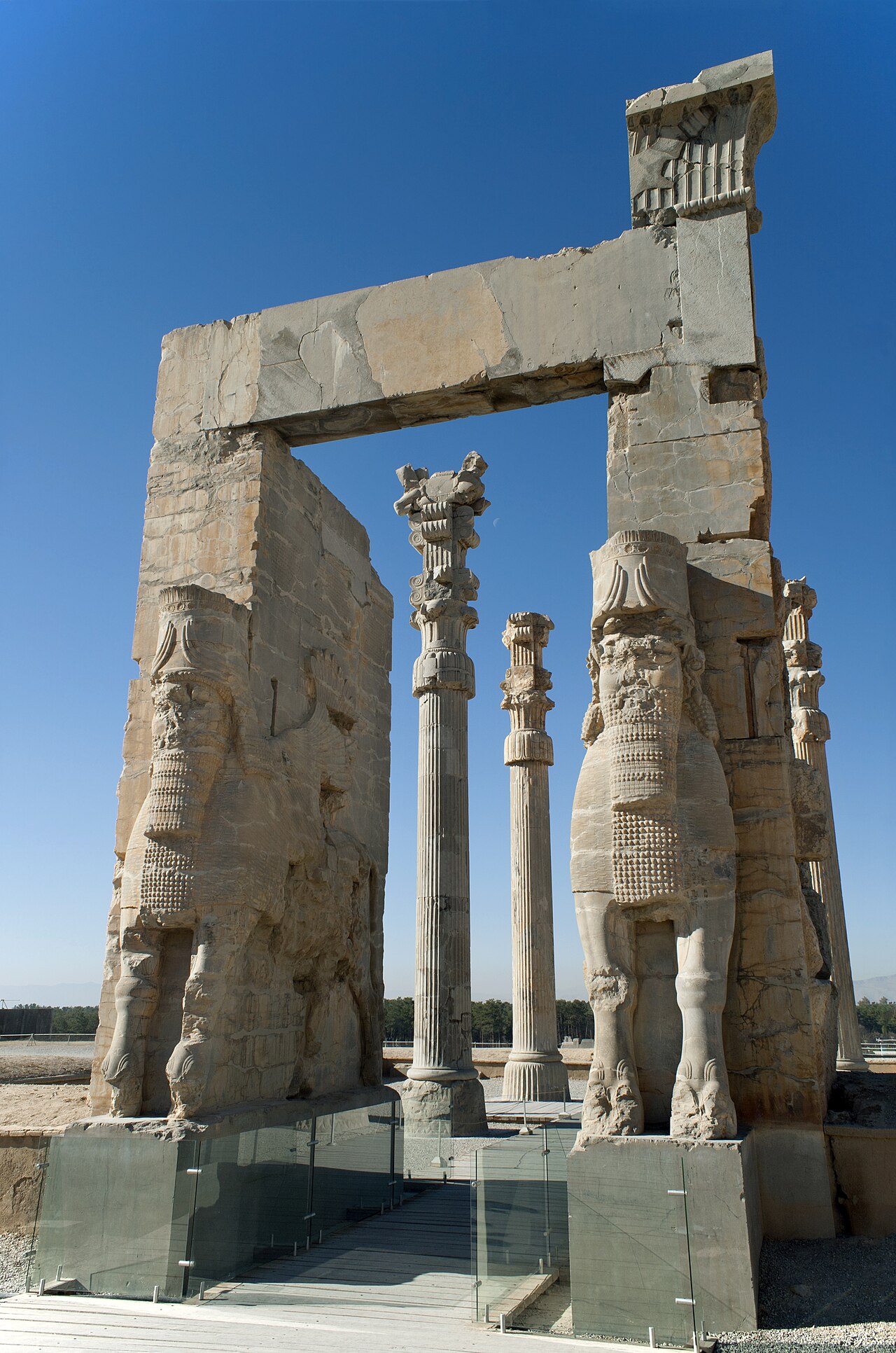

Choosing the site
Darius I already had palaces at Susa, the old Elamite capital, and could use Pasargadae, the residence of Cyrus some 40 kilometres to the north (see Pasargadae). Around 518 BCE, a few years after taking the throne, he chose a new site in the Marvdasht plain, at the foot of the mountain now called Kuh-e Rahmat, the “Mountain of Mercy”. It lay in Fars, the Persian homeland, and gave Darius a royal centre of his own, not one inherited from Cyrus. One of his inscriptions on the terrace wall states that no fortress had been built on that spot before, and that he built it by the will of Ahura Mazda.
The terrace
The first task was the platform. Workers levelled a spur of the mountain, cutting away rock in some places and building up retaining walls of huge, close-fitted stone blocks in others, to make a terrace of about 455 by 300 metres. Under it they cut a network of drains and channels into the rock to carry away rainwater from the roofs, which shows that the whole plan was worked out before the buildings went up. Visitors reached the top by a broad double staircase with low, shallow steps.
Who built what
Persepolis was not built at once. The main works can be assigned to individual kings from their inscriptions and from the style of the stonework.
- Darius I built the terrace and the drainage system, began the Apadana, the great audience hall, built his own palace, the Tachara, and started the Treasury.
- Xerxes I finished the Apadana, built the Gate of All Nations at the top of the stairway, his own palace (the Hadish), the building known as the Harem, enlarged the Treasury and began further palaces. His inscriptions repeat that he completed what his father had begun.
- Artaxerxes I completed the Hall of a Hundred Columns and other buildings begun by his father.
- Later kings made smaller additions; Artaxerxes III added a staircase to the Tachara, and a great gateway in the forecourt of the Hall of a Hundred Columns was still unfinished in 330 BCE.
In practice the site was a building site for most of its life. For the reign of Xerxes, see Xerxes I: King of Kings.
The foundation deposits of the Apadana
When the Apadana was begun, Darius had stone boxes placed under the corners of the hall, set over coins then in circulation, Lydian and Greek. In 1933 the Oriental Institute expedition found two of these boxes. Each held a gold plaque and a silver plaque inscribed in Old Persian, Elamite and Babylonian. The text, known as DPh, names Darius and describes the extent of his kingdom, from the Saka beyond Sogdiana to Kush, and from India to Sardis. The coins have been used to date the start of the Apadana, though the exact date is still argued.
Stone, brick and timber
Most of the stone is a grey limestone quarried on the mountain behind the site; a darker, finer stone came from Majdabad, about 40 kilometres to the west. The stone parts of the buildings were the columns, doorways, window frames, stairways and wall bases. The walls between them were of mud brick, plastered and painted, and the roofs rested on cedar beams. When the roofs burned and the brick walls melted away, the stone frames were left standing alone, which is why the ruins look as they do today.
The blocks were joined without mortar. Masons dressed the edges of each face so that blocks fitted tightly, and held them with iron clamps set in molten lead. The clamps of Darius’s time are dovetail-shaped and later ones straight, a detail that helps date the different parts of the site. The columns of the Apadana stood close to 20 metres high, among the tallest of the ancient world, crowned with capitals of paired bulls, lions or griffins that carried the beams.
Many blocks carry masons’ marks, and the Unfinished Gate shows how the work proceeded: the stone was set in place as rough blocks, then carved where it stood, so that the final shapes of the bull figures can be seen emerging from the stone.
The workers
Royal inscriptions give the king all the credit, but administrative tablets show who did the work. The Fortification and Treasury tablets record rations and payments to workers called kurtash in Elamite, organised in groups and often listed by origin: Persians, Elamites, Babylonians, Egyptians, Ionians, Lydians, Carians and others. Some groups were skilled stoneworkers, carpenters or metalworkers; others were labourers. Men, women and children appear among them. The Treasury tablets, from 492 to 457 BCE, show part of their wages being paid in silver as well as in grain, wine and animals.
These workers were not the slaves of later legend, but they were not free contractors either. They were labour assigned by the state, fed and paid through the royal storehouses, and some had probably been deported from conquered lands. A similar mix of craftsmen is listed in Darius’s foundation charter from his palace at Susa; see The Palace of Darius at Susa.
The decoration
The stone reliefs on the stairways, the most famous at the Apadana, show the king’s guards and delegations from the subject peoples bringing gifts. They are covered on a separate page, The Apadana Reliefs. Traces of paint show that the reliefs and walls were once brightly coloured.
From burning to excavation
Alexander’s troops burned the palaces in 330 BCE (see The Burning of Persepolis). The ruins were never fully buried, and travellers described them for centuries. Systematic excavation began in 1931 with the Oriental Institute of the University of Chicago, led first by Ernst Herzfeld and then by Erich Schmidt, until 1939. Iranian archaeologists continued the work, and an Irano-Italian team began restoring the stonework in the 1960s. Persepolis was added to the UNESCO World Heritage List in 1979.
Persian words from this page
| تخت جمشید | Takht-e Jamshid | Persepolis (“Throne of Jamshid”) |
| پارسه | Pârseh | Parsa, the ancient name |
| آپادانا | Âpâdânâ | Apadana |
| دروازه ملل | Darvâzeh-ye Melal | Gate of All Nations |
| کوه رحمت | Kuh-e Rahmat | Mountain of Mercy |
| سنگ | sang | stone |
Sources and further reading
- Erich F. Schmidt, Persepolis I: Structures, Reliefs, Inscriptions (1953).
- Encyclopaedia Iranica, “Persepolis”.
- UNESCO World Heritage Centre, Persepolis.
- Pierre Briant, From Cyrus to Alexander: A History of the Persian Empire (2002).
- Amélie Kuhrt, The Persian Empire: A Corpus of Sources from the Achaemenid Period (2007), for the foundation texts.
Want to learn Persian? Get the free Starter Pack
Get the 14-page printable Starter Pack (all 32 letters, a 7-day reading plan, 100 core words and 20 survival phrases) and a short 5-email course. Free.
More in The Achaemenid Empire (550–330 BCE)
- Achaemenes, Teispes and the Early Persian Kings of Anshan
- Cyrus the Great: Birth, Legends and Rise to Power
- Cyrus Conquers Lydia: Croesus and the Battle of Thymbra
- The Persian Conquest of Ionia and Asia Minor
- Cyrus Takes Babylon (539 BCE)
- The Cyrus Cylinder
- Cyrus and the Return of the Jews
- The Death of Cyrus and the Massagetae
- Pasargadae: Cyrus’s Capital and Tomb
- The Tomb of Cyrus through History
- Cambyses II
- Cambyses Conquers Egypt: The Battle of Pelusium
- Bardiya and Gaumata: The Usurper Question
- Darius the Great Takes the Throne
- The Great Revolts of 522–521 BCE
- The Behistun Inscription
- The Persian Conquest of the Indus Valley
- Darius’s Scythian Campaign
- Darius’s Canal from the Nile to the Red Sea
- Darius’s Reforms: Satrapies, Taxes and Law
- The Royal Road and the Persian Postal System
- The Daric: Achaemenid Coinage and Economy
- The Ionian Revolt (499–493 BCE)
- The Greco-Persian Wars: An Overview
- Mardonius and the First Persian Expedition to Greece (492 BCE)
- The Battle of Marathon (490 BCE)
- The Death of Darius I and the Succession of Xerxes
- The Royal Tombs of Naqsh-e Rostam
- Xerxes I: King of Kings (486–465 BCE)
- Xerxes’ Invasion of Greece (480–479 BCE)
- The Battle of Thermopylae (480 BCE)
- The Battle of Artemisium (480 BCE)
- The Persian Capture of Athens (480–479 BCE)
- The Battle of Salamis (480 BCE)
- The Battle of Plataea and the End of the Invasion (479 BCE)
- The Palace of Darius at Susa
- Building Persepolis: How Darius and Xerxes Built Parsa
- The Persepolis Fortification and Treasury Tablets
- Herodotus and the Persians
- The Apadana Reliefs: Nations Bringing Gifts
- The Achaemenid Paradise Gardens
- The Persian Immortals and the Achaemenid Army
- The Achaemenid Navy
- Religion of the Achaemenid Kings
- Women of the Achaemenid Court
- Old Persian Language and Cuneiform
- Egypt under Persian Rule
- Babylon under Persian Rule
- Artaxerxes I
- The Peace of Callias
- Darius II and the Peloponnesian War
- Famous Satraps of the Persian Empire
- Artaxerxes II Mnemon
- Cyrus the Younger and the Battle of Cunaxa
- The King’s Peace (387 BCE)
- The Great Satraps’ Revolt
- Artaxerxes III and the Reconquest of Egypt
- Darius III, the Last Achaemenid King
- The Battle of the Granicus (334 BCE)
- The Battle of Issus (333 BCE)
- Alexander Takes Tyre, Gaza and Egypt (332 BCE)
- The Battle of Gaugamela (331 BCE)
- Ariobarzanes and the Battle of the Persian Gate
- The Burning of Persepolis (330 BCE)
- The Death of Darius III and Bessus
- The Legacy of the Achaemenid Empire