Achaemenes (Old Persian Haxāmaniš) is the ancestor who gave the Achaemenid dynasty its name, a shadowy figure probably of the early seventh century BCE who is known only from inscriptions carved generations later. Before Cyrus the Great built an empire, his family ruled Anshan in what is now Fars province as minor kings on the edge of Elam, Assyria and Media. Almost everything about them comes from two royal family trees that do not quite match, and that mismatch is one of the real puzzles of ancient Iranian history.
| Dynasty named after | Achaemenes (Haxāmaniš) |
|---|---|
| Kingdom | Anshan, at Tall-e Malyan in the Beyza plain of Fars |
| Kings before Cyrus the Great | Teispes, Cyrus I, Cambyses I |
| Approximate dates | c. 700–559 BCE (reckoned by generations, not recorded) |
| Key sources | Cyrus Cylinder (539 BCE), Behistun inscription (c. 520 BCE), Herodotus, a seal of “Kurash of Anshan” |

Two royal genealogies that disagree
The earliest Persian kings left no inscriptions of their own that survive. What we have are two later statements of descent, made by two different kings for two different audiences.
The first is the Cyrus Cylinder, written in Babylonian after Cyrus captured Babylon in 539 BCE. Cyrus calls himself the son of Cambyses, grandson of Cyrus and descendant of Teispes, and gives each of them the title “great king, king of Anshan”. He never mentions Achaemenes, and he never calls himself a Persian. In Babylonian eyes he was the heir of an old royal house of Anshan.
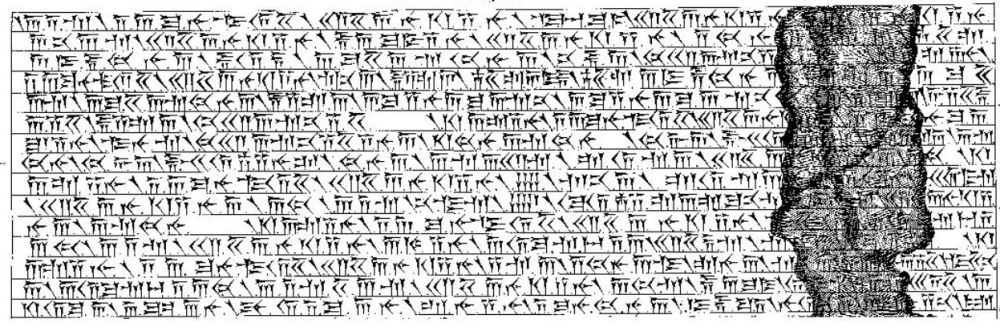
The second is the Behistun inscription, carved for Darius I around 520 BCE. Darius traces his line from his father Hystaspes through Arsames and Ariaramnes to Teispes, and then to Achaemenes. “For this reason we are called Achaemenids,” he explains, and adds that eight of his family had been kings before him and that he was the ninth. The Old Persian word that follows is often translated “in two lines”, although the meaning is debated.
Herodotus (7.11) puts a longer list of ancestors into the mouth of Xerxes, which seems to merge the two lines and repeats some names. It shows that Greeks knew of the family tree but not how to make it fit.
The family tree as usually reconstructed
If both genealogies are taken at face value, they meet at Teispes, who would have had two sons. One line ran to Cyrus the Great, the other to Darius:
| Generation | Line of Cyrus | Line of Darius |
|---|---|---|
| 1 | Achaemenes | |
| 2 | Teispes | |
| 3 | Cyrus I | Ariaramnes |
| 4 | Cambyses I | Arsames |
| 5 | Cyrus II, the Great (r. 559–530 BCE) | Hystaspes |
| 6 | Cambyses II and Bardiya | Darius I (r. 522–486 BCE) |
The dates often printed for these men, such as Teispes c. 675–640 BCE or Cambyses I c. 600–559 BCE, are estimates counted backwards at roughly 25 to 30 years a generation. No contemporary document dates any of them. The scheme also leaves a problem: Darius counts eight royal predecessors, but Ariaramnes, Arsames and Hystaspes are not known to have ruled anything, and Hystaspes was still alive, serving his son, when Darius became king.
Did Darius borrow Cyrus’s ancestors?
Many historians now suspect that the shared ancestry was at least partly constructed. Darius came to the throne in 522 BCE after killing a king he said was an impostor, a story told on the page about Bardiya and Gaumata. He was not a son of Cyrus, and he needed a claim that made his rule look like a continuation rather than a seizure.
Several details support the suspicion. Cyrus’s own Babylonian text knows Teispes but not Achaemenes. The short inscriptions at Pasargadae that read “I am Cyrus the king, an Achaemenid” were probably added under Darius, since the Old Persian script itself seems to have been developed in his reign. Darius also married Cyrus’s daughters Atossa and Artystone, which tied his house to the old one in the most direct way available.
Not every scholar goes so far. Some accept a real distant kinship between the two branches, with Darius stressing it for political reasons rather than inventing it. Because of the uncertainty, some historians call Cyrus’s line the “Teispids” and keep “Achaemenids” for Darius and his successors. Either way, the name stuck: later kings, Greek writers and modern Persian all call the whole dynasty after Achaemenes. The full story of how Darius won power is on Darius the Great Takes the Throne.
The gold tablets of Ariaramnes and Arsames
Two small gold tablets found at Hamadan carry Old Persian texts in the names of Ariaramnes and Arsames, each calling himself “king of Persia”. If genuine, they would prove that Darius’s grandfather and great-grandfather were kings. Most specialists doubt them: the grammar contains errors, and the tablets are generally treated as later Achaemenid productions or as forgeries, not as evidence for the seventh century.
Anshan: the kingdom before the empire
Anshan was an ancient city long before any Persian ruled it. For more than a thousand years Elamite kings had used the title “king of Anshan and Susa”, pairing their highland centre in Fars with the lowland city of Susa. The site was identified in the early 1970s as Tall-e Malyan, a large mound in the Beyza plain north-west of Shiraz, after inscribed bricks naming Anshan were found there.
Persian-speaking groups were settling in Fars by the early first millennium BCE. They lived alongside Elamites, intermarried with them and borrowed heavily from Elamite court culture. The great sack of Susa by the Assyrian king Ashurbanipal around 646 BCE, described on the Neo-Elamite period and the fall of Susa, weakened Elam and opened room for local dynasties in the highlands. The Persian kings of Anshan grew up in that space. When their descendants ran an empire, the administrative tablets at Persepolis were still written mostly in Elamite.
Kurash of Parsumash and the seal of Kurash of Anshan
Two pieces of evidence outside the royal genealogies may touch this family directly.
An inscription of Ashurbanipal records that after his victory over Elam, a ruler called Kurash of Parsumash sent his eldest son Arukku to Nineveh with tribute. The name is the same as Cyrus, and for a long time historians identified this Kurash with Cyrus I, which would give the dynasty a fixed date in the 640s BCE. The identification is now often questioned. Parsumash may not be the same as Anshan, and the dates are tight: a ruler active in the 640s would have to have been the grandfather of a man born around 600 BCE, which is possible but strained.
The second piece is a seal. Impressions of it appear on Persepolis Fortification tablets from around 500 BCE, and its Elamite inscription reads “Kurash of Anshan, son of Teispes”. It shows a horseman spearing enemies. The seal was an heirloom, still in use generations after its owner died, and it is the nearest thing we have to a contemporary document of Cyrus I. It confirms that the kings of Anshan named in the Cyrus Cylinder were real.
Achaemenes in legend and in the tribes of Persis
Of Achaemenes himself nothing historical survives. The Roman-era writer Aelian repeats a story that he was raised by an eagle, a typical founder’s legend. His name is usually explained as “having a friend’s mind”, from the Old Persian words for friend and mind.
Herodotus (1.125) gives a little social background. He says the Persians were divided into tribes, of which the Pasargadae were the most noble, and that the Achaemenids were a clan within the Pasargadae. The same name was later given to Cyrus’s capital, discussed on Pasargadae: Cyrus’s Capital and Tomb.
For the life of Cyrus himself, start with the site’s overview of Cyrus the Great, then read the next page in this series, Cyrus the Great: Birth, Legends and Rise to Power.
Persian words from this page
| هخامنش | Hakhâmanesh | Achaemenes |
| هخامنشیان | Hakhâmaneshiyân | the Achaemenids |
| چیشپیش | Chishpish | Teispes |
| کمبوجیه | Kambujiye | Cambyses |
| انشان | Anshân | Anshan |
| ویشتاسپ | Vishtâsp | Hystaspes |
| داریوش | Dâriyush | Darius |
Sources and further reading
- The Behistun inscription of Darius I, column I §§1–4; R. Schmitt, The Bisitun Inscriptions of Darius the Great: Old Persian Text (Corpus Inscriptionum Iranicarum, 1991).
- The Cyrus Cylinder, British Museum BM 90920; translation by Irving Finkel in The Cyrus Cylinder (ed. I. Finkel, 2013).
- Encyclopaedia Iranica, “Achaemenes” and “Cyrus ii. Cyrus I”.
- Herodotus, Histories 1.125 and 7.11.
- Amélie Kuhrt, The Persian Empire: A Corpus of Sources from the Achaemenid Period (Routledge, 2007).
- Matt Waters, Ancient Persia: A Concise History of the Achaemenid Empire, 550–330 BCE (Cambridge University Press, 2014).
Want to learn Persian? Get the free Starter Pack
Get the 14-page printable Starter Pack (all 32 letters, a 7-day reading plan, 100 core words and 20 survival phrases) and a short 5-email course. Free.
More in The Achaemenid Empire (550–330 BCE)
- Achaemenes, Teispes and the Early Persian Kings of Anshan
- Cyrus the Great: Birth, Legends and Rise to Power
- Cyrus Conquers Lydia: Croesus and the Battle of Thymbra
- The Persian Conquest of Ionia and Asia Minor
- Cyrus Takes Babylon (539 BCE)
- The Cyrus Cylinder
- Cyrus and the Return of the Jews
- The Death of Cyrus and the Massagetae
- Pasargadae: Cyrus’s Capital and Tomb
- The Tomb of Cyrus through History
- Cambyses II
- Cambyses Conquers Egypt: The Battle of Pelusium
- Bardiya and Gaumata: The Usurper Question
- Darius the Great Takes the Throne
- The Great Revolts of 522–521 BCE
- The Behistun Inscription
- The Persian Conquest of the Indus Valley
- Darius’s Scythian Campaign
- Darius’s Canal from the Nile to the Red Sea
- Darius’s Reforms: Satrapies, Taxes and Law
- The Royal Road and the Persian Postal System
- The Daric: Achaemenid Coinage and Economy
- The Ionian Revolt (499–493 BCE)
- The Greco-Persian Wars: An Overview
- Mardonius and the First Persian Expedition to Greece (492 BCE)
- The Battle of Marathon (490 BCE)
- The Death of Darius I and the Succession of Xerxes
- The Royal Tombs of Naqsh-e Rostam
- Xerxes I: King of Kings (486–465 BCE)
- Xerxes’ Invasion of Greece (480–479 BCE)
- The Battle of Thermopylae (480 BCE)
- The Battle of Artemisium (480 BCE)
- The Persian Capture of Athens (480–479 BCE)
- The Battle of Salamis (480 BCE)
- The Battle of Plataea and the End of the Invasion (479 BCE)
- The Palace of Darius at Susa
- Building Persepolis: How Darius and Xerxes Built Parsa
- The Persepolis Fortification and Treasury Tablets
- Herodotus and the Persians
- The Apadana Reliefs: Nations Bringing Gifts
- The Achaemenid Paradise Gardens
- The Persian Immortals and the Achaemenid Army
- The Achaemenid Navy
- Religion of the Achaemenid Kings
- Women of the Achaemenid Court
- Old Persian Language and Cuneiform
- Egypt under Persian Rule
- Babylon under Persian Rule
- Artaxerxes I
- The Peace of Callias
- Darius II and the Peloponnesian War
- Famous Satraps of the Persian Empire
- Artaxerxes II Mnemon
- Cyrus the Younger and the Battle of Cunaxa
- The King’s Peace (387 BCE)
- The Great Satraps’ Revolt
- Artaxerxes III and the Reconquest of Egypt
- Darius III, the Last Achaemenid King
- The Battle of the Granicus (334 BCE)
- The Battle of Issus (333 BCE)
- Alexander Takes Tyre, Gaza and Egypt (332 BCE)
- The Battle of Gaugamela (331 BCE)
- Ariobarzanes and the Battle of the Persian Gate
- The Burning of Persepolis (330 BCE)
- The Death of Darius III and Bessus
- The Legacy of the Achaemenid Empire