In September 480 BCE, a few weeks after Thermopylae, the army of Xerxes entered an almost empty Athens, stormed the Acropolis and burned its temples. Mardonius occupied the city again in the summer of 479 and destroyed much of what was left. For the Persians it was the punishment Darius had promised for the burning of Sardis in 498; for the Athenians it was a wound they kept visible for generations and later used to justify their own empire.
| First capture | September 480 BCE, shortly before Salamis |
|---|---|
| Second occupation | June to August 479 BCE, under Mardonius |
| Persian commanders | Xerxes I (480); Mardonius (479) |
| Defenders | A small group on the Acropolis; most Athenians evacuated |
| Main damage | Temples of the Acropolis, including the unfinished Older Parthenon; city walls and houses |
| Motive given | Revenge for the burning of Sardis and its temples |

An empty city
When the Greek fleet withdrew from Artemisium and the army of Xerxes came through Boeotia, the Peloponnesian allies decided to defend the Isthmus of Corinth rather than Attica. Athens was left alone. On Themistocles’s advice the Athenians evacuated the city: women, children and the old went to Troezen in the Peloponnese, to Aegina and to Salamis, and the men of fighting age went to the fleet.
An inscription found at Troezen in 1959, known as the Themistocles Decree, records an order to evacuate the city and man the ships. It was carved in the third century BCE, long after the event, and historians still debate whether it preserves a genuine decree, a later reworking, or a patriotic invention. Herodotus describes a hasty evacuation after the retreat from Artemisium; the decree implies a plan made earlier.
The siege of the Acropolis
Not everyone left. A small group, which Herodotus describes as temple treasurers and poor men, stayed on the Acropolis behind a wooden barricade, believing that this was the “wooden wall” promised by the Delphic oracle. Persian archers took up position on the Areopagus, the hill facing the western entrance, and shot arrows wrapped in burning tow at the barricade until it caught fire. Exiled members of the family of Peisistratus, the old tyrants of Athens, who were with Xerxes, offered the defenders terms, which they refused.
The Acropolis was finally taken from an unexpected side. Some Persian soldiers climbed a sheer cliff on the far side from the entrance, near the shrine of Aglauros, where no guard had been posted because nobody thought it could be climbed. Seeing them on the summit, some defenders threw themselves from the walls and others fled into the temple. The Persians opened the gates, killed those who had taken refuge, plundered the sanctuary and set the whole Acropolis on fire.
A message to Susa
Herodotus says Xerxes at once sent a rider to Susa to tell his uncle Artabanus of his success. The next day he ordered the Athenian exiles in his camp to go up to the Acropolis and offer sacrifice in their own way. Herodotus adds a story that the sacred olive tree of Athena, burned in the fire, had already put out a new shoot a cubit long.
The order to sacrifice is significant. It suggests that Xerxes did not intend to wipe out Athenian religion, but to show that the city now belonged to the king and that its gods would be served by Athenians loyal to him. Exiles such as the Peisistratids had served the same purpose for Darius at Marathon. From the Persian side, the capture of Athens fulfilled the stated aim of the war: the city that had helped burn Sardis had been burned in return. Herodotus himself reports that the Persians cited the temples of Sardis as their reason.
Mardonius returns, 479 BCE
After the defeat at Salamis Xerxes went back to Asia, and Mardonius wintered in Thessaly. In 479 he tried diplomacy first, sending Alexander I of Macedon to offer Athens self-government, restoration of its territory and the rebuilding of its temples in exchange for an alliance. The Athenians refused. Mardonius marched south and occupied Athens again in early summer; the population had once more crossed to Salamis. A final offer was also refused. When the Spartan army at last marched north, Mardonius withdrew to Boeotia, where the ground suited his cavalry, and before leaving he burned the city and pulled down whatever walls, houses and temples were still standing. This second destruction was more systematic than the first. The campaign ended weeks later at Plataea.
What archaeologists found
The destruction is visible in the ground. When the Athenians returned, they buried broken statues and building pieces in pits and used them as fill when levelling the Acropolis. Archaeologists call this material the Perserschutt, German for “Persian debris”. Excavations in the 1880s uncovered many of the painted marble maidens (korai) now in the Acropolis Museum, preserved because they had been buried after the sack.
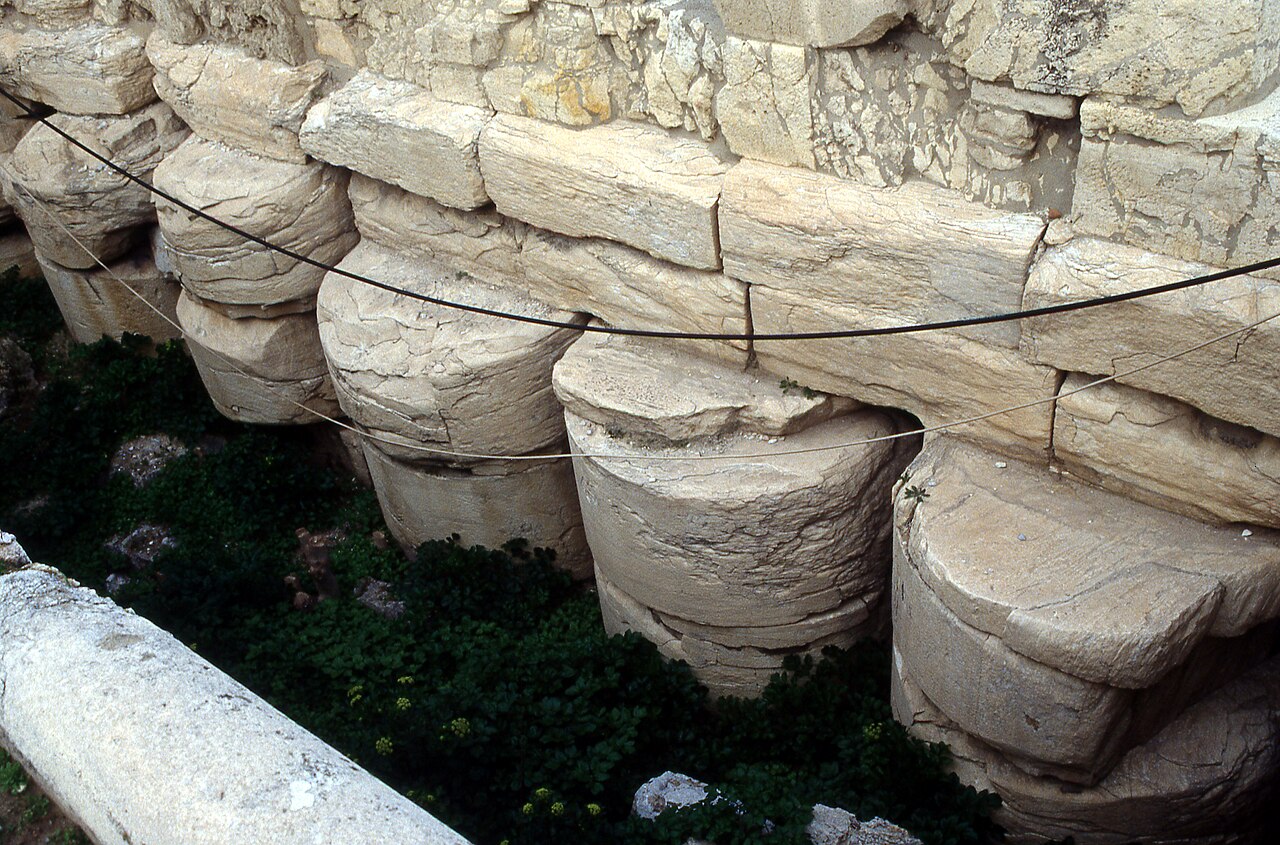
The Athenians also chose to leave reminders in plain view. Column drums from the unfinished temple known as the Older Parthenon, which had been under construction on the site of the later Parthenon, were built into the north wall of the Acropolis, where they can still be seen from the city below. Ancient writers report an oath, said to have been sworn by the Greeks before Plataea, not to rebuild the burned temples but to leave them as a memorial of the barbarians’ impiety. Its authenticity was already questioned in antiquity, but the major temples of the Acropolis were indeed not rebuilt for about thirty years, until Pericles began the Parthenon in 447 BCE.
A memory that lasted
The Persians also carried off the bronze statues of Harmodius and Aristogeiton, the tyrant-slayers who were symbols of Athenian freedom. The Athenians quickly commissioned replacements. Later Greek and Roman writers say the originals were eventually sent back from Persia, though they disagree on whether it was Alexander or one of his successors who returned them.
The burning of the Acropolis became part of how Greeks explained their relationship with Persia. Athens used the threat of another invasion to lead the Delian League, which grew into an Athenian empire. A century and a half later, Alexander’s propaganda presented his campaign as revenge for the temples of Athens, and when his troops set fire to the palaces in 330 BCE that same justification was offered; see The Burning of Persepolis. In both cases, a city’s burning was answered by the burning of another.
All of this comes from Greek sources. No Persian text describes the capture of Athens, though for a king who could claim to have taken and punished a rebel city, it would have been a fitting close to the campaign. On the reliability of Herodotus for these events, see Herodotus and the Persians.
Persian words from this page
| آکروپولیس | Âkropolis | Acropolis |
| معبد | ma’bad | temple |
| آتش | âtash | fire |
| انتقام | enteqâm | revenge |
| شوش | Shush | Susa |
| تندیس | tandis | statue |
Sources and further reading
- Herodotus, Histories, Book 8, chapters 40–55, and Book 9, chapters 1–13.
- Arrian, Anabasis of Alexander, Book 3 (the return of the tyrant-slayer statues and the burning of Persepolis).
- Jeffrey M. Hurwit, The Athenian Acropolis: History, Mythology, and Archaeology from the Neolithic Era to the Present (1999).
- Pierre Briant, From Cyrus to Alexander: A History of the Persian Empire (2002).
- J. F. Lazenby, The Defence of Greece, 490–479 BC (1993).
Want to learn Persian? Get the free Starter Pack
Get the 14-page printable Starter Pack (all 32 letters, a 7-day reading plan, 100 core words and 20 survival phrases) and a short 5-email course. Free.
More in The Achaemenid Empire (550–330 BCE)
- Achaemenes, Teispes and the Early Persian Kings of Anshan
- Cyrus the Great: Birth, Legends and Rise to Power
- Cyrus Conquers Lydia: Croesus and the Battle of Thymbra
- The Persian Conquest of Ionia and Asia Minor
- Cyrus Takes Babylon (539 BCE)
- The Cyrus Cylinder
- Cyrus and the Return of the Jews
- The Death of Cyrus and the Massagetae
- Pasargadae: Cyrus’s Capital and Tomb
- The Tomb of Cyrus through History
- Cambyses II
- Cambyses Conquers Egypt: The Battle of Pelusium
- Bardiya and Gaumata: The Usurper Question
- Darius the Great Takes the Throne
- The Great Revolts of 522–521 BCE
- The Behistun Inscription
- The Persian Conquest of the Indus Valley
- Darius’s Scythian Campaign
- Darius’s Canal from the Nile to the Red Sea
- Darius’s Reforms: Satrapies, Taxes and Law
- The Royal Road and the Persian Postal System
- The Daric: Achaemenid Coinage and Economy
- The Ionian Revolt (499–493 BCE)
- The Greco-Persian Wars: An Overview
- Mardonius and the First Persian Expedition to Greece (492 BCE)
- The Battle of Marathon (490 BCE)
- The Death of Darius I and the Succession of Xerxes
- The Royal Tombs of Naqsh-e Rostam
- Xerxes I: King of Kings (486–465 BCE)
- Xerxes’ Invasion of Greece (480–479 BCE)
- The Battle of Thermopylae (480 BCE)
- The Battle of Artemisium (480 BCE)
- The Persian Capture of Athens (480–479 BCE)
- The Battle of Salamis (480 BCE)
- The Battle of Plataea and the End of the Invasion (479 BCE)
- The Palace of Darius at Susa
- Building Persepolis: How Darius and Xerxes Built Parsa
- The Persepolis Fortification and Treasury Tablets
- Herodotus and the Persians
- The Apadana Reliefs: Nations Bringing Gifts
- The Achaemenid Paradise Gardens
- The Persian Immortals and the Achaemenid Army
- The Achaemenid Navy
- Religion of the Achaemenid Kings
- Women of the Achaemenid Court
- Old Persian Language and Cuneiform
- Egypt under Persian Rule
- Babylon under Persian Rule
- Artaxerxes I
- The Peace of Callias
- Darius II and the Peloponnesian War
- Famous Satraps of the Persian Empire
- Artaxerxes II Mnemon
- Cyrus the Younger and the Battle of Cunaxa
- The King’s Peace (387 BCE)
- The Great Satraps’ Revolt
- Artaxerxes III and the Reconquest of Egypt
- Darius III, the Last Achaemenid King
- The Battle of the Granicus (334 BCE)
- The Battle of Issus (333 BCE)
- Alexander Takes Tyre, Gaza and Egypt (332 BCE)
- The Battle of Gaugamela (331 BCE)
- Ariobarzanes and the Battle of the Persian Gate
- The Burning of Persepolis (330 BCE)
- The Death of Darius III and Bessus
- The Legacy of the Achaemenid Empire