Darius I died in late 486 BCE, probably in November, after a reign of thirty-six years and at an age of about sixty-four. He left behind an Egypt in revolt and an unfinished plan for a new war against Athens. His successor was Xerxes, his eldest son by Atossa, daughter of Cyrus the Great, chosen over an older half-brother in one of the smoothest successions in Achaemenid history.
| Death | Between mid-November and early December 486 BCE (dated Babylonian documents) |
|---|---|
| Age | About 64 |
| Reign | 522–486 BCE |
| Burial | Rock-cut tomb at Naqsh-e Rostam, Fars |
| Successor | Xerxes I, son of Atossa |
| Rival claimant | Artobarzanes, eldest son by the daughter of Gobryas (Herodotus) |
| Crisis at death | Revolt in Egypt |

Darius’s last years
After the defeat at Marathon in 490 BCE, Herodotus says, Darius was more determined than ever to punish Athens and spent three years gathering ships, horses, food and soldiers from across the empire. In the fourth year after Marathon, around 486 BCE, Egypt revolted. Herodotus gives no reason, but heavy demands for the coming war may have played a part. Darius now faced two campaigns at once, and he was no longer young.
Inside the empire, the last decade of his reign was a period of building and administration rather than crisis. The Persepolis terrace was rising, with the Apadana and his own palace, the Tachara, under construction (see Building Persepolis), and the Fortification tablets show a busy, well-supplied administration in Fars until 493 BCE.
A contest between brothers
Herodotus reports that a Persian king had to name his successor before leaving on campaign. Darius had sons by several wives. Before he became king he had married a daughter of Gobryas, one of his fellow conspirators of 522, and had three sons by her, the eldest called Artobarzanes. After he took the throne he married Atossa, daughter of Cyrus and widow of both Cambyses and Bardiya, and had four sons by her, the eldest Xerxes.
According to Herodotus, Artobarzanes claimed the throne as the eldest son, while Xerxes argued that he was the grandson of Cyrus and the first son born to Darius as king. Herodotus adds a Greek touch: the exiled Spartan king Demaratus, then living at the Persian court, is said to have advised Xerxes to stress that he was born while his father was king, as was the custom in Sparta. Herodotus himself doubts that this was decisive. Atossa, he writes, held all the power, and Xerxes would have been king anyway.
Other Greek and Roman writers tell a different version. Plutarch names the rival brother Ariamenes and describes a friendly settlement, with the loser accepting his brother’s rule and receiving honours. The names and details cannot be reconciled, and none of these writers had access to court records.
Xerxes’s own account
The Persian side survives in a single inscription. In a text found at Persepolis, known to scholars as XPf, Xerxes states that Darius had other sons, but that, by the will of Ahura Mazda, his father made him the greatest after himself. The inscription confirms the key fact behind Herodotus’s story: Xerxes was not the eldest son, and his choice needed explaining. It also shows how the royal family presented the decision, as the father’s choice and the god’s will rather than a matter of birth order.
Some historians think Xerxes was formally named heir years before his father’s death and took on public duties. Reliefs from the Treasury at Persepolis show a seated king with a prince standing behind him. These were once taken to be Darius and Xerxes, but the identification is not certain, and some scholars prefer Xerxes and his own son. What is clear is that, unlike the deaths of Cyrus and Cambyses, Darius’s death did not set off a civil war.
Death and burial
The date of death comes from Babylonian documents, which were dated by the regnal years of the reigning king. The last tablets dated to Darius belong to November 486 BCE and the first dated to Xerxes to early December, so Darius died in between. Ctesias, a Greek doctor at the Persian court some eighty years later, says he died after an illness of thirty days. Ctesias is unreliable on many points, and this detail cannot be checked.
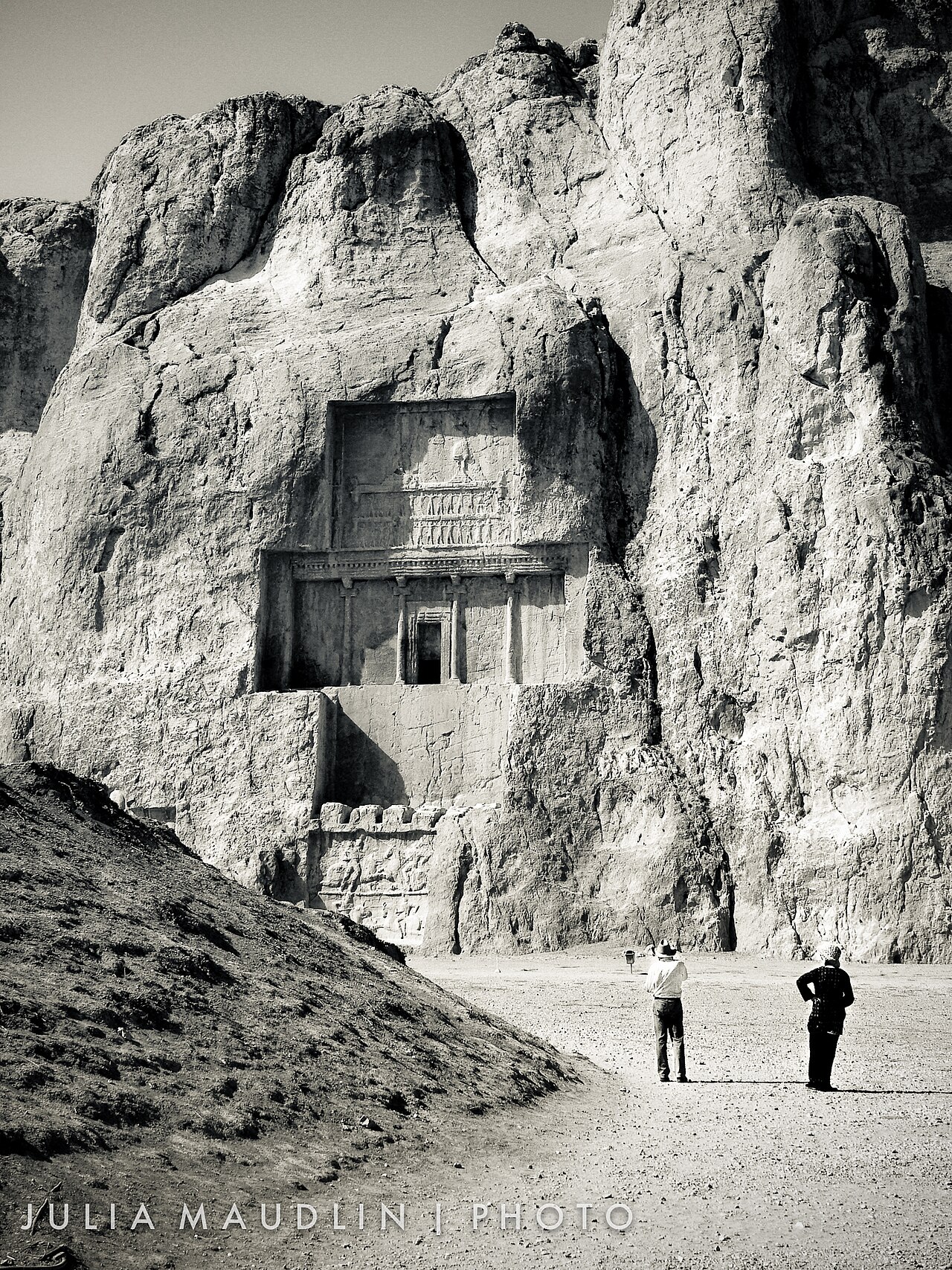
Darius was buried at Naqsh-e Rostam, about six kilometres from Persepolis, in a tomb cut high into the cliff. Its cross-shaped facade copies the front of a palace, and above it a relief shows the king standing on a platform carried by figures representing the peoples of the empire. Two inscriptions accompany it. One, DNa, lists the lands he ruled and describes his conquests. The other, DNb, is a statement of royal character: the king says he is a friend to right, not to wrong, that he does not lose his temper, and that he rewards and punishes according to what each man has done. Xerxes later had much of this text copied in his own name, a sign of how he wished to be seen as his father’s heir. The tomb set the pattern for three later kings buried beside him; see The Royal Tombs of Naqsh-e Rostam.
What Xerxes inherited
The new king’s first task was Egypt. Xerxes reconquered it in 484 BCE and placed his brother Achaemenes there as satrap. The war against Greece, prepared by Darius, now became Xerxes’s war. Greek writers, especially Herodotus, later shaped the story so that Xerxes appears to have been talked into invading by ambitious advisers like Mardonius. That is a literary pattern as much as a record of court debate. Xerxes’s reign is covered in Xerxes I: King of Kings, and the invasion itself in Xerxes’ invasion of Greece. The site’s general article on the Persian Empire gives the wider setting.
Persian words from this page
| خشایارشا | Khashâyârshâ | Xerxes |
| آتوسا | Âtusâ | Atossa |
| ولیعهد | valiahd | crown prince, heir |
| آرامگاه | ârâmgâh | tomb |
| نقش رستم | Naqsh-e Rostam | Naqsh-e Rostam |
| مصر | Mesr | Egypt |
Sources and further reading
- Herodotus, Histories, Book 7, chapters 1–7.
- Xerxes, Persepolis inscription XPf; Darius, Naqsh-e Rostam inscriptions DNa and DNb. English translations in Amélie Kuhrt, The Persian Empire: A Corpus of Sources from the Achaemenid Period (2007).
- Pierre Briant, From Cyrus to Alexander: A History of the Persian Empire (2002).
- Encyclopaedia Iranica, “Darius I the Great”.
- Matt Waters, Ancient Persia: A Concise History of the Achaemenid Empire, 550–330 BCE (2014).
Want to learn Persian? Get the free Starter Pack
Get the 14-page printable Starter Pack (all 32 letters, a 7-day reading plan, 100 core words and 20 survival phrases) and a short 5-email course. Free.
More in The Achaemenid Empire (550–330 BCE)
- Achaemenes, Teispes and the Early Persian Kings of Anshan
- Cyrus the Great: Birth, Legends and Rise to Power
- Cyrus Conquers Lydia: Croesus and the Battle of Thymbra
- The Persian Conquest of Ionia and Asia Minor
- Cyrus Takes Babylon (539 BCE)
- The Cyrus Cylinder
- Cyrus and the Return of the Jews
- The Death of Cyrus and the Massagetae
- Pasargadae: Cyrus’s Capital and Tomb
- The Tomb of Cyrus through History
- Cambyses II
- Cambyses Conquers Egypt: The Battle of Pelusium
- Bardiya and Gaumata: The Usurper Question
- Darius the Great Takes the Throne
- The Great Revolts of 522–521 BCE
- The Behistun Inscription
- The Persian Conquest of the Indus Valley
- Darius’s Scythian Campaign
- Darius’s Canal from the Nile to the Red Sea
- Darius’s Reforms: Satrapies, Taxes and Law
- The Royal Road and the Persian Postal System
- The Daric: Achaemenid Coinage and Economy
- The Ionian Revolt (499–493 BCE)
- The Greco-Persian Wars: An Overview
- Mardonius and the First Persian Expedition to Greece (492 BCE)
- The Battle of Marathon (490 BCE)
- The Death of Darius I and the Succession of Xerxes
- The Royal Tombs of Naqsh-e Rostam
- Xerxes I: King of Kings (486–465 BCE)
- Xerxes’ Invasion of Greece (480–479 BCE)
- The Battle of Thermopylae (480 BCE)
- The Battle of Artemisium (480 BCE)
- The Persian Capture of Athens (480–479 BCE)
- The Battle of Salamis (480 BCE)
- The Battle of Plataea and the End of the Invasion (479 BCE)
- The Palace of Darius at Susa
- Building Persepolis: How Darius and Xerxes Built Parsa
- The Persepolis Fortification and Treasury Tablets
- Herodotus and the Persians
- The Apadana Reliefs: Nations Bringing Gifts
- The Achaemenid Paradise Gardens
- The Persian Immortals and the Achaemenid Army
- The Achaemenid Navy
- Religion of the Achaemenid Kings
- Women of the Achaemenid Court
- Old Persian Language and Cuneiform
- Egypt under Persian Rule
- Babylon under Persian Rule
- Artaxerxes I
- The Peace of Callias
- Darius II and the Peloponnesian War
- Famous Satraps of the Persian Empire
- Artaxerxes II Mnemon
- Cyrus the Younger and the Battle of Cunaxa
- The King’s Peace (387 BCE)
- The Great Satraps’ Revolt
- Artaxerxes III and the Reconquest of Egypt
- Darius III, the Last Achaemenid King
- The Battle of the Granicus (334 BCE)
- The Battle of Issus (333 BCE)
- Alexander Takes Tyre, Gaza and Egypt (332 BCE)
- The Battle of Gaugamela (331 BCE)
- Ariobarzanes and the Battle of the Persian Gate
- The Burning of Persepolis (330 BCE)
- The Death of Darius III and Bessus
- The Legacy of the Achaemenid Empire