The Achaemenid Empire lasted from about 550 to 330 BCE, but much of what it built outlived it: a model of rule through provinces and governors that Alexander and his successors kept, an official Aramaic that gave rise to the scripts of later Iran, Persian words that spread across the world, and an image of tolerant kingship centred on Cyrus. In Iran itself the dynasty was almost forgotten for a thousand years, and then rediscovered as a pillar of modern national identity.

A model for later empires
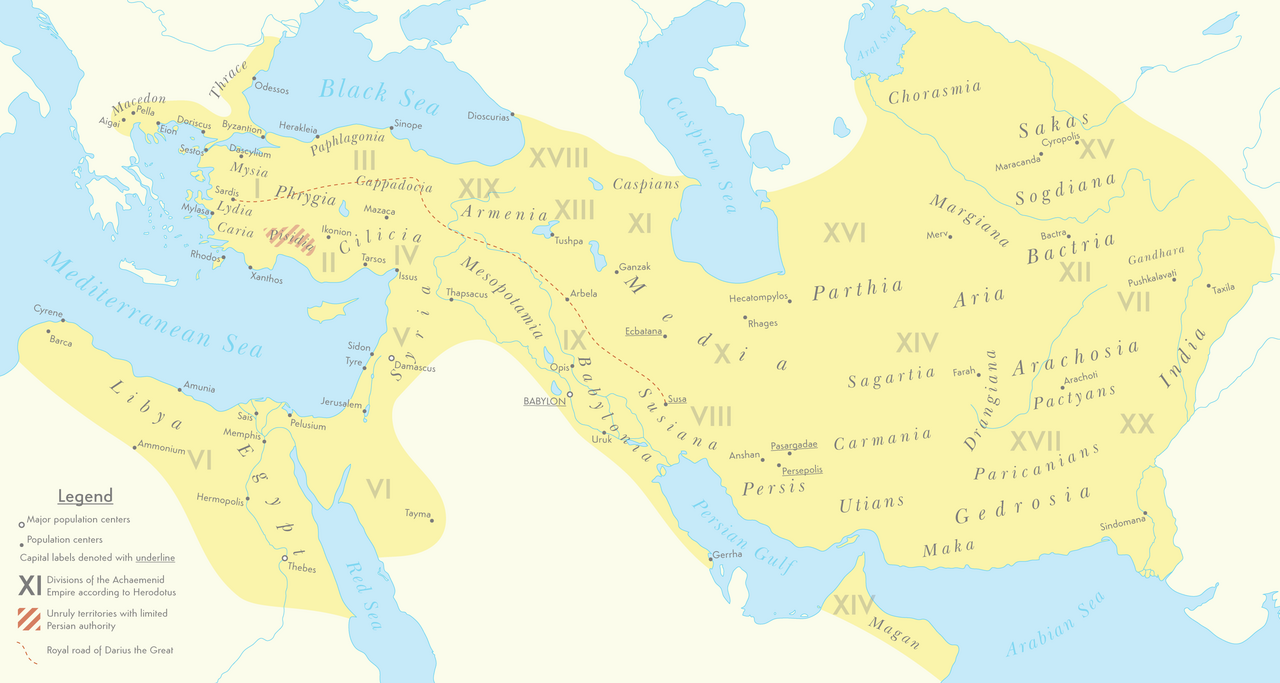
The Achaemenids were the first to rule, for two centuries, a state that stretched from the Aegean and Egypt to Central Asia and the Indus. They did it with a system that Darius I set in order around 520 to 500 BCE: provinces under satraps, regular tribute assessed by region, royal roads with relay stations, and a royal chancery with archives in several languages (see Darius’s reforms and the Royal Road).
Alexander did not replace this machine; he took it over. He kept Persian nobles as satraps in many provinces, used the treasuries and roads, adopted elements of Persian court dress and ceremony, and married into the royal family. Pierre Briant, the leading modern historian of the empire, has called Alexander “the last of the Achaemenids” for this reason. The Seleucid kings who followed ruled through much the same provinces. The Parthian and Sasanian empires, which later ruled Iran for almost nine centuries, were also organised around a king of kings ruling great provinces through regional nobles.
The language of government and its scripts
The Persian kings wrote their monumental inscriptions in Old Persian cuneiform, but the daily language of the imperial administration from Egypt to Bactria was Aramaic, written in a simple alphabet. When the empire fell, local scribes kept using that alphabet for their own languages. The Parthian, Middle Persian, Sogdian and Khwarazmian scripts all developed from Achaemenid chancery Aramaic, as did the Kharoshthi script of north-western India and the square Hebrew alphabet still used today.
The habit lasted surprisingly long. Middle Persian scribes under the Sasanians still wrote many common words as Aramaic spellings and read them aloud as Persian: they wrote MLK’, the Aramaic for “king”, and said shâh. This system is explained on Middle Persian (Pahlavi) language and literature, and the Old Persian background on Old Persian language and cuneiform.
Words that travelled
A few words from Achaemenid Persia are still used around the world:
- Paradise. An old Iranian word for a walled enclosure or park, known in Avestan as pairidaēza, passed into Greek as paradeisos and from there into the Bible and European languages. Modern Persian has it as پردیس (pardis). See the Achaemenid paradise gardens.
- Satrap. From Old Persian xšaçapāvan, “protector of the realm”, through Greek satrapēs.
- Shah. Old Persian xšāyaθiya, “king”, became Middle and New Persian shâh, and the royal title “king of kings” became shâhanshâh.
Water, money and building
Several practical techniques spread under Persian rule. Underground water channels, the qanats, were dug in Persian Egypt in the Kharga oasis, where archaeologists have dated some to the Achaemenid period (see Qanats). Gold darics and silver sigloi set a standard for royal coinage in Anatolia (see the daric). The columned audience hall, the apadana, influenced later palace architecture, and many historians see Persian models behind the polished stone columns and animal capitals of the Mauryan emperor Ashoka in India in the third century BCE, though how direct the influence was is still argued.
The image of tolerant kingship
The Achaemenid reputation for respecting local religions rests on real evidence. Cyrus restored temples and gods in Babylon (see the Cyrus Cylinder); the Book of Isaiah calls him the Lord’s anointed for allowing the Jewish exiles to return (see Cyrus and the return of the Jews); Darius sponsored Egyptian temples. The kings generally ruled through local elites and traditions instead of imposing one religion or law.
Historians add two qualifications. First, this was a policy of control, not a principle of rights: rebels were punished harshly, and temples were sometimes destroyed when cities revolted, as when the sanctuary at Didyma near Miletus was burned after the Ionian Revolt. Second, the modern description of the Cyrus Cylinder as “the first charter of human rights”, popularised in the 1960s and 1970s, reads modern ideas into a text that follows the conventions of Mesopotamian royal inscriptions.
Persia in the Greek and European imagination
Much of the Western picture of Persia came from Greeks who had fought it. Aeschylus’s play The Persians (472 BCE) and Herodotus’s Histories shaped an enduring contrast between Greek freedom and Persian despotism and luxury (see Herodotus and the Persians). At the same time Xenophon’s Cyropaedia, a novel-like “education of Cyrus”, made the founder a model ruler. It was widely read by Renaissance and early modern writers on government; Machiavelli cites Cyrus several times, and Thomas Jefferson owned copies. Modern Achaemenid studies since the 1980s, based on Persian, Elamite and Babylonian documents such as the Persepolis tablets, have tried to see the empire from the inside rather than through Greek eyes.
Forgotten and rediscovered in Iran
Surprisingly, Iranians themselves lost most of the memory of the dynasty. The Sasanian kings (224 to 651 CE) carved their own reliefs below the Achaemenid royal tombs at Naqsh-e Rostam, and some Roman writers say they claimed the lands once ruled by their ancestors. But the official Sasanian history, which later became the basis of Ferdowsi’s Shahnameh, built its past on the legendary Kayanian kings. Scholars disagree about how much the Sasanians actually knew of the Achaemenids; Ehsan Yarshater argued for very little, while others, such as A. Shapur Shahbazi and Touraj Daryaee, see more continuity. In the Shahnameh only Dara and his father Darab clearly echo the last Achaemenids (see Darius III and myth and history in the Shahnameh).
In the Islamic period the monuments were given new identities: Persepolis became Takht-e Jamshid, the throne of the legendary king Jamshid, and Cyrus’s tomb became the shrine of the mother of Solomon (see the tomb of Cyrus through history). Cyrus and Darius returned to Iranian history through European scholarship: the decipherment of Old Persian, begun by Georg Friedrich Grotefend in 1802 and completed by Henry Rawlinson’s work on the Behistun inscription in the 1830s and 1840s, made the kings speak again in their own words. In the early twentieth century Iranian historians, above all Hasan Pirnia in his Iran-e Bastan (“Ancient Iran”), brought this history into Persian.
A modern symbol
Under the Pahlavi dynasty the Achaemenids became central to state ideology, culminating in the 1971 celebration of 2,500 years of monarchy at Persepolis and Pasargadae (see the 2,500-year celebration). After the 1979 revolution official attitudes changed and have varied since, from early hostility to monarchical symbols to wider official use of the heritage later, such as the exhibition of the Cyrus Cylinder in Tehran in 2010 and 2011, which drew large crowds. For many Iranians, whatever their politics, the empire of Cyrus and Darius remains a source of pride, visible in popular first names such as Kurosh and Dariush and in visits to Persepolis and Pasargadae. Historians, for their part, continue to argue about which parts of that image belong to the ancient empire and which to its modern admirers.
Persian words from this page
| هخامنشیان | Hakhâmaneshiyân | the Achaemenids |
| شاهنشاه | shâhanshâh | king of kings |
| پردیس | pardis | park, paradise |
| قنات | qanât | underground water channel |
| ایران باستان | Irân-e bâstân | ancient Iran |
| کوروش | Kurosh | Cyrus |
| میراث | mirâs | heritage, legacy |
Sources and further reading
- Pierre Briant, From Cyrus to Alexander: A History of the Persian Empire (2002)
- Amélie Kuhrt, The Persian Empire: A Corpus of Sources from the Achaemenid Period (2007)
- Ehsan Yarshater, “Were the Sasanians Heirs to the Achaemenids?”, in La Persia nel Medioevo (Rome, 1971)
- Touraj Daryaee, Sasanian Persia: The Rise and Fall of an Empire (2009)
- Encyclopaedia Iranica, “Achaemenid Dynasty“
- Ali M. Ansari, The Politics of Nationalism in Modern Iran (2012)
Want to learn Persian? Get the free Starter Pack
Get the 14-page printable Starter Pack (all 32 letters, a 7-day reading plan, 100 core words and 20 survival phrases) and a short 5-email course. Free.
More in The Achaemenid Empire (550–330 BCE)
- Achaemenes, Teispes and the Early Persian Kings of Anshan
- Cyrus the Great: Birth, Legends and Rise to Power
- Cyrus Conquers Lydia: Croesus and the Battle of Thymbra
- The Persian Conquest of Ionia and Asia Minor
- Cyrus Takes Babylon (539 BCE)
- The Cyrus Cylinder
- Cyrus and the Return of the Jews
- The Death of Cyrus and the Massagetae
- Pasargadae: Cyrus’s Capital and Tomb
- The Tomb of Cyrus through History
- Cambyses II
- Cambyses Conquers Egypt: The Battle of Pelusium
- Bardiya and Gaumata: The Usurper Question
- Darius the Great Takes the Throne
- The Great Revolts of 522–521 BCE
- The Behistun Inscription
- The Persian Conquest of the Indus Valley
- Darius’s Scythian Campaign
- Darius’s Canal from the Nile to the Red Sea
- Darius’s Reforms: Satrapies, Taxes and Law
- The Royal Road and the Persian Postal System
- The Daric: Achaemenid Coinage and Economy
- The Ionian Revolt (499–493 BCE)
- The Greco-Persian Wars: An Overview
- Mardonius and the First Persian Expedition to Greece (492 BCE)
- The Battle of Marathon (490 BCE)
- The Death of Darius I and the Succession of Xerxes
- The Royal Tombs of Naqsh-e Rostam
- Xerxes I: King of Kings (486–465 BCE)
- Xerxes’ Invasion of Greece (480–479 BCE)
- The Battle of Thermopylae (480 BCE)
- The Battle of Artemisium (480 BCE)
- The Persian Capture of Athens (480–479 BCE)
- The Battle of Salamis (480 BCE)
- The Battle of Plataea and the End of the Invasion (479 BCE)
- The Palace of Darius at Susa
- Building Persepolis: How Darius and Xerxes Built Parsa
- The Persepolis Fortification and Treasury Tablets
- Herodotus and the Persians
- The Apadana Reliefs: Nations Bringing Gifts
- The Achaemenid Paradise Gardens
- The Persian Immortals and the Achaemenid Army
- The Achaemenid Navy
- Religion of the Achaemenid Kings
- Women of the Achaemenid Court
- Old Persian Language and Cuneiform
- Egypt under Persian Rule
- Babylon under Persian Rule
- Artaxerxes I
- The Peace of Callias
- Darius II and the Peloponnesian War
- Famous Satraps of the Persian Empire
- Artaxerxes II Mnemon
- Cyrus the Younger and the Battle of Cunaxa
- The King’s Peace (387 BCE)
- The Great Satraps’ Revolt
- Artaxerxes III and the Reconquest of Egypt
- Darius III, the Last Achaemenid King
- The Battle of the Granicus (334 BCE)
- The Battle of Issus (333 BCE)
- Alexander Takes Tyre, Gaza and Egypt (332 BCE)
- The Battle of Gaugamela (331 BCE)
- Ariobarzanes and the Battle of the Persian Gate
- The Burning of Persepolis (330 BCE)
- The Death of Darius III and Bessus
- The Legacy of the Achaemenid Empire