Darius I had a canal dug or completed from the Nile to the Red Sea, through the Wadi Tumilat valley and the Bitter Lakes, about 2,400 years before the modern Suez Canal. He marked it with large granite stelae carved in Old Persian, Elamite, Babylonian and Egyptian, which say that ships went “from Egypt through this canal to Persia”. It is one of the clearest signs of how Darius thought of his empire as one connected world.
| Built | Under Darius I (522–486 BCE); often dated around 500 BCE, though the exact year is unknown |
|---|---|
| Route | From the Pelusiac (Bubastite) branch of the Nile near Bubastis, east along the Wadi Tumilat to Lake Timsah and the Bitter Lakes, then to the Gulf of Suez |
| Earlier work | Begun by the pharaoh Necho II (610–595 BCE), according to Herodotus |
| Monuments | Stelae along the route, including Tell el-Maskhuta and Kabret (the Chalouf stela, found 1866) |
| Languages | Old Persian, Elamite, Babylonian, Egyptian hieroglyphs |
The idea before Darius
Egyptian kings had long wanted a water route from the Nile to the Red Sea, which would let ships reach the land of Punt and Arabia without a desert crossing. Herodotus (2.158) says the pharaoh Necho II began such a canal around 600 BCE and that 120,000 Egyptians died digging it before an oracle told him to stop, because he was working for “the barbarian”. Herodotus then says that Darius finished it. Some ancient writers claim that earlier pharaohs had started the work, and traces of older channels in the Wadi Tumilat suggest that Darius was improving and extending earlier works rather than starting from nothing.
Herodotus on the finished canal
Herodotus, who visited Egypt in the 5th century BCE when it was still under Persian rule, describes the canal as a working waterway. It took four days to sail its length, he says, and it was wide enough for two triremes to be rowed side by side. It drew water from the Nile a little above Bubastis and ran east past the city of Patumos to the Red Sea.

The canal stelae
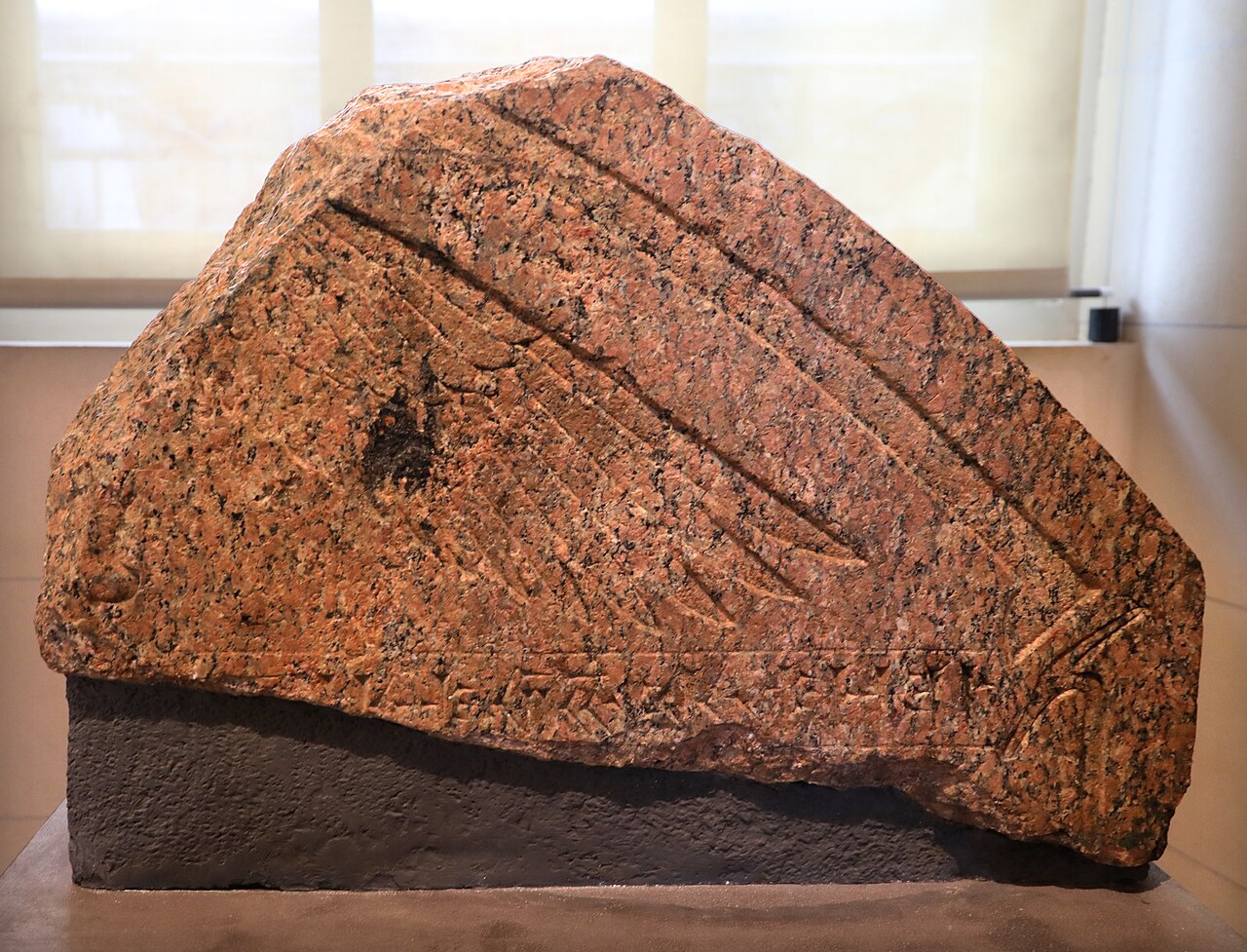
In the 19th century, during work on the modern canal, engineers and scholars found the remains of several large stelae of pink granite along the line of Darius’s canal. The best known is the Chalouf (Shaluf) stela, found near Kabret in 1866 by Charles de Lesseps, the son of the builder of the modern Suez Canal. Other stelae or fragments come from Tell el-Maskhuta, the ancient Pithom area, and from near the Serapeum and Suez.
The stelae had two faces. One side carried cuneiform texts in the three languages of the Persian court. The other was in Egyptian hieroglyphs, with Egyptian royal imagery, and here Darius appears in the role of a pharaoh, with figures representing the peoples of the empire. The Egyptian texts are badly damaged, and their full content is still debated.
What Darius says
The Old Persian text is short. Darius introduces himself as the Great King and son of Hystaspes, and then says, in summary:
- “I am a Persian; from Persia I seized Egypt.”
- He ordered a canal dug from the river called Nile, which flows in Egypt, to the sea that begins in Persia.
- The canal was dug as he ordered, and ships went from Egypt through it to Persia, “as was my desire”.
The “sea that begins in Persia” is the Red Sea seen as one body of water with the Persian Gulf, linked by the sea route around Arabia. The text is a royal statement, not a technical report: it gives no length, no date and no number of workers.
Why build it?
Historians offer several explanations, which are not mutually exclusive:
- A sea link with Persia. The text itself states this aim. Ships could sail from the Mediterranean and the Nile to the Persian Gulf and up to the southern edge of Persia and Elam. Herodotus says that Darius had earlier sent a Greek captain, Scylax of Caryanda, on a voyage from the Indus to Egypt, described on the Persian conquest of the Indus Valley. The canal completed the sea route from one end of the empire to the other.
- Royal prestige. Completing a work that pharaohs had failed to finish showed Darius as a legitimate king of Egypt. On the hieroglyphic side he is presented in exactly that way.
- Trade and tribute. The canal may have carried goods and tribute, though there is little direct evidence of heavy traffic.
Darius also took a close interest in Egypt in other ways: he is credited with codifying Egyptian law, building a temple to Amun at Hibis in the Kharga Oasis, and treating the Egyptian priesthood more carefully than Cambyses.
Was it ever finished?
Here the ancient sources disagree. Herodotus says plainly that Darius completed the canal, and the stelae say ships used it. Later writers, including Aristotle, Strabo and Pliny the Elder, report that Darius stopped the work because he was told the Red Sea was higher than Egypt and would flood the land with salt water. They credit the completion to Ptolemy II Philadelphus in the 3rd century BCE.
Most historians trust the earlier witnesses, Herodotus and the stelae, and assume that the later story reflects the canal silting up after Darius’s time, so that the Ptolemies had to rebuild it. Canals in the shifting sands of the Wadi Tumilat needed constant dredging, and any of them could fall out of use in a generation.
Later canals on the same line
The Nile to Red Sea canal was reopened several times. The Ptolemies restored it, the Roman emperor Trajan rebuilt it in the 2nd century CE, and after the Arab conquest of Egypt in the 7th century it was cleared again to carry grain towards Arabia, until it was closed in the 8th century. The modern Suez Canal, opened in 1869, follows a different route, cutting straight across the isthmus from the Mediterranean to the Red Sea.
Darius’s canal belongs with his other works of connection, such as the Royal Road, and with the organisation of the empire described on Darius’s reforms.
Persian words from this page
| کانال | kânâl | canal |
| دریای سرخ | Daryâ-ye Sorkh | the Red Sea |
| کشتی | kashti | ship |
| سوئز | Su’ez | Suez |
| پارس | Pârs | Persia, Persis |
| رود | rud | river |
Sources and further reading
- Herodotus, Histories, Book 2, chapter 158, and Book 4, chapters 39 and 44.
- Darius I, Suez inscriptions (DZa–DZc), translated in Amélie Kuhrt, The Persian Empire: A Corpus of Sources (2007), and on Livius.org.
- Strabo, Geography 17.1.25; Pliny the Elder, Natural History 6.33.
- Pierre Briant, From Cyrus to Alexander (2002), chapter 12.
- Encyclopaedia Iranica, “Darius iii. Darius I the Great”.
Want to learn Persian? Get the free Starter Pack
Get the 14-page printable Starter Pack (all 32 letters, a 7-day reading plan, 100 core words and 20 survival phrases) and a short 5-email course. Free.
More in The Achaemenid Empire (550–330 BCE)
- Achaemenes, Teispes and the Early Persian Kings of Anshan
- Cyrus the Great: Birth, Legends and Rise to Power
- Cyrus Conquers Lydia: Croesus and the Battle of Thymbra
- The Persian Conquest of Ionia and Asia Minor
- Cyrus Takes Babylon (539 BCE)
- The Cyrus Cylinder
- Cyrus and the Return of the Jews
- The Death of Cyrus and the Massagetae
- Pasargadae: Cyrus’s Capital and Tomb
- The Tomb of Cyrus through History
- Cambyses II
- Cambyses Conquers Egypt: The Battle of Pelusium
- Bardiya and Gaumata: The Usurper Question
- Darius the Great Takes the Throne
- The Great Revolts of 522–521 BCE
- The Behistun Inscription
- The Persian Conquest of the Indus Valley
- Darius’s Scythian Campaign
- Darius’s Canal from the Nile to the Red Sea
- Darius’s Reforms: Satrapies, Taxes and Law
- The Royal Road and the Persian Postal System
- The Daric: Achaemenid Coinage and Economy
- The Ionian Revolt (499–493 BCE)
- The Greco-Persian Wars: An Overview
- Mardonius and the First Persian Expedition to Greece (492 BCE)
- The Battle of Marathon (490 BCE)
- The Death of Darius I and the Succession of Xerxes
- The Royal Tombs of Naqsh-e Rostam
- Xerxes I: King of Kings (486–465 BCE)
- Xerxes’ Invasion of Greece (480–479 BCE)
- The Battle of Thermopylae (480 BCE)
- The Battle of Artemisium (480 BCE)
- The Persian Capture of Athens (480–479 BCE)
- The Battle of Salamis (480 BCE)
- The Battle of Plataea and the End of the Invasion (479 BCE)
- The Palace of Darius at Susa
- Building Persepolis: How Darius and Xerxes Built Parsa
- The Persepolis Fortification and Treasury Tablets
- Herodotus and the Persians
- The Apadana Reliefs: Nations Bringing Gifts
- The Achaemenid Paradise Gardens
- The Persian Immortals and the Achaemenid Army
- The Achaemenid Navy
- Religion of the Achaemenid Kings
- Women of the Achaemenid Court
- Old Persian Language and Cuneiform
- Egypt under Persian Rule
- Babylon under Persian Rule
- Artaxerxes I
- The Peace of Callias
- Darius II and the Peloponnesian War
- Famous Satraps of the Persian Empire
- Artaxerxes II Mnemon
- Cyrus the Younger and the Battle of Cunaxa
- The King’s Peace (387 BCE)
- The Great Satraps’ Revolt
- Artaxerxes III and the Reconquest of Egypt
- Darius III, the Last Achaemenid King
- The Battle of the Granicus (334 BCE)
- The Battle of Issus (333 BCE)
- Alexander Takes Tyre, Gaza and Egypt (332 BCE)
- The Battle of Gaugamela (331 BCE)
- Ariobarzanes and the Battle of the Persian Gate
- The Burning of Persepolis (330 BCE)
- The Death of Darius III and Bessus
- The Legacy of the Achaemenid Empire