Cyrus the Great died in 530 BCE while campaigning on the north-eastern frontier of his empire in Central Asia. How he died is uncertain. Herodotus says he was killed in battle by the Massagetae, nomads ruled by Queen Tomyris, who put his head in a skin filled with blood; Ctesias says he was fatally wounded fighting another people, and Xenophon has him die peacefully in bed in Persia.
| Date | 530 BCE, probably in summer (Babylonian documents switch to Cambyses’s reign in late summer) |
|---|---|
| Place | Central Asia, beyond a river Herodotus calls the Araxes, probably the Syr Darya or Amu Darya |
| Enemy (Herodotus) | The Massagetae, led by Queen Tomyris |
| Enemy (Ctesias) | The Derbices, with Indian allies |
| Reign | 29 years (559–530 BCE) |
| Buried | Pasargadae, according to Ctesias and Arrian |
| Successor | His elder son, Cambyses II |
Why Cyrus was in Central Asia
After Babylon, Cyrus turned east. His conquests there are poorly recorded, but by the end of his reign the empire included Bactria, Sogdia and the lands up to the Syr Darya river, where, according to later Greek writers, he founded a frontier fort that the Greeks called Cyropolis. Beyond that line lived Iranian-speaking nomads of the steppe, called Saka by the Persians and Scythians by the Greeks. Herodotus names one group of them the Massagetae.
The steppe nomads were a recurring danger to settled Iran, and a war to secure the frontier makes sense. Herodotus, however, frames the campaign as a needless war of greed by a king who had come to think himself more than human.
Herodotus: Tomyris and the trap of wine
Herodotus (1.201–214) gives the fullest account and admits that he chose it from many versions as the most credible.
The Massagetae were ruled by a widowed queen, Tomyris. Cyrus first sent to ask for her hand in marriage. She understood that he wanted her kingdom, not her, and refused. Cyrus then marched to the river that bordered her land and began to build a bridge of boats. Tomyris sent a message telling him to rule his own people and leave hers alone, but offering, if he insisted on fighting, to withdraw three days’ march so he could cross in peace.
Croesus’s advice
Cyrus’s council advised him to let the Massagetae come over to his side. Croesus, the former king of Lydia, now Cyrus’s adviser (his story is on Cyrus Conquers Lydia), argued the opposite: cross the river, then leave a camp full of food and unmixed wine guarded by the weakest troops. The nomads, unused to wine, would feast and could be destroyed. Cyrus agreed. Before crossing, he sent his son Cambyses home with Croesus and named him his heir.
The plan worked at first. A third of the Massagetae army, led by Tomyris’s son Spargapises, overran the camp, ate and drank, and fell asleep. The Persians returned, killed many and captured Spargapises. Tomyris sent Cyrus a message calling his victory a trick of the wine and promising, if he did not return her son, to give him more blood than he could drink. When Spargapises sobered up, he asked to be untied and killed himself.
The battle and the head
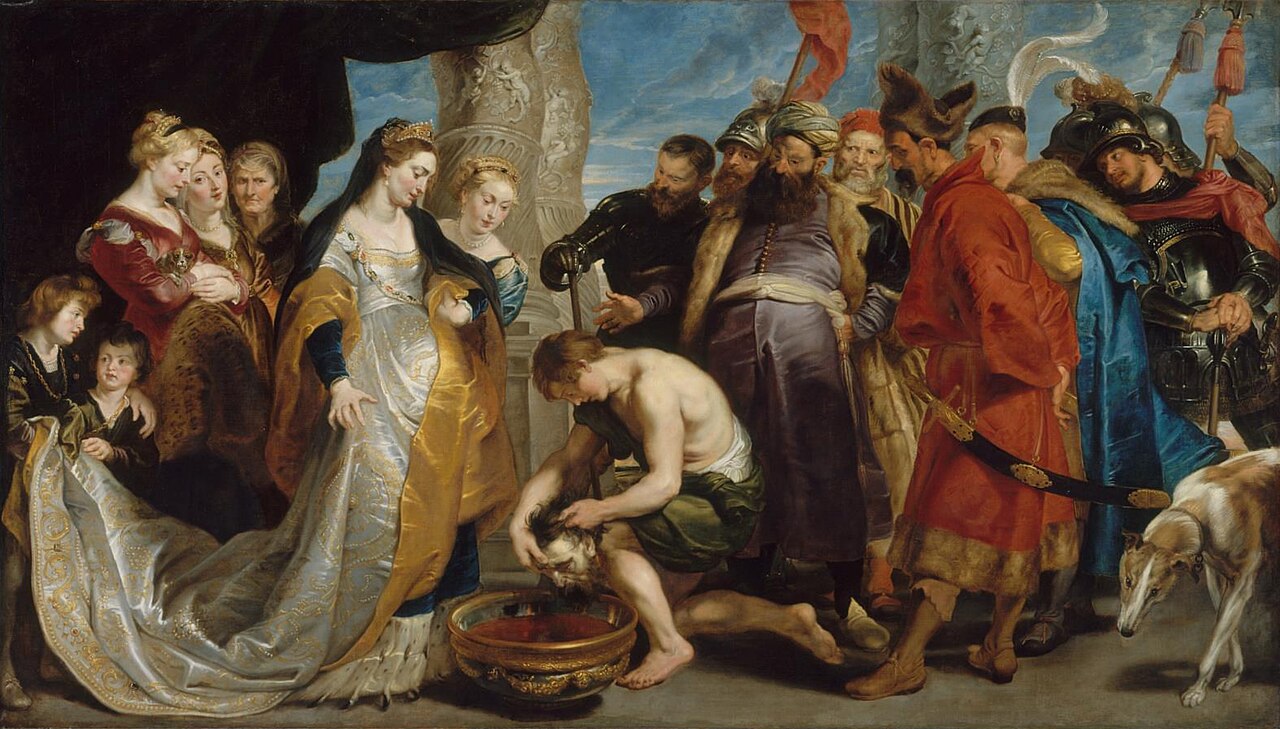
Tomyris then attacked with all her forces. Herodotus calls it the fiercest battle ever fought between non-Greeks: first with arrows at a distance, then hand to hand with spears and daggers. Most of the Persian army was destroyed, and Cyrus was killed. Tomyris had his body found among the dead, filled a wineskin with human blood and pushed his head into it, telling the corpse that she was giving him his fill of blood, as she had promised.
Herodotus also places in this campaign Cyrus’s dream that Darius, the young son of his officer Hystaspes, had wings that shadowed Asia and Europe. Cyrus sent Hystaspes home to keep watch on his son. The story was obviously written with hindsight, after Darius had become king.

Other ancient versions
Ctesias: the Derbices and the Indian javelin
Ctesias, writing at the Persian court around 400 BCE, gives a different war. In the summary of his work made by Photius, Cyrus marched against the Derbices, a people of Central Asia led by a king called Amoraeus. The Derbices suddenly brought up elephants they had hidden in ambush, Cyrus’s cavalry broke, Cyrus fell from his horse, and an Indian fighting for the Derbices wounded him with a javelin in the thigh. Saka allies then won the battle for the Persians. Cyrus lived three days, long enough to name Cambyses king and give his younger son, called Tanyoxarces by Ctesias (the Bardiya of Persian sources), the eastern provinces free of tribute. Cambyses sent his father’s body home to Persia for burial.
Xenophon: a philosopher’s death
Xenophon’s Cyropaedia ends with an aged Cyrus in Persia. Warned of his death in a dream, he calls his sons and friends, divides the kingdom between Cambyses and his brother, speaks about the immortality of the soul and the duties of rulers, and dies quietly. This fits Xenophon’s idealised portrait and has no value as evidence for how Cyrus actually died.
Justin and the Roman tradition
The Roman historian Justin, summarising the lost work of Pompeius Trogus, follows Herodotus but inflates the scale: he says 200,000 Persians died, with no survivor left to carry the news home. Through Justin and Herodotus, Tomyris became a popular subject for European painters, as in the Rubens painting above.
Weighing the stories
The date is secure. Babylonian business documents are dated by Cyrus’s reign until the summer of 530 BCE and then by Cambyses’s, which agrees with Herodotus’s 29-year reign.
Most historians accept that Cyrus died on campaign in Central Asia, probably from a battle wound, since both Herodotus and Ctesias, using different traditions, agree on that much. The details are another matter. Herodotus’s version is shaped by his favourite theme, that great power leads to arrogance and a fall, and the head in the blood-filled skin is a powerful literary image. Ctesias’s elephants in Central Asia have also been doubted.
One practical point weighs against the most gruesome part of Herodotus. The tomb of Cyrus at Pasargadae still held his body in a golden coffin, with a couch beside it, when Alexander’s men entered it two centuries later, according to Arrian. That suggests the body was recovered and brought home, as Ctesias says. The tomb’s later history is told on The Tomb of Cyrus through History.
After Cyrus
The succession passed smoothly, at first. Cambyses, already named heir, became king, and his brother Bardiya seems to have held a large command in the east. Within eight years both brothers would be dead and the throne in dispute, a story that begins on Cambyses II. The nomads of the steppe frontier remained a challenge for every later Iranian state, from the Achaemenids to the Parthians and beyond.
For Cyrus’s life and achievements as a whole, see the site’s main article on Cyrus the Great.
Persian words from this page
| تومیریس | Tomiris | Tomyris |
| ماساگتها | Mâsâget-hâ | the Massagetae |
| سکاها | Sakâ-hâ | the Saka, steppe nomads |
| سیحون | Seyhun | the Syr Darya river |
| جیحون | Jeyhun | the Amu Darya (Oxus) river |
| خون | khun | blood |
| آرامگاه | ârâmgâh | tomb, resting place |
Sources and further reading
- Herodotus, Histories 1.201–216.
- Ctesias, Persica, as summarised by Photius, in L. Llewellyn-Jones and J. Robson, Ctesias’ History of Persia: Tales of the Orient (Routledge, 2010).
- Xenophon, Cyropaedia 8.7; Justin, Epitome of Pompeius Trogus 1.8; Arrian, Anabasis of Alexander 6.29.
- Encyclopaedia Iranica, “Cyrus iii. Cyrus II the Great”.
- Pierre Briant, From Cyrus to Alexander: A History of the Persian Empire (Eisenbrauns, 2002).
Want to learn Persian? Get the free Starter Pack
Get the 14-page printable Starter Pack (all 32 letters, a 7-day reading plan, 100 core words and 20 survival phrases) and a short 5-email course. Free.
More in The Achaemenid Empire (550–330 BCE)
- Achaemenes, Teispes and the Early Persian Kings of Anshan
- Cyrus the Great: Birth, Legends and Rise to Power
- Cyrus Conquers Lydia: Croesus and the Battle of Thymbra
- The Persian Conquest of Ionia and Asia Minor
- Cyrus Takes Babylon (539 BCE)
- The Cyrus Cylinder
- Cyrus and the Return of the Jews
- The Death of Cyrus and the Massagetae
- Pasargadae: Cyrus’s Capital and Tomb
- The Tomb of Cyrus through History
- Cambyses II
- Cambyses Conquers Egypt: The Battle of Pelusium
- Bardiya and Gaumata: The Usurper Question
- Darius the Great Takes the Throne
- The Great Revolts of 522–521 BCE
- The Behistun Inscription
- The Persian Conquest of the Indus Valley
- Darius’s Scythian Campaign
- Darius’s Canal from the Nile to the Red Sea
- Darius’s Reforms: Satrapies, Taxes and Law
- The Royal Road and the Persian Postal System
- The Daric: Achaemenid Coinage and Economy
- The Ionian Revolt (499–493 BCE)
- The Greco-Persian Wars: An Overview
- Mardonius and the First Persian Expedition to Greece (492 BCE)
- The Battle of Marathon (490 BCE)
- The Death of Darius I and the Succession of Xerxes
- The Royal Tombs of Naqsh-e Rostam
- Xerxes I: King of Kings (486–465 BCE)
- Xerxes’ Invasion of Greece (480–479 BCE)
- The Battle of Thermopylae (480 BCE)
- The Battle of Artemisium (480 BCE)
- The Persian Capture of Athens (480–479 BCE)
- The Battle of Salamis (480 BCE)
- The Battle of Plataea and the End of the Invasion (479 BCE)
- The Palace of Darius at Susa
- Building Persepolis: How Darius and Xerxes Built Parsa
- The Persepolis Fortification and Treasury Tablets
- Herodotus and the Persians
- The Apadana Reliefs: Nations Bringing Gifts
- The Achaemenid Paradise Gardens
- The Persian Immortals and the Achaemenid Army
- The Achaemenid Navy
- Religion of the Achaemenid Kings
- Women of the Achaemenid Court
- Old Persian Language and Cuneiform
- Egypt under Persian Rule
- Babylon under Persian Rule
- Artaxerxes I
- The Peace of Callias
- Darius II and the Peloponnesian War
- Famous Satraps of the Persian Empire
- Artaxerxes II Mnemon
- Cyrus the Younger and the Battle of Cunaxa
- The King’s Peace (387 BCE)
- The Great Satraps’ Revolt
- Artaxerxes III and the Reconquest of Egypt
- Darius III, the Last Achaemenid King
- The Battle of the Granicus (334 BCE)
- The Battle of Issus (333 BCE)
- Alexander Takes Tyre, Gaza and Egypt (332 BCE)
- The Battle of Gaugamela (331 BCE)
- Ariobarzanes and the Battle of the Persian Gate
- The Burning of Persepolis (330 BCE)
- The Death of Darius III and Bessus
- The Legacy of the Achaemenid Empire