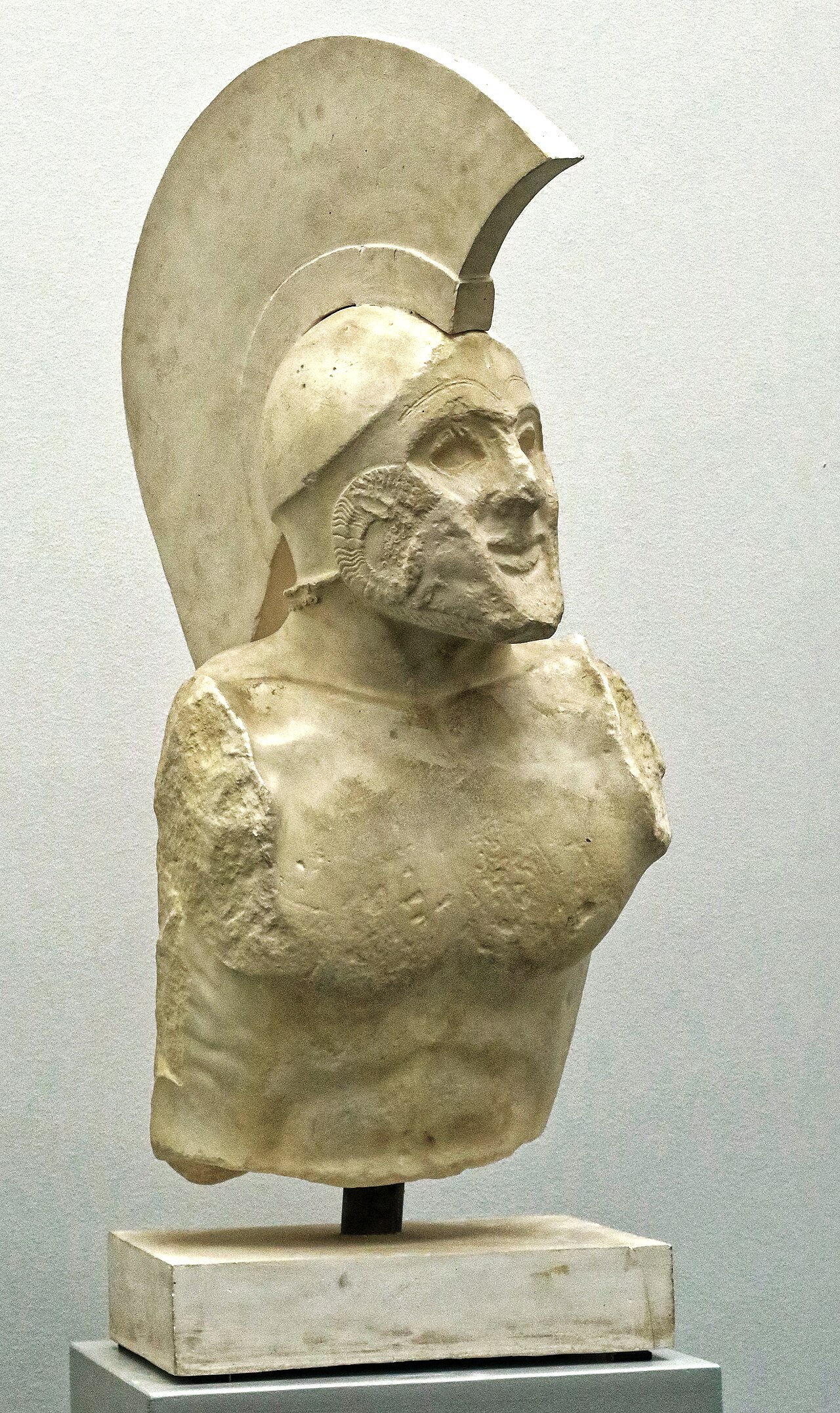
The Battle of Thermopylae was fought in late summer 480 BCE at a narrow pass in central Greece, where a Greek force of about 7,000 men under the Spartan king Leonidas blocked the army of Xerxes for three days. The Persians broke through by sending elite troops along a mountain path that turned the Greek position; Leonidas and his rearguard were killed. To the Greeks it became the model of a heroic last stand. To the Persian command it was a costly but successful opening of the road to Athens.
| Date | August or September 480 BCE, at the time of the Olympic games |
|---|---|
| Place | The pass of Thermopylae (“Hot Gates”), between Mount Kallidromo and the Malian Gulf |
| Persian commander | Xerxes I; Hydarnes led the Immortals over the mountain |
| Greek commander | Leonidas I of Sparta |
| Greek force | About 5,200 listed by Herodotus, plus Locrians and 1,000 Phocians; perhaps 7,000 in all |
| Persian force | Unknown; much smaller than Herodotus claims |
| Result | Persian victory; Greek rearguard destroyed |

Why Thermopylae
The Greek allies had chosen to fight on land and sea together. While their fleet held the strait at Artemisium, about 60 kilometres to the east, a land force would hold Thermopylae, the main route from Thessaly into central Greece. In 480 BCE the sea came much closer to the mountains than it does now; silt from the Spercheios River has since pushed the coast several kilometres away. At its narrowest points the road was only wide enough for a cart or two, and the Phocians had once built a wall across it, which the Greeks repaired.
The Spartans sent only 300 citizen soldiers with Leonidas. Herodotus says the rest were held back by the Carneia festival and that the Olympic games were taking place, and that more troops would follow. Whether Sparta meant to hold the pass for long, or only to delay the enemy, has been argued about ever since.
The Greek army
Herodotus lists the contingents: 300 Spartans, about 2,800 from other Peloponnesian cities such as Tegea, Mantinea and Corinth, 700 from Thespiae and 400 from Thebes, joined by the Opuntian Locrians and 1,000 Phocians. The Spartans also had helots with them, whose numbers he does not give. Later writers give slightly different totals. On any count the Greeks were few, which is why the position had to be narrow.
Four days of waiting, three of fighting
Xerxes camped near Trachis and, Herodotus says, waited four days, expecting the Greeks to withdraw. He also sent a scout who reported that the Spartans were exercising and combing their hair; the exiled Spartan king Demaratus explained to Xerxes that this is what they did before risking their lives.
On the fifth day Xerxes sent in the Medes and the Cissians (troops from Elam, around Susa). In the narrow space their numbers counted for little, and their shorter spears and lighter shields were outmatched by the hoplites’ long spears and bronze armour. The Immortals, the royal guard under Hydarnes, attacked next and also failed. Herodotus says that Xerxes three times leapt up from his seat in fear for his army. The next day brought the same result.
The mountain path
The deadlock was broken by local knowledge. A man of Malis, Ephialtes son of Eurydemus, told Xerxes about a path called the Anopaea that climbed over the mountain and came down behind the Greek position. Herodotus knew of a rival story naming two other men as the guides, but he believed Ephialtes was guilty, and the Greeks later put a price on his head. Hydarnes and the Immortals set off at nightfall. At dawn they came upon the 1,000 Phocians guarding the path, who retreated to a hilltop expecting to be attacked; the Persians simply marched past them.
When word reached Leonidas, he sent most of the allies away. He stayed with the Spartans, the Thespians, who refused to leave, and the Thebans. Herodotus says the Thebans were kept against their will and surrendered once the fighting turned; this claim reflects the hatred of later Greeks for Thebes, which had joined Persia, and some historians doubt it.
The last stand
On the final morning the Greeks advanced into the wider part of the pass and fought there until their spears broke. Leonidas was killed, and Herodotus says there was a fierce struggle over his body. Two of Xerxes’s half-brothers, Abrocomes and Hyperanthes, sons of Darius, died in this fighting. When the Immortals arrived from behind, the survivors fell back to a small hill and were killed by arrows and missiles. Herodotus names a Spartan, Dieneces, who, hearing that the Persian arrows would hide the sun, said that they would then fight in the shade.
In 1939 the Greek archaeologist Spyridon Marinatos excavated the hill, called Kolonos, and found large numbers of arrowheads, including types used by the Persian army, which fits Herodotus’s account of the end.
Herodotus says Xerxes had Leonidas’s head cut off and the body impaled, and treats this as an outrage. He also claims that 20,000 men had died on the Persian side and that Xerxes hid most of the bodies before letting his sailors view the battlefield. Neither figure can be checked; the casualty figure, like most Persian numbers in Greek sources, is likely to be exaggerated.
How the battle looks from the Persian side
No Persian source mentions Thermopylae. From the point of view of Xerxes’s generals, the battle cost several days and heavy losses among the guard, but it did what it had to do. The road into Phocis, Boeotia and Attica was open, the Greek fleet at Artemisium withdrew when it heard the news, and within a few weeks the Persian army was in Athens. It is worth noting that the troops who bore the brunt of the fighting, Medes, Cissians and the Immortals, were Iranians and Elamites from the core of the empire, not the reluctant subject levies of Greek legend.
The legend grew later. A famous epitaph for the Spartans, quoted by Herodotus, was set up on the site, and Thermopylae became a symbol of sacrifice for freedom, from Roman times to the modern film 300, which many Iranians criticised for its portrayal of the Persians. The phrase “molon labe” (“come and take them”), said to be Leonidas’s reply when ordered to surrender his weapons, comes from Plutarch, writing about 600 years later, and is not in Herodotus. On how Greek writers shaped the Persian image, see Herodotus and the Persians. The campaign as a whole is in Xerxes’ invasion of Greece, and the Persian elite troops in The Persian Immortals and the Achaemenid Army.
Persian words from this page
| ترموپیل | Termopil | Thermopylae |
| لئونیداس | Le’onidâs | Leonidas |
| جاویدان | jâvidân | immortal; the Immortals |
| گذرگاه | gozargâh | pass, passage |
| تیر | tir | arrow |
| نبرد | nabard | battle |
Sources and further reading
- Herodotus, Histories, Book 7, chapters 175–239, and Book 8, chapters 24–25.
- Paul Cartledge, Thermopylae: The Battle That Changed the World (2006).
- J. F. Lazenby, The Defence of Greece, 490–479 BC (1993).
- Pierre Briant, From Cyrus to Alexander: A History of the Persian Empire (2002).
Want to learn Persian? Get the free Starter Pack
Get the 14-page printable Starter Pack (all 32 letters, a 7-day reading plan, 100 core words and 20 survival phrases) and a short 5-email course. Free.
More in The Achaemenid Empire (550–330 BCE)
- Achaemenes, Teispes and the Early Persian Kings of Anshan
- Cyrus the Great: Birth, Legends and Rise to Power
- Cyrus Conquers Lydia: Croesus and the Battle of Thymbra
- The Persian Conquest of Ionia and Asia Minor
- Cyrus Takes Babylon (539 BCE)
- The Cyrus Cylinder
- Cyrus and the Return of the Jews
- The Death of Cyrus and the Massagetae
- Pasargadae: Cyrus’s Capital and Tomb
- The Tomb of Cyrus through History
- Cambyses II
- Cambyses Conquers Egypt: The Battle of Pelusium
- Bardiya and Gaumata: The Usurper Question
- Darius the Great Takes the Throne
- The Great Revolts of 522–521 BCE
- The Behistun Inscription
- The Persian Conquest of the Indus Valley
- Darius’s Scythian Campaign
- Darius’s Canal from the Nile to the Red Sea
- Darius’s Reforms: Satrapies, Taxes and Law
- The Royal Road and the Persian Postal System
- The Daric: Achaemenid Coinage and Economy
- The Ionian Revolt (499–493 BCE)
- The Greco-Persian Wars: An Overview
- Mardonius and the First Persian Expedition to Greece (492 BCE)
- The Battle of Marathon (490 BCE)
- The Death of Darius I and the Succession of Xerxes
- The Royal Tombs of Naqsh-e Rostam
- Xerxes I: King of Kings (486–465 BCE)
- Xerxes’ Invasion of Greece (480–479 BCE)
- The Battle of Thermopylae (480 BCE)
- The Battle of Artemisium (480 BCE)
- The Persian Capture of Athens (480–479 BCE)
- The Battle of Salamis (480 BCE)
- The Battle of Plataea and the End of the Invasion (479 BCE)
- The Palace of Darius at Susa
- Building Persepolis: How Darius and Xerxes Built Parsa
- The Persepolis Fortification and Treasury Tablets
- Herodotus and the Persians
- The Apadana Reliefs: Nations Bringing Gifts
- The Achaemenid Paradise Gardens
- The Persian Immortals and the Achaemenid Army
- The Achaemenid Navy
- Religion of the Achaemenid Kings
- Women of the Achaemenid Court
- Old Persian Language and Cuneiform
- Egypt under Persian Rule
- Babylon under Persian Rule
- Artaxerxes I
- The Peace of Callias
- Darius II and the Peloponnesian War
- Famous Satraps of the Persian Empire
- Artaxerxes II Mnemon
- Cyrus the Younger and the Battle of Cunaxa
- The King’s Peace (387 BCE)
- The Great Satraps’ Revolt
- Artaxerxes III and the Reconquest of Egypt
- Darius III, the Last Achaemenid King
- The Battle of the Granicus (334 BCE)
- The Battle of Issus (333 BCE)
- Alexander Takes Tyre, Gaza and Egypt (332 BCE)
- The Battle of Gaugamela (331 BCE)
- Ariobarzanes and the Battle of the Persian Gate
- The Burning of Persepolis (330 BCE)
- The Death of Darius III and Bessus
- The Legacy of the Achaemenid Empire