Darius II ruled the Persian Empire from 424/423 to 404 BCE. He seized the throne in a war between the sons of Artaxerxes I and spent much of his reign putting down revolts, but he is remembered above all for the decision, in 412 BCE, to pay for Sparta’s fleet in the Peloponnesian War. Persian silver, handed out by the satraps Tissaphernes and Pharnabazus and then by his son Cyrus the Younger, helped Sparta defeat Athens in 404 BCE.
| Reign | 424/423–404 BCE |
|---|---|
| Birth name | Ochus (Greek form); Greek nickname Nothos, “the bastard” |
| Modern Persian | داریوش دوم (Dâriush-e dovvom) |
| Parents | Artaxerxes I and a Babylonian wife, Cosmartidene (Ctesias) |
| Queen | Parysatis, his half-sister |
| Sons | Arsaces (Artaxerxes II), Cyrus the Younger, and others |
| Key officials | Tissaphernes (Sardis), Pharnabazus (Dascylium), Arshama (Egypt) |
The war of the brothers
When Artaxerxes I died in 424 BCE, his only son by the queen, Xerxes II, was murdered after about six weeks by a half-brother, Sogdianus. A third son, Ochus, the satrap of Hyrcania by the Caspian Sea, gathered support from the army and the nobles and marched against him. According to Ctesias, Ochus promised Sogdianus his safety, then had him put to death by being smothered in hot ashes, a punishment reserved for the worst crimes. Ochus took the throne name Darius, which tied him to the founder of the dynasty’s second line. Because his mother was not the queen, the Greeks called him Nothos, “the bastard”.
Darius married his half-sister Parysatis, who became one of the most powerful women in Achaemenid history; her story is told on the page on Women of the Achaemenid Court.

A reign of revolts
The new king had to fight his own family and officials. His full brother Arsites rebelled with a son of Megabyzus and was defeated. In Lydia the satrap Pissuthnes revolted; the king sent Tissaphernes, who bribed Pissuthnes’ Greek mercenaries to change sides, captured him and took his satrapy. Pissuthnes’ son Amorges carried on the revolt in Caria and found support from Athens, which gave the king a direct reason to turn against the Athenians.
At court, a noble named Terituchmes, married to a daughter of Darius, was killed after a plot, and Parysatis had most of his family destroyed. Only his sister Stateira was spared, because she was married to the crown prince Arsaces. Late in the reign the Medes rose briefly, and around 404 BCE Egypt broke away under a new local ruler, Amyrtaeus. Egypt would stay independent for some sixty years.
Egypt and the Elephantine papyri
Darius II’s reign is unusually well documented in Egypt, thanks to Aramaic letters. A set of leather letters sent by the satrap Arshama to his estate managers shows a Persian noble running lands, workers and supplies from far away. At Elephantine, on the southern border, papyri of the Jewish garrison include a letter of 419 BCE about the keeping of the Passover, and a petition of 407 BCE about the temple of their god Yahu, destroyed in 410 BCE by the priests of the local god Khnum with the help of a Persian commander, while Arshama was away at the court. The garrison appealed to the Persian governor of Judah for permission to rebuild. These documents show how Persian rule worked on the ground, with local disputes brought to Persian officials for decision.
Persian gold in the Peloponnesian War
The decision of 412 BCE
Athens and Sparta had been at war since 431 BCE. Persia had kept out of it, apart from talks that came to nothing. The turning point was the destruction of the Athenian expedition to Sicily in 413 BCE. Thucydides reports that Darius then ordered his two western satraps, Tissaphernes at Sardis and Pharnabazus at Dascylium in Hellespontine Phrygia, to collect the tribute owed by the Greek cities of Asia Minor, which had been paying Athens instead. To do that, they needed Athens beaten at sea. Both satraps offered to fund a Spartan fleet.
Treaties and a double game
In 412 and 411 BCE Sparta and Persia made three agreements, recorded by Thucydides. In the first, Sparta recognised that all the land and cities the king and his ancestors had held belonged to him, which in principle included the Greek cities of Asia. In return, Persia paid the Spartan rowers. The later versions narrowed Persia’s claim to Asia but kept the payments.
Tissaphernes, however, paid irregularly. Thucydides says that the Athenian exile Alcibiades, then at his court, advised him to let the Greeks wear each other out and not let either side win outright. Whether this was Tissaphernes’ policy or simply his style, the result was a slow war. The Phoenician fleet he promised was brought to Aspendus in 411 BCE and then sent home without fighting (see the Achaemenid navy). Pharnabazus, in the north, was a more direct ally and fought beside the Spartans at Cyzicus in 410 BCE, where the Spartan fleet was destroyed.
Cyrus the Younger and Lysander
In 407 BCE Darius changed his approach. He sent his younger son Cyrus, then about sixteen, to Sardis with command over all the western forces, over the heads of the satraps. Cyrus formed a close partnership with the Spartan admiral Lysander. Xenophon says that when Lysander asked him to raise the pay of the rowers, Cyrus agreed to four obols a day instead of three, which drew rowers away from the Athenian fleet. With steady Persian money, Lysander rebuilt the Spartan navy and destroyed the Athenian fleet at Aegospotami on the Hellespont in 405 BCE. Athens surrendered in the spring of 404 BCE.
Persia had won what Xerxes could not: the Greek cities of Asia were again within the king’s reach, and Athens was broken. It had done so with money, not an army. For the satraps’ later careers, see Famous Satraps of the Persian Empire.
Death and the seeds of civil war
Darius fell ill in 405 BCE and called Cyrus to his side. He died at Babylon in 404 BCE. His eldest son Arsaces became king as Artaxerxes II. Plutarch says Parysatis had argued for Cyrus, on the ground that he was born after his father became king, while Arsaces had been born earlier. Tissaphernes accused Cyrus of plotting to kill his brother at the coronation; only his mother’s pleading saved him. Cyrus went back to Sardis and began to gather the army that would meet his brother at Cunaxa three years later.
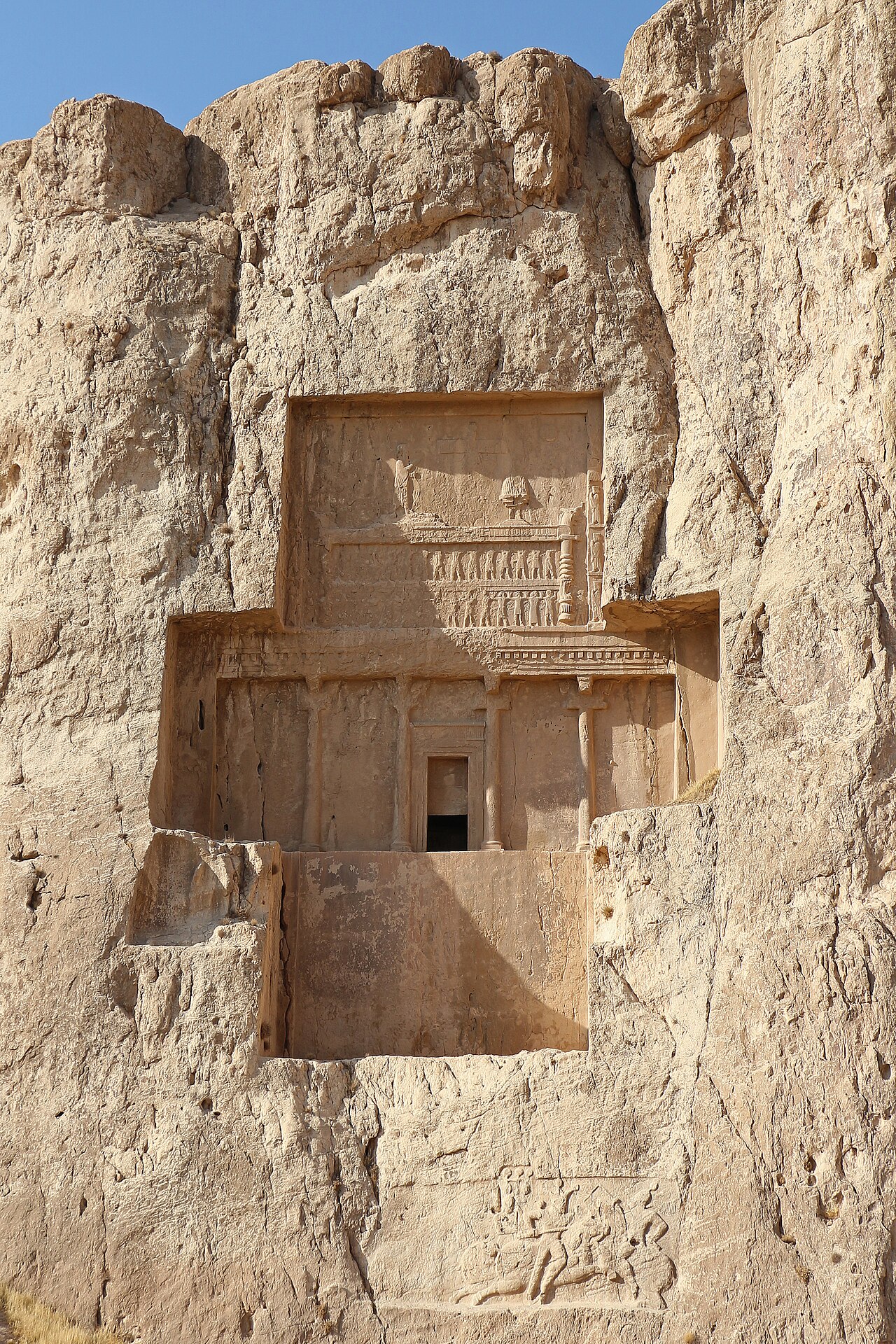
Darius II is usually thought to lie in one of the uninscribed royal tombs at Naqsh-e Rostam, though which one is a matter of convention, not proof.
Persian words from this page
| داریوش | Dâriush | Darius |
| کوروش کوچک | Kurosh-e Kuchak | Cyrus the Younger |
| شهربان | shahrbân | satrap, governor |
| اسپارت | Espârt | Sparta |
| طلا | talâ | gold |
| نقره | noghreh | silver |
| جنگ | jang | war |
Sources and further reading
- Thucydides, History of the Peloponnesian War, Book 8 (the treaties of 412–411 BCE, Tissaphernes and Alcibiades).
- Xenophon, Hellenica, Books 1–2 (Cyrus the Younger and Lysander).
- Ctesias, Persica, in Lloyd Llewellyn-Jones and James Robson, Ctesias’ History of Persia (2010).
- Bezalel Porten (ed.), The Elephantine Papyri in English (Leiden, 1996).
- David M. Lewis, Sparta and Persia (Leiden, 1977).
- Encyclopaedia Iranica, “Darius v. Darius II”.
Want to learn Persian? Get the free Starter Pack
Get the 14-page printable Starter Pack (all 32 letters, a 7-day reading plan, 100 core words and 20 survival phrases) and a short 5-email course. Free.
More in The Achaemenid Empire (550–330 BCE)
- Achaemenes, Teispes and the Early Persian Kings of Anshan
- Cyrus the Great: Birth, Legends and Rise to Power
- Cyrus Conquers Lydia: Croesus and the Battle of Thymbra
- The Persian Conquest of Ionia and Asia Minor
- Cyrus Takes Babylon (539 BCE)
- The Cyrus Cylinder
- Cyrus and the Return of the Jews
- The Death of Cyrus and the Massagetae
- Pasargadae: Cyrus’s Capital and Tomb
- The Tomb of Cyrus through History
- Cambyses II
- Cambyses Conquers Egypt: The Battle of Pelusium
- Bardiya and Gaumata: The Usurper Question
- Darius the Great Takes the Throne
- The Great Revolts of 522–521 BCE
- The Behistun Inscription
- The Persian Conquest of the Indus Valley
- Darius’s Scythian Campaign
- Darius’s Canal from the Nile to the Red Sea
- Darius’s Reforms: Satrapies, Taxes and Law
- The Royal Road and the Persian Postal System
- The Daric: Achaemenid Coinage and Economy
- The Ionian Revolt (499–493 BCE)
- The Greco-Persian Wars: An Overview
- Mardonius and the First Persian Expedition to Greece (492 BCE)
- The Battle of Marathon (490 BCE)
- The Death of Darius I and the Succession of Xerxes
- The Royal Tombs of Naqsh-e Rostam
- Xerxes I: King of Kings (486–465 BCE)
- Xerxes’ Invasion of Greece (480–479 BCE)
- The Battle of Thermopylae (480 BCE)
- The Battle of Artemisium (480 BCE)
- The Persian Capture of Athens (480–479 BCE)
- The Battle of Salamis (480 BCE)
- The Battle of Plataea and the End of the Invasion (479 BCE)
- The Palace of Darius at Susa
- Building Persepolis: How Darius and Xerxes Built Parsa
- The Persepolis Fortification and Treasury Tablets
- Herodotus and the Persians
- The Apadana Reliefs: Nations Bringing Gifts
- The Achaemenid Paradise Gardens
- The Persian Immortals and the Achaemenid Army
- The Achaemenid Navy
- Religion of the Achaemenid Kings
- Women of the Achaemenid Court
- Old Persian Language and Cuneiform
- Egypt under Persian Rule
- Babylon under Persian Rule
- Artaxerxes I
- The Peace of Callias
- Darius II and the Peloponnesian War
- Famous Satraps of the Persian Empire
- Artaxerxes II Mnemon
- Cyrus the Younger and the Battle of Cunaxa
- The King’s Peace (387 BCE)
- The Great Satraps’ Revolt
- Artaxerxes III and the Reconquest of Egypt
- Darius III, the Last Achaemenid King
- The Battle of the Granicus (334 BCE)
- The Battle of Issus (333 BCE)
- Alexander Takes Tyre, Gaza and Egypt (332 BCE)
- The Battle of Gaugamela (331 BCE)
- Ariobarzanes and the Battle of the Persian Gate
- The Burning of Persepolis (330 BCE)
- The Death of Darius III and Bessus
- The Legacy of the Achaemenid Empire