After taking Babylon in 539 BCE, Cyrus the Great allowed Jews deported by Nebuchadnezzar to return to Judah and rebuild the temple in Jerusalem, according to the biblical Book of Ezra. The Second Temple was finished in 515 BCE, under Darius I. For this the Hebrew Bible honours Cyrus as no other foreign king: the Book of Isaiah calls him the Lord’s “anointed”, the word that became “messiah”.
| Babylonian exile | Deportations from Judah in 597, 587/586 and 582 BCE; First Temple destroyed 587/586 BCE |
|---|---|
| Cyrus’s decree | “First year of Cyrus” as king of Babylon, 539/538 BCE (Ezra 1:1) |
| Leaders of the return | Sheshbazzar, then Zerubbabel and the priest Jeshua |
| Second Temple completed | Adar of Darius I’s sixth year, early 515 BCE (Ezra 6:15) |
| Main sources | Ezra 1–6, 2 Chronicles 36, Isaiah 44–45, Josephus, Babylonian tablets from Judean villages |

From Jerusalem to Babylon
In 597 BCE the Babylonian king Nebuchadnezzar II captured Jerusalem and deported the king of Judah and thousands of the elite to Babylonia. A revolt ten years later ended in 587/586 BCE with the city burned and the temple of Solomon destroyed. More deportations followed. The exiles were settled in Babylonia, many of them in farming villages along the canals near Nippur.
That exile, remembered in Psalm 137 (“By the rivers of Babylon”), was still in its second generation when Cyrus defeated Nabonidus. The fall of Babylon, told on Cyrus Takes Babylon (539 BCE), put Judah and its deportees under a new master.
The decree in the Book of Ezra
The Bible preserves Cyrus’s permission in two different forms, and the difference matters to historians.
The Hebrew proclamation (Ezra 1:1–4)
The first version is a royal proclamation in Hebrew, dated to “the first year of Cyrus king of Persia”. Cyrus declares that the God of heaven has given him all the kingdoms of the earth and charged him to build a house for him in Jerusalem. Any of his people may go up to Judah, and their neighbours are to help them with silver, gold, goods and animals. The same words close the Second Book of Chronicles (36:22–23), so in the traditional Jewish order of books, the Hebrew Bible ends with Cyrus’s decree.
The Aramaic memorandum (Ezra 6:3–5)
The second version is set years later. When local officials questioned the rebuilding under Darius I, a search was made in the royal archives and a scroll was found in the fortress at Ecbatana (Hamadan). Written in Aramaic, the working language of the empire, it is a dry administrative note: the temple is to be rebuilt as a place of sacrifice, with given measurements and building materials, its costs paid from the royal treasury, and the gold and silver vessels Nebuchadnezzar had taken are to be returned.
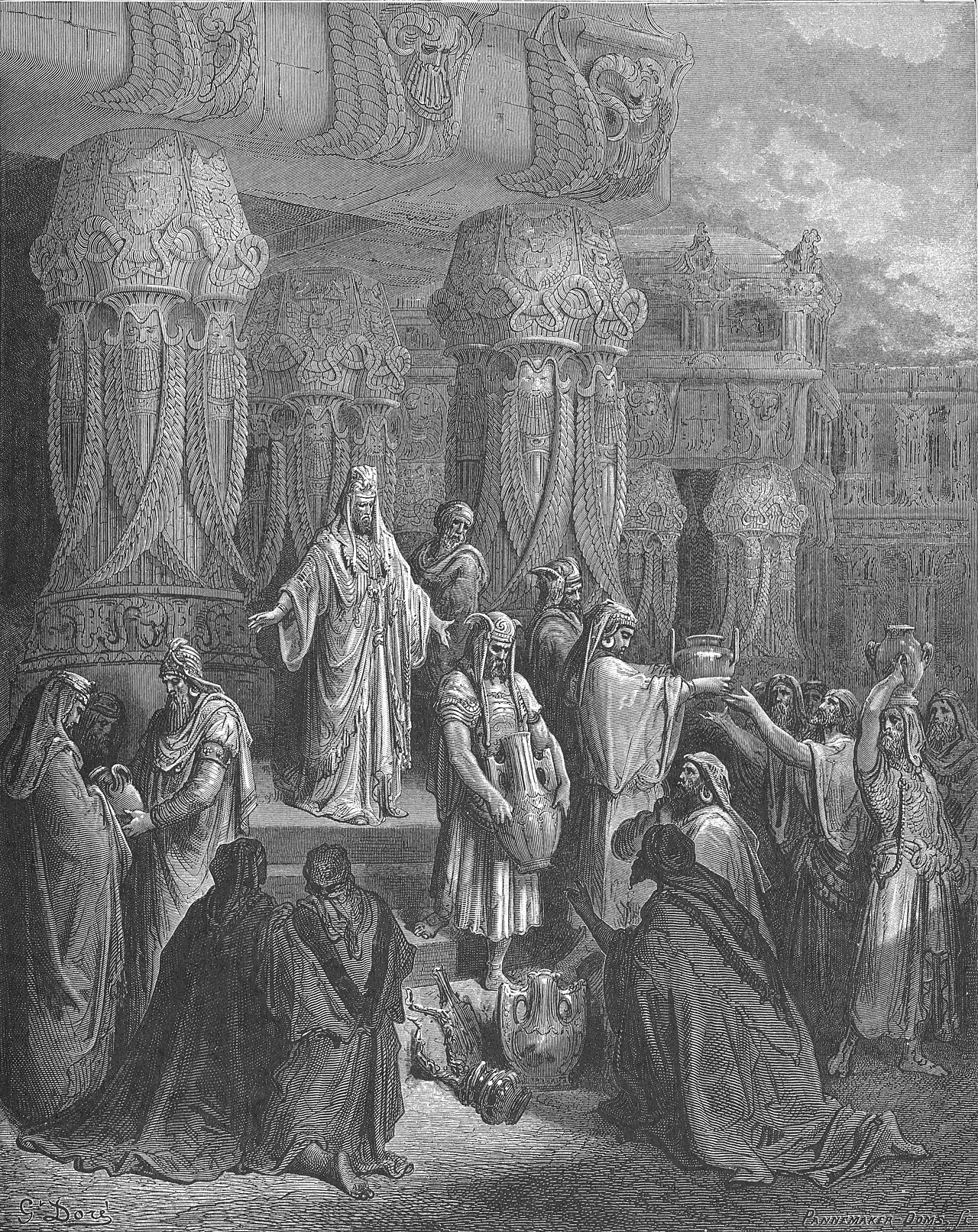
Ezra 1:7–11 adds that Cyrus had the vessels brought out by his treasurer Mithredath and counted over to Sheshbazzar, “the prince of Judah”. The scene inspired Gustave Doré’s engraving above.
Is the edict genuine?
Scholars disagree about the Hebrew proclamation more than about the Aramaic memorandum.
The Hebrew text sounds very Israelite: Cyrus speaks of the God of Israel almost as a believer would. Some scholars see it as a later Jewish composition that turned a Persian permission into a religious manifesto. Others note that Persian kings did address local gods in local terms. In Babylon, the Cyrus Cylinder has Cyrus praising Marduk in the language of Babylonian piety, so a text praising the God of Israel for a Judean audience would follow the same pattern.
The Aramaic memorandum, with its archive setting, specific details and bureaucratic tone, is accepted as authentic, or at least based on a real document, by many historians. Elias Bickerman made the classic argument for its authenticity in 1946. Sceptics point out that the text could still have been shaped by the editors of Ezra, who wrote generations later.
The Cyrus Cylinder does not mention the Jews or Jerusalem. What it does describe, the return of gods and displaced communities to their sanctuaries in Mesopotamia, is a policy of the same kind, which is why most historians accept that some permission for Judah was granted, even if its wording in Ezra cannot be taken as a transcript.
The return and the Second Temple
The return was not a single mass migration. Ezra 2 lists 42,360 people plus servants and singers, but this list probably combines several waves over many years. Archaeology shows that Persian-period Judah, the small province called Yehud, was thinly populated and that Jerusalem remained a modest town for a long time.
According to Ezra, work on the temple foundations began soon after the return but stopped because of opposition from neighbouring peoples. It resumed in the second year of Darius I (520 BCE), encouraged by the prophets Haggai and Zechariah, under the governor Zerubbabel and the high priest Jeshua. The temple was completed on the third of Adar in Darius’s sixth year, in early 515 BCE. This Second Temple, later rebuilt on a grand scale by Herod, stood until the Romans destroyed it in 70 CE.
The Jews who stayed in Babylonia
Many exiles chose not to leave. Cuneiform tablets from a village called Al-Yahudu, “Judah-town”, and nearby settlements, about two hundred texts dating from 572 to 477 BCE, record Judean families renting land, paying taxes and raising children with Hebrew names under Babylonian and then Persian rule. Later archives from Nippur, in the fifth century BCE, also include many Jewish names. Babylonia remained a major centre of Jewish life for more than fifteen centuries, and Jewish communities in Iran itself trace their roots to these Achaemenid-era settlements, a history told on The Jews of Iran.
Cyrus in Jewish tradition
The highest praise comes in the second part of the Book of Isaiah, written by a prophet of the exile around the time of Cyrus’s conquests. God calls Cyrus “my shepherd” (Isaiah 44:28) and “his anointed” (45:1), Hebrew mashiach, and promises to go before him and open doors for him. No other non-Israelite in the Hebrew Bible is given that title. The Book of Daniel, too, dates Daniel’s later visions to the reign of Cyrus.
The Jewish historian Josephus, writing in the first century CE, adds that Cyrus issued his decree after reading Isaiah’s prophecy about himself. That detail is a later legend, but it shows how firmly Cyrus had become part of Jewish sacred history. Later rabbinic writings are more mixed in their judgement of him, but his name remained one of honour among Jews of Iran and beyond.
The Persian role in Judah did not end with Cyrus. Ezra and Nehemiah, sent from the Persian court, reorganised the community in the following century, under Artaxerxes I. For an overview of Cyrus’s reign as a whole, see the site’s article on Cyrus the Great.
Persian words from this page
| یهودیان | Yahudiyân | the Jews |
| اورشلیم | Urshalim | Jerusalem |
| معبد | ma’bad | temple |
| تبعید | tab’id | exile |
| بازگشت | bâzgasht | return |
| پیامبر | payâmbar | prophet |
Sources and further reading
- The Hebrew Bible: Ezra 1–6; 2 Chronicles 36:22–23; Isaiah 44:24–45:7; Haggai; Zechariah 1–8.
- Josephus, Jewish Antiquities 11.1–4.
- Elias J. Bickerman, “The Edict of Cyrus in Ezra 1”, Journal of Biblical Literature 65 (1946).
- Laurie E. Pearce and Cornelia Wunsch, Documents of Judean Exiles and West Semites in Babylonia in the Collection of David Sofer (CDL Press, 2014).
- Amélie Kuhrt, “The Cyrus Cylinder and Achaemenid Imperial Policy”, Journal for the Study of the Old Testament 25 (1983).
- Lester L. Grabbe, A History of the Jews and Judaism in the Second Temple Period, vol. 1 (T&T Clark, 2004).
Want to learn Persian? Get the free Starter Pack
Get the 14-page printable Starter Pack (all 32 letters, a 7-day reading plan, 100 core words and 20 survival phrases) and a short 5-email course. Free.
More in The Achaemenid Empire (550–330 BCE)
- Achaemenes, Teispes and the Early Persian Kings of Anshan
- Cyrus the Great: Birth, Legends and Rise to Power
- Cyrus Conquers Lydia: Croesus and the Battle of Thymbra
- The Persian Conquest of Ionia and Asia Minor
- Cyrus Takes Babylon (539 BCE)
- The Cyrus Cylinder
- Cyrus and the Return of the Jews
- The Death of Cyrus and the Massagetae
- Pasargadae: Cyrus’s Capital and Tomb
- The Tomb of Cyrus through History
- Cambyses II
- Cambyses Conquers Egypt: The Battle of Pelusium
- Bardiya and Gaumata: The Usurper Question
- Darius the Great Takes the Throne
- The Great Revolts of 522–521 BCE
- The Behistun Inscription
- The Persian Conquest of the Indus Valley
- Darius’s Scythian Campaign
- Darius’s Canal from the Nile to the Red Sea
- Darius’s Reforms: Satrapies, Taxes and Law
- The Royal Road and the Persian Postal System
- The Daric: Achaemenid Coinage and Economy
- The Ionian Revolt (499–493 BCE)
- The Greco-Persian Wars: An Overview
- Mardonius and the First Persian Expedition to Greece (492 BCE)
- The Battle of Marathon (490 BCE)
- The Death of Darius I and the Succession of Xerxes
- The Royal Tombs of Naqsh-e Rostam
- Xerxes I: King of Kings (486–465 BCE)
- Xerxes’ Invasion of Greece (480–479 BCE)
- The Battle of Thermopylae (480 BCE)
- The Battle of Artemisium (480 BCE)
- The Persian Capture of Athens (480–479 BCE)
- The Battle of Salamis (480 BCE)
- The Battle of Plataea and the End of the Invasion (479 BCE)
- The Palace of Darius at Susa
- Building Persepolis: How Darius and Xerxes Built Parsa
- The Persepolis Fortification and Treasury Tablets
- Herodotus and the Persians
- The Apadana Reliefs: Nations Bringing Gifts
- The Achaemenid Paradise Gardens
- The Persian Immortals and the Achaemenid Army
- The Achaemenid Navy
- Religion of the Achaemenid Kings
- Women of the Achaemenid Court
- Old Persian Language and Cuneiform
- Egypt under Persian Rule
- Babylon under Persian Rule
- Artaxerxes I
- The Peace of Callias
- Darius II and the Peloponnesian War
- Famous Satraps of the Persian Empire
- Artaxerxes II Mnemon
- Cyrus the Younger and the Battle of Cunaxa
- The King’s Peace (387 BCE)
- The Great Satraps’ Revolt
- Artaxerxes III and the Reconquest of Egypt
- Darius III, the Last Achaemenid King
- The Battle of the Granicus (334 BCE)
- The Battle of Issus (333 BCE)
- Alexander Takes Tyre, Gaza and Egypt (332 BCE)
- The Battle of Gaugamela (331 BCE)
- Ariobarzanes and the Battle of the Persian Gate
- The Burning of Persepolis (330 BCE)
- The Death of Darius III and Bessus
- The Legacy of the Achaemenid Empire