The Battle of Plataea was fought in late summer 479 BCE in southern Boeotia, between the Persian army left in Greece under Mardonius and the largest Greek army yet assembled, led by the Spartan regent Pausanias. After days of manoeuvring, the Persians attacked a Greek army in the middle of a confused retreat, were beaten back, and lost their commander. Together with the Persian defeat at Mycale on the Ionian coast in the same season, Plataea ended the invasion of Greece begun by Xerxes the year before.
| Date | August 479 BCE (exact day debated) |
|---|---|
| Place | Near Plataea, between the Asopus River and Mount Kithairon, Boeotia |
| Persian commander | Mardonius, killed in the battle; Artabazus commanded a second corps |
| Greek commander | Pausanias, regent of Sparta; Aristides led the Athenians |
| Greek army (Herodotus) | 38,700 hoplites and about 70,000 light troops |
| Persian army (Herodotus) | 300,000 plus about 50,000 Greek allies; modern estimates much lower |
| Result | Decisive Greek victory; Persian withdrawal from Europe |

Mardonius’s last year
After Salamis Xerxes went back to Sardis and left Mardonius in Greece with a picked army, which included the Persian, Median, Saka and Bactrian troops who were the best in the empire. Mardonius wintered in Thessaly. In 479 he tried to split the Greek alliance by diplomacy, offering Athens generous terms through Alexander I of Macedon. When Athens refused, he reoccupied the city and then, as the Spartan army marched north, burned it again and withdrew into Boeotia. The plain there suited his cavalry, and the Thebans and other Boeotians were his allies.
He built a fortified camp of timber on the Asopus River. The Greek army, gathered from about two dozen states, came over the passes of Mount Kithairon and took up a position on the foothills facing him.
Days of manoeuvre
The two armies watched each other for about eleven days. Both sides’ seers reported unfavourable omens for attacking, which reflects a real tactical problem: the Greek hoplites did not want to fight on open ground against cavalry, and Mardonius did not want to attack heavy infantry uphill.
The Persian cavalry did the most damage. In the first clash their commander Masistius, conspicuous in gold armour, was unhorsed and killed by Athenian troops, and the Greeks carried his body along the lines; Herodotus says the Persians mourned him with loud lamentation across Boeotia. After that the horsemen changed tactics. They attacked the Greek supply trains in the passes behind the army and then choked the spring of Gargaphia, which was the Greeks’ main water supply.
The night retreat
Short of water and food, the Greek commanders decided to fall back at night to a better position nearer Plataea. The withdrawal went badly. The centre moved too far and ended up near the town; a Spartan officer, Amompharetus, at first refused to retreat, calling it shameful; and at dawn the Spartans and Tegeans were still on open ground, separated from the Athenians.
Mardonius saw the Greeks apparently in flight and ordered a general attack. The Persian infantry set up a wall of wicker shields and shot volleys of arrows at the Spartans, who held their position, under fire, until the sacrifices turned favourable. Then the Spartans and Tegeans charged.
The death of Mardonius
Herodotus says the Persians were not inferior in courage or strength, but they lacked armour and the training to fight against massed hoplites. They grabbed the Greek spears and broke them, and rushed out singly or in small groups. Mardonius, on a white horse with a thousand chosen men around him, fought in the front line, and while he lived the Persians held. When a Spartan named Arimnestus killed him, the Persian line broke and fled to the stockade.
Elsewhere, the Athenians fought the Boeotians, who were on the Persian side and fought hard; the Thebans lost about 300 of their leading men. Artabazus, who had disagreed with Mardonius’s decision to fight, led his corps away from the field and marched north towards the Hellespont. The Greeks stormed the Persian camp and killed many of those inside. Herodotus says the Greeks lost only 159 men in the main fighting, a figure that later writers raised to over 1,300; the Persian losses he gives are too large to believe.
The rich tents of the Persian camp became part of Greek legend. Herodotus says Pausanias had Mardonius’s cooks prepare a Persian banquet beside a plain Spartan meal and laughed at the folly of men who lived like that and came to rob the Spartans of their poor fare.
Mycale and the coast of Ionia
Herodotus places on the same day the battle of Mycale, on the mainland of Asia Minor opposite Samos. A Greek fleet under the Spartan king Leotychidas and the Athenian Xanthippus sailed east, and the Persian navy, unwilling to fight at sea, beached its ships under the protection of an army. The Greeks landed and attacked. The Samians and other Ionians in the Persian army turned against it, the Persian commander Tigranes was killed, and the ships were burned. The revolt of the Ionian cities that followed ended the system set up after the Ionian Revolt.
The victory monument
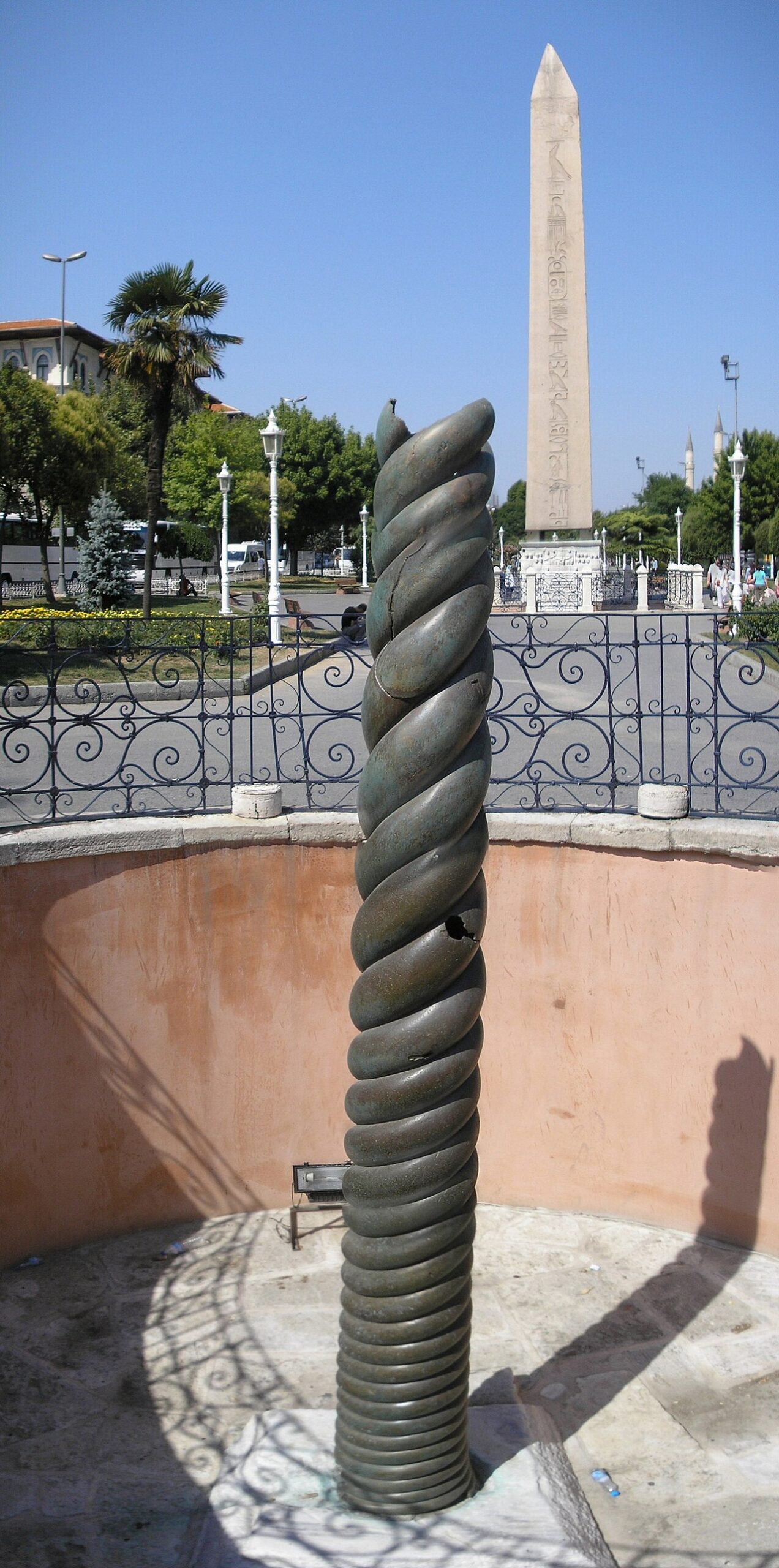
From a tenth of the spoils the Greeks dedicated a golden tripod at Delphi on a bronze column of three twisted snakes, with the names of the 31 states that had fought on the Greek side inscribed on the coils. The gold was later melted down, but the column survived. In the fourth century CE Constantine moved it to his new capital, and it still stands, damaged and headless, in the former Hippodrome in Istanbul.
How the war looks from Persia
No Persian text mentions Plataea, Mycale or the loss of the European province. The royal inscriptions were not war reports, and the kings had no reason to record defeats. From Xerxes’s point of view, the war cost him a leading general and the European conquests of Darius, and it brought Greek fleets to the coasts of Asia Minor. But it did not threaten the empire itself. In the following decades Persian policy towards Greece changed from conquest to diplomacy, money and alliances, and by the end of the fifth century Persian gold was deciding the wars between Athens and Sparta; see Darius II and the Peloponnesian War and The King’s Peace.
For Herodotus, whose history ends soon after Plataea and Mycale, the battles closed the story he had set out to tell. His account was written by a Greek for Greeks, and he relied on the memories of the victors. The Persian army appears through their eyes: brave, numerous, poorly armoured and badly led. The broader conflict, which did not formally end for another thirty years, is summarised in The Greco-Persian Wars: An Overview.
Persian words from this page
| سواره | savâreh | horseman, cavalry |
| اسب سفید | asb-e sefid | white horse |
| سپر | separ | shield |
| اردوگاه | ordugâh | camp |
| ستون | sotun | column |
| مار | mâr | snake |
Sources and further reading
- Herodotus, Histories, Book 9.
- Plutarch, Life of Aristides.
- J. F. Lazenby, The Defence of Greece, 490–479 BC (1993).
- Pierre Briant, From Cyrus to Alexander: A History of the Persian Empire (2002).
- Encyclopaedia Iranica, “Mardonius”.
Want to learn Persian? Get the free Starter Pack
Get the 14-page printable Starter Pack (all 32 letters, a 7-day reading plan, 100 core words and 20 survival phrases) and a short 5-email course. Free.
More in The Achaemenid Empire (550–330 BCE)
- Achaemenes, Teispes and the Early Persian Kings of Anshan
- Cyrus the Great: Birth, Legends and Rise to Power
- Cyrus Conquers Lydia: Croesus and the Battle of Thymbra
- The Persian Conquest of Ionia and Asia Minor
- Cyrus Takes Babylon (539 BCE)
- The Cyrus Cylinder
- Cyrus and the Return of the Jews
- The Death of Cyrus and the Massagetae
- Pasargadae: Cyrus’s Capital and Tomb
- The Tomb of Cyrus through History
- Cambyses II
- Cambyses Conquers Egypt: The Battle of Pelusium
- Bardiya and Gaumata: The Usurper Question
- Darius the Great Takes the Throne
- The Great Revolts of 522–521 BCE
- The Behistun Inscription
- The Persian Conquest of the Indus Valley
- Darius’s Scythian Campaign
- Darius’s Canal from the Nile to the Red Sea
- Darius’s Reforms: Satrapies, Taxes and Law
- The Royal Road and the Persian Postal System
- The Daric: Achaemenid Coinage and Economy
- The Ionian Revolt (499–493 BCE)
- The Greco-Persian Wars: An Overview
- Mardonius and the First Persian Expedition to Greece (492 BCE)
- The Battle of Marathon (490 BCE)
- The Death of Darius I and the Succession of Xerxes
- The Royal Tombs of Naqsh-e Rostam
- Xerxes I: King of Kings (486–465 BCE)
- Xerxes’ Invasion of Greece (480–479 BCE)
- The Battle of Thermopylae (480 BCE)
- The Battle of Artemisium (480 BCE)
- The Persian Capture of Athens (480–479 BCE)
- The Battle of Salamis (480 BCE)
- The Battle of Plataea and the End of the Invasion (479 BCE)
- The Palace of Darius at Susa
- Building Persepolis: How Darius and Xerxes Built Parsa
- The Persepolis Fortification and Treasury Tablets
- Herodotus and the Persians
- The Apadana Reliefs: Nations Bringing Gifts
- The Achaemenid Paradise Gardens
- The Persian Immortals and the Achaemenid Army
- The Achaemenid Navy
- Religion of the Achaemenid Kings
- Women of the Achaemenid Court
- Old Persian Language and Cuneiform
- Egypt under Persian Rule
- Babylon under Persian Rule
- Artaxerxes I
- The Peace of Callias
- Darius II and the Peloponnesian War
- Famous Satraps of the Persian Empire
- Artaxerxes II Mnemon
- Cyrus the Younger and the Battle of Cunaxa
- The King’s Peace (387 BCE)
- The Great Satraps’ Revolt
- Artaxerxes III and the Reconquest of Egypt
- Darius III, the Last Achaemenid King
- The Battle of the Granicus (334 BCE)
- The Battle of Issus (333 BCE)
- Alexander Takes Tyre, Gaza and Egypt (332 BCE)
- The Battle of Gaugamela (331 BCE)
- Ariobarzanes and the Battle of the Persian Gate
- The Burning of Persepolis (330 BCE)
- The Death of Darius III and Bessus
- The Legacy of the Achaemenid Empire